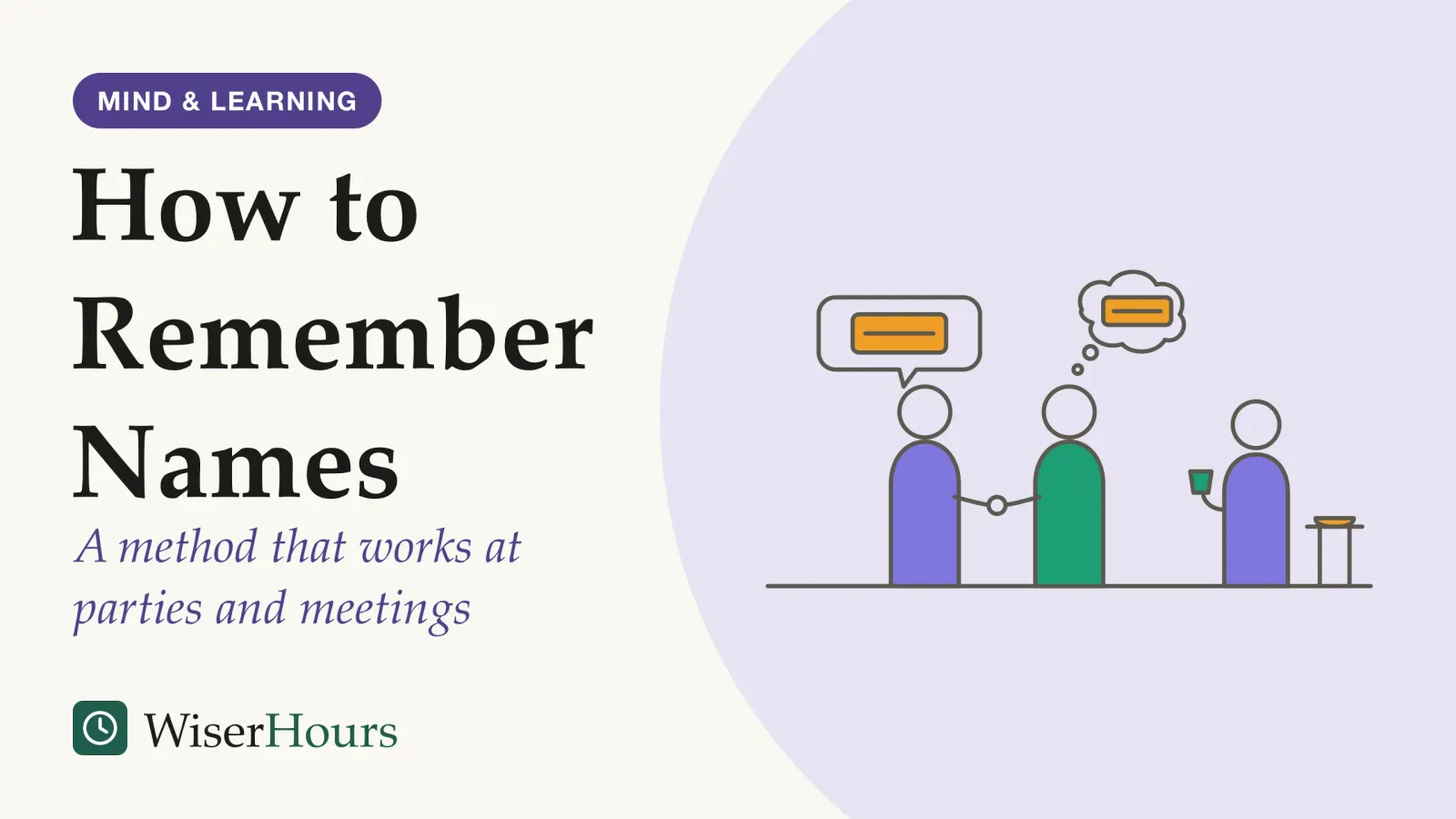
How to Remember Names: A Method That Works at Parties and Meetings
4 steps for remembering names, built on the best-tested one: recall a new name to yourself soon after you hear it, then again after longer gaps.
It is harder to remember that a man is called Baker than that he is a baker. In a 1987 experiment by Kathryn McWeeny and colleagues, people learned a surname and a job for each of 16 unfamiliar faces, and the names stayed much harder to recall than the jobs, even for words that could serve as either.1 Serge Brédart, a cognitive psychologist at the University of Liège, calls this Baker/baker paradox probably the most solid evidence that people’s names are harder to recall than ordinary nouns.2
So a name needs deliberate handling, and the handling is simple. Learning how to remember names comes down to one habit: shortly after someone tells you their name, ask yourself what it was, silently, and ask again after longer gaps, rather than counting on hearing it again. A 2019 review by Brédart concluded that spaced self-testing helps both young and older adults learn names, in the lab and in more everyday settings, and appears to work better than picture-based memory tricks.3 Four steps, the best-tested first:
- Recall the name silently a minute later, then after longer gaps
- Write names from memory before you check a list
- Tie the name to a meaning or a person you know
- Keep face-and-picture tricks for names you can study in advance
Why a name is harder to hold than a job
A person’s name tells your memory almost nothing about them, which is one leading explanation for why it slips. Brédart’s 2017 review of the research on naming people explains that if you learn someone is a baker, you can infer a lot: they make bread and sell cakes, for a start. Learn that someone is called Mr. Baker and you can infer nothing, because the name has lost the meaning of the job.2
The same review gives a second reason. Most things can be named in several ways, so a forgotten word can be swapped for another: trousers, jeans, the blue pair. A person usually has one right answer, and no synonym will do.2 That fits a familiar experience: at the end of a conference day, you can describe the woman who runs the Lisbon office in detail and still not produce “Ana.”
Timing makes it worse. In a 1973 experiment by Malcolm Brenner, people reading words aloud in turn around a table recalled fewer of the words read just before their own turn, which he called the next-in-line effect. Later experiments by Charles Bond and colleagues found that asking people to process those words deeply removed the effect, and placed the cost at the moment of learning rather than of recall. Put simply, while you wait for your own turn, the names said just before it are stored less well, a failure of encoding, the first stage of how memory works. Noah Forrin’s team at the University of Waterloo, who recount this history in a 2019 paper, suggest the same may happen when coworkers introduce themselves in turn.4
The fix for your next round of introductions starts before it: have your own two sentences ready, so the names just before yours get your full attention.
Further reading
The Seven Sins of Memory: How the Mind Forgets and Remembers
Its chapter on blocking explains why names slip more than other words, the Baker/baker puzzle this article opens with.

As an Amazon Associate WiserHours earns from qualifying purchases.
How to remember names after an introduction
The most reliable way to remember names is to practice recalling them, spaced out over time, with some meaning attached. Brédart’s 2019 review found spaced self-testing more efficient than face-and-picture tricks and easier to use, with meaning links a useful addition; the picture tricks work in the lab but are hard to use while talking.3
1. Recall the name silently a minute later, then after longer gaps
Hearing a name again is weaker than pulling it out of memory yourself. The idea goes back to a 1978 study by Thomas Landauer and Robert Bjork, who noted that in a real conversation a new name is rarely repeated, and suggested repeating it silently and testing yourself at intervals after the introduction. In their first experiment, university students imagining a cocktail party recalled names better when the tests came at gaps that grew longer than when the tests were bunched together or evenly spread at about the same average gap.3
Later studies agree on spacing but not on the growing gaps. A 2021 meta-analysismeta-analysis: A study that combines the results of earlier studies on the same question into one overall estimate. Pooling makes the estimate more precise, but it cannot repair the studies it pools: a meta-analysis of surveys is still survey evidence.Full entry in the glossary by Alice Latimier and colleagues in Paris found that spreading recall attempts out led to much better retention than bunching them, while gaps that grow longer did no better on average than even gaps.5 One explanation Brédart describes is effort: a recall that takes some work strengthens the memory more than an easy one, as long as the name is still there to find.3
In practice, this looks like a few silent checks. You meet Daniel at the coffee urn and say his name once in reply. A minute later, while he is still talking, you ask yourself what he is called. You check again when you move to the next group, again as you leave, and once more on the way home.
The study
Limited evidence
Which strategy holds up at an actual party?
At the start of an academic year, Peter Morris and colleagues invited people to a party that was also an experiment. One group was told to test themselves on each name shortly after hearing it and again after a longer interval; one was taught a face-and-picture trick; one was simply asked to learn as many names as possible. Shown photos of the guests later, the self-testing group recalled about a quarter of the names (0.24), against about one in eight for the picture group (0.12) and one in six for the uninstructed group (0.16). The picture trick did no better than no instruction.63
A quarter of the names sounds modest, and it is: even with the best strategy, most names were not recalled. The point is the relative gain from a habit that costs nothing but a few silent seconds. Two caveats apply: it was a single experiment, and we could not read the full paper, so its sample size is not reported here.
If the name has already gone at the first check, ask again. Hearing it a second time costs little, and it turns the next check into a real recall.
2. Write names from memory before you check a list
Looking a name up feels like studying, but in experiments, recalling it came out well ahead. In lab experiments reported in the same 2005 paper, people who retrieved names on a schedule of growing gaps recalled more than twice as many as people who were simply shown the names again on the same schedule.6
So after a meeting, write down everyone’s name from memory before you open the attendee list or the video call’s participant panel. Then check, correct the misses and try those again the next morning.
3. Tie the name to a meaning or a person you know
Meaning gives a name the clues it lacks. In the 2005 lab experiments, recall was better when people formed associations with a name’s meaning than when they did not, and better still when they combined meaning with self-testing.6
Everyday names give you material. Rosa can hold a rose, Mr. Fisher a rod, and a new colleague called Sam can be linked to the Sam you went to school with. One caution from Brédart’s 2019 review: a 1980 experiment found that turning a name into a sound-alike phrase, without a picture, did not help on its own. Brédart suggests the difference may depend on the names and instructions used, so treat meaning links as a helpful extra, not a method on their own.3
4. Keep face-and-picture tricks for names you can study in advance
The classic face-name trick has three parts: pick a prominent feature of the face, turn the name into a concrete sound-alike, and imagine the two interacting. It works like the sound-alike image method in the guide to mnemonics for beginners. Brédart’s 2019 review finds it effective in lab studies with both young and older adults, but effortful and hard to apply mid-conversation, and in one study it did not improve recall when people tried it during real conversations.3
Use it where you have time and photos: learning a staff directory before a first day, or a class list before term. For live introductions, spaced self-testing is the better bet, with a quick meaning link where one comes easily.
For the next introduction
Running introductions in a meeting: play the name game
For a team, class or workshop, the leader can build recall into the introductions. In the name game, studied by Peter Morris and Catherine Fritz in 2000, each person repeats the names of everyone who spoke before, then adds their own. Compared with the common routine of pairs introducing each other, name-game players remembered one another’s names much better half an hour, 2 weeks and 11 months later. A version matched for the number of times each name was heard did worse, which points to recall itself doing the work.7
The same researchers later improved the game by reversing it: each person says their own name first, then recalls the name of the person just before them and works back to the first. That order tests the newest name while it is still easy to find, and it beat the original version. The game also worked in groups of about 25, though it can take more than half an hour at that size, and most participants in these studies were university students.3
A manager with a new group of up to a dozen people can open with the reversed name game, which gives everyone several recall attempts. With a much larger group, allow for the time it takes, or play it table by table.
Names get harder with age, and the same methods still help
In many studies, though not all, trouble with names grows more than trouble with other words as people age. Brédart’s 2017 review describes lab studies in which older adults had more tip-of-the-tongue moments than younger adults for the names of familiar famous people, but not for their jobs.2 In daily life, that is knowing exactly which actor played the detective in a series you loved, and what else she was in, while her name stays out of reach.
Learning new face-name pairs is also harder for older adults, and his 2019 review reports that picture tricks and spaced self-testing have both been used with some success with older participants in lab studies.3 A small 2025 randomized trialrandomized controlled trial: A study that assigns participants to the treatment or the comparison group at random, so the groups start out alike and a difference in what happens next can be put down to the treatment. Random assignment makes the two groups comparable; it does not make the people in the trial representative of anyone else.Full entry in the glossary led by Benjamin Hampstead of the University of Michigan found that among 30 older adults without cognitive impairment, those taught a three-step memory strategy for face-name pairs improved more on a face-name memory test than those given a comparison training, and the advantage held a month later. One author earns royalties from a memory-rehabilitation program, and this summary rests on the abstract alone.8
The advice does not change with age: recall new names silently at spaced moments, and keep the picture method for names you can practice in advance. If you notice changes in your memory, the US National Institute on Aging advises talking with a doctor.9
Which name-learning methods have the best evidence?
Spaced recall has the broadest support of the methods here, from a meta-analysis of spacing in general to one real party; the others rest on a handful of experiments each.
| What it is | What the best evidence found | Evidence |
|---|---|---|
| Spaced silent self-tests | Names recalled better than with picture tricks or no strategy, including at a real party | Experiments, limited6 |
| Spacing, in general | Spread-out recall beat bunched recall; growing gaps no better than even ones on average | Meta-analysis, moderate5 |
| Meaning links | Better name recall than without them, and better still combined with self-testing | Lab experiments, limited6 |
| Face-and-picture trick | Works in lab tests for young and older adults; did not help in real conversations | Narrative review of experiments, limited3 |
| Name game for groups | Better recall than paired introductions, still visible 11 months later | Experiments with student groups, limited7 |
The bottom line
The habit that matters most costs a few seconds: after you hear a new name, recall it silently a minute later, then again after a longer gap, and write names from memory before you check a list. Add a meaning when one comes easily, keep picture tricks for names you can study in advance, and in a group, let the introductions do the practice for you with the name game.
Frequently asked questions
Are some names easier to remember than others?
In lab experiments, yes: names that describe their owner were easier to learn. Serge Brédart's 2017 and 2019 reviews describe experiments in which descriptive names for cartoon characters, such as a name meaning long for a giraffe, were learned more easily than names unrelated to the character's appearance, in younger and older adults, with a stronger effect in the older group. Physically descriptive names helped more than names describing character.
Can you learn names without trying, just by seeing them often?
Possibly, for older adults, but the evidence is early. Serge Brédart's 2019 review describes lab experiments in which older adults who had seen faces with names printed on them, while told to ignore the names, later learned those same pairings better. Younger adults showed no such benefit. The researchers suggest showing acquaintances' faces and names on a screen during everyday computer use, which the review presents as a possibility, not a tested method.
Does brain stimulation help people learn names?
Not in any way you can use yet. Serge Brédart's 2019 review describes small lab studies with young adults in which weak electrical stimulation over parts of the frontal lobe during learning improved name recall in some experiments, while stimulation over the left anterior temporal lobe did not. These were short lab experiments with adults aged 20 to 38, not tests of everyday name learning.
Sources
- Putting names to faces. McWeeny, K. H., Young, A. W., Hay, D. C. & Ellis, A. W. (1987). British Journal of Psychology, 78(2)
- The cognitive psychology and neuroscience of naming people. Brédart, S. (2017). Neuroscience and Biobehavioral Reviews, 83
- Strategies to Improve Name Learning: A Review. Brédart, S. (2019). European Psychologist, 24(4)
- Wait for it… performance anticipation reduces recognition memory. Forrin, N. D., Ralph, B. C. W., Dhaliwal, N. K., Smilek, D. & MacLeod, C. M. (2019). Journal of Memory and Language, 109, 104050
- A Meta-Analytic Review of the Benefit of Spacing out Retrieval Practice Episodes on Retention. Latimier, A., Peyre, H. & Ramus, F. (2021). Educational Psychology Review, 33
- Strategies for learning proper names: expanding retrieval practice, meaning and imagery. Morris, P. E., Fritz, C. O., Jackson, L., Nichol, E. & Roberts, E. (2005). Applied Cognitive Psychology, 19(6)
- The name game: Using retrieval practice to improve the learning of names. Morris, P. E. & Fritz, C. O. (2000). Journal of Experimental Psychology: Applied, 6(2)
- A randomized trial showing mnemonic strategy training increases memory, brain activation, and functional connectivity more than vanishing cue training in cognitively intact older adults. Hampstead, B. M., Iordan, A. D., Ploutz-Snyder, R., Ghosh, B., Harrie, A., Stringer, A. Y. & Sathian, K. (2025). Neuropsychological Rehabilitation, 36(3)
- Memory Problems, Forgetfulness, and Aging. National Institute on Aging, US National Institutes of Health (content reviewed 2023-11-22)
How we researched this
We searched Europe PMC, PubMed, Crossref and the web in September 2026 for experiments on learning people's names, starting from the most recent review of name-learning strategies (2019) and a 2021 meta-analysis of spaced recall. Five sources, one of them a US government health page, were read in full and four as abstracts only, marked in the editor's notes. The studies span 1987 to 2025. Main limitation: most experiments are short lab sessions with university students.
Keep reading
Do Brain-Training Games Work? What Large Studies Found
Do brain-training games work? From a 2010 BBC trial to 20 years of US data, large studies find they train the game, not everyday memory.
Dementia Risk Factors You Can Change: What Major Reviews Conclude
A 2024 Lancet Commission links 14 changeable dementia risk factors to about 45% of cases. What WHO's 2026 guideline and trials like FINGER add.
Mnemonics for Beginners: The Memory Techniques Worth Learning
4 mnemonics worth learning as a beginner, why they work, and where the evidence behind each one is solid, thin or surprisingly weak.
Working Memory Explained: Your Brain's Mental Scratchpad
Working memory is the mind's small scratchpad. A 2017 review counted 9 definitions; here are the main models, how it is tested and what lowers it.