Types of Meditation Compared: How to Choose One That Suits You
Most types of meditation fall into 3 families. What each one trains, what the trials show, who should go carefully, and a two-week way to test one.

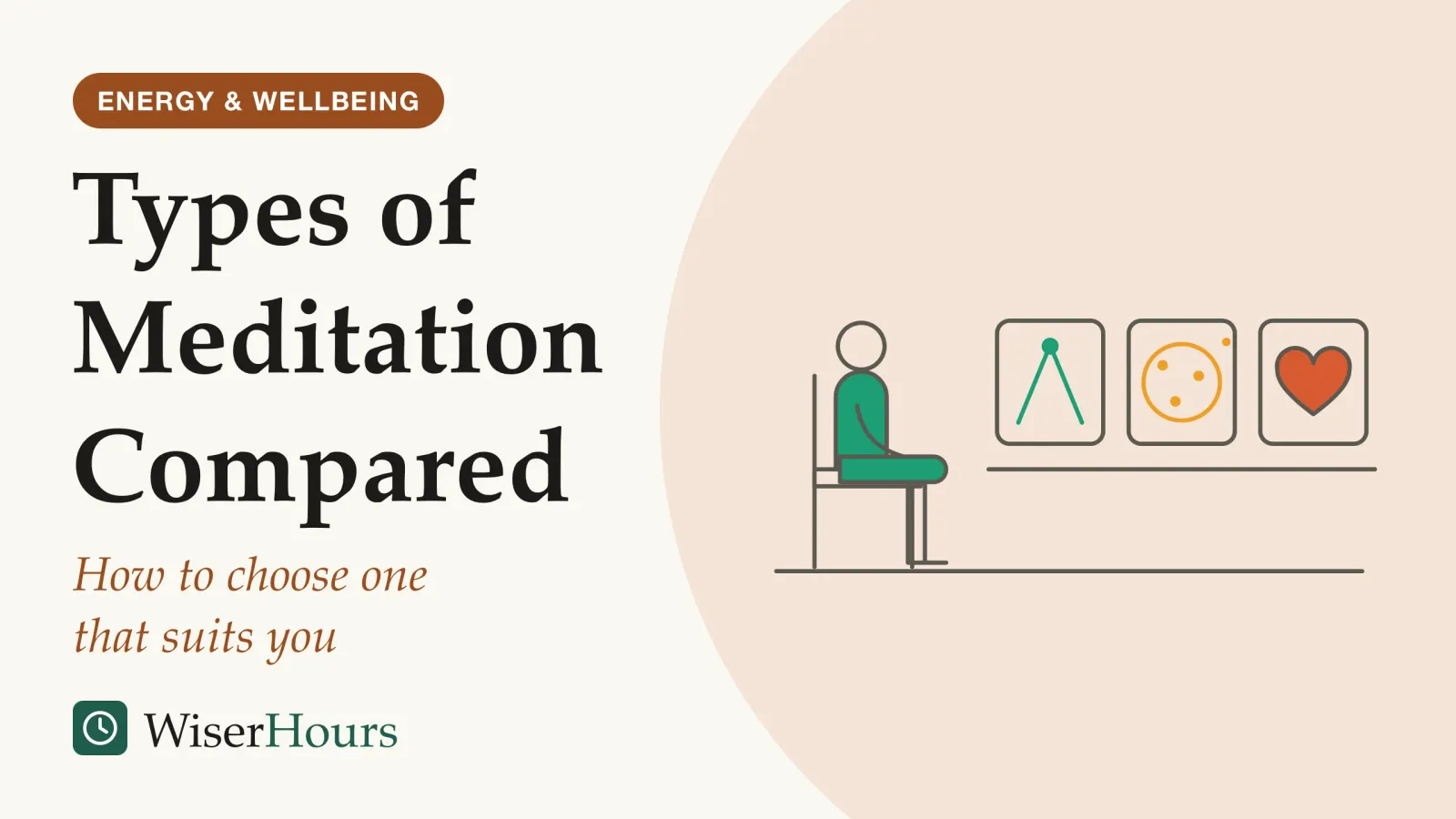
Behind the long lists of named techniques, most types of meditation belong to one of three families. In a 2015 map, the neuroscientists Cortland Dahl, Antoine Lutz and Richard Davidson grouped them into attentional practices that steady or widen attention, constructive practices that build a quality such as kindness, and deconstructive practices that examine how experience is put together.1 Breath focus, body scans, mantras, walking meditation, loving-kindness and visualization are variations inside those families.
Choosing one is less about finding the best type than about matching a practice to what you want to train and what you can safely handle. The widest look at the evidence is Simon Goldberg and colleagues’ 2022 umbrella reviewumbrella review: A review that gathers and compares existing systematic reviews and meta-analyses on a broad question, rather than individual studies. It gives a wide view quickly, but it inherits the limits of the reviews it collects.Full entry in the glossary, which covered 44 meta-analyses. It found that mindfulness-based programs outperformed no treatment on most outcomes and roughly matched proven therapies such as cognitive behavioral therapy.2 Trials that pit one type directly against another are far rarer, so any ranking of types rests on thin ground. For the basics of the most studied family, see what mindfulness is and how well it works.
The short version for a beginner: decide what you want to get better at, start with a simple breath-focus practice, and give that one practice two weeks before judging it. The four steps near the end show how.
The types of meditation, grouped by what they ask of attention
Meditation types differ mainly in what they ask attention to do. A 2008 review by Antoine Lutz and colleagues split common practices into focused attention, which holds attention on one chosen object, and open monitoring, which notices whatever arises without holding on to anything. In focused attention, the work has three parts: keep attention on the object, notice when it has slipped, and bring it back.3
Think of reading on a busy train: you realize you have been listening to the conversation behind you, and you return to the page. That small return, repeated many times, is the exercise.
Open monitoring drops the single object. You notice sounds, thoughts and sensations as they come and go, the way you might watch people pass from a park bench without following any of them. Lutz’s group describes it as a style usually taken up once focused attention has steadied the mind.3
Dahl’s 2015 map keeps both styles inside an attentional family and adds two more: constructive practices, which deliberately cultivate something such as warmth toward yourself and others, and deconstructive practices, which use self-inquiry to look at how thoughts and the sense of self are built.1
A 2019 German study by Karin Matko and Peter Sedlmeier came at the question from the practitioner’s side. Experienced meditators sorted popular techniques by how similar they felt, and two dimensions explained most of the sorting: how activating a practice is, and how much it centers on the body.4 Their seven clusters, from mantra meditation to meditation with movement, are a reminder that most real practices blend families.
So read a practice’s instruction rather than its name. Ask where your attention is meant to go, and whether you are holding it on one thing or letting it open.
Seven common practices, side by side
Seven practices cover most of what a beginner meets in classes, books and apps. The evidence column describes each practice’s own research, which is often thinner than the research on the programs that include it.
| Practice | What you do | Family | Suits a wish to | Evidence, in brief |
|---|---|---|---|---|
| Breath focus | Rest attention on the feel of breathing; when it drifts, notice and return | Focused attention | Steady a wandering mind | The classic example of focused attention and a staple of mindfulness courses; the trial evidence is for courses that include it, not for the breath alone2 |
| Body scan | Move attention slowly through the body, noticing sensations | Body-centered cluster | Notice tension and body signals | Usually studied inside eight-week courses; rarely tested on its own4 |
| Open monitoring and noting | Notice whatever arises without holding on; noting adds a brief silent label | Open monitoring | See thoughts as passing events | Mostly studied for attention in the lab; usually learned after focused attention3 |
| Mantra, including Transcendental Meditation | Silently repeat a word or sound | Mantra cluster | Rest on a simple repeated anchor | Blood pressure trials of TM; a 2004 review found authors linked to the TM organization on every trial5 |
| Loving-kindness and compassion | Silently offer good wishes to yourself, then to others | Constructive | Feel warmer toward yourself and others | Moderate help with self-reported depression against no active treatment in a 2014 review; study quality low to moderate6 |
| Walking meditation | Attend to the feel of each step at a slow pace | Meditation with movement | Practice without sitting still | Few trials of walking meditation on its own; evidence thin4 |
| Visualization | Build and hold a mental image, such as a place or a person | Constructive; visual concentration cluster | Practice with imagery | Little clinical research on its own4 |
The practices with the most research, breath focus and the body scan, are mostly studied as parts of packages such as Mindfulness-Based Stress Reduction (MBSR), so the share each piece contributes is unknown. A friend who credits a body scan is also crediting the course, the teacher and the weekly group. If walking meditation or visualization appeals, go ahead, knowing you are choosing on preference, not proof.
- Myth
- There is one best type of meditation, and the rest are second-rate.
- Fact
- The families train different skills, and few trials compare types directly. Which one suits you depends on the skill you want and on your health.
Does the type of practice change what you get?
Different practices do seem to train different things, according to a large German study built to test the question. In the ReSource Project, summarized in 2019 by Tania Singer and Veronika Engert, the same adults practiced attention-based, compassion-based and perspective-taking modules in turn.7 That makes it one of the few studies to compare types within the same people.
The study
Moderate evidence
Three kinds of training in the same adults, each followed by its own pattern of change
The Presence module trained attention and body awareness, the Affect module trained compassion and kindness, and the Perspective module trained observing your own thoughts and taking other people’s viewpoint. Each was followed by its own pattern of change in experience, behavior, brain structure and body, which the authors summarize as “it matters what you practice.”7 In a lab stress test, only the Affect and Perspective modules were followed by a smaller cortisolcortisol: A hormone made by the adrenal glands that helps regulate energy, blood pressure and the body's response to stress. Its level follows a daily rhythm, high on waking and low at night, so a single reading says little on its own.Full entry in the glossary response, though participants reported less stress after each kind of training.8
Three limits apply. The volunteers were healthy adults, the outcomes were lab tests and brain measures rather than everyday functioning, and the design has not, as far as we know, been repeated elsewhere.
Your own sense of progress can mislead: in the study, feeling calmer and measuring calmer did not always move together, so a practice that feels pleasant is not automatically the one doing the most for you. You might end a breath session feeling lighter and still react as sharply as ever when a deadline moves; that reaction, not the pleasant session, is what to track.
Kindness and mantra practices: big reputations, weaker trials
Two families arrive with big reputations and thinner evidence than their fans suggest. A 2014 review by Julieta Galante and colleagues found that kindness-based meditation moderately eased self-reported depression and raised compassion compared with no active treatment. Against active comparisons the results were inconclusive, and the authors rated study quality low to moderate and the results imprecise.6
A kindness practice trains a feeling rather than attention. You silently wish yourself well, then someone you love, then a neutral acquaintance, and eventually the colleague who talks over you in meetings. If that appeals, treat the early results as a promising start rather than a settled answer.
Transcendental Meditation (TM) is a standardized mantra technique taught through its own organization. A 2004 systematic review by Paul Canter and Edzard Ernst found insufficient good-quality evidence that it lowers blood pressure, and noted that every trial it could assess was potentially biased because its authors included people affiliated with the TM organization.5 A 2013 US scientific statement from the American Heart Association rated TM above other meditation techniques as a way to lower blood pressure, but judged the evidence for these behavioral approaches modest, mixed or inconsistent, and rated exercise more strongly than either.9 A broader 2017 AHA statement said only that meditation may be considered as an add-on to standard heart-risk care, with benefits yet to be better established.10
The lesson for a buyer: when a course promises a benefit unique to its own method, ask whether independent trials, run against an active comparison, back it. A mantra does not require a proprietary course; the US National Center for Complementary and Integrative Health lists focusing on a repeated word or sound among ordinary forms of meditation.11
Which practices need more care, and for whom
Any type of meditation can bring unpleasant experiences, and some people need a clinician’s input before they start. The NCCIH notes that meditation is usually considered low-risk, but that too few studies have looked for harms to make definite statements about safety.11 Willoughby Britton’s 2021 US study followed adults with depression symptoms through an eight-week mindfulness course: of the 81 who rated the effects of their practice, 37 percent described at least one effect that harmed their functioning.12
Van Dam’s 2018 review notes that guidance for Mindfulness-Based Cognitive Therapy (MBCT) warns people with trauma histories about possible flashbacks, and that standard courses screen out people with current suicidal thoughts or a current psychiatric disorder.13 Britton’s trial left out anyone who had ever had psychosis or bipolar disorder, and anyone with current post-traumatic stress disorder or active suicidal thoughts.12
Ask a clinician before your first session if
You have current suicidal thoughts, past psychosis or bipolar disorder, post-traumatic stress disorder or another current mental health condition. Courses exclude these groups for a reason, and a clinician or a teacher trained to work with them can say which practice, if any, fits and how to adapt it.
In daily terms, notice how a practice leaves you in the hour afterwards. Settled, a little bored or restless is ordinary. Panic, feeling unreal or cut off, or old memories flooding back is a signal to stop that practice and talk to someone, rather than pushing through.
How to choose a type of meditation and give it a fair test
Choose by the skill you want to train, rule out anything that does not suit your health now, and test one practice for about two weeks before judging it. The steps below are suggestions for healthy adults built from the research above, not a tested program.
1. Name the skill you want to build
Steadier attention points to focused attention. Warmth toward yourself or others points to a kindness practice. If sitting still is the obstacle, walking meditation keeps the same focus on moving feet. Paced breathing drills such as box breathing for quick calm are a different tool: they change how you breathe rather than train where attention goes.
2. Start with focused attention if you are new
Open monitoring usually comes after focused attention, and the breath is the usual first anchor. Starting there teaches the basic move of noticing and returning, which every other type assumes.
3. Run a two-week trial at a length you can repeat
Keep sessions short and hang them on a fixed point in your day, such as the first coffee. The few trials behind our guide to how long a beginner should meditate found short sessions did no worse than long ones. An app can supply the timer and the guidance; the research on whether meditation apps work says what to expect from one.
4. Review against the skill, then keep, adjust or switch
At the end of the two weeks, ask whether the skill you named has moved at all in daily life, not whether the sessions felt pleasant. If a practice leaves you worse, stop it and talk to a doctor.
Two weeks, one practice
Now, soon or before you start: where to turn for help
A crisis calls for urgent help, not a different meditation practice, and distress that outlasts your sessions deserves a doctor’s view. The three tiers below sort advice from three health bodies, the NIMH and the NCCIH in the US and the NHS in the UK; the sorting is ours.
- Now: if anyone is in immediate danger, phone your local emergency number first; if suicidal thoughts arise, contact a crisis line. US readers can call or text 988, the Suicide and Crisis Lifeline, which the National Institute of Mental Health lists for suicidal thoughts or emotional distress, alongside 911 for life-threatening situations.14 For UK readers, the NHS advises dialing 999 or going to A&E when someone’s life is in danger, and Samaritans answer on 116 123.15 If you live elsewhere, look up your own country’s crisis lines.
- Within days: if panic, a sense of unreality, poor sleep or traumatic memories keep returning after practice, stop that practice and book a doctor. In England, the NHS points to NHS 111, which has a mental health option, or an urgent GP appointment.15
- Before your first session: any current mental health condition, or past trauma, is worth raising with a clinician. The NCCIH cautions against letting meditation take the place of conventional care or delay a visit to a health care provider.11
The bottom line
The types of meditation differ in what they train: holding attention, opening it, or building a quality such as kindness. No trial has crowned one type as best, and the evidence for single practices is thinner than for the courses that combine them. Pick the family that trains the skill you want, start with focused attention if you are new, test it for two weeks at a length you can keep, and if you have a psychiatric or trauma history, get a clinician’s view before you begin.
This article is general information, not medical advice. If you're worried about your health, talk to a doctor or another qualified professional.
Frequently asked questions
Can you combine different types of meditation?
Yes, and the best-known courses already do. Mindfulness-Based Stress Reduction mixes a body scan, sitting meditation and gentle movement, and Germany's ReSource Project trained the same adults in attention, compassion and perspective-taking practices one after another. If you are new, the simplest route is to settle into one practice for a couple of weeks before adding a second, so you can tell which one is doing what.
Do brain scans show which type of meditation is best?
No. Brain-imaging research links different practices to different patterns of activity or structure, but a change on a scan does not tell you whether anyone feels or functions better. Nicholas Van Dam's team, in a 2018 critical review, warned that meditation research, including brain imaging, is often overinterpreted, so treat a scan-based claim about the best type with caution.
Is a paid course better than learning a type for free?
Not on the evidence available. None of the sources behind this article compares a proprietary course with a free version of the same kind of practice. The US National Center for Complementary and Integrative Health suggests asking any instructor about their training and experience, and telling your health care providers about any complementary approach you use.
Sources
- Reconstructing and deconstructing the self: cognitive mechanisms in meditation practice. Dahl, C. J., Lutz, A. & Davidson, R. J. (2015). Trends in Cognitive Sciences, 19(9)
- The Empirical Status of Mindfulness-Based Interventions: A Systematic Review of 44 Meta-Analyses of Randomized Controlled Trials. Goldberg, S. B., Riordan, K. M., Sun, S. & Davidson, R. J. (2022). Perspectives on Psychological Science, 17(1)
- Attention regulation and monitoring in meditation. Lutz, A., Slagter, H. A., Dunne, J. D. & Davidson, R. J. (2008). Trends in Cognitive Sciences, 12(4)
- What Is Meditation? Proposing an Empirically Derived Classification System. Matko, K. & Sedlmeier, P. (2019). Frontiers in Psychology, 10
- Insufficient evidence to conclude whether or not Transcendental Meditation decreases blood pressure: results of a systematic review of randomized clinical trials. Canter, P. H. & Ernst, E. (2004). Journal of Hypertension, 22(11)
- Effect of kindness-based meditation on health and well-being: a systematic review and meta-analysis. Galante, J., Galante, I., Bekkers, M.-J. & Gallacher, J. (2014). Journal of Consulting and Clinical Psychology, 82(6)
- It matters what you practice: differential training effects on subjective experience, behavior, brain and body in the ReSource Project. Singer, T. & Engert, V. (2019). Current Opinion in Psychology, 28
- Specific reduction in cortisol stress reactivity after social but not attention-based mental training. Engert, V., Kok, B. E., Papassotiriou, I., Chrousos, G. P. & Singer, T. (2017). Science Advances, 3(10)
- Beyond Medications and Diet: Alternative Approaches to Lowering Blood Pressure. A Scientific Statement From the American Heart Association. Brook, R. D., Appel, L. J., Rubenfire, M. et al. (2013). Hypertension, 61(6)
- Meditation and Cardiovascular Risk Reduction: A Scientific Statement From the American Heart Association. Levine, G. N., Lange, R. A., Bairey-Merz, C. N. et al. (2017). Journal of the American Heart Association, 6(10)
- Meditation and Mindfulness: Effectiveness and Safety. National Center for Complementary and Integrative Health, US National Institutes of Health (last updated June 2022)
- Defining and measuring meditation-related adverse effects in mindfulness-based programs. Britton, W. B., Lindahl, J. R., Cooper, D. J., Canby, N. K. & Palitsky, R. (2021). Clinical Psychological Science, 9(6)
- Mind the Hype: A Critical Evaluation and Prescriptive Agenda for Research on Mindfulness and Meditation. Van Dam, N. T., van Vugt, M. K., Vago, D. R. et al. (2018). Perspectives on Psychological Science, 13(1)
- Help for Mental Illnesses. National Institute of Mental Health, US National Institutes of Health (last reviewed April 2026)
- Where to get urgent help for mental health. NHS (UK), page last reviewed 26 April 2023
How we researched this
We started from a research dossier commissioned by the site owner and traced its claims to primary sources: classification reviews, systematic reviews of randomized trials, a large German training study, a US scientific statement on blood pressure and studies of adverse effects, dating from 2004 to 2022. Main limitation: few trials compare one type of meditation directly with another, and most compare meditation with doing nothing.
Keep reading
Meditation Apps: What the Research Says About Whether They Work
Mindfulness apps eased depression and anxiety symptoms a little in trials of up to 8 weeks; in one usage study, about 1 in 20 users still opened one at 30 days.
Box Breathing: How to Do It and When It Helps
Box breathing paces you in four equal counts. A 2026 review of 8 trials found short-term calm; no trial shows it beats other slow breathing.
Gratitude Journaling: What the Research Shows and How to Do It Well
Gratitude journaling is linked to a small lift in well-being, not a cure. What 4 meta-analyses found, why weekly may beat daily, and how to keep one well.
How Long Should You Meditate? What Research Suggests for Beginners
Trials comparing 10 minutes of daily meditation with 20 or 30 found no clear difference. What the research suggests for beginners, and where it runs out.