Rejection Therapy: Does Seeking Out "No" Make You Braver?
Rejection therapy, a 2009 self-help game, means seeking out no on purpose. No trial has tested it, but research on asking shows how to try it safely.

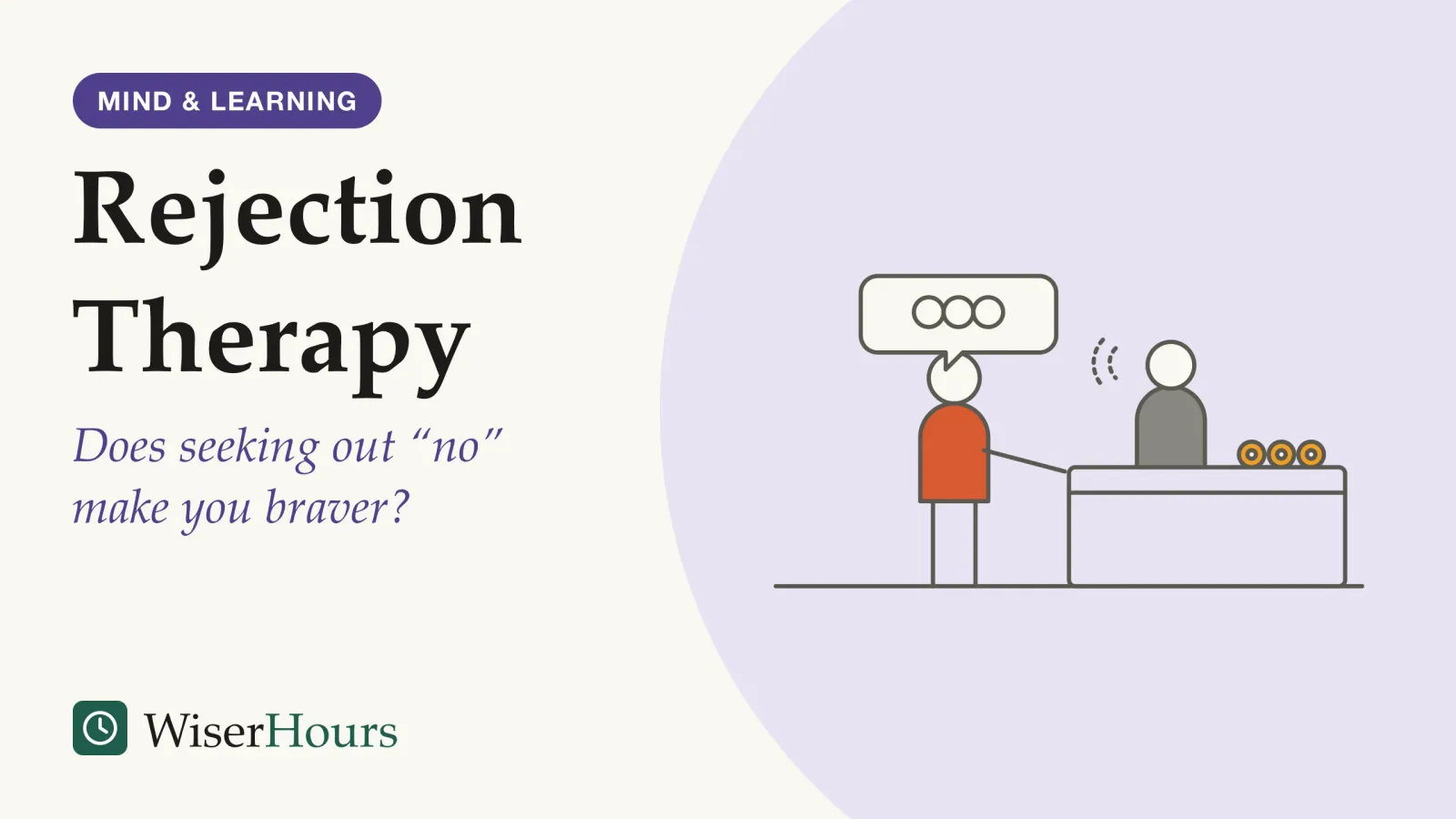
Jia Jiang, an entrepreneur who dreaded hearing no, once walked into a Krispy Kreme and asked the manager for doughnuts shaped like the Olympic rings. She made them and gave them to him for free. It was one stop in a run of 100 requests he set himself after finding a game called rejection therapy online.1
Rejection therapy is the practice of deliberately making requests you expect to be turned down, so that hearing no loses its sting. No published trial has tested it directly. Its logic borrows from exposure therapy, and studies of asking show that people say yes far more often than askers predict. Like other beliefs that shape what you are willing to try, the fear of a no works quietly, and rejection therapy is one way to test it. A gentle version takes five steps:
- Choose small, polite, legal requests.
- Make no an easy answer.
- Write your prediction, then what happened.
- Ask plainly and stay for the answer.
- Repeat over at least a week.
What is rejection therapy?
Rejection therapy is a self-help game created by Jason Comely, with one official rule: get rejected by another person at least once a day. Wikipedia’s entry on the game describes its purpose as overcoming the fear of rejection through controlled, deliberate exposure.2
Comely, a Canadian, invented it as a card game in 2009 after his wife left him, according to a 2022 MEL Magazine feature, and his cards set ordinary tasks such as striking up a conversation with a stranger.3 Jia Jiang’s 2015 TEDxMtHood talk, which describes asking a stranger to lend him 100 dollars and asking a burger restaurant for a “burger refill”, brought the idea to a wide audience: TED’s page for it counts more than 11 million plays.4 Jiang had come across the game in 2012, recorded his daily attempts in a blog and video series, soon concluded that his fear of rejection was a bigger obstacle than rejection itself, and bought the game in 2016.2
The design turns the usual goal upside down. When the aim of a request is to be refused, a no counts as a success, so the outcome you fear becomes the one you are hoping for.
A person who has not asked for a pay review in three years may be held back more by the imagined conversation than by the manager. Scoring the attempt instead of the answer is the part of the game anyone can borrow: you succeed the moment you ask.
Where the idea comes from: exposure therapy
Rejection therapy is a do-it-yourself relative of exposure therapy. The World Health Organization reports that the best-supported psychological treatments for anxiety disorders rest on cognitive-behavioral principles, and exposure therapy, where people practice confronting what frightens them, is one of them.5
Avoidance is what keeps a fear alive. If you never ask, you never find out that the answer was survivable, so the prediction stays untested. In a 2014 review of how exposure works, Michelle Craske of the University of California, Los Angeles, and colleagues explain that exposure does not erase the old fear; it builds new learning that competes with it. They advise designing each exposure to violate the person’s expectation as sharply as possible, so the gap between what was feared and what happened is plain.6
Clinicians already use something close to rejection therapy. In social mishap exposures, described in 2013 by Angela Fang, Stefan Hofmann and colleagues, a person with social anxiety disorderanxiety disorder: A mental health condition in which worry or fear is persistent, out of proportion to the situation and hard to control, and gets in the way of daily life. It differs from ordinary anxiety, which passes, and it is diagnosed by a clinician.Full entry in the glossary deliberately breaks a small social norm, such as singing on a subway or walking slowly backwards along a crowded street. The aim is to test how costly a social blunder really is. Their paper is a case report, and the authors call for treatment studies that compare social mishap exposures directly with traditional exposures.7
The difference lies in the support around it. In therapy, a clinician plans the steps with the client and builds up gradually. Psychotherapist Tracy Pryce told MEL Magazine that the game is not therapy because therapy is not done alone, and warned that badly pitched exposure can overwhelm people.3 Wikipedia’s own entry flags its claim that the game shares components with exposure therapy as dubious.2 The piece worth taking from exposure is the habit of writing down what you expect before you ask, so the result has something to correct.
People say yes more often than askers expect
People who make requests of strangers expect more refusals than they get. Vanessa Bohns’s 2016 review of studies in which participants put requests to more than 14,000 strangers reports that askers underestimated how often people would agree by about 48 percent on average, an error that held across different samples and requests.8
The pattern first appeared in a 2008 paper by Francis Flynn and Vanessa Lake (now Bohns). In three studies run in experimental and everyday settings, people underestimated by as much as 50 percent the chance that others would agree to a direct request for help. A further study in the paper traced the error to a blind spot: askers think about what a yes costs the helper and give too little weight to the social cost of refusing.9
That finding cuts both ways. Bohns links the error to askers missing how awkward refusing feels, which helps explain why requests succeed more often than askers fear. The review covers her own research program, and its abstract notes factors that strengthen, weaken or even reverse the effect, so the average says little about any single big ask such as a loan or a date.8 If refusing is that awkward, some people may also say yes mainly to avoid saying no.
A request that leaves room for a refusal is fairer to the other person and a better test for you. Adding “no problem if not” costs nothing and keeps the exercise from turning into pressure on a stranger.
Does rejection therapy work?
Nobody knows for sure, because no published controlled trial has tested rejection therapy as Comely or Jiang describe it; searches of research databases for this article found none. The closest evidence is a 2022 study in which students spent a week starting conversations with strangers.
Jiang’s own story is a single case. BYU Magazine reports that about half of his requests were granted, which persuaded him that the right wording raised his chances.1 That is useful as an illustration and says nothing about how the game works for anyone else.
The study
Limited evidence
A week of talking to strangers, Sandstrom, Boothby and Cooney (2022)
At a US and a UK university, 286 students used a scavenger-hunt app every weekday for a week. One group had to find a stranger and talk to them; a comparison group found a stranger and only observed. By the end, the talkers expected fewer rejections than the observers, and the gap was still there a week after the study ended. On the first day, 40% of the talkers expected the first person they approached to talk to them; 92% did.10
A British Academy grant funded the study, which was registered in advance, and its limits are clear. The participants were students averaging about 20 years old, whole weekly groups were placed in the same condition, about 3 in 10 of those who started were excluded for dropping out early or failing an honesty check, and the observers improved on some measures too.10 It tested starting conversations rather than asking for favors, and the authors note they do not know how well the effect carries over to less game-like formats. The fair reading is that a week of low-stakes contact with strangers went with a less gloomy forecast in young adults; whether hunting for refusals does the same is untested.
refusals expected that day refusals met that day
The most practical finding is about repetition. Daily reports showed expected rejections falling day by day while actual rejections stayed low and roughly flat, and the authors propose that one pleasant conversation is easy to write off as a lucky exception.10 Plan a run of small requests across at least a week, and judge the exercise by the pattern of answers.
- Myth
- Rejection therapy is a proven technique.
- Fact
- No trial has tested it. Its support comes from exposure therapy research and from studies showing that askers expect more refusals than they meet.
How do you do rejection therapy safely?
A gentle version of rejection therapy uses small, polite, legal requests, made once a day, with your prediction written down first. These steps suit people who feel nervous asking for things. They are not a treatment for social anxiety disorder; if asking brings on panic attacks, exposure is safer planned with a clinician, as the next section explains.
1. Choose small, polite, legal requests
Pick asks that cost the other person little and harm nobody: a recommendation, a small discount, a swap of seats. Steer clear of anything that asks a worker to break their employer’s rules, involves money from strangers, or puts someone in an uncomfortable spot with no easy exit, and leave alone anyone who looks busy, upset or uneasy.
2. Make no an easy answer
Saying no carries a social cost that askers tend to underrate, according to Flynn and Lake.9 Phrase each request so that declining is simple (“Is that possible? No worries if not”), and accept a no warmly. The exercise is about your fear; it should never become a test of how hard you can push.
3. Write your prediction, then what happened
Before each ask, note how likely you think a yes is and how bad a no would feel. Afterwards, write down what happened. This is the expectancy test that Craske and colleagues describe as central to exposure.6
- 1Predicthow likely is a yes, how bad is a no
- 2Ask oncesmall, polite, easy to refuse
- 3Stay for the answerno rushing off
- 4Comparewhat you feared against what happened
Then repeat from “Predict”
4. Ask plainly and stay for the answer
Long apologies before a request, or hurrying away before the reply, protect you from the outcome and so keep the fear untested. Therapists who use social mishap exposures ask clients to drop such safety behaviors, apologizing among them.7 A plain ask with a courteous exit tests the prediction properly.
5. Repeat over at least a week
Comely’s rule is one rejection a day.2 The 2022 study found expectations shifting gradually over a week.10 If a step feels far too big, choose a smaller one tomorrow.
Before each request
What are some rejection therapy ideas?
Good rejection therapy ideas are requests with a real chance of a no and no cost to anyone if the answer is yes. The game advises new players to start with small rejections before moving on to more meaningful ones, according to Wikipedia’s entry.2 Adjust the lists below to what is usual where you live.
Easy starters:
- Ask a stranger for a local recommendation, such as a good place for lunch nearby.
- Ask a café whether they would add an extra shot or a different topping at no charge.
- Ask a colleague you rarely talk to for five minutes of advice on something they know well.
A step up:
- Ask for a small discount at an independent shop or market stall.
- Ask a busy expert for a short call about their work.
- Ask your manager for a stretch task or a seat in a meeting you would usually miss.
Odd but harmless, Jiang-style:
- Ask a restaurant for a “refill” of something that never comes refilled, as Jiang did with a burger.
- Ask a bakery or café for an unusual shape or design, as Jiang did with his Olympic-ring doughnuts.
Requests at work carry more weight than ones to strangers, because you will see the person again. Keep them reasonable, and a no there is information about timing and priorities as much as about you. If refusals tend to land as a verdict on your worth, the article on why some people feel rejection more deeply covers that pattern.
Is it ordinary nerves or social anxiety disorder?
Rejection therapy is meant for ordinary nerves about asking. The WHO describes social anxiety disorder as strong fear and worry in social settings where a person could end up humiliated, embarrassed or rejected, and it advises anyone with anxiety symptoms to seek care.5
The NHS (UK) page on social anxiety lists signs such as worrying about being criticized, avoiding eye contact and low self-esteem, and names cognitive behavioral therapycognitive behavioral therapy: A structured talking therapy that works on the links between thoughts, feelings and behavior, usually over a set number of sessions with practice between them. It is given by a trained therapist or through guided programs, and versions exist for specific problems.Full entry in the glossary as the treatment usually thought to work best; in England, NHS talking therapies accept self-referrals.11 A 2014 meta-analysismeta-analysis: A study that combines the results of earlier studies on the same question into one overall estimate. Pooling makes the estimate more precise, but it cannot repair the studies it pools: a meta-analysis of surveys is still survey evidence.Full entry in the glossary funded by the UK’s National Institute for Health and Care Excellence, which compared treatments across more than 100 trials, concluded that individual CBT should be regarded as the best initial treatment for adults with social anxiety disorder.12 Elsewhere, a family doctor or community health clinic can say which therapies are offered locally.
- Now: if you have urges to harm yourself or end your life, or feel unsafe, phone emergency services on your local number without delay, or reach a crisis line today. In the US, calling or texting 988 connects to the Suicide and Crisis Lifeline, and 911 is for a life-threatening emergency.13
- Soon: if the fear does not go away and affects daily life, or comes with panic attacks, see a doctor, as the NHS advises for suspected social anxiety.11
- Routine: if nerves about asking bother you but do not stop you doing what you need to, mention them at your next routine visit; a doctor can say whether a self-help approach suits you.
The bottom line
The strongest reason to try rejection therapy is that your forecast of a no is probably too gloomy, and a forecast only changes when you test it. Pick one small, polite request for tomorrow, write down how likely you think a yes is, ask in a way that makes no easy, and compare the answer with your guess.
This article is general information, not medical advice. If you're worried about your health, talk to a doctor or another qualified professional.
Frequently asked questions
How long should you do rejection therapy?
Nobody has tested the ideal length. Jason Comely's game asks for one rejection every day for as long as you play, though many players take a 30-day challenge, and Jia Jiang set himself 100 days. In a 2022 study by Gillian Sandstrom and colleagues, a week of daily conversations with strangers was enough to shift students' expectations, and the authors found the change built gradually over the days.
Can rejection therapy make anxiety worse?
It can if the steps are too big. Psychotherapist Tracy Pryce told MEL Magazine in 2022 that exposure pitched badly can overwhelm people. Clinicians who use exposure for anxiety plan it with the client and build up gradually. If a request brings on panic, or you dread it for days, scale back and talk to a doctor or therapist.
Who invented rejection therapy?
Jason Comely, a Canadian, created rejection therapy as a card game in 2009, according to MEL Magazine, after his wife left him. The entrepreneur Jia Jiang came across it in 2012, recorded 100 days of requests in a blog and videos, and acquired the game in 2016, according to Wikipedia's entry on it.
Sources
- 100 Days of Rejection. Bay, A. T. (2017). BYU Magazine, Brigham Young University (US), Spring 2017
- Rejection Therapy. Wikipedia (accessed 2 November 2026)
- The Response to Rejection Therapy Should Have Been No. Vinopal, L. (2022). MEL Magazine, 3 March 2022
- What I learned from 100 days of rejection. Jiang, J. (2015). TEDxMtHood, TED
- Anxiety disorders. World Health Organization, fact sheet, 15 September 2026
- Maximizing exposure therapy: An inhibitory learning approach. Craske, M. G., Treanor, M., Conway, C. C., Zbozinek, T. & Vervliet, B. (2014). Behaviour Research and Therapy, 58, 10-23
- Social mishap exposures for social anxiety disorder: An important treatment ingredient. Fang, A., Sawyer, A. T., Asnaani, A. & Hofmann, S. G. (2013). Cognitive and Behavioral Practice, 20(2), 213-220
- (Mis)Understanding our influence over others: A review of the underestimation-of-compliance effect. Bohns, V. K. (2016). Current Directions in Psychological Science, 25(2), 119-123
- If you need help, just ask: Underestimating compliance with direct requests for help. Flynn, F. J. & Lake, V. K. B. (2008). Journal of Personality and Social Psychology, 95(1), 128-143
- Talking to strangers: A week-long intervention reduces psychological barriers to social connection. Sandstrom, G. M., Boothby, E. J. & Cooney, G. (2022). Journal of Experimental Social Psychology, 102, 104356
- Social anxiety (social phobia). NHS (UK), page last reviewed 17 May 2023
- Psychological and pharmacological interventions for social anxiety disorder in adults: a systematic review and network meta-analysis. Mayo-Wilson, E., Dias, S., Mavranezouli, I., Kew, K., Clark, D. M., Ades, A. E. & Pilling, S. (2014). The Lancet Psychiatry, 1(5), 368-376
- Suicide Prevention. National Institute of Mental Health, US National Institutes of Health (page last reviewed August 2026)
How we researched this
We searched PubMed, Crossref, Google Scholar and the web in November 2026 for any study of rejection therapy, for research on underestimating compliance, for talking-to-strangers interventions and for exposure-based treatment of social anxiety. Sources date from 2008 to 2026. We read the 2022 Sandstrom study, the Craske and Fang papers and the WHO and NHS pages in full; the Flynn and Lake, Bohns and Mayo-Wilson papers were read as abstracts only. Main limitation: no controlled study of rejection therapy itself exists.
Keep reading
Rejection Sensitivity: Why Some People Feel It More Deeply
Rejection sensitivity, as defined by psychologists in 1996, is anxiously expecting, readily seeing and strongly reacting to rejection. Its causes are unsettled.
Mental Toughness Explained: The Four Cs Model and Its Limits
The 4 Cs of mental toughness are control, commitment, challenge and confidence. Where the model came from, how it is measured and what critics found.
Grit: What Angela Duckworth's Research Shows and Where Critics Push Back
Angela Duckworth's grit is passion and perseverance for long-term goals. What her studies found, and why a 2017 review judged the effect modest.
"Fake It Till You Make It": Does Acting Confident Work?
Does fake it till you make it work? A 17-lab test of the famous smile study found no effect. Acting confident helps most by getting you to practice.