Rejection Sensitivity: Why Some People Feel It More Deeply
Rejection sensitivity, as defined by psychologists in 1996, is anxiously expecting, readily seeing and strongly reacting to rejection. Its causes are unsettled.

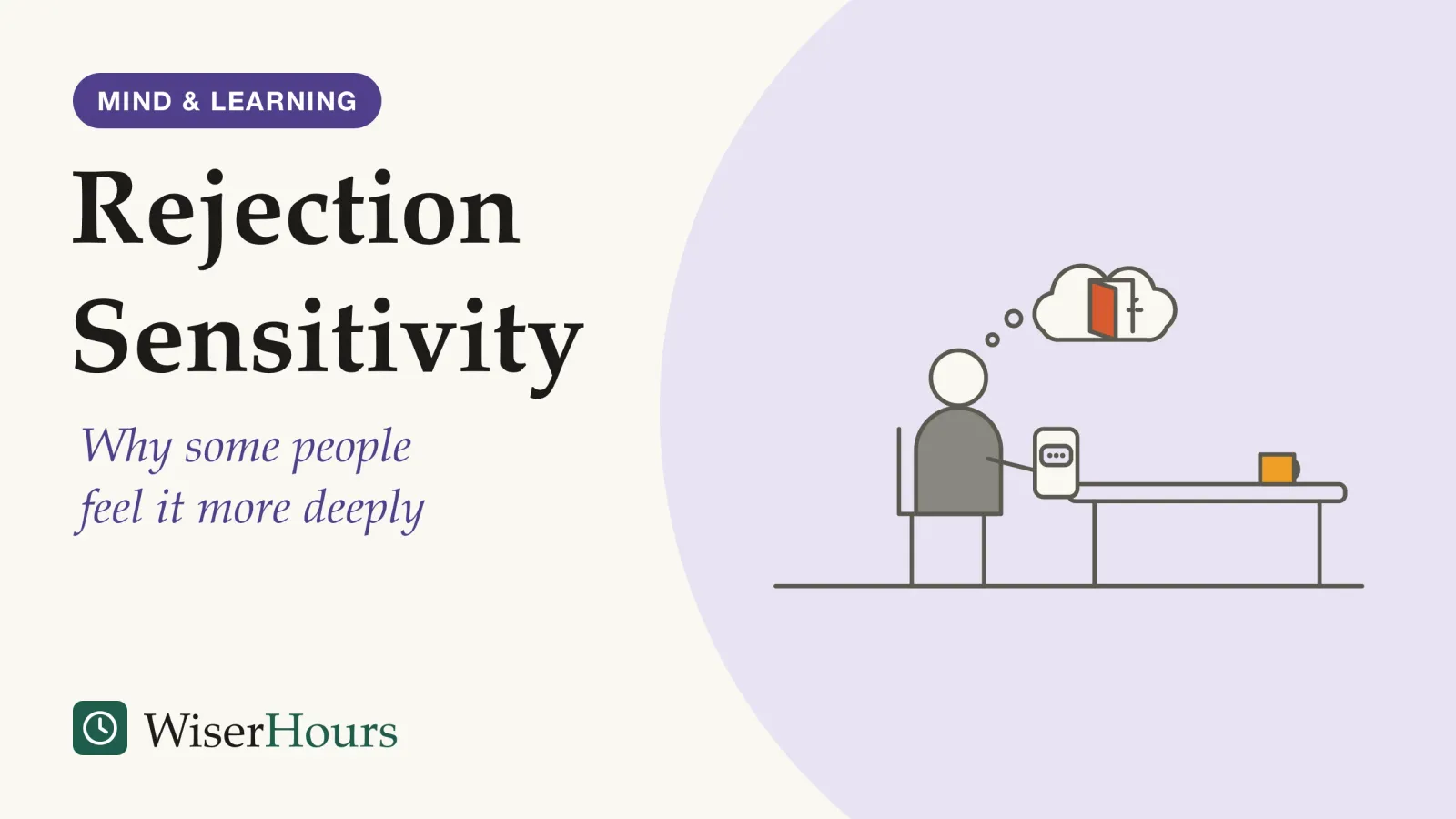
Rejection sensitivity is the tendency to anxiously expect rejection, to see it readily in unclear signals, and to react to it intensely. A one-word reply, a meeting invite with no agenda or a friend who leaves a message unanswered is neutral to some people and lands as a verdict for others. Geraldine Downey of Columbia University and Scott Feldman of the University of California, Los Angeles, defined the pattern in a 1996 paper and designed a questionnaire that places people on a scale for it.1
The trait matters beyond hurt feelings. Shuling Gao and colleagues’ 2017 meta-analysismeta-analysis: A study that combines the results of earlier studies on the same question into one overall estimate. Pooling makes the estimate more precise, but it cannot repair the studies it pools: a meta-analysis of surveys is still survey evidence.Full entry in the glossary, which pooled studies from North America, Europe, Australia and Asia, found that rejection sensitivity is moderately linked to depression, anxiety and loneliness, though most of the studies could not show which came first.2 Like other mindsets that filter what you notice, expectations of rejection work in the background, so the practical skill is catching the guess before acting on it.
Rejection sensitivity defined: expect, perceive, overreact
Rejection sensitivity is a way of handling social situations in which three things happen in sequence: you go in anxiously expecting rejection, you readily perceive it in ambiguous behavior, and you overreact to what you perceive. Downey and Feldman described it in 1996 as a disposition that grows out of experience and then shapes behavior in the moment.1
Definition
Rejection sensitivity is the tendency to anxiously expect, readily perceive and intensely react to rejection by people who matter to you.
The sequence explains why the reaction can feel out of proportion to the event. In Downey and Feldman’s model, the anxious expectation makes a person watchful for signs of rejection, so a minimal or unclear cue gets read as intentional. The reactions they list include anger and hostility, low mood, withdrawing support, jealousy and attempts to control the other person.1
A manager writes “Can we talk tomorrow?” late on a Thursday. A person low in rejection sensitivity assumes a scheduling question; a person high in it may lose sleep rehearsing a dismissal that was never coming. The middle step is the one to catch: when a cue feels like rejection, ask what else it could mean before you act on it.
How researchers measure rejection sensitivity
The standard tool is the Rejection Sensitivity Questionnaire, which Downey and Feldman built from interviews with undergraduates. It describes 18 situations in which you ask something of a person who matters to you, such as asking a friend for a big favor or asking your parents to come to an important event. For each, you rate how anxious you would be about the answer and how likely a yes would be, and a high score needs both worry and a gloomy expectation.1
The authors also tested whether the score predicted anything. In a small experiment, students chatted with a stranger who was secretly working with the researchers; some were then told the stranger did not want to continue, with no reason given. The higher a student’s score, the more rejected they reported feeling, while students told the session had to end for lack of time showed no such pattern.1
The questionnaire and its later versions are self-reportself-report: A measure in which people describe their own behavior, feelings or circumstances, usually by answering a questionnaire. When the same person supplies both of the things being compared, shared habits of answering can make the link between them look stronger than it is.Full entry in the glossary research tools. They place people on a scale; nobody “has” rejection sensitivity the way someone has a diagnosis.
The two ratings also help with a request you keep putting off, such as asking a manager for a day off or a friend for help with a move. Rate how nervous you feel about asking and, separately, how likely a yes is. Strong nerves next to a fair chance of a yes suggest the fear is doing the talking.
Rejection sensitivity and rejection sensitive dysphoria are different things
Rejection sensitive dysphoria, often shortened to RSD, is an informal term used mostly in writing about ADHD for intense emotional pain set off by rejection or failure. The US medical center Cleveland Clinic says in a 2022 health page that it is not an officially recognized symptom or diagnosis and that research on it is limited.3
The two terms describe similar experiences, which is why they get blurred, but they differ in origin and in how much testing stands behind them. A 2026 study from the University of Sussex in the UK notes that attention to this side of ADHD has come from anecdotal reports, and takes its definition from an article a physician wrote for an ADHD magazine. The study itself was five students with ADHD in two focus groups, enough to hear what the experience is like and far too few to say how common it is. All five said the expectation of rejection caused more distress than the rejection itself.4
If “RSD” describes your experience, the label can give you words for it. Describe the experience itself to a clinician (what sets it off, how long it lasts, what you do next), since the label is not something they can diagnose.
What causes rejection sensitivity? Early experience, peers and temperament
Nobody knows for sure what causes rejection sensitivity. The leading theory, from Downey and Feldman, is that it develops when a child’s needs are repeatedly met with rejection, so the child learns to expect rejection and to fear it.1
The same Gao team’s 2024 meta-analysis pooled 16 studies from the US, China, South Korea and Germany and found that people who reported maltreatment in childhood tended to score higher on rejection sensitivity, a small association that was stronger for emotional abuse than for physical abuse. As the authors point out, the pooled studies were cross-sectional, measuring both things at one point in time with people recalling their childhood, so faded memories and reluctance to disclose could color the reports and the order of events cannot be settled.5
Peer rejection also seems to count. In a two-wave study of middle school students, Bonita London, Downey and colleagues at Columbia found that being rejected by classmates predicted a later rise in expectations of rejection, but only for boys. Being liked by classmates predicted a fall in anxious expectations for both boys and girls.6
Temperament may also play a part. Wikipedia’s summary of the research notes that rejection sensitivity overlaps with neuroticism, which suggests some genetic predisposition, and that there is no conclusive evidence for any single explanation.7
Someone who was bullied at school and now tenses up whenever a group chat goes quiet may be running an expectation formed years ago. Naming where the alarm comes from makes it easier to judge today’s silence on its own terms.
Is rejection sensitivity linked to ADHD or anxiety?
Rejection sensitivity is clearly linked to anxiety and depression, and less clearly to ADHD. The strongest evidence is the 2017 meta-analysis by Gao and colleagues, which pooled studies on five mental health problems.
The study
Moderate evidence
Does rejection sensitivity travel with distress? 75 studies pooled by Gao and colleagues in 2017
Across 75 studies with 21,008 participants, higher rejection sensitivity went with more depression (pooled correlation r = 0.33), anxiety (r = 0.41) and loneliness (r = 0.39), moderate links by the usual conventions. The links were similar in clinical and community samples, and in the 12 studies that followed people over time, rejection sensitivity measured first went with later depression, anxiety and loneliness, small to moderate links.2
The links are real but cannot show direction. Roughly two in three pooled studies measured everything at a single point (a cross-sectionalcross-sectional: Describes a study that measures everyone in its sample at a single point in time. Because the possible cause and the outcome are recorded together, it can show that two things occur together but not which of them came first.Full entry in the glossary design), and the authors, funded by the National Natural Science Foundation of China, say the associations may run both ways: rejection sensitivity may feed depression, and depression may make people more sensitive to rejection.2
Social anxiety overlaps with rejection sensitivity without being the same thing. Downey and Feldman found that social anxiety, which centers on strangers and public settings, did not explain how sensitive people read hurtful intent into a new partner’s behavior.1
The ADHD evidence is thin and pulls in two directions. In a study of 1,235 German 10- to 19-year-olds, those with ADHD symptoms reported higher rejection sensitivity than their peers.8 A small 2007 US study of undergraduate men, by contrast, found no higher rejection sensitivity in those diagnosed with ADHDADHD: Attention deficit hyperactivity disorder: a condition, usually present from childhood, marked by persistent inattention, hyperactivity or impulsiveness that affects daily life. In adults it can show up as disorganization or trouble finishing tasks, and a specialist makes the diagnosis.Full entry in the glossary.9
Because low mood and rejection sensitivity may feed each other, a week in which every reply seems cold is a cue to ask how your mood has been overall, and to look after that in its own right.
- Myth
- Rejection sensitivity is an ADHD symptom.
- Fact
- It is linked most clearly with anxiety and depression. Studies of ADHD disagree, and RSD is not an officially recognized symptom.
The self-fulfilling loop in relationships and at work
Expecting rejection may help bring it about. Downey’s team at Columbia found evidence for this loop in 1998 in two studies of dating couples: relationships of highly rejection-sensitive people were more likely to break up, and after conflicts, the partners of highly sensitive women responded more rejectingly. In the lab study, the women’s negative behavior during a tense discussion helped explain their partners’ colder responses afterwards; in the diary study, these conflict patterns did not show up for men.10
- Expect rejection going into a request or a relationship anxiously expecting a "no"
- Scan for signs watching closely for anything that could mean the other person is pulling away
- Read an unclear cue as rejection a late reply, a short answer or a cancelled plan feels like a deliberate rebuff
- React strongly withdrawing, going quiet, or turning hostile or jealous
- The other person pulls back the reaction strains the relationship, which seems to prove the fear right and feeds step 1
The pattern holds across many studies of couples. A 2023 meta-analysis of 60 studies by Mandira Mishra and Mark Allen, researchers in Australia and the UK, linked higher rejection sensitivity with lower relationship satisfaction, more conflict and jealousy, and more self-silencing, keeping your own needs quiet to avoid trouble.11
Work has had far less study. In a 2026 survey of 156 front-line staff at three US mental health agencies, funded by the US Substance Abuse and Mental Health Services Administration, more rejection-sensitive staff were less likely to ask for feedback on their work and rated the feedback they received as poorer.12 Because everyone answered only once, the survey cannot say whether the trait or the feedback habit came first. Someone who avoids asking how a project went misses the early, low-stakes feedback that would have made the formal review less of a shock.
Can you become less sensitive to rejection?
Probably, but trials aimed at reducing rejection sensitivity itself are scarce, and the 2017 Gao review calls for experiments that could settle cause and effect.2 The best-tested ideas come from lab studies on handling a rejection once it lands, and from treatments for the conditions rejection sensitivity travels with.
One idea is to change what you focus on. In a 2002 experiment by Ozlem Ayduk, Walter Mischel and Downey, participants recalled a past rejection while focusing either on their feelings and body sensations or on the physical setting. Those who focused on the setting had fewer hostile thoughts and feelings.13 The study was done in the lab, so it shows an effect in the moment, not a lasting change in the trait.
Self-control skills may also buffer the effects. In a 2000 US study by Ayduk and colleagues, highly sensitive people who had been better at delaying gratification as preschoolers had fewer of the problems linked to rejection sensitivity, such as low self-worth, about two decades later; the authors tie this to skill at steering attention.14
Before you answer a message that stung
When a message or a meeting invite feels like rejection, name the guess (“I think she is annoyed with me”), list two other explanations, and wait before replying. If the doubt remains, ask the person directly.
Treating your own reaction with the kindness described in research on self-compassion after setbacks may help keep one sting from turning into a story about your worth, and building self-confidence through action is a way to work on the expectation itself. Rejection sensitivity can come with social anxiety, a long-term fear of social situations that includes fear of being criticized. The NHS (UK) social anxiety page, last reviewed in 2023, says cognitive behavioral therapycognitive behavioral therapy: A structured talking therapy that works on the links between thoughts, feelings and behavior, usually over a set number of sessions with practice between them. It is given by a trained therapist or through guided programs, and versions exist for specific problems.Full entry in the glossary is generally considered the best treatment and encourages a GP appointment if you suspect the condition.15 Readers in other countries can ask a family doctor or clinic.
When rejection fears need professional help
High rejection sensitivity is not a disorder, but it travels with depression, anxiety and loneliness, so distress that lasts deserves care from a professional rather than more effort to toughen up.
- Now: thoughts of suicide or self-harm, or a sense that you might not stay safe, need help today from your local emergency number or a crisis line. In the US, one example is 988 (call or text), with 911 for a life in danger.16 For UK readers, 999 and A&E cover emergencies, NHS 111 includes a mental health route, and Samaritans’ number is 116 123.17
- Soon: low mood or lost pleasure in usual activities that persists for most of the day, nearly daily, over two weeks or longer is a reason to book a doctor’s visit soon. The World Health Organization’s 2026 depression fact sheet advises seeking care for symptoms of depression and says it can be treated, with psychological treatments as the first option.18 Your local health service can say what treatment is available where you live.
- Routine: if fear of rejection stops you asking for things, applying for jobs or keeping up friendships, or you wonder whether you have ADHD, mention it when you next see your doctor. The NHS (UK) page on adult ADHD, last reviewed in 2025, sorts the symptoms into inattention, hyperactivity and impulsivity, and recommends a GP visit when they cause trouble at work, in study or in relationships.19
The bottom line
Rejection sensitivity is a habit of reading people that research has measured for three decades and linked to depression, anxiety and strained relationships. In Downey and Feldman’s model, the hurt starts with a guess about someone else’s intent. Next time a reply feels like a rejection, write down two other explanations and check before you react.
This article is general information, not medical advice. If you're worried about your health, talk to a doctor or another qualified professional.
Frequently asked questions
Is rejection sensitivity a personality trait?
Researchers treat it as a fairly stable disposition. In Downey and Feldman's 1996 study, scores on their questionnaire stayed similar when students retook it two to three weeks or four months later. A 2017 review by Shuling Gao and colleagues notes that researchers see it as learned through experience, so it may differ from one situation to another.
Can rejection sensitivity be about race, gender or looks?
Yes. Researchers have built versions of the Rejection Sensitivity Questionnaire for expecting rejection because of race, gender, age, sexual orientation, appearance or weight, according to a 2017 review by Shuling Gao and colleagues. Each version asks about the same anxious expectation of rejection, focused on one part of who you are.
Does high rejection sensitivity mean borderline personality disorder?
No. A 2017 meta-analysis by Shuling Gao and colleagues found a moderate link between rejection sensitivity and borderline personality disorder, which means the two often go together without being the same thing. A questionnaire score is not a diagnosis; only an assessment by a qualified mental health professional can say whether a disorder is present.
Sources
- Implications of rejection sensitivity for intimate relationships. Downey, G. & Feldman, S. I. (1996). Journal of Personality and Social Psychology, 70(6), 1327-1343
- Associations between rejection sensitivity and mental health outcomes: A meta-analytic review. Gao, S., Assink, M., Cipriani, A. & Lin, K. (2017). Clinical Psychology Review, 57, 59-74
- Rejection Sensitive Dysphoria (RSD). Cleveland Clinic (US), health library, last updated 30 August 2022
- The lived experiences of rejection sensitivity in ADHD: A qualitative exploration. Rowney-Smith, A., Sutton, B., Quadt, L. & Eccles, J. A. (2026). PLOS One, 21(1), e0314669 (title corrected by the journal, March 2026)
- Child maltreatment as a risk factor for rejection sensitivity: A three-level meta-analytic review. Gao, S., Assink, M., Bi, C. & Chan, K. L. (2024). Trauma, Violence, & Abuse, 25(1), 680-690
- Social causes and consequences of rejection sensitivity. London, B., Downey, G., Bonica, C. & Paltin, I. (2007). Journal of Research on Adolescence, 17(3), 481-506
- Social rejection: Rejection sensitivity. Wikipedia (accessed 17 October 2026)
- Justice and rejection sensitivity in children and adolescents with ADHD symptoms. Bondü, R. & Esser, G. (2015). European Child & Adolescent Psychiatry, 24(2), 185-198
- Rejection sensitivity and social outcomes of young adult men with ADHD. Canu, W. H. & Carlson, C. L. (2007). Journal of Attention Disorders, 10(3), 261-275
- The self-fulfilling prophecy in close relationships: Rejection sensitivity and rejection by romantic partners. Downey, G., Freitas, A. L., Michaelis, B. & Khouri, H. (1998). Journal of Personality and Social Psychology, 75(2), 545-560
- Rejection sensitivity and romantic relationships: A systematic review and meta-analysis. Mishra, M. & Allen, M. S. (2023). Personality and Individual Differences, 208, 112186
- Expecting less and getting it: The role of rejection sensitivity in feedback-seeking and supervisory relationships. Bosk, E., Mendez, A., Hardan, T., Williams-Butler, A., Mackie, T. & MacKenzie, M. (2026). Psychology International, 8(1), 5
- Attentional mechanisms linking rejection to hostile reactivity: The role of hot versus cool focus. Ayduk, O., Mischel, W. & Downey, G. (2002). Psychological Science, 13(5), 443-448
- Regulating the interpersonal self: Strategic self-regulation for coping with rejection sensitivity. Ayduk, O., Mendoza-Denton, R., Mischel, W., Downey, G., Peake, P. K. & Rodriguez, M. (2000). Journal of Personality and Social Psychology, 79(5), 776-792
- Social anxiety (social phobia). NHS (UK), page last reviewed 17 May 2023
- Suicide Prevention. National Institute of Mental Health, US National Institutes of Health (page last reviewed August 2026)
- Where to get urgent help for mental health. NHS (UK), page last reviewed 26 April 2023
- Depressive disorder (depression). World Health Organization, fact sheet (checked current 2026-10-17)
- Attention deficit hyperactivity disorder (ADHD) in adults. NHS (UK), page last reviewed 19 March 2025
How we researched this
We searched PubMed, OpenAlex, Crossref and publishers' pages in October 2026 for the founding rejection sensitivity papers, meta-analyses on mental health, causes and relationships, and studies on ADHD and work. Sources date from 1996 to 2026. We read Downey and Feldman's 1996 paper, both Gao meta-analyses and the PLOS One study in full; several studies were read as abstracts only, and the rejection sensitive dysphoria label has little research of its own.
Keep reading
"Fake It Till You Make It": Does Acting Confident Work?
Does fake it till you make it work? A 17-lab test of the famous smile study found no effect. Acting confident helps most by getting you to practice.
Toxic Positivity: When Looking on the Bright Side Does Harm
Toxic positivity meets pain with forced cheer. A 40-country study links pressure to feel happy with worse well-being. Examples, and what to say instead.
Delayed Gratification: How to Get Better at Waiting for What You Want
Delayed gratification is easier to set up than to force. 4 evidence-based ways to wait for money, food, screens or goals, and when waiting is not worth it.
How to Build Self-Confidence: What Actually Works
Albert Bandura named 4 sources of confidence in 1977. The evidence favors small wins, peer models and task feedback over power poses and affirmations.