"Fake It Till You Make It": Does Acting Confident Work?
Does fake it till you make it work? A 17-lab test of the famous smile study found no effect. Acting confident helps most by getting you to practice.

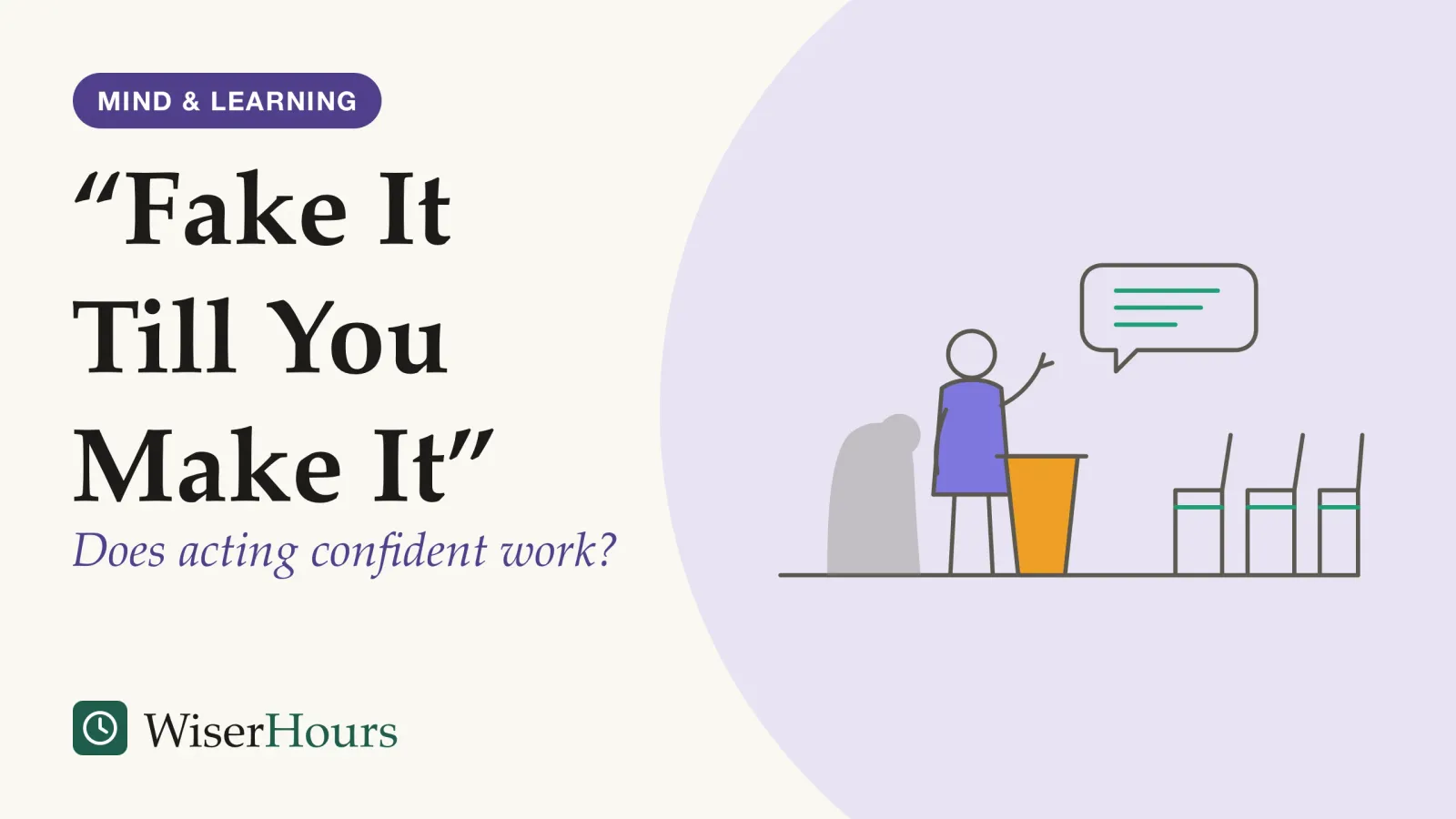
In 1973, a US federal appeals court described how Dare to Be Great, a recruiting scheme it called “a gigantic and successful fraud”, trained its salespeople. They were told to “fake it ’til you make it”: to look wealthy whether they were or not, and to go into debt for a new car and flashy clothes if necessary.1 Wikipedia’s entry on fake it till you make it cites that case as the earliest record of the phrase, and the case shows the version of the advice most likely to go wrong.2
Fake it till you make it works, but more narrowly than the slogan promises. Acting cheerful or confident shifts how you feel a little, and acting outgoing for a week lifted mood on average in two small trials, though not for everyone. In a test across 19 countries, designed by supporters and skeptics of the idea together, posing a smile lifted happiness, but only slightly. The stronger reason to act as if is that it gets you doing the thing, and practice builds the skill that lasting confidence follows.
The useful version is small: act ready for one short round of a task you have been avoiding, such as speaking first in a meeting, and let the confidence come later from the record those rounds leave, which is how self-confidence is built from experience.
Where does “fake it till you make it” come from?
The phrase is recent, but the idea behind it is more than a century old. William James, the American psychologist, argued that action and feeling go together, so by regulating what you do you can indirectly regulate what you feel; Wikipedia quotes the passage from an essay reprinted in 1922.2
So to feel brave, act as if we were brave, use all our will to that end, and a courage-fit will very likely replace the fit of fear.
In the 1920s the psychotherapist Alfred Adler used a technique he called acting as if, which gave clients a chance to practice alternatives to unhelpful behavior.2
Those uses blend three separate claims. The first is that acting a feeling produces the feeling. The second is that acting a part changes how other people see you, which is what the Dare to Be Great trainers were selling. The third is that acting as if gets you to do things you would otherwise avoid, and the doing changes what you can do. A new manager told to “fake confidence” before a first team meeting could hear any of the three: smile and feel calmer, look like someone in charge, or run the meeting anyway and learn from it. The research treats each claim very differently, so work out which one a piece of advice means before you take it.
Can smiling or acting happy really change your mood?
Smiling on purpose nudges happiness up by a small amount; a 2019 meta-analysis and a 2022 study run in many countries agree on that. The famous version of the idea, a pen held in the teeth to force a smile, did not hold up when 17 labs repeated it in 2016.
That 1988 pen study, by Fritz Strack and colleagues in Germany, had people hold a pen either in their teeth, which pulls the face toward a smile, or in their lips, which blocks one. The teeth group reported stronger amusement at cartoons.3 The point of the pen was that people did not know they were smiling, so the result seemed to show a feeling caused by the face alone.
- Myth
- Holding a pen in your teeth to force a smile makes cartoons funnier.
- Fact
- When 17 labs repeated the 1988 pen study to one vetted protocol in 2016, the smile and pout groups rated their amusement almost exactly the same.
The 2016 replicationreplication: Running a study again with fresh data and the same method, to see whether the original result comes back. A finding that fails to replicate is not automatically wrong, but it stops being something you can lean on.Full entry in the glossary pooled about 1,900 people, the overall gap was close to zero, and no lab found a clear difference. Its authors stressed that this did not rule out facial feedback in general, only this test of it.4 A 2019 meta-analysismeta-analysis: A study that combines the results of earlier studies on the same question into one overall estimate. Pooling makes the estimate more precise, but it cannot repair the studies it pools: a meta-analysis of surveys is still survey evidence.Full entry in the glossary of 138 studies by Nicholas Coles and colleagues then found that posed expressions do shift reported emotion, but by a small and variable amount.5
The study
Moderate evidence
Supporters and skeptics of facial feedback run one test together
Researchers who disagreed about facial feedback, Fritz Strack among them, designed one preregistered test together and ran it with thousands of volunteers. Copying smiling faces in photos, or moving the face into a smile on instruction, raised self-reported happiness, with or without pleasant pictures on screen. The pen task gave inconclusive results. Where effects appeared they were small, about the same size as the lift from looking at mildly positive photos.6
In the Many Smiles data, effects were larger among participants rated as more aware of the study’s purpose, though they also appeared among people who showed no such awareness. Many of the authors doubted that a smile in the mirror each morning would work as a well-being practice, because looking at pleasant photos has never become one.6
A deliberate smile before a tense phone call may take a little of the edge off, about as much as glancing at a photo you like. Use it as a small nudge, and don’t expect it to carry a hard morning.
Does acting extraverted make you happier, and for whom?
Acting more outgoing for a week raised positive mood on average in two randomized trialsrandomized controlled trial: A study that assigns participants to the treatment or the comparison group at random, so the groups start out alike and a difference in what happens next can be put down to the treatment. Random assignment makes the two groups comparable; it does not make the people in the trial representative of anyone else.Full entry in the glossary, one in Australia in 2019 and one in the US in 2020. The Australian trial also found that the most introverted people gained little, felt more tired and felt less like themselves.
In the Australian trial, a team led by Rowan Jacques-Hamilton at the University of Melbourne asked 147 adults, most of them young, to act “bold, talkative, outgoing, active, and assertive” in their dealings with others for a week, while a comparison group was asked to act in calmer, more unassuming ways. On average the outgoing group reported more positive emotion and felt more authentic. The more introverted a person was, the smaller the lift, and the most introverted reported more negative feelings and tiredness and felt less authentic. Two weeks after the week ended, the effects on well-being were gone.7 A correction published in 2026 notes that one authenticity question, how much people were “putting on an act”, was left out of the analysis.8
In the US trial, Seth Margolis and Sonja Lyubomirsky had 131 undergraduates spend one week acting talkative, assertive and spontaneous and another acting deliberate, quiet and reserved, in random order. Positive mood, feeling connected to others and absorption in activities rose in the outgoing week and fell in the quiet one. Baseline introversion made no clear difference here, but students who found the outgoing week less natural and enjoyable gained less. Both prompts told students the behaviors were good for them, which the authors note may have pushed results upward.9
The Melbourne team found that the extra outgoing behavior itself explained much of the mood lift, while the amount of time people spent with others did not change.7 The way people behaved in each exchange counted for more than the number of exchanges. A quiet analyst who decides to speak first in two meetings a day is closer to what helped than one who forces a full week of being the loudest in the room.
The Australian authors suggested a lighter dose for introverts: acting outgoing in a few interactions a day, with time to recover in between.7 Watch for tiredness and the sense of putting on a show, the two costs the most introverted volunteers reported in that trial.
What is the psychology behind fake it till you make it?
The main explanation is self-perception theory, developed by the psychologist Daryl Bem in papers from 1967 and 1972. It holds that when people lack a settled attitude and their inner signals are ambiguous, they work out what they feel by watching their own behavior, much as an outside observer would.10 Facial feedback is a narrower version of the same idea, applied to the face.
Self-perception offers a reason why acting as if can shift how you see yourself, and also a limit. The theory applies where your view of yourself is still open. Someone in a first leadership role has little evidence either way about whether they can chair a meeting, so each meeting they run becomes evidence. A person who has given a dozen talks and remembers every one going badly has a settled view, and a confident walk to the stage adds little against it.
Treat acting as if as most useful at the start of something new: a new job, a new skill, a first attempt at speaking up. Where you already have a long record, the record usually needs changing first, and that takes new results.
Acting as if pays off most by getting you to practice
The strongest case for acting confident is indirect. It gets you to try things you would otherwise avoid, and the doing builds skill, which is what lasting confidence follows. When Traci Sitzmann and Gillian Yeo pooled studies in 2013, they concluded that self-efficacyself-efficacy: A person's belief in their ability to carry out a particular task or reach a particular goal. It is specific to the task, so someone can feel capable at work and unsure with money, and it goes with how readily people start and keep going.Full entry in the glossary, your belief that you can handle a particular task, mostly grows out of how well you did that task before, more than it drives how well you do next.11
- The feeling route: posing a smile lifts happiness a little, measured shortly after a brief pose
- The watching-yourself route: where you have no settled view of yourself, your own actions become evidence about who you are
- The practice route: acting as if gets you doing the task; each round builds skill, and confidence follows past performance
The order runs from action to evidence to feeling. Acting as if gets you into the room before you feel ready; the attempt produces a result and some feedback; and a run of results gives the feeling something to rest on. Waiting to feel confident first can stall the whole sequence, because the feeling depends on results you never collect.
An accountant who dreads presenting can volunteer for the short monthly update at a team meeting. The first attempts may be shaky. Each one still shows what worked and what to fix, and by the time the update feels routine, the confidence rests on the updates already given.
Is fake it till you make it bad advice? Where faking backfires
The advice turns bad when the thing being faked is knowledge, credentials or results, rather than composure. The 1973 court case is the extreme form, with salespeople told to pretend to a wealth they did not have.1 Two quieter costs are better documented.
The first is strain. In 2011 the psychologists Ute R. Hülsheger and Anna F. Schewe pooled 95 studies of emotional labor and found that surface acting, displaying feelings you do not have, was linked to substantially worse well-being and poorer job attitudes. Deep acting, trying to feel the emotion you need to show, had only weak links with poor well-being and was linked to better customer satisfaction.12 Most of those studies were correlational, which leaves open whether faking feelings causes the strain; the pattern still matches what the Melbourne trial saw in its most introverted volunteers.
The second is that an act can deepen the doubt it was meant to cover. Pauline Clance and Suzanne Imes, who described the impostor phenomenon in 1978, saw clients engage in what they called intellectual inauthenticity: hiding their real views and telling people what they wanted to hear. Because those clients never tested their own ideas, they never learned whether those ideas would have passed, which the authors saw as keeping the impostor feelings alive. Clients who won a mentor’s approval through charm fell into a similar trap: when praise came, they credited their other qualities instead of their intellect.13 Their account comes from therapy and classes with a selected group of high-achieving women, so it records what the authors saw in that group. Later research is gathered in the guide to impostor syndrome and why success does not cure it.
Keep the act to how you carry yourself, and be plain about what you know. Saying “I have not run one of these before, so I will check my work with someone who has” lets you take on the task without staking anything on a pretense.
Each version of the idea, graded
The versions of fake it till you make it range from refuted to well supported. Power poses have their own replication story, told in the confidence guide linked near the top.
| Version of the idea | What the best evidence found | Evidence |
|---|---|---|
| A pen in the teeth forces a smile and lifts mood | Almost no difference between smile and pout groups across 17 labs | Preregistered multi-lab replication; strong evidence against the original effect4 |
| Smiling on purpose lifts happiness | A small, variable lift in self-reported happiness | Meta-analysis and a large preregistered study; moderate, small effect56 |
| Acting outgoing for a week | Positive mood up on average; little gain and some cost for the most introverted in one trial | Two randomized trials, mostly students and young adults; limited79 |
| Watching yourself act changes how you see yourself | A plausible account where your view of yourself is unformed | Theory with supporting experiments; mixed10 |
| Acting as if to get practice | Confidence follows past performance more than it drives the next attempt | Meta-analysis following the same people across repeated tasks; moderate11 |
| Displaying feelings you do not have at work | Linked to worse well-being and job attitudes | Meta-analysis, mainly correlational data; moderate for the association12 |
| Faking knowledge or results | Keeps impostor feelings going in clinical accounts | Clinical observation; limited13 |
The bottom line
Acting confident works best as a way to start: it gets you into the meeting, onto the stage or into the task, and the practice that follows builds the confidence you were faking. Smiles and outgoing weeks add a small lift, less for some people than others. Pick one task you have been avoiding, act ready for a short round of it this week, be honest about what you do not yet know, and note what the attempt taught you.
Frequently asked questions
How long do you have to act confident before it feels real?
No study has timed it. In a 2019 Australian trial, the mood boost from acting outgoing had gone two weeks after people stopped, so a short burst of acting is unlikely to change much on its own. A 2013 meta-analysis found that confidence in a task mostly follows how well you did it before, which suggests the feeling arrives through repeated rounds of the task rather than by a set date.
Is acting as if the same as the law of attraction?
No. The psychotherapist Alfred Adler used acting as if in the 1920s so clients could practice new behavior. The law-of-attraction movement, popularized by Rhonda Byrne's 2006 book The Secret, uses act as if to mean pretending you already have something so that it comes to you, an idea Wikipedia describes as pseudoscientific. The research in this article tests behavior and mood, not attracting outcomes.
Why did the pen-in-mouth smile study fail to replicate?
Nobody knows for sure. One suggestion was that the 2016 replication filmed participants, which may have made them self-conscious. But a 2019 meta-analysis found facial feedback effects with or without overt recording, and the 2022 Many Smiles study ran its pen task without filming and still got inconclusive results. Participants there also rated the pen smile as less genuine than a deliberate one.
Sources
- Securities and Exchange Commission v. Glenn W. Turner Enterprises, Inc., 474 F.2d 476. United States Court of Appeals, Ninth Circuit (1973). Opinion text via Public.Resource.Org
- Fake it till you make it. Wikipedia, accessed 17 October 2026
- Inhibiting and facilitating conditions of the human smile: A nonobtrusive test of the facial feedback hypothesis. Strack, F., Martin, L. L. & Stepper, S. (1988). Journal of Personality and Social Psychology, 54(5), 768-777
- Registered Replication Report: Strack, Martin, & Stepper (1988). Wagenmakers, E.-J., Beek, T., Dijkhoff, L., Gronau, Q. F., et al. (2016). Perspectives on Psychological Science, 11(6), 917-928
- A meta-analysis of the facial feedback literature: Effects of facial feedback on emotional experience are small and variable. Coles, N. A., Larsen, J. T. & Lench, H. C. (2019). Psychological Bulletin, 145(6), 610-651
- A multi-lab test of the facial feedback hypothesis by the Many Smiles Collaboration. Coles, N. A., March, D. S., Marmolejo-Ramos, F., et al. (2022). Nature Human Behaviour, 6(12), 1731-1742
- Costs and benefits of acting extraverted: A randomized controlled trial. Jacques-Hamilton, R., Sun, J. & Smillie, L. D. (2019). Journal of Experimental Psychology: General, 148(9), 1538-1556
- Correction to Costs and benefits of acting extraverted: A randomized controlled trial by Jacques-Hamilton et al. (2019). American Psychological Association (2026). Journal of Experimental Psychology: General, 155(7), 1725
- Experimental manipulation of extraverted and introverted behavior and its effects on well-being. Margolis, S. & Lyubomirsky, S. (2020). Journal of Experimental Psychology: General, 149(4), 719-731
- Self-perception theory. Wikipedia, accessed 17 October 2026; summarizes Bem, D. J. (1967), Psychological Review, 74, and Bem (1972), Advances in Experimental Social Psychology, Vol. 6
- A meta-analytic investigation of the within-person self-efficacy domain: Is self-efficacy a product of past performance or a driver of future performance? Sitzmann, T. & Yeo, G. (2013). Personnel Psychology, 66(3), 531-568
- On the costs and benefits of emotional labor: A meta-analysis of three decades of research. Hülsheger, U. R. & Schewe, A. F. (2011). Journal of Occupational Health Psychology, 16(3), 361-389
- The imposter phenomenon in high achieving women: Dynamics and therapeutic intervention. Clance, P. R. & Imes, S. A. (1978). Psychotherapy: Theory, Research & Practice, 15(3), 241-247. Read via the transcript on paulineroseclance.com
How we researched this
We read the 1988 pen study's abstract, the 2016 multi-lab replication, the 2019 facial feedback meta-analysis and the 2022 Many Smiles study, two randomized trials of acting extraverted (2019, Australia; 2020, US), a correction published in 2026, a 2011 emotional labor meta-analysis, a 1978 clinical paper and a 1973 US court opinion, and used Wikipedia for the phrase's history. Main limitation: the trials are short and mostly use students, and two meta-analyses are cited only for what their abstracts state.
Keep reading
How to Build Self-Confidence: What Actually Works
Albert Bandura named 4 sources of confidence in 1977. The evidence favors small wins, peer models and task feedback over power poses and affirmations.
Rejection Sensitivity: Why Some People Feel It More Deeply
Rejection sensitivity, as defined by psychologists in 1996, is anxiously expecting, readily seeing and strongly reacting to rejection. Its causes are unsettled.
Toxic Positivity: When Looking on the Bright Side Does Harm
Toxic positivity meets pain with forced cheer. A 40-country study links pressure to feel happy with worse well-being. Examples, and what to say instead.
Delayed Gratification: How to Get Better at Waiting for What You Want
Delayed gratification is easier to set up than to force. 4 evidence-based ways to wait for money, food, screens or goals, and when waiting is not worth it.