The Diderot Effect: How One New Purchase Can Set Off a Chain of Others
The Diderot effect, named after a 1769 essay, is when one new purchase sets off others. Why it happens, what studies show, and 5 ways to stop the chain.

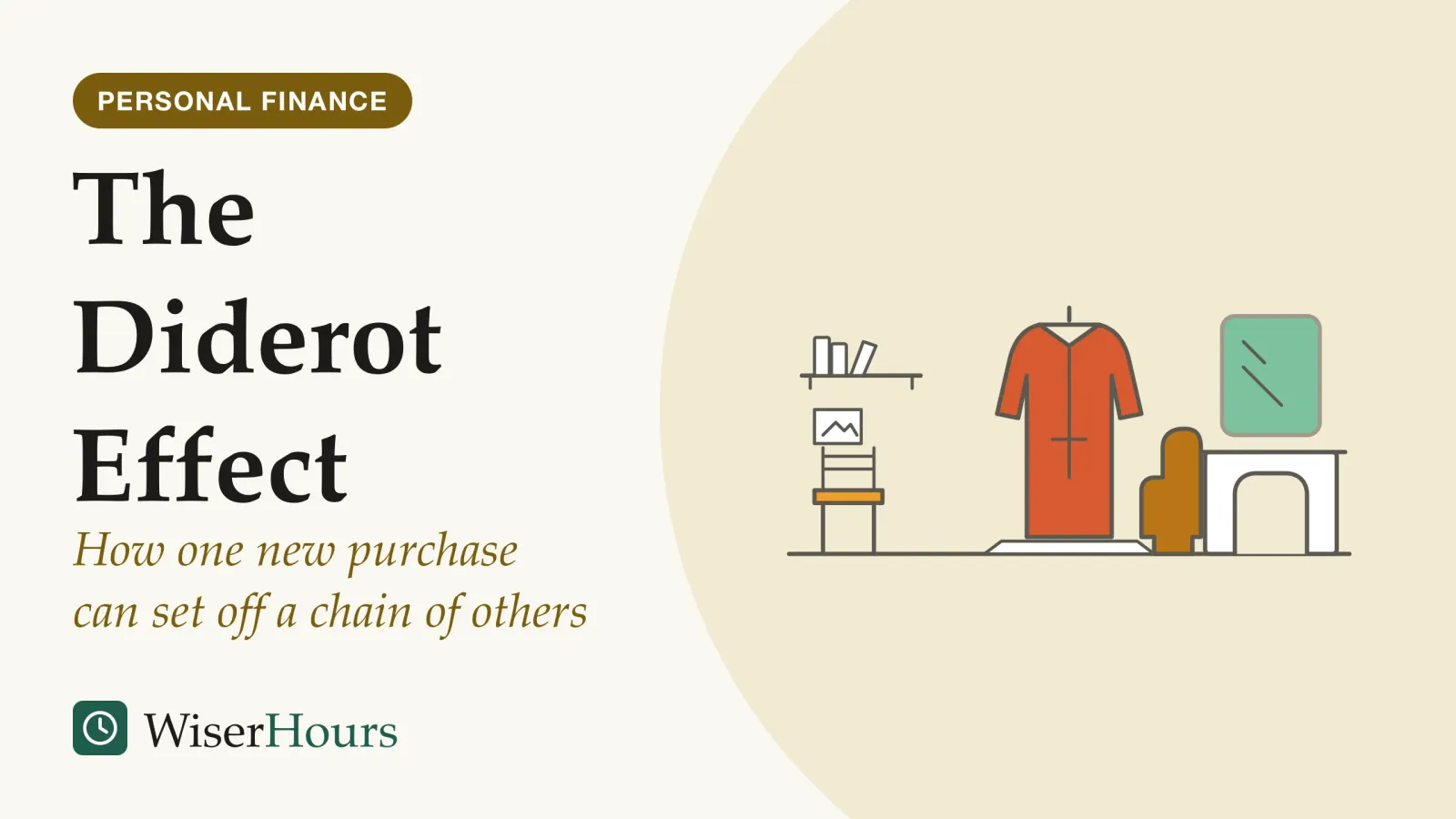
A new phone arrives on Monday. By Friday a case, a faster charger and new earbuds have followed it, and the old laptop bag looks scruffy too.
The Diderot effect is the chain of spending that can follow one new possession: the new thing makes the things around it look shabby or mismatched, so you buy more to bring them up to its level. It is named after the French philosopher Denis Diderot, who described it happening to him in a 1769 essay about a scarlet dressing gown.1
Lab research points to two forces behind the pull. People like their things to match as a set, and in small 2007 experiments buying a wanted first item made an unrelated second purchase likelier.2 Both forces are easiest to slow before they start: add up the cost of the whole set before you buy the first piece, then leave a gap of a day or more before buying any add-ons.
The effect is one small part of how money beliefs and habits form.
What is the Diderot effect?
The Diderot effect, as consumer researchers use the term, is the pressure to keep your possessions consistent with each other, so that one new item that does not fit pushes you to replace the things around it. The anthropologist Grant McCracken named it in his 1988 book Culture and Consumption, building on Diderot’s essay.3
McCracken’s idea rests on what he called Diderot unities: groups of goods that belong together in a culture, such as the clothes, car and gadgets that go with one kind of job. Later researchers summarize his account as describing three ways the effect works. Most often it keeps you from buying things that would clash with what you own. Sometimes one “intruder” gets in, often through a gift, a new design or a life change such as marriage or a new job, and the rest of the set is rebuilt around it. McCracken called that first item a departure purchase. And people can use it on purpose, buying outside their usual style to try out a new version of themselves.4
- Myth
- The Diderot effect is about buying luxury.
- Fact
- It is about fit. Any new item that clashes with what you own can start the chain, whatever it costs, and most of the time the same pull stops you buying clashing things at all.
When something you own starts to look wrong, check what changed. If the old lamp still works and only its neighbour is new, the urge to replace it comes from the set.
Why is it called the Diderot effect?
It is called the Diderot effect after Denis Diderot (1713-1784), the French philosopher whose essay “Regrets for my Old Dressing Gown” tells how one fine new garment led him to refit his whole study.1 He wrote it in 1769, and it was first published in 1772.5
Wikipedia describes the new scarlet gown as a gift.1 In the essay, Diderot mourns his old one, which was shaped to his body and streaked with ink from wiping his quill; the new one gave him the air of a rich good-for-nothing. His straw chair, wooden table, Bergamo wall hanging and unframed prints had once formed a harmonious whole; next to the scarlet gown, nothing matched.6
I was the absolute master of my old robe. I have become the slave of the new one.
One by one, the old things went. A leather chair pushed the straw chair into the hall, a large mirror took over the mantelpiece, and a costly desk replaced the wooden table. Each new piece left a gap that seemed to need filling, so a clock and then more paintings followed. Diderot admits he has run up debts. The one old thing left was a worn rug, which he kept as a reminder of where he started.6
Nobody in the story decides to spend a fortune. Each purchase fixes the mismatch the last one created, so the cheapest place to stop is the first gap.
- 1A new item arrivesa gift, a new job, a new design
- 2The old things look wrong
- 3One is replaced
- 4A new gap appears
Then repeat from “A new item arrives”
Why one purchase pulls in the next
Two lab findings help explain the chain: many people choose items that fit a set even over better single items, and a first purchase seems to shift shoppers from weighing a decision to acting on it. Neither study tested the Diderot effect by name.
The first force is fit. In four experiments reported in 2014, Ellen Evers, Yoel Inbar and Marcel Zeelenberg at Tilburg University in the Netherlands found that people judge a set as good when its items are all alike or all different. Offered a better pen on its own, most people took it. When three plain pens matching the worse one came with either choice, about half took the worse pen, because it completed the set. Students imagining a fourth beer for a party leaned heavily toward the brewer of the three they already had.7 The goods were cheap or imagined, and samples were online workers, students and Dutch schoolchildren, so nobody has measured the pattern on sofas.
The second force is momentum.
The study
Limited evidence
A CD, a key chain and an envelope of rupees: the 2007 shopping-momentum tests by Dhar, Huber and Khan
In a series of small experiments, mostly with university students in South Asia who were paid in rupees for a questionnaire and then offered goods to buy, a first purchase made a second, unrelated purchase more likely. When the first item on offer was one students wanted (an educational CD), 65% went on to buy a key chain, against 37% when the first offer was a light bulb few wanted and 47% when only the key chain was offered. In a later test with 80 people, paying for the second item out of a separate envelope of money cut key-chain buying from 70% to about 43%.2
The authors’ explanation is a change of mind-set: before the first purchase you weigh pros and cons, and after it you are thinking about how and when to buy, which lowers the barrier to the next item. They also found no momentum when the first item came as a free gift rather than a purchase, and in their view the effect is short-lived.2 The sums were small and the samples were students, so the numbers say little about household spending, but they suggest your guard is lowest just after you buy. A cyclist who has just paid for a new bike is in the easiest state to say yes to the lights, lock and helmet offered at the till, which makes it the moment to write them on a list instead.
What is an example of the Diderot effect?
A common example of the Diderot effect is a new laptop or phone followed by a case, a charger, earbuds or a keyboard, each bought to go with the first. A 2025 study of US Amazon purchase histories found that pattern among laptop buyers, though it could not tell planned add-ons from extra ones.4
André Santos, Nuno António and Paulo Rita at NOVA University Lisbon in Portugal used the review histories of people who reviewed best-selling laptops on Amazon’s US site as a stand-in for their purchases. About 3 in 10 of the reviewers also bought something from Amazon’s computer accessories category, most often a bag or case, earbuds, a keyboard or a mouse, usually in the same order as the laptop or soon after. The medianmedian: The middle value when numbers are put in order, so half fall below it and half above. Unlike the average (mean), it is not pulled up or down by a few very large or very small values, which is why it is often used for incomes and wealth.Full entry in the glossary amount spent on those accessories, for purchases up to 2021, was about 26 US dollars, which the authors call a likely underestimate because many prices were missing. The data cover reviewers only, have no exact purchase dates, and cannot separate a real need from a chain set off by the laptop itself.4
The home version is slower and costs more. A new grey sofa arrives, and against it the old rug looks tired, the coffee table too dark, the cushions wrong and the wall in need of paint. Six months later the living room has been redone, and the sofa was the cheapest part.
Researchers have also tied the chain to identity. In exploratory interviews reported in 2003, Teresa Davis and Gary Gregory suggested that an impulse purchase can become the first piece of a new set when it fits a “possible self”, someone the buyer hopes to become.8 A 2025 survey of 416 adults in Türkiye found that people who scored higher on materialism also reported a stronger pull to complete sets, which in turn went with more impulsive online buying. The survey was cross-sectionalcross-sectional: Describes a study that measures everyone in its sample at a single point in time. Because the possible cause and the outcome are recorded together, it can show that two things occur together but not which of them came first.Full entry in the glossary, run once among social-media users recruited online, so it cannot show cause.9 If a purchase is part of becoming someone new, such as a cyclist, a photographer or a person with a professional wardrobe, expect a kit to follow it and price that kit before you start.
How much research is behind the Diderot effect?
Research on the Diderot effect is thin: an essay from 1769, an anthropologist’s 1988 theory, two sets of small lab experiments on the forces behind it, one study of online purchase records and a few surveys. No large trial has tested it directly, and a 2020 study by Gürdin, as a later paper reports, found no clear effect on general purchase decisions.9
| Idea | What the research found | Evidence |
|---|---|---|
| Possessions form sets that belong together | McCracken’s 1988 theory of Diderot unities and departure purchases, built on cultural analysis | Expert theory, 1988 book4 |
| People pick items that fit a set | Choices shifted toward items that completed a matching set, even worse ones | Four small experiments, Netherlands and online, 20147 |
| A first purchase makes the next one easier | A wanted first item raised purchases of an unrelated second item; a separate pot of money weakened it | Small experiments with students, 20072 |
| Big purchases are followed by add-ons | Many laptop buyers went on to buy accessories, mostly soon after | Observational purchase records, US Amazon reviewers, 20254 |
| The pull links to impulsive buying | Stronger set-completion tendencies went with more impulsive online buying | One-time survey, 416 adults, Türkiye, 20259 |
How do you avoid the Diderot effect?
The Diderot effect is easiest to resist when you decide the full cost of a set before the first item, then put a pause and a separate budget between it and the add-ons. The first three steps follow from the research above; the last two are common practice without direct tests, and none promises a saving.
1. Price the whole set before the first piece
Before a purchase that could start a chain, list what usually comes with it and add it up. A new sofa may bring a rug, cushions and a lamp; a new hobby brings equipment, clothing and fees. If the total is more than you would pay, the first item is the one to rethink: in the set-fit experiments, the rest of a set steered people’s choice, sometimes toward a worse item.7
2. Put a pause between the first item and the add-ons
Momentum seems strongest just after you buy. In the 2007 experiments, the pull came from the act of buying and the authors expected it to fade quickly.2 Buy only the first item on the day, put the add-ons on a list, and come back to it after a wait you choose, such as a day for small things or a month for furniture. When the urge to buy right now is the bigger problem, ways to stop impulse buying go further.
3. Pay for extras from a separate budget
Give add-ons their own spending limit, separate from the main purchase. In the momentum experiments, paying for the second item from a different pot of money weakened the chain; the authors suggest a new source of money makes people deliberate again.2
4. Use a one-in, one-out rule
When something new comes in, let one old thing of the same kind leave, by selling, giving away or recycling it. The rule has no study behind it, but it forces the question of whether the old one was failing at all. Diderot’s straw chair still worked; it only looked wrong. He kept his old rug on purpose, and one well-loved old thing beside the new one is a reminder that the set need not match.6
5. Watch for departure moments
Gifts, a new job, marriage and new product designs are the moments McCracken linked to departure purchases.4 At those times, and at similar turning points such as a move, decide in advance what will change and what will stay; a new home does not need new furniture in every room at once.
Before the first piece of a new set
When the chain turns into debt
A chain of purchases can end in debt, as it did for Diderot. When add-ons and upgrades keep landing on cards or buy-now-pay-later plans you struggle to repay, it is time for free help.
The money anxiety guide lists where to find free debt advice in several countries. Elsewhere, search for a no-cost debt service run by your government or a charity, and check how consumer credit is regulated where you live. A decision tied to your personal situation, like borrowing for a home refit, is worth taking to a regulated, fee-only adviser. When the spending is mostly about being seen, the research on conspicuous consumption explains that separate pull.
If worry about money ever brings thoughts of self-harm, make the first call to your local emergency number. Find A Helpline, a directory that the International Association for Suicide Prevention links to from its website, covers over 150 countries with free, confidential lines.10
The bottom line
The Diderot effect is less about any one purchase than about the chain it can start, because a new thing makes the old ones look wrong and the act of buying makes the next purchase easier. Before you buy something that could be the first piece of a set, add up the cost of the whole set, buy only the first item, and wait before deciding on the rest.
This article is general education, not financial advice. For decisions about your own money, speak to a qualified, regulated adviser.
Frequently asked questions
Is the Diderot effect always a bad thing?
No. Grant McCracken's 1988 account, as later researchers summarize it, describes a third use: people can buy something outside their usual style on purpose, to try out a new version of themselves. A new pair of running shoes that leads to a running habit is the kind case. The cost comes when the chain runs on without a decision and the add-ons outgrow the budget.
How is the Diderot effect different from impulse buying?
Impulse buying is a sudden, unplanned urge to buy one thing now. The Diderot effect is a chain: one purchase, often a planned one, makes related things feel necessary so that the set matches. They can overlap. A 2025 survey of 416 adults in Türkiye linked a stronger Diderot tendency to more impulsive online buying, but it was a one-time survey and cannot show cause.
What does Atomic Habits say about the Diderot effect?
In his 2018 book Atomic Habits, James Clear retells Diderot's dressing gown story to show how one action becomes the cue for the next. He then turns the idea around for good use, as habit stacking: attaching a new habit to one you already do every day, so the old habit cues the new one.
Sources
- Diderot effect. Wikipedia, accessed 2026-11-07
- The Shopping Momentum Effect. Dhar, R., Huber, J. & Khan, U. (2007). Journal of Marketing Research, 44(3), 370-378
- Culture and Consumption: New Approaches to the Symbolic Character of Consumer Goods and Activities. McCracken, G. (1988). Indiana University Press; Internet Archive catalogue record
- The Diderot effect: a data-driven validation. Santos, A., António, N. & Rita, P. (2025, online; 2026 issue). Journal of Marketing Analytics, 14(2), 535-551
- Diderot Effect. Southerton, D. (ed.) (2011). Encyclopedia of Consumer Culture, SAGE, pp. 450-451
- Regrets for my Old Dressing Gown, or A warning to those who have more taste than fortune. Diderot, D. (1769). English translation by Mitchell Abidor, Marxists Internet Archive, 2005
- Set-fit effects in choice. Evers, E. R. K., Inbar, Y. & Zeelenberg, M. (2014). Journal of Experimental Psychology: General, 143(2), 504-509
- Creating Diderot unities – quest for possible selves? Davis, T. & Gregory, G. (2003). Journal of Consumer Marketing, 20(1), 44-54
- The Effect of Materialism on Impulsive Buying: The Mediating Role of the Diderot Effect. Şen Doğan, R. (2025). Behavioral Sciences, 15(10), 1403
- Crisis Centres & Helplines. International Association for Suicide Prevention (IASP), accessed 2026-11-07
How we researched this
We read Diderot's 1769 essay in an English translation, the catalogue record of Grant McCracken's 1988 book, and peer-reviewed studies found through Crossref, Europe PMC and publisher pages in November 2026: two experimental papers (2007, 2014), a 2025 study of online purchase histories and two survey or interview studies. Main limitation: the effect has few direct tests, and McCracken's book was read through summaries.
Keep reading
Buyer's Remorse: Why It Happens and How to Shop With Fewer Regrets
Buyer's remorse is regret after a purchase. Why it happens, when the UK and EU give you 14 days to cancel, and 5 steps to shop with fewer regrets.
How to Stop Impulse Buying: Strategies That Hold Up in Studies
How to stop impulse buying: 6 tactics sorted by how well studies support them, from paying cash and a purposeful wait to lists and fewer sale emails.
Manifesting Money: What Psychology Says About Wishing vs. Planning
No study shows manifesting money raises income. In 94 tests, if-then plans helped people reach goals, and a savings lock raised savings in a Philippine trial.

Why Automation Works: The Psychology of Paying Yourself First
Pay yourself first means saving on payday, before bills and spending. Why automation beats willpower, from UK auto-enrollment to a 2001 US study.