Why Automation Works: The Psychology of Paying Yourself First
Pay yourself first means saving on payday, before bills and spending. Why automation beats willpower, from UK auto-enrollment to a 2001 US study.

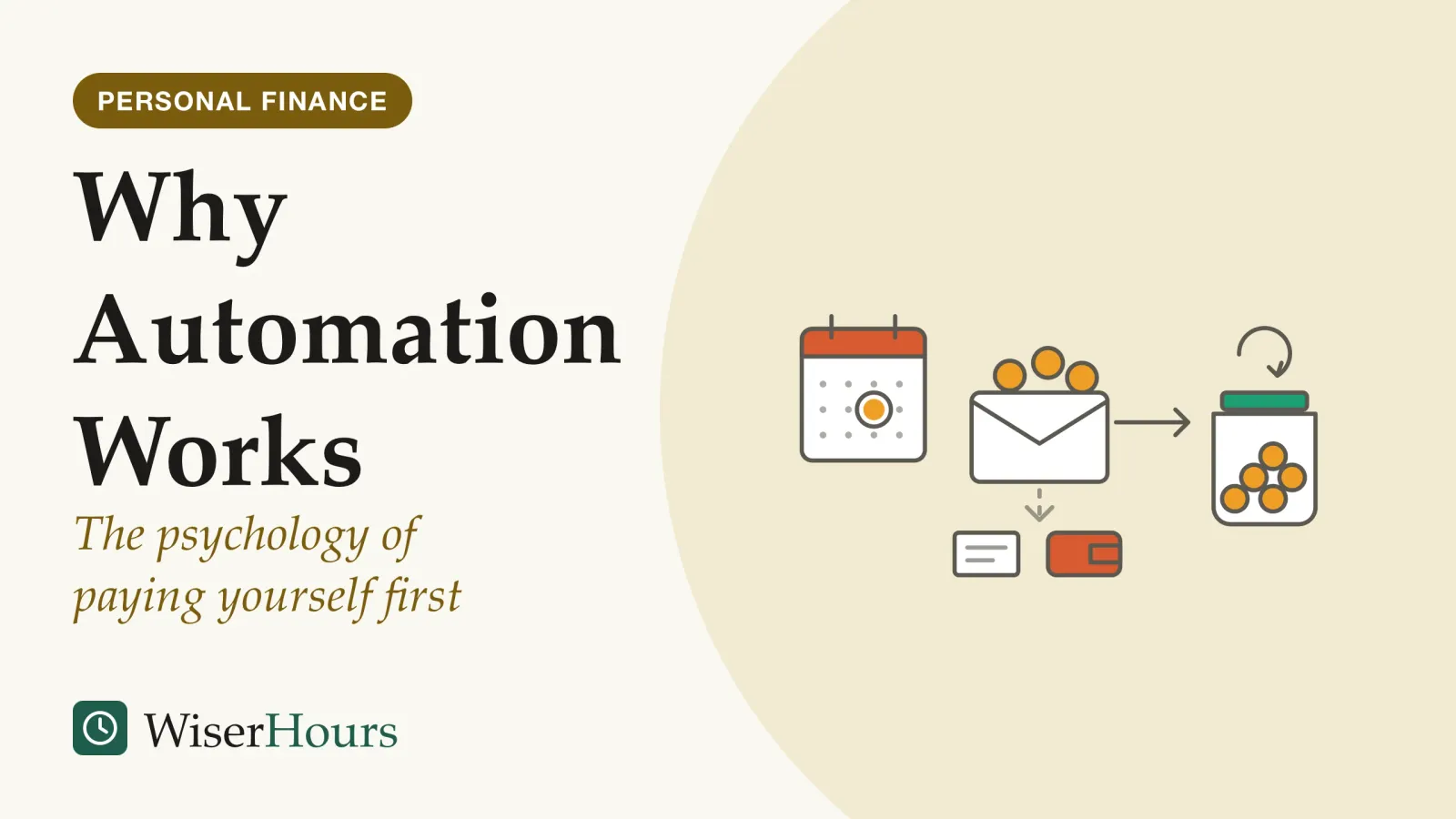
In the research on saving, the plans with the strongest evidence behind them are the ones that run by themselves. Pay yourself first means your saving leaves your account on payday, before bills and everyday spending get a turn, instead of coming from whatever is left over. Done by hand, it is a promise you have to keep every month. Set up as a standing transfer or a split of your pay, it keeps happening while you do nothing.
That reverses the usual problem: procrastination, which normally stops people saving, now keeps the money moving. The best large-scale evidence comes from workplace pensions: after the UK began enrolling workers automatically in 2012, about 9 in 10 eligible employees in Great Britain were saving by 2025, up from about 55 percent when the scheme started, according to the Department for Work and Pensions.1
Like most ideas in the psychology of how people handle money, the method has limits. It can backfire on a tight budget, and uneven pay needs a different rhythm.
What does pay yourself first mean?
Pay yourself first is a saving habit in which a set amount moves to savings as soon as your pay arrives, treated as a fixed cost alongside rent and bills. The idea is old: George S. Clason’s 1926 book The Richest Man in Babylon, first published as pamphlets handed out by US banks and insurers, told readers to keep back a tenth of everything they earned.2
What changes is the order. The usual sequence is to pay the bills, spend through the month and save the remainder; paying yourself first moves saving up to sit right after essentials. Someone paid on the 25th who sets a transfer for the 26th never sees that money in the spending pot at all.
The US Consumer Financial Protection Bureau (CFPB) describes two routes: a recurring transfer set up with your bank or credit union, or asking your employer whether your pay can be split between two accounts.3 Where the money goes depends on your country and goal: a plain savings account for a cash buffer, or a long-term account such as a workplace pension or an ISA in the UK, or a 401(k)401(k): A US workplace retirement plan in which employees save part of their pay, often with a matching contribution from the employer and tax advantages. Contribution limits, vesting of the employer's money and plan terms are set by US rules and each plan's documents.Full entry in the glossary or IRA in the US.
How to set up pay-yourself-first in four steps
Setting up pay yourself first takes four steps: choose where the money goes, size the amount, date the transfer and book a check-in. No trial has tested this exact sequence, so adjust it to your own bills and pay dates; the sections on debt and irregular income below explain when to change it.
1. Choose the goal and the account
A buffer for surprises belongs somewhere easy to reach. Long-term saving may suit a pension or a tax-favored account, depending on your country’s rules.
2. Pick an amount your leanest normal month can carry
Take what a tight month leaves after essentials and minimum debt payments, keep a margin for surprises, and set the transfer below that ceiling.
3. Schedule the transfer for the day after payday
Set a recurring transfer, or ask your employer about splitting your pay between accounts.3 A day’s gap lets the pay clear first.
4. Book a check-in with yourself
Raise the amount when you can. In a hard month, lowering it keeps the habit alive where cancelling would end it.
Before you switch on an automatic transfer
Why automatic saving works better than willpower
Automatic saving works because it changes what happens when you do nothing. Once a transfer is set up, inaction keeps you saving, and stopping takes effort. The landmark evidence is a 2001 study by economists Brigitte Madrian and Dennis Shea of a large US company that started enrolling new staff in its 401(k) plan automatically.4
The study
Moderate evidence
Automatic 401(k) enrollment at one US employer, 1998
At a large US health care and insurance company, new employees were enrolled in the 401(k) plan automatically from April 1998, at a 3% contribution rate in a money market fund, unless they opted out. Among staff with 3 to 15 months in the job, 86% of those hired under automatic enrollment were in the plan, against 37% of a group hired earlier under the old sign-up rules. About 6 in 10 of the new hires stayed at exactly the default rate and fund, a combination almost nobody had chosen before. The study compares groups hired at different times at one company, so it is not a randomized trial.4
None of the plan’s money features changed, including the employer’s matching contribution; only the default did.4 Madrian and Shea put the result down to inertia and procrastination, plus some employees taking the default as advice from the company.
The UK turned that idea into national policy in 2012, requiring employers to enroll eligible staff in a workplace pension. Participation climbed during the roll-out and then leveled off; by 2025 about 22.6 million eligible employees in Great Britain were saving.1 These official statistics show a trend that other changes could also have shaped, but they match the company study. New Zealand’s KiwiSaver uses the same approach: an employer may enroll a new employee automatically, and the usual window for opting out runs from the end of the second to the eighth week of the job.5
Defaults reach well beyond pensions. When Jon Jachimowicz and colleagues pooled 58 default studies in a meta-analysismeta-analysis: A study that combines the results of earlier studies on the same question into one overall estimate. Pooling makes the estimate more precise, but it cannot repair the studies it pools: a meta-analysis of surveys is still survey evidence.Full entry in the glossary published in 2019, people were generally more likely to end up with a pre-set option, though several of the studies showed no significant effect.6 A transfer you set up yourself is a default of your own making, so decide once, when you are calm, and let the setting carry you through busy days.
How paying yourself first changes the way money feels
Pay yourself first also works with three well-described habits of mind: sorting money into mental pots, preferring rewards now, and avoiding effortful choices. Each makes saving from leftovers hard and saving on payday easier.
Mental accounting is Richard Thaler’s name for the way people sort money into separate accounts in their heads, such as rent money, fun money and savings, and treat each pot by its own rules even though money is interchangeable.7 People seem to build these accounts partly as a self-controlself-control: The ability to override an impulse or habit in favor of a longer-term goal, often called willpower. The popular idea that it runs on a limited fuel that each hard task burns up has not held up in large preregistered tests.Full entry in the glossary device. A transfer on payday uses that habit on purpose: money already in a savings account labeled for a goal feels spoken for, while money sitting in a checking or current account feels available.
Present bias is the pull toward a smaller reward now over a larger one later.8 Saving at the end of the month asks you to beat it on the very evenings when spending is easiest. Saving on payday asks you to beat it once, when you set up the transfer, and after that the reward you are giving up is never in front of you.
The third force is effort. Two common explanations for why defaults stick are the mental effort of making an active choice and the cost of switching away from the default.9 A manual saver makes a fresh saving decision every payday, each one a chance to put it off. An automatic saver makes one decision, then only revisits it. Cutting decisions counts most when money is tight, which the article on how a scarcity mindset narrows attention explains.
- Essentials come first in both: rent, food, bills and at least the minimum debt payments have to fit before any saving does
- The saving moves on payday: a repeating transfer or a split of your pay takes the amount out before spending starts, so leaving it in place needs no decision
- Spending fits what is left: the rest of the month runs on the smaller balance, so check it still covers your bills before the transfer goes out
A teacher who saves by hand might mean to move money on the 1st, get busy, and find on the 28th that it went on groceries and a birthday present. With a transfer dated the day after payday, the spending pot is smaller from the start and the groceries fit around it.
- Myth
- People who save automatically just have more willpower.
- Fact
- Automation reduces how often willpower is needed. The saving happens on a schedule, and keeping it going takes no new decision.
How much should I pay myself first?
No research finding sets the right amount for everyone, so the figure is a judgment about your own budget. Clason’s tenth is a rule of thumb from a book of parables, and the CFPB stresses that even a small amount of savings can give some financial security.3
The Madrian and Shea result carries a warning here. Contributions bunched at the 3 percent default instead of the 6 percent or more many earlier hires had chosen, so the first amount you set may quietly become the amount you save for years.4 Look at the figure again every six or twelve months and whenever your pay changes; raising it when pay rises, before the extra money joins everyday spending, is a common approach.
If your essentials and minimum debt payments leave a narrow margin, a modest transfer that never bounces beats an ambitious one you cancel in March. The guide to making a budget shows how to find that margin.
Is pay yourself first a good idea if I have debt?
Pay yourself first can still make sense with debt, but only after essentials and at least the minimum payment on every debt are covered, and saving should never push you into borrowing. Research on UK automatic enrollment found some extra saving matched by extra debt.
A team led by economist John Beshears, including three people who work for NEST, the UK’s government-backed workplace pension scheme, studied about 160,000 small employers whose enrollment dates were assigned in an as-good-as-random way. Over the first 41 months, automatic enrollment raised pension saving and also raised unsecured debt such as personal loans and overdrafts, by an amount equal to roughly a fifth of the extra saving. Mortgage borrowing rose too. Loan defaults fell and credit scores rose a little. As a working paper, it has yet to pass peer review.10 Beshears and a partly overlapping team had earlier looked at civilian employees of the US Army, and found little sign of extra financial distress four years after automatic enrollment: no significant change in credit scores or in debt other than car loans and first mortgages, with a possible rise in first-mortgage balances in foreclosure.11 A 2025 study by economist Taha Choukhmane of more than 100 US retirement plans and a representative UK panel found that the early gains in saving from automatic enrollment shrink by 36 months, leaving modest average increases.12
For a personal transfer the arithmetic is plain. Money earning a modest savings rate while a card balance charges a much higher one costs more in interest than it earns, and a transfer that tips your checking or current account into an overdraft is saving paid for with expensive credit. The CFPB’s guidance on recurring transfers comes with its own warning to watch your balances so you do not run up overdraft fees.3 A small buffer can still come first, since it keeps one surprise bill off the card; the emergency fund guide weighs that trade-off.
With debt, a common order is essentials, minimum payments, a small buffer, then extra debt payments or savings according to the interest rates. If minimum payments alone do not fit, free debt advice is the better next step.
How do I pay myself first with irregular income?
With irregular income, tie the saving to each payment as it arrives rather than to a calendar date, or route all income through a buffer account and pay yourself a steady amount from it. A fixed transfer on the 1st can bounce in a lean month, the overdraft risk the CFPB flags.3
Two rhythms suit uneven pay. A percentage rule moves a set share of every invoice or payout to savings on the day it lands, so the amount shrinks in lean months and grows in good ones. A holding account collects every payment and sends a fixed salary to your everyday account, with saving taken from that salary; the guide to budgeting with irregular income by paying yourself a steady salary sets out that method in full.
A freelance designer might send a slice of each client payment to savings the moment it clears and skip a month with no payments at all.
When to ask an adviser or a debt service
The right amount and account depend on your income, debts, taxes and country, which is why a personal decision is worth taking to a regulated or fee-only adviser. Free services exist in many countries for the debt side.
- Now: if a transfer has already pushed your account into an overdraft, or you are missing priority bills such as rent, energy or tax, cancel or pause the transfer first and contact your bank, then seek free debt advice. If money worries come with thoughts of suicide or self-harm, call your local emergency number or a crisis line straight away; in the US, the 988 Suicide & Crisis Lifeline takes calls, texts and chats, free and confidential at any hour.13
- Soon: if minimum debt payments take most of your spare money, talk to a free adviser within a few weeks. In the US, credit counselors offer help with budgeting and managing debts; according to the CFPB, they usually work for non-profit organizations, though some services carry a fee.14 For UK readers, the government’s own page on dealing with debts lists MoneyHelper as a route to free advice.15
- Routine: when you start a new job or your pay changes, check what your employer offers, such as a pension with employer contributions, before setting your own transfers.
Readers in other countries can usually find a free money advice service run by a public body or a charity; your own financial regulator can confirm whether a paid service is legitimate.
The bottom line
Workplace pensions show how much a default can do for saving, and a transfer you set up yourself uses the same pull of inertia. It helps only once essentials and minimum debt payments are covered. Schedule one transfer for the day after your pay clears, at an amount your leanest month can carry, and set a reminder to look at it again in six months.
This article is general education, not financial advice. For decisions about your own money, speak to a qualified, regulated adviser.
Frequently asked questions
Is pay yourself first the same as automatic enrollment?
They rest on the same idea but differ in who sets them up. Automatic enrollment, used for workplace pensions in the UK and KiwiSaver in New Zealand, is arranged by employers under national rules, and you have to act to leave. Pay yourself first is a habit you set up yourself, usually with a recurring transfer or a split of your pay, for any goal you choose.
Should I pay myself first into a pension or a savings account?
That depends on your situation, and no rule fits everyone. Many people keep two pots: a cash buffer for surprises and long-term saving through a workplace or personal pension, which in some countries comes with employer contributions or tax relief. Rules differ by country, so check what your employer and tax office offer, and speak to a regulated or fee-only adviser for a personal decision.
Can I change or stop an automatic transfer later?
Usually yes. A recurring transfer you set up in your own banking app can normally be changed or canceled there, and a split of your pay is changed through your employer. Leaving a workplace pension follows that scheme's own rules: New Zealand's tax office, for example, sets an opt-out window for people automatically enrolled in KiwiSaver. Check the terms before you rely on any of them.
Sources
- Workplace pension participation and savings trends of employees: 2009 to 2025. Department for Work and Pensions (UK), official statistics, 30 July 2026; tables 1.1; checked 2026-10-24
- The Richest Man in Babylon. Wikipedia, accessed 2026-10-24
- An essential guide to building an emergency fund. Consumer Financial Protection Bureau (US), page last modified 29 October 2025; checked 2026-10-24
- The Power of Suggestion: Inertia in 401(k) Participation and Savings Behavior. Madrian, B. C. & Shea, D. F. (2001). The Quarterly Journal of Economics, 116(4), 1149-1187; read as NBER Working Paper 7682 (2000)
- Opt out of KiwiSaver. Inland Revenue (New Zealand), last updated 25 June 2026; checked 2026-10-24
- When and why defaults influence decisions: a meta-analysis of default effects. Jachimowicz, J. M., Duncan, S., Weber, E. U. & Johnson, E. J. (2019). Behavioural Public Policy, 3(2), 159-186
- Mental accounting. Wikipedia, accessed 2026-10-24
- Present bias. Wikipedia, accessed 2026-10-24
- Default effect. Wikipedia, accessed 2026-10-24
- Does Pension Automatic Enrollment Increase Debt? Evidence from a Large-Scale Natural Experiment. Beshears, J., Blakstad, M., Choi, J. J., Firth, C., Gathergood, J., Laibson, D., Notley, R., Sheth, J. D., Sandbrook, W. & Stewart, N. (2024). NBER Working Paper 32100, revised October 2024
- Borrowing to Save? The Impact of Automatic Enrollment on Debt. Beshears, J., Choi, J. J., Laibson, D., Madrian, B. C. & Skimmyhorn, W. L. (2022). The Journal of Finance, 77(1), 403-447; published abstract checked 2026-10-24
- Default Options and Retirement Saving Dynamics. Choukhmane, T. (2025). American Economic Review, 115(11), 3749-3787; abstract only
- 988 Suicide & Crisis Lifeline. 988 Suicide & Crisis Lifeline (US), checked 2026-10-24
- What is credit counseling? Consumer Financial Protection Bureau (US), last reviewed 2 August 2023; checked 2026-10-24
- Options for dealing with your debts. GOV.UK (UK government), updated 8 November 2024; checked 2026-10-24
How we researched this
We searched Google Scholar, Crossref, NBER, GOV.UK and US and New Zealand government pages in October 2026 for studies, official statistics and guidance on automatic saving, defaults and paying yourself first. We read the full text of every study we report figures from except a meta-analysis and a 2025 study of long-run effects, used for their abstracts only. Sources date from 2001 to 2026. Main limitation: most evidence comes from workplace pensions; no trial has tested personal pay-yourself-first transfers.
Keep reading
Prize-Linked Savings and Gamified Saving: Do They Work?
Prize linked savings swap interest for prize draws without staking your deposit. What trials in 3 countries found, and the return you may give up.
Financial Infidelity: What It Is, Why It Happens, and How to Rebuild Trust
Financial infidelity is hiding money from a partner. In a 2018 US poll, about 1 in 5 partnered adults hid an account. What counts, and how to rebuild trust.
Scarcity Mindset: What It Is and What the Research Shows
A scarcity mindset is the narrow focus that comes with having too little. What 2 Science studies found, why the evidence is disputed, and what helps.
Conspicuous Consumption vs. Quiet Wealth: Why Visible Spending Misleads
Conspicuous consumption, Veblen's 1899 term, is spending meant to be seen. Why visible spending is a poor guide to wealth, and how quiet wealth looks.