The Disposition Effect: Why Investors Sell Winners and Hold On to Losers
The disposition effect, named in 1985, is the pull to sell winners too soon and hold losers too long. Why it happens and 2 fixes that worked in lab tests.

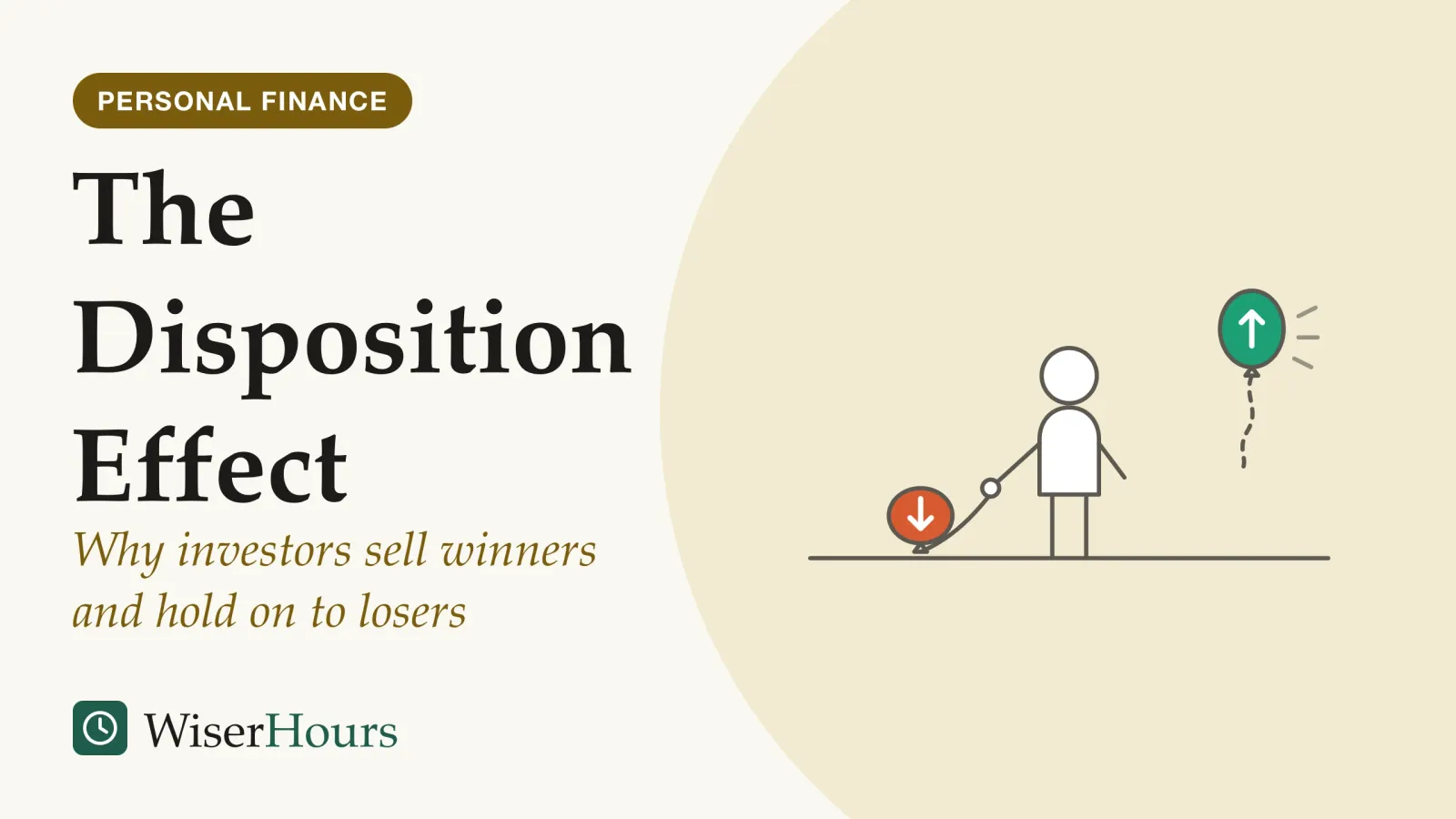
The price you paid for an investment means nothing to the market, yet it often steers which holdings people sell. The disposition effect is that pull: the tendency of investors to sell investments that have risen since they bought them too soon and to hold on to investments that have fallen for too long. A 2014 investor bulletin from the Securities and Exchange Commission (SEC), the US market regulator, highlights a 2010 Library of Congress report that lists the disposition effect among the investing behaviors that can undermine investment performance. The bulletin adds that winners sold often keep outperforming the losers still held.1
The hinge is the price you paid. Two holdings can look equally promising today, yet the one showing a gain feels easy to sell and the one showing a loss feels like money the market still owes you. One question cuts through it: if you held cash instead of this investment today, would you buy it at the current price? We offer it as a rule of thumb that no study has tested; the fixes that did work in experiments come further down. For the wider picture of how beliefs shape money choices, see what a money mindset is and what psychologists actually measure.
A selling habit, named by two economists in 1985
The disposition effect is a pattern in selling, not buying: given a choice, investors tend to cash in holdings that are up and keep holdings that are down, measured against what they paid. The economists Hersh Shefrin and Meir Statman gave it its name in 1985, in a Journal of Finance article titled after the habit itself.2
Definition
The disposition effect is the tendency to sell investments that have gained value since purchase sooner than investments that have lost value. The comparison point is usually the purchase price. We built this definition from the studies cited below.
Shefrin and Statman started from a feature of Daniel Kahneman and Amos Tversky’s approach to choice under uncertainty: an aversion to realizing losses. They placed that aversion in a wider framework with four other ingredients: mental accounting, regret aversion, self-control and taxes.2 Why a loss stings more than an equal gain pleases is explained in our piece on prospect theory and how people weigh wins against losses; the disposition effect is what that lopsided weighting looks like at the moment of selling.
Here is how it plays out, in an illustrative case. You own two shares bought on the same day: one is now up by about a third, the other down by about a third. A car repair means you need cash. Selling the first feels like banking a win. Selling the second feels like making a loss official, so you keep it “until it comes back”.
The market does not know what you paid. The price you paid is a fact about the past; the choice in front of you is which holding you would rather own from here.
How the disposition effect shows up in real trading records
Terrance Odean’s 1998 study of trading at a large US discount brokerage, the best-known test of the disposition effect, found investors far readier to sell winners than losers, and the winners they sold went on to beat the losers they kept.3
The study
Moderate evidence
Odean (1998): what 10,000 brokerage accounts sold, and what they kept
Across the year, a stock that was up was more than 50% more likely to be sold, from day to day, than a stock that was down. The pattern survived checks for portfolio rebalancing and for the higher trading costs of low-priced shares, and it reversed only in December, when tax-motivated selling of losers took over. Over the following year, the winners investors sold beat a market index by about 3.4 percentage points more than the losers they held.3
The practical meaning: the habit did not just feel cautious, it pointed money the wrong way, because the stocks people held on to in hope of a rebound tended to lag. Two caveats matter. These were one broker’s self-directed customers more than 30 years ago, and the comparison sets stock returns against an index rather than tracking each investor’s own result after costs; Odean does argue that in taxable accounts the habit also lowers after-tax returns.3
The pattern is not only American. A 2001 study that tracked the daily trades of individuals and institutions in Finland’s stock market also found investors reluctant to realize losses, alongside tax-loss selling.4 The takeaway for an ordinary portfolio is modest but real: if you notice that your sales are mostly of holdings in profit, it is worth asking whether that is a plan or a reflex.
Why a losing investment is so hard to sell
No single explanation of the disposition effect has won.5 The leading accounts point to the purchase price acting as a reference point, to a reluctance to admit a mistake, and to a belief that losers will bounce back, and each has some support from experiments or trading data.
The reference-point account comes from prospect theory. Measured from the purchase price, Odean explains, a stock that has risen sits where people tend to play safe and lock in a gain, while one that has fallen sits where people become willing to gamble on getting back to even. He also notes that the two motives blur: an investor who will not sell at a loss may persuade himself the stock will bounce back rather than admit he cannot accept the loss.3
Investors who sell winners and hold losers because they expect the losers to outperform the winners in the future are, on average, mistaken.
If the purchase price drives the habit, making it less visible should help, and in one lab test it did. In a 2014 Caltech experiment by Cary Frydman and Antonio Rangel, the disposition effect was about a quarter smaller when the trading screen stopped displaying what each stock had cost, though it did not disappear.5
- Purchase price: the reference point studies usually measure gains and losses from
- Above it, a winner: tempting to sell and lock in the gain
- Below it, a loser: tempting to hold and wait to get back to even
- From here: what each holding is likely to do next is what the decision is about; in Odean’s data, sold winners went on to beat held losers
A second account is about self-image: selling at a loss means admitting that buying was a mistake. In brokerage data and an experiment, Tom Chang, David Solomon and Mark Westerfield found the disposition effect in individual stocks but a reverse pattern in mutual funds, where investors realized losses more readily than gains. Their explanation is that delegating lets an investor blame the fund manager instead of themselves.6 Picture a bad month in your account: on that theory, the stock you chose yourself reads as a verdict on your judgment, while a fund’s fall can be pinned on whoever runs it.
Not everyone accepts that investors simply hate realizing losses. Itzhak Ben-David and David Hirshleifer found that individual investors were more likely to sell big winners and big losers than small ones, with little sign of a jump in selling at break-even. They conclude that a simple preference for selling at a gain does not drive the pattern, and that changing beliefs about a stock could explain it.7
Whatever the mix, the explanations share a weak spot: the decision to sell is made in the moment, with the purchase price on screen and your judgment on trial. The fixes worth trying therefore work on that moment, either by settling the decision before it arrives or by taking the price off the screen.
What reduces the disposition effect in experiments
The best evidence on fixes comes from lab experiments, and two approaches have worked: committing in advance to automatic sales, and hiding the purchase price. In a 2017 experiment by Urs Fischbacher, Gerson Hoffmann and Simeon Schudy, student investors who could set automatic sell limits in advance showed a smaller disposition effect, while reminders of their own plans did not help.8
The authors’ reading is that a loss is easier to accept before it exists. Once the price has fallen, the calm plan gets renegotiated; an automatic sale removes the renegotiation. Their caveat applies to you too: this was a small lab market with students and simple assets, not a test of stop-loss orders in real markets.8
Outside the lab, the nearest equivalent is a broker’s automatic sell order, such as a stop order. That is a description, not a recommendation: the SEC’s Investor.gov (US, checked 2026) warns that a short-term price swing can trigger such a sale, and the price you get may differ from the one you set.9 A sell rule you only write down is closer to the reminder condition, which did not help. We found no randomized test with real investors’ money, so what carries over is the timing: think a fall through while the loss is still hypothetical.
In a 2006 study of trading records from a major discount brokerage, Ravi Dhar and Ning Zhu found that wealthier investors, those in professional occupations and those who traded more often showed a smaller disposition effect. The study shows an association; it does not show that experience cures the habit.10
One caution applies to the lab fixes above. A meta-analysismeta-analysis: A study that combines the results of earlier studies on the same question into one overall estimate. Pooling makes the estimate more precise, but it cannot repair the studies it pools: a meta-analysis of surveys is still survey evidence.Full entry in the glossary of disposition effect experiments by Stephen Cheung, a working paper revised in 2025 and not peer reviewed, found stronger signs of selective reporting for tests of fixes than for the basic pattern, so read the size of any lab benefit with some caution.11
| Approach | What the study found | Evidence |
|---|---|---|
| Automatic sell limits set in advance | Automatic limits shrank the effect by helping people realize losses | Trial (small lab experiment, students), limited8 |
| Reminders of your own sell plan | No clear reduction compared with no plan | Trial (small lab experiment, students), limited8 |
| Hiding the purchase price | The effect was about a quarter smaller | Trial (lab experiment, Caltech participants), limited5 |
| Wealth, job and trading experience | Linked to a smaller effect | Observational (one discount broker), limited10 |
Fund investors are not immune, though the pattern can run the other way. In Chang’s team’s brokerage data, mutual fund investors were readier to sell funds at a loss than at a gain.6 The study did not look at index funds on their own, so it says nothing specific about people who hold low-cost index funds. If you hold funds of any kind, a bad spell calls for the same fresh-cash question as a falling stock, whichever way your instinct pulls.
When keeping a losing investment can make sense
Sometimes the reasons behind the disposition effect are sound: rebalancing a portfolio, avoiding high trading costs and taxes can all justify selling a winner or keeping a loser. Odean tested the first two, and they did not explain the pattern he found. For taxable accounts under US tax rules, he adds, the tax logic usually points the other way: defer gains, realize losses.3
Tax rules show why. US rules, as the Internal Revenue Service describes them, let capital losses offset capital gains, let a limited amount of any excess loss reduce other income, and let the rest carry forward to later years (as of 2026).12 The UK government’s guidance says a reported loss on a chargeable asset is deducted from gains made in the same tax year, and unused losses can be carried forward (as of 2026).13 Rules differ elsewhere, so check your own tax authority’s guidance.
- Myth
- It isn't a real loss until you sell.
- Fact
- The drop in value has already happened. Selling records it, which can matter for tax, and frees the money for something else; it does not change what the holding is worth today.
Consider a worked example with no numbers attached. Someone holds a fund bought for retirement that has fallen, and a single stock that has doubled and now makes up most of the account. Rebalancing may argue for selling some of the winner; a plan built around the fund may argue for keeping the loser. Both are reasons that would still apply if the purchase prices were erased.
Reasons that would survive without the price
Before a sale, list the reasons for keeping each holding that never mention the price you paid: your plan, your mix of investments, taxes and costs. If the only reason left for keeping a loser is getting back to even, the disposition effect may be doing the choosing.
Then put the fresh-cash question from the top of this page to each holding in turn.
When a sale needs personal advice
Whether to sell a particular holding depends on your taxes, goals and the rest of your portfolio, which general research cannot weigh for you. The lab fixes above describe what reduced a bias in experiments; they are not a trading strategy, and the right choice for you may differ.
- Before a large sale, or one with tax consequences, a regulated financial adviser or a tax professional can go through your figures with you; find out how they are paid before you start. Investor.gov, the SEC’s site for US investors, advises checking the background and license of any financial professional.14 The UK’s Financial Conduct Authority notes that almost all firms offering financial services must be authorised or registered by it, and shows how to check.15 Outside the US and UK, look up your own country’s financial regulator.
- At a routine review of your investments, look at which holdings you sold over the past year and whether the reasons would survive without the purchase price. Beginners setting up a first plan can start with how investing works and the steps regulators suggest.
The bottom line
What you paid for an investment is history to the market, and the disposition effect is what happens when that history still picks the sale. Records of real investors show the habit, and the losers people kept tended to lag the winners they sold. The fixes with the best lab support act before the moment of decision: automatic sales committed to in advance, and less attention to what you paid. Neither has been tested with real portfolios, and real automatic orders carry their own risks.
This article is general education, not financial advice. For decisions about your own money, speak to a qualified, regulated adviser.
Frequently asked questions
Is the disposition effect the same as loss aversion?
No, though they are related. Loss aversion, from Kahneman and Tversky's prospect theory, means losses weigh more than gains of the same size. The disposition effect is a trading pattern: selling winners sooner than losers. Shefrin and Statman's 1985 paper treated a dislike of realizing losses as one ingredient, alongside mental accounting, regret aversion, self-control and taxes.
How do researchers measure the disposition effect?
Most studies follow Terrance Odean's 1998 method. On each day an investor sells something, researchers sort every holding into a gain or a loss against its purchase price, then compare the share of gains that were sold with the share of losses that were sold. If gains are sold at a higher rate, the investor shows a disposition effect.
Do experienced or professional investors show less of it?
Less, on average, in the evidence we found. A 2006 study of accounts at a major discount brokerage by Ravi Dhar and Ning Zhu found that wealthier investors, people in professional occupations and investors who traded more often showed a smaller disposition effect. It covered individual investors' accounts, not professional fund managers, and it shows links, not causes.
Is selling losers for a tax loss the opposite of the disposition effect?
It pulls the other way. In Odean's US data, the preference for selling winners reversed in December, which he attributed to tax-motivated selling of losers. Shefrin and Statman argued that bunching loss sales at year end is itself not fully rational, and read it as self-control: investors reluctant to take a loss use the tax deadline to make themselves do it.
Sources
- Investor Bulletin: Behavioral Patterns of U.S. Investors. US Securities and Exchange Commission, Office of Investor Education and Advocacy (2014), June 16, 2014; summarizing Library of Congress Federal Research Division, Behavioral Patterns and Pitfalls of U.S. Investors (2010)
- The Disposition to Sell Winners Too Early and Ride Losers Too Long: Theory and Evidence. Shefrin, H. & Statman, M. (1985). The Journal of Finance, 40(3), 777-790
- Are Investors Reluctant to Realize Their Losses? Odean, T. (1998). The Journal of Finance, 53(5), 1775-1798
- What Makes Investors Trade? Grinblatt, M. & Keloharju, M. (2001). The Journal of Finance, 56(2), 589-616
- Debiasing the disposition effect by reducing the saliency of information about a stock's purchase price. Frydman, C. & Rangel, A. (2014). Journal of Economic Behavior & Organization, 107(B), 541-552
- Looking for Someone to Blame: Delegation, Cognitive Dissonance, and the Disposition Effect. Chang, T. Y., Solomon, D. H. & Westerfield, M. M. (2016). The Journal of Finance, 71(1), 267-302
- Are Investors Really Reluctant to Realize Their Losses? Trading Responses to Past Returns and the Disposition Effect. Ben-David, I. & Hirshleifer, D. (2012). The Review of Financial Studies, 25(8), 2485-2532
- The Causal Effect of Stop-Loss and Take-Gain Orders on the Disposition Effect. Fischbacher, U., Hoffmann, G. & Schudy, S. (2017). The Review of Financial Studies, 30(6), 2110-2129
- Stop Order. US Securities and Exchange Commission, Investor.gov glossary, accessed 2026-09-24
- Up Close and Personal: Investor Sophistication and the Disposition Effect. Dhar, R. & Zhu, N. (2006). Management Science, 52(5), 726-740
- A meta-analysis of disposition effect experiments (working paper). Cheung, S. L. (2024; revised August 2025). University of Sydney School of Economics Working Paper 2024-02; not peer reviewed
- Topic no. 409, Capital gains and losses. Internal Revenue Service (US), page last reviewed or updated 24 September 2026; accessed 2026-09-24
- Capital Gains Tax: If you make a loss. GOV.UK (UK government), guide last substantively updated 30 October 2024; accessed 2026-09-24
- Check Out Your Investment Professional. US Securities and Exchange Commission, Investor.gov, accessed 2026-09-24
- How to check a firm or individual is authorised. Financial Conduct Authority (UK), first published 20 March 2023, last updated 22 September 2026
How we researched this
Field studies, experiments and reviews of the disposition effect were found through Crossref, OpenAlex, RePEc and Google Scholar searches run in September 2026, alongside US and UK regulator and tax pages. Research dates from 1985 to 2025; regulator and tax pages were checked on 2026-09-24. Main limitation: the field evidence is observational and mostly from older brokerage data, the tests of fixes are small lab studies, and for five papers we saw the abstract but not the full text.
Keep reading

Does Money Buy Happiness? How the Research Has Evolved
Does money buy happiness? From the $75,000 plateau of 2010 to the 2023 truce: what income studies, lottery winners and the Easterlin debate show.

Money Anxiety: Why It Happens, How It Shows Up, and What Helps
In a 39-country OECD survey, only 29% of adults said they don't tend to worry about paying living costs. How money anxiety shows up and what helps.

What Is a Money Mindset? Separating Psychology From Pop Slogans
What is a money mindset? What psychologists actually measure, the 4 money scripts in Klontz's research, and how to test your beliefs against your numbers.