What Is an Index Fund? How Tracking a Market Index Works
An index fund copies a market index instead of trying to beat it. How tracking works, why the copy is never exact, and 5 questions to ask before you buy.

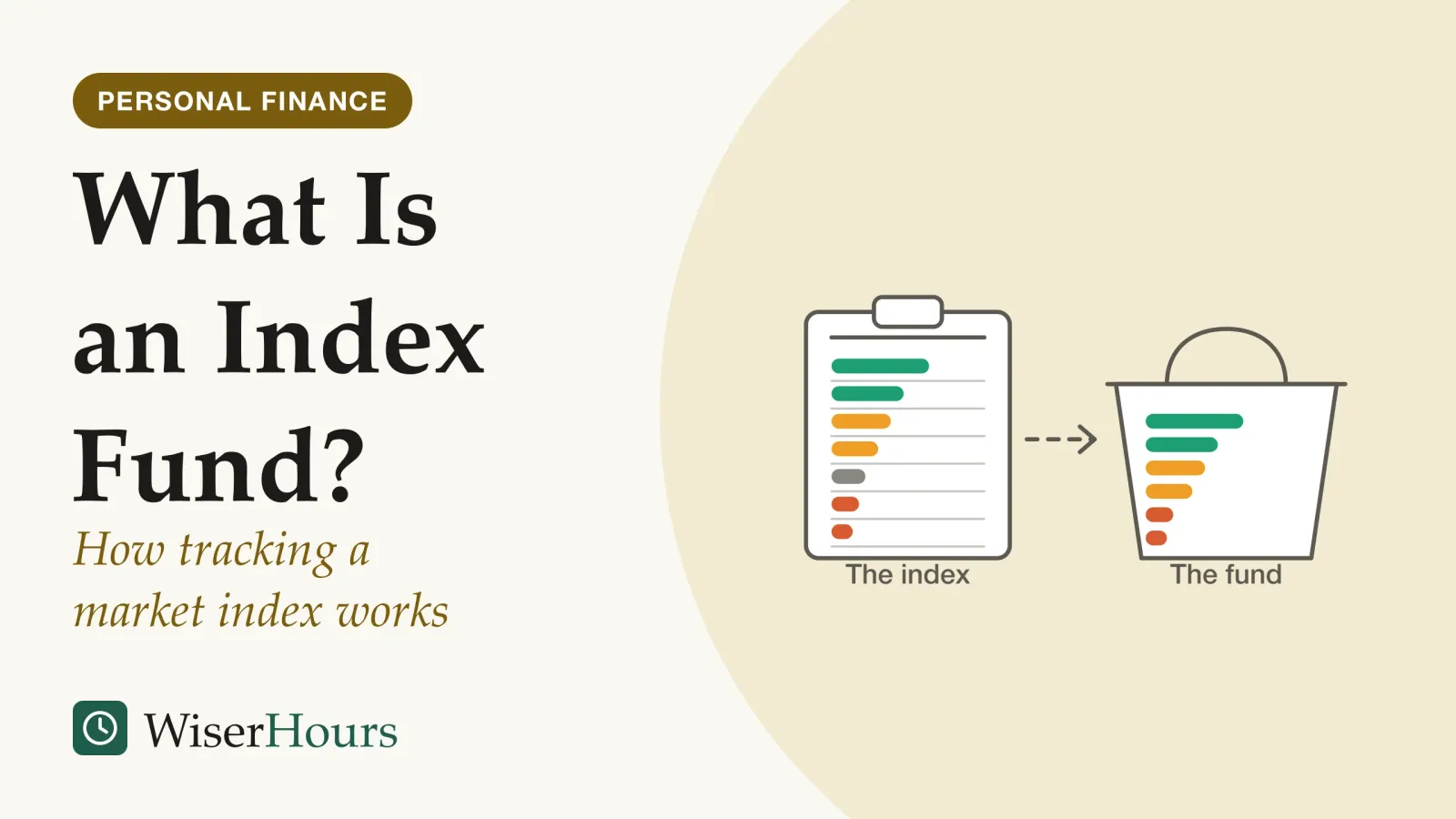
Every index fund begins with a list that somebody else writes. The list says which companies or bonds belong in a market, and how much of each one counts. The fund’s only job is to own that list.
The US Securities and Exchange Commission’s answer to what is an index fund fits in one sentence: a mutual fund or an exchange-traded fund that seeks to track the returns of a market index, by owning all of the securities on that index’s list or only a sample of them. Index funds have generally followed a passive style of investing rather than an active one, the SEC adds, so the manager is not picking securities.1 Copying is the whole design, which means the fund aims to match a market rather than beat it, and after its own costs it generally ends up behind the index it copies, the UK’s Financial Conduct Authority found in a market study covering more than 20,000 fund share classes.23 If funds are new to you, our guide to how investing works and where beginners should start covers where they sit among stocks, bonds and cash.
What is an index fund, and what an index actually is
An index fund is a fund defined by the list it follows. A market index measures the performance of a basket of securities meant to represent a sector of a stock market or of an economy, and you cannot buy an index directly, the SEC explains; an index fund exists to give you an indirect way in.1
Definition
An index fund, in the US SEC’s definition, is a pooled fund whose stated aim is to track the returns of a named market index, by holding every security in that index or only a sample of them.
The list is not neutral, because somebody chose its rules. Indexes often weight holdings by market capitalization, the total value of a company’s shares, so the biggest companies take up the most room; some, such as the Dow Jones Industrial Average, weight by share price instead.1 That is why the S&P 500 and the FTSE 100 behave differently from each other, and from a bond index: different lists, different rules.
Some funds follow an index built to order rather than a broad market one, the SEC notes, which is how smart beta products work: still copying, but copying a recipe.4
So when someone says they bought an index fund, they have told you almost nothing until they name the list. Ask which index, and what it was built to represent: that answer sets almost everything else.
How a fund copies an index, share by share
A fund copies an index in one of two ways. Some buy all of the securities in the index; others buy only a sample, and some use derivatives such as options or futures to help hit the target. Picture a fund copying a broad index of thousands of small companies: buying every last name would mean trading in shares that barely trade, so the manager holds only a sample instead, and the SEC warns that a fund doing this may be less likely to match the index.1
- 1A provider publishes the listwhich securities, and the weight of each
- 2The fund buys the listall of it, or only a sample
- 3The list changesnames join, leave or grow
- 4The fund trades to followand costs come out at every step
Then repeat from “A provider publishes the list”
The same index can be sold in two wrappers. Mutual fund shares are bought from and sold back to the fund itself at the next calculated value of its holdings, on any business day; ETF shares trade on a stock exchange at a market price that can sit above or below that value, so you may pay more or less than the holdings are worth.56 The index inside is the same; the wrapper decides when you can buy or sell, and at what price.
Why a tracker fund is never an exact copy
A tracker fund falls short of its index because the index is free and the fund is not. The market index is a theoretical construct that does not take into account the costs of investing, the FCA wrote in its 2016 interim report, so a passive fund would generally underperform its benchmark after costs.2
The FCA gives the gap a name and takes it apart. Tracking difference is the distance between the index’s return and the fund’s, and it comes from the fund’s ongoing charges, trading costs that are not included in those charges, differences between what the fund holds and what the index holds at any moment, revenue the fund earns by lending out its securities, and other factors such as tax and exchange rates.2 One of those, lending revenue, pushes the other way and narrows the gap.
- What the investor keeps: the index return, less the costs of owning it
- Securities lending revenue, where the fund lends out holdings and is paid for it: this one is added back
- Ongoing charges, the fee taken from the fund year after year
- Trading costs, which are not included in the ongoing charges figure
- Holdings that differ from the index at any moment, plus tax and exchange rates
The SEC describes a related idea under the name tracking error, and lists it among the risks of index funds: a fund may underperform its index because of its fees and expenses, its trading costs and tracking error.1
The practical lesson: a low headline charge is a claim about one part of the gap, not the whole of it. Two funds following the same index can finish a different distance behind it, and only the record of several years shows which did what.
The charge you can see before you buy
The one cost you can check in advance is the fund’s own running charge. The expenses of managing a fund are deducted from its assets, usually as a percentage known as the expense ratio, which the prospectus sets out as annual fund operating expenses, the SEC explains.7 It is taken in the years a market falls as well as the years it rises, and in the years you do nothing.
The SEC’s 2025 fee bulletin sizes that drag with a hypothetical portfolio: US$100,000 held for 20 years at a steady 4 percent a year, at three annual fees.
Those are the figures from the SEC staff’s own bulletin, for a hypothetical portfolio, not a forecast. The example holds the return steady at 4 percent a year, which no real market does: actual returns move about and can be negative, and the fee still comes out in those years. The amounts are US dollars, and the example makes no allowance for inflation or tax.
Cheapness is not automatic. In the UK, the FCA found around £6bn sitting in passive equity funds charging 0.5 percent a year or more for clean share classes, or 1 percent or more for bundled ones, and said those investors would probably be better off in a lower-priced passive fund in the same category.2 The sum is in pounds, as of December 2015, from the FCA’s November 2016 interim report. The word index is not a price. The same list is sold at very different charges, and a fund’s name tells you nothing about which end of that range it sits at.
What the evidence for index investing really shows
The evidence is about costs, not foresight, and it is more mixed than the sales pitch. Indexing for ordinary investors started small. First Index Investment Trust, as Vanguard’s fund was then called, began on 31 August 1976 with net assets of US$11.4 million, less than a tenth of what its sponsor had hoped to attract; the company’s own annual report, filed with the SEC, calls it the industry’s first index mutual fund.8 It was unpopular long before it was obvious.
The study
Moderate evidence
Twenty years of US large-cap funds, scored by S&P Dow Jones Indices
Of the 758 actively managed US large-cap equity funds that existed 20 years earlier, 91 percent trailed the S&P 500 over the period, and only about a third of them still existed at the end.9
Two things keep that in perspective. S&P Dow Jones Indices, which publishes the Mid-Year 2025 scorecard, also licenses indexes, so it profits when people index and it is scoring funds against its own benchmark. And the finding describes US funds in the past, not the next 20 years. What earns it a place here is the last line of the card: funds that closed along the way are counted, which most league tables leave out.
Peer-reviewed work points the same way without being as tidy. Eugene Fama and Kenneth French, in a 2010 study of actively managed US equity mutual funds in the Journal of Finance, reported that the high costs of active management show up intact as lower returns to investors, and that their simulations suggest few funds earn enough above their benchmark to cover those costs.10 Morningstar’s Active/Passive Barometer, a commercial report that scores US funds against passive peers in Morningstar’s own fund categories, with data to 30 June 2026, put the chance that an active manager picked at random lags its average passive peer at 60 percent, and found that the cheapest fifth of active funds improved those odds in most categories.11
That last finding is the honest version of the argument. What these sources keep pointing at is cost, not the index label itself; the FCA was blunter still, concluding that neither active nor passive funds outperform their benchmarks after costs, and that it found poor value in both camps.12
Tracking is not safety, and the list is not the market
An index fund can lose money, and plenty of it. Its risks are the general risks of the securities on the list it copies, the SEC says, and it has less flexibility than other funds to react when prices in that index fall.1 It cannot drop a company whose price is sliding and stay a copy of the list: if the market on that list falls by a third, a fund copying it falls too.
- Myth
- An index fund holds the whole market, so it is automatically spread widely.
- Fact
- It holds one list. Different indexes overlap, some weight a handful of names heavily, and a narrow one may spread your money hardly at all.
The SEC makes the point directly in its bulletin on non-traditional index funds: look through the index to the actual holdings, because different indexes may hold the same securities or weight some of them more heavily than you expect, and it tells investors to make sure their investments are as diversified as they think they are.4 Two index funds can leave you in very different places, so read the holdings, not the label.
The shift toward indexing may also be changing the market it copies. In a Federal Reserve Bank of Boston working paper revised in 2020, four researchers concluded that the move from active to passive investing cuts both ways: some passive strategies amplify market volatility and the shift has concentrated the asset management industry, while it has lessened some liquidity and redemption risks.13 The views are the authors’ own, not the Federal Reserve’s.
What a fund’s own documents can answer before you buy
Before buying any fund, read what it publishes, the prospectus and the most recent shareholder report, the SEC advises, and ask what fees you will pay, what risks it carries, how the makeup of its index is determined and how its strategy fits your goals.1 The five questions below put that advice to a tracker’s paperwork. None of them is a recommendation to buy anything.
Five questions to put to a tracker's paperwork
The last question is the one people skip, and the only one whose answer reports what happened rather than what was intended.
Five minutes with a factsheet
Open the factsheet of a fund you hold, or one you have been offered. Write down the index name, the ongoing charge and the largest holding as a share of the fund. If any of the three is hard to find, that is information about the fund too.
Where to go when the answer depends on your own numbers
General education ends where your own circumstances start. The order below is ours; each route belongs to the regulator named with it.
- First, before money leaves your hands: verify the seller, not only the product. The search tool on Investor.gov reports whether a US financial professional and their firm hold a license, and whether any discipline sits on the record; the SEC prefaces it with a blunt fact: a large share of the investment fraud committed in the United States is the work of people holding no license and no registration.14 FINRA’s BrokerCheck, also in the US, is free and covers brokerage firms, investment professionals and investment adviser firms, listing disciplinary events, customer disputes and, for firms, arbitration awards.15 British readers can put a firm through the FCA’s Firm Checker and walk away from any business without permission for what it is selling; the same FCA page points consumers to MoneyHelper for plain explanations of financial products.16 Elsewhere, start with whichever authority licenses firms where you live.
- Next, when the sum is large or the account is tangled: a regulated adviser can set a fund choice against your tax position, your borrowing and the date you will want the money back, which no article can see. Ask in advance what that advice costs and how the person is paid.
- Then yearly: reopen the charge and the holdings of whatever you own. Both change quietly, and no one writes to tell you.
The bottom line
An index fund is a copying machine, and knowing that tells you what to check. It is not trying to beat the market it follows; it will not protect you when that market falls, because it holds the same things; and it hands you the index’s return less a gap you can partly see in advance and partly only measure later. Find the index, find the charge, look at what the fund holds, and treat every claim about long-run outperformance as a claim about costs.
This article is general education, not financial advice. For decisions about your own money, speak to a qualified, regulated adviser.
Frequently asked questions
Is an index fund the same thing as a tracker fund?
In everyday use, yes. American sources, including the US Securities and Exchange Commission, say index fund; British ones, including the Financial Conduct Authority, more often say tracker fund, index tracker or passive fund. All of them describe a fund whose stated job is to track the returns of a named market index rather than to pick securities itself. What matters is not the label but which index the fund follows and what it charges.
Who decides which companies go into an index?
An index provider does, by setting the index's rules. The SEC explains that a market index measures a basket of securities meant to represent part of a market or economy, and that the rules decide the weights: indexes often weight by market capitalization, so bigger companies count for more, while some, such as the Dow Jones Industrial Average, weight by share price instead. Those rules are choices, and different providers make different ones.
What happens to my money when the index changes?
The fund trades to keep up, and you pay for that indirectly. Companies join and leave an index and their weights drift, so a fund that is copying the list has to buy and sell to stay close to it. The FCA counts those trading costs, which sit outside the published ongoing charges figure, among the reasons a tracker's return differs from its index.
Can an index fund be closed down?
Yes. Funds of every kind are merged into other funds or wound up. The UK's Financial Conduct Authority, in its asset management market study, found that worse-performing funds were more likely to be closed or merged, but that not all persistently poor performers are, and that it can take a long time. A closure does not by itself wipe out your money, but it does take the choice of when to sell out of your hands.
Sources
- Index Funds. US Securities and Exchange Commission, Investor.gov, accessed 23 September 2026
- Asset Management Market Study: Interim Report (MS15/2.2). Financial Conduct Authority (UK), November 2016; findings confirmed as final in June 2017
- Asset management market study. Financial Conduct Authority (UK), first published 18 November 2015, last updated 24 September 2018; checked current 23 September 2026
- Investor Bulletin: Smart Beta, Quant Funds and other Non-Traditional Index Funds. US Securities and Exchange Commission, Investor.gov, accessed 23 September 2026
- Mutual Funds. US Securities and Exchange Commission, Investor.gov, accessed 23 September 2026
- Exchange-Traded Funds (ETFs). US Securities and Exchange Commission, Investor.gov, accessed 23 September 2026
- How Fees and Expenses Affect Your Investment Portfolio - Investor Bulletin. US Securities and Exchange Commission, Office of Investor Education and Assistance, 23 July 2025
- Vanguard Index Funds annual report for the year ended December 31, 2001 (Form N-30D). Vanguard Index Funds, filed with the US Securities and Exchange Commission, 1 March 2002
- SPIVA U.S. Scorecard: Mid-Year 2025. S&P Dow Jones Indices LLC (2025). Commercial research; data as of 30 June 2025
- Luck versus Skill in the Cross-Section of Mutual Fund Returns. Fama, E. F. & French, K. R. (2010). The Journal of Finance, 65(5)
- Active Fund Manager Success Rates Ticked Up in 2026, but Passive Funds Still Hold the Advantage. Morningstar, Inc., commentary on the US Active/Passive Barometer, midyear 2026 installment; data as of 30 June 2026
- Asset Management Market Study: Final Report (MS15/2.3). Financial Conduct Authority (UK), June 2017
- The Shift from Active to Passive Investing: Risks to Financial Stability? Anadu, K., Kruttli, M., McCabe, P. & Osambela, E. Federal Reserve Bank of Boston SRA Working Paper 18-04, first draft 27 August 2018, revised 15 May 2020
- Check Out Your Investment Professional. US Securities and Exchange Commission, Investor.gov, accessed 23 September 2026
- About BrokerCheck. Financial Industry Regulatory Authority (FINRA, US), accessed 23 September 2026
- How to check a firm or individual is authorised. Financial Conduct Authority (UK), first published 20 March 2023, last updated 22 September 2026
How we researched this
We researched this in September 2026, reading the US Securities and Exchange Commission's Investor.gov pages and investor bulletins on index funds, mutual funds, ETFs, fees and non-traditional index funds; the UK Financial Conduct Authority's Asset Management Market Study interim and final reports; a Vanguard annual report filed with the SEC in 2002 for the 1976 launch; peer-reviewed work on fund performance; and two commercial scorecards, from S&P Dow Jones Indices and Morningstar, each named and dated in the text. Sources date from 2002 to 2026. Main limitation: the performance evidence is historical, mostly American, and cannot predict what any fund will do next.
Keep reading
Bear Markets Explained: What They Are and How Long They've Lasted Historically
A bear market is usually a fall of 20% or more, a convention rather than a rule. US bear markets since 1929 fell for 1 month to about 2.5 years.
The Behavior Gap: How Investors End Up Earning Less Than Their Own Funds
Fund investors often earn less than their funds report. How the behavior gap is measured, why estimates range from about 8.5 points to 0.1, and what to do.
Dollar-Cost Averaging vs. Lump Sum: What the Research Says
Dollar-cost averaging vs lump sum: why investing each paycheck is a different question, and what Vanguard and research since 1979 found about windfalls.
Diversification Explained: Why Spreading Your Money Reduces Risk
Diversification explained: why spreading cuts one company's risk but not the market's, and why one US study found the stocks needed rose from about 20 to 50.