How We Make Decisions: The Psychology in Plain English
How we make decisions: fast impressions, slower checks and mental shortcuts, plus which classic findings held up across 36 samples and which did not.

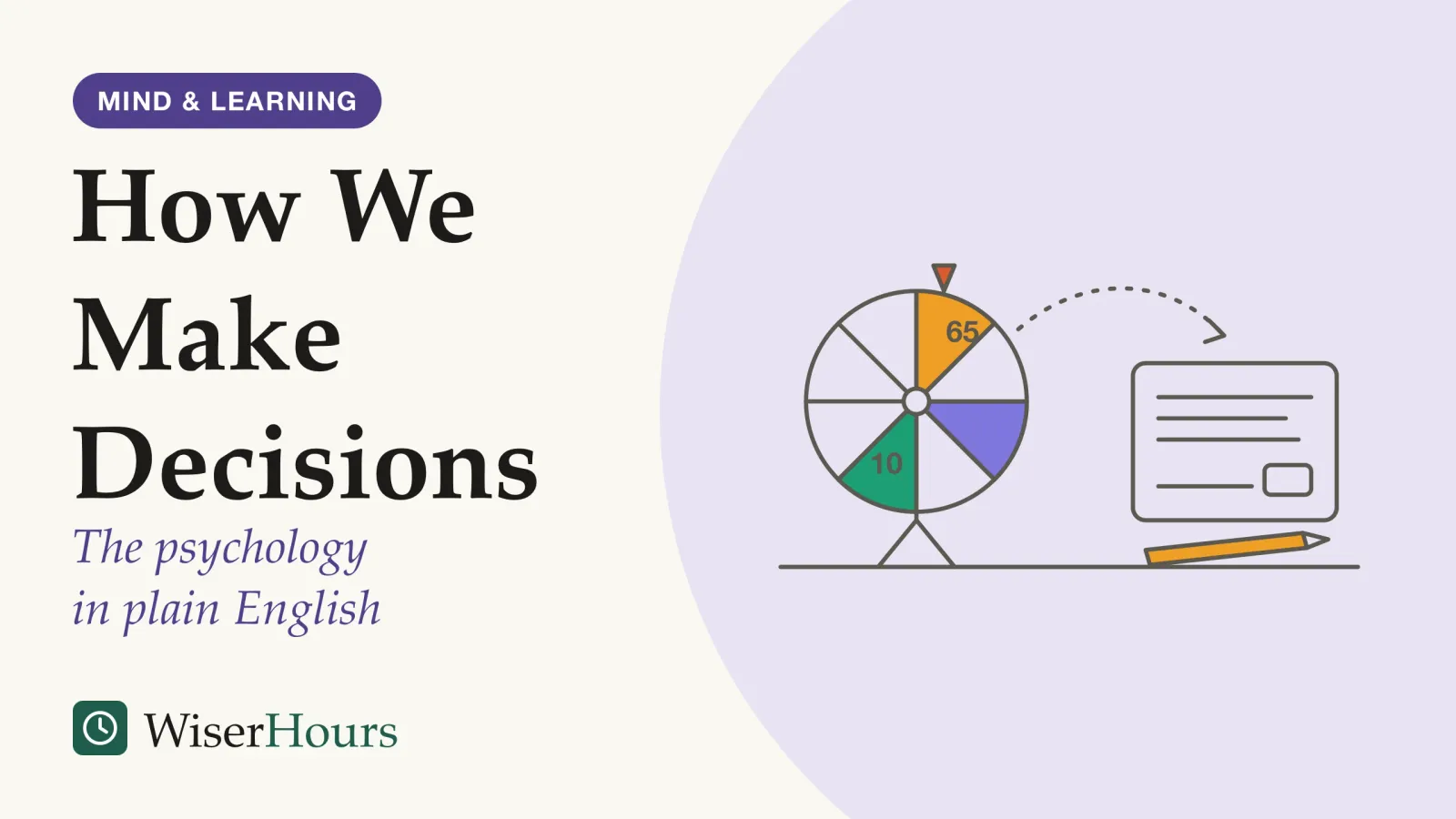
In a demonstration Amos Tversky and Daniel Kahneman described, a wheel of fortune was spun in front of volunteers, who were then asked to estimate quantities such as the percentage of African countries in the United Nations. In their 1974 report, people given 10 as a starting number gave a median estimate of 25 percent; people given 65 gave a median of 45 percent. Paying for accuracy did not reduce the pull of the number.1
In the most influential account, most choices begin with a fast, automatic impression, and slower, deliberate thinking checks it only some of the time: that is how we make decisions, in plain terms. The mental shortcuts behind those impressions usually serve people well, but they bend judgment in predictable ways, as the wheel did. Feelings, the wording of a choice and experience all feed in.
That pull is not a museum piece. Anchoring and framing effects replicated when a 2014 project repeated 13 classic and newer psychology effects in 36 samples; two priming effects did not.2
Fast first answers, occasional checks: how we make decisions
Many psychologists describe decision making as two kinds of thinking working together. In a 2003 article in American Psychologist, Daniel Kahneman described System 1 as fast, automatic, effortless and often emotionally charged, and System 2 as slower, serial, effortful and deliberately controlled.3
The check is often light. In a puzzle Kahneman cites from Shane Frederick, a bat and a ball cost $1.10 together and the bat costs $1 more than the ball. The quick answer, 10 cents, is wrong (the ball costs 5 cents), yet about half of the Princeton students and more than half of the University of Michigan students who were asked gave it. Kahneman reads this as a sign of how lightly System 2 monitors the output of System 1.3
Not everyone accepts the neat split. Jonathan Evans and Keith Stanovich, two leading dual-process researchers, prefer “Type 1” and “Type 2” processes to “systems”, and argue in a 2013 review that what defines Type 2 thinking is its heavy load on working memory. They call it a persistent fallacy that intuition causes all bad thinking and reflection always gets things right.4 Going further, David Melnikoff and John Bargh argued in 2018 that the two-type framework is a convenient myth, siding with critics who say it lacks empirical support and is internally incoherent.5 Gordon Pennycook, Evans, Stanovich and two colleagues replied that the critique targets an outdated list-of-features version of the theory that current dual-process researchers have left behind.6
- Fast route: automatic and effortless; it supplies a first answer almost at once
- Slow route: deliberate and effortful; it draws heavily on working memory
- The check: slow thinking can endorse or override the first answer, but the check is often light
- Two types, or a continuum?: researchers still argue over whether the split is real or a useful simplification
Treat fast and slow thinking, then, as a useful description of how choices feel and fail, not as two separate machines in the head.
Mental shortcuts usually help, and sometimes mislead
Tversky and Kahneman’s 1974 paper in Science named three shortcuts, or heuristics, that people use to judge probabilities: representativeness (how closely something resembles a type), availability (how easily examples come to mind) and anchoring (starting from a number and adjusting away from it). In general, they wrote, these heuristics are quite useful, but sometimes they lead to severe and systematic errors.1
The psychologists Gerd Gigerenzer and Wolfgang Gaissmaier put more weight on the first half of that sentence. In a 2011 review they define a heuristic as a strategy that ignores part of the information in order to decide more quickly, frugally or accurately than more complex methods, and they report that in a number of uncertain situations, simple heuristics were more accurate than standard statistical methods using the same or more information.7 Shortcuts are not flaws to be removed; the question is whether a given shortcut fits the situation.
A 2014 project put several of these shortcuts to a direct test.
The study
Moderate evidence
Thirteen effects rerun in 36 samples: the Many Labs project
Richard Klein, Kate Ratliff, Michelangelo Vianello and dozens of colleagues ran the same short experiments in 36 samples. Ten of the 13 effects replicated consistently, including four anchoring questions, the gain-versus-loss framing problem and the sunk-cost effect. One effect showed weak support, and two priming effects, a flag nudging people toward conservatism and images of money nudging them to defend the social system, did not replicate. Lab versus online and US versus international samples made little difference.2
The anchoring effects came out larger than in the original studies, while framing came out at about half its original size. The main caveats: the team chose 13 effects, not a random sample of psychology, and every task was a quick question with nothing real at stake.2
The same choice, worded differently, gets a different answer
The wording of a choice changes what people pick, even when the outcomes are identical. In Tversky and Kahneman’s 1981 disease problem, 72 percent of respondents chose a program described as saving 200 of 600 people for certain. When the same programs were described to a second group in terms of deaths, 78 percent chose the risky option.8
Framing belongs to prospect theory, the wider account of how people choose under risk, and its patterns have held up well. A 2020 study led by Kai Ruggeri ran the original prospect theory questions with 4,098 people in 19 countries and 13 languages and replicated the results for 94 percent of items, with some weakening.9 One pattern in prospect theory is the extra weight people give to losses: Kahneman notes that most people turn down an even-odds gamble unless the possible win is at least twice the possible loss.3 These are illustrations of how people weigh gains and losses, not guidance on any financial choice.
People also rarely search for the best option. The social scientist Herbert Simon argued in 1956 that people and other organisms adapt well enough to “satisfice” rather than optimize, and that much can be learned about decisions by starting from the limits of what an organism can do.10
Further reading
Sources of Power: How People Make Decisions
Klein's field studies of firefighters and nurses show when experienced intuition earns trust, the conditions this article sets out.
Superforecasting: The Art and Science of Prediction
The forecasting tournament cited here, told by its lead researcher: reference classes, base rates and keeping score of your judgments.

As an Amazon Associate WiserHours earns from qualifying purchases.
Feelings and experience feed the fast route
Emotions drive decisions, sometimes for better and sometimes for worse, a 2015 Annual Review of Psychology article by Jennifer Lerner and three colleagues concludes. It describes two routes: emotions tied to the choice itself, which can be a useful guide, and incidental emotions from something unrelated, which carry over into decisions they should not touch.11
Experience can make the fast route trustworthy, but only under conditions that Kahneman and the decision researcher Gary Klein agreed on in a 2009 article.12
When a hunch has earned some trust
Skilled intuition, in Kahneman and Klein’s account, needs a setting regular enough to be learned, prolonged practice in it, and feedback that is rapid and unequivocal. Feeling sure is not on the list: they agreed that high confidence is not a good sign that an intuition is valid.12
Three famous stories that shrank on a second look
Some of the best-known stories about decisions have weakened under larger, stricter tests or closer reanalysis. The broader record is sobering: in a 2015 attempt to repeat 100 published psychology studies, 36 percent of the replications produced a statistically significant result, against 97 percent of the originals.13
Willpower as a fuel tank is the first casualty. In a preregistered 2021 test in 36 labs with 3,531 people, a demanding self-control task did not clearly weaken self-control on the task that followed; only exploratory analyses found hints, including a larger effect among people who said they felt more tired.14 A sense of being worn out may still matter, then, which is why the same test comes up in practical advice on how to focus.
The hungry judges study is the second. A 2011 analysis of Israeli parole hearings found that favorable rulings fell from about 65 percent to nearly zero within each session and returned to about 65 percent after a food break.15 Keren Weinshall-Margel of Israel’s court research division and John Shapard replied that the order of cases was not random: prisoners without a lawyer usually went last in a session and were less likely to win parole, and the board tried to finish all cases from one prison before a break.16 A 2016 simulation by Andreas Glöckner concluded that the effect is overestimated: because favorable rulings took longer, a judge who simply avoided starting a long case just before a break would produce a similar downward pattern. Glöckner judged that this explains the original findings only in part, so some of the pattern may reflect case timing rather than tired or hungry judges.17 The pattern is in the data; its cause is disputed.
The jam study is the third. In a 2000 field experiment in an upscale grocery store, a larger share of passing shoppers stopped at a display of 24 jams than at a display of 6 (60 versus 40 percent), but 30 percent of those who stopped at the small display bought a jar, against 3 percent at the large one.18
- Myth
- More options always make people less likely to choose anything.
- Fact
- A 2010 meta-analysis of 50 experiments with 5,036 people found an average choice-overload effect of virtually zero; a 2015 meta-analysis found that overload depends on specific conditions.
Benjamin Scheibehenne and colleagues found considerable variation between studies behind that near-zero average.19 In a 2015 meta-analysis, Alexander Chernev and colleagues identified four conditions that make overload more likely: a complex set of options, a difficult decision task, unclear preferences and a goal of choosing with minimal effort. With those conditions taken into account, they found a significant overall effect.20
Habits that make everyday judgments less lopsided
Training aimed at a few common biases has experimental support, but the gains are modest and mostly measured on tests rather than real decisions; the habits below borrow from what that training teaches and have not been tested on their own. A 2025 meta-analysis that drew on 54 randomized trials of debiasing training in education found a small average reduction in bias, with every study at unclear or high risk of bias and open questions about transfer beyond the classroom.21
1. Look for the evidence that would prove you wrong
Before committing, list what you would expect to see if your favored option were wrong, then check for it. In a 2019 field study at HEC Paris, graduate business students who had played a bias-training video game before an unannounced business case chose the flawed, hypothesis-confirming answer less often than untrained classmates, 59 versus 72 percent. Training dates depended on the school’s timetable rather than random assignment, and the game is proprietary, so the authors did not publish it.22
2. Treat the first number you hear as a suggestion
Anchors pull even when they are plainly arbitrary, and in the 1974 demonstration paying for accuracy did not help.1 Before you respond to an opening price, estimate or deadline, write your own figure from scratch. Training has been tried as well. In two 2015 experiments with adults in Pittsburgh, one of them on anchoring and two other biases, bias-test scores fell by roughly a third or more right after a single training game and by roughly a quarter or more two to three months later. Players were compared with their own earlier scores and with people shown a training video, not with an untrained group, so the drop cannot be pinned on the game alone. The work was funded by IARPA, a US intelligence research agency, and two co-authors worked for private firms.23
3. Start from how similar cases usually turn out
Ask how often things like this work out in general before weighing what makes your case special. In a two-year geopolitical forecasting tournament, volunteers randomly assigned to a training module of about 45 minutes, which taught them to use reference classes and avoid base-rate neglect and overconfidence, made more accurate forecasts than untrained volunteers. All had at least a bachelor’s degree; most were US citizens and men, and almost two thirds had some postgraduate training.24
4. Trust a gut feeling only where you have had quick, clear feedback
A hunch about a task you have practiced for years, with honest results arriving soon after, deserves more weight than a hunch about a hiring decision or a market you rarely see resolved. Run any hunch past Kahneman and Klein’s three conditions before acting on it: a regular environment, prolonged practice and rapid, unequivocal feedback.12
A decision worth slowing down for
Anchoring and framing hold up best; ego depletion trails
Anchoring, framing and the core patterns of prospect theory have the strongest replication record of the ideas in this guide, from multisite projects with thousands of people; ego depletion, broad choice overload and two priming effects have the weakest.29
| What it is | What the best evidence found | Evidence |
|---|---|---|
| Fast and slow thinking | Widely used; whether the two types truly separate is disputed | Expert reviews, contested345 |
| Anchoring | Replicated in 36 samples, larger than first reported | Multisite trial, moderate2 |
| Gain versus loss framing | Replicated in 36 samples, about half the original size | Multisite trial, moderate2 |
| Prospect theory patterns | 94% of items replicated in 19 countries, some weakening | Multinational trial, moderate9 |
| Flag and currency priming | Did not replicate | Multisite trial, moderate (for no effect)2 |
| Ego depletion | No clear effect in a preregistered 36-lab test | Multisite trial, moderate14 |
| Hungry judges | Sharp drop within sessions; cause disputed | Observational, mixed1517 |
| Choice overload | Average near zero; appears under specific conditions | Meta-analyses, mixed1920 |
| Debiasing training | Small average reduction on tests; transfer unclear | Meta-analysis, limited21 |
The bottom line
Your decisions start with fast impressions shaped by shortcuts, wording and mood, and slower thinking often checks them only lightly. The biases with the best replication record, such as anchoring and framing, are worth guarding against on choices that matter: write your own number first, look for disconfirming evidence and ask how similar cases usually end. Treat tidier stories, like willpower as fuel or shoppers frozen by jam, with more caution.
Frequently asked questions
Do experts make the same judgment errors as everyone else?
Often, when they rely on intuition alone. Tversky and Kahneman's 1974 paper in Science noted that experienced researchers are prone to the same biases as laypeople when they think intuitively. Kahneman and Gary Klein's 2009 review adds that real expert intuition does develop, but only in settings regular enough to learn, with prolonged practice and feedback that is rapid and unequivocal.
Can a bad mood change a decision about something unrelated?
Yes, according to a 2015 Annual Review of Psychology article by Jennifer Lerner and colleagues. They describe incidental emotions, feelings caused by something else entirely, as carrying over into decisions that should be unrelated to them. They also cite studies in which people in a good mood leaned more on shortcut cues, such as how likeable or attractive a speaker was, than people in a bad mood.
Do these findings hold outside the United States?
The classic ones mostly do. In the 2014 Many Labs project, 11 of the 36 samples came from outside the US, and whether a sample was American or international made little difference to the results. A 2020 study of 4,098 people in 19 countries replicated 94 percent of the original prospect theory items, with some weakening and some differences between countries.
Sources
- Judgment under Uncertainty: Heuristics and Biases. Tversky, A. & Kahneman, D. (1974). Science, 185(4157)
- Investigating variation in replicability: A “Many Labs” replication project. Klein, R. A., Ratliff, K. A., Vianello, M., et al. (2014). Social Psychology, 45(3)
- A perspective on judgment and choice: Mapping bounded rationality. Kahneman, D. (2003). American Psychologist, 58(9)
- Dual-Process Theories of Higher Cognition: Advancing the Debate. Evans, J. St. B. T. & Stanovich, K. E. (2013). Perspectives on Psychological Science, 8(3)
- The Mythical Number Two. Melnikoff, D. E. & Bargh, J. A. (2018). Trends in Cognitive Sciences, 22(4)
- The Mythical Dual-Process Typology. Pennycook, G., De Neys, W., Evans, J. St. B. T., Stanovich, K. E. & Thompson, V. A. (2018). Trends in Cognitive Sciences, 22(8)
- Heuristic Decision Making. Gigerenzer, G. & Gaissmaier, W. (2011). Annual Review of Psychology, 62
- The Framing of Decisions and the Psychology of Choice. Tversky, A. & Kahneman, D. (1981). Science, 211(4481)
- Replicating patterns of prospect theory for decision under risk. Ruggeri, K., Alí, S., Berge, M. L., et al. (2020). Nature Human Behaviour, 4
- Rational choice and the structure of the environment. Simon, H. A. (1956). Psychological Review, 63(2)
- Emotion and Decision Making. Lerner, J. S., Li, Y., Valdesolo, P. & Kassam, K. S. (2015). Annual Review of Psychology, 66
- Conditions for intuitive expertise: A failure to disagree. Kahneman, D. & Klein, G. (2009). American Psychologist, 64(6)
- Estimating the reproducibility of psychological science. Open Science Collaboration (2015). Science, 349(6251)
- A multisite preregistered paradigmatic test of the ego-depletion effect. Vohs, K. D., Schmeichel, B. J., Lohmann, S., et al. (2021). Psychological Science, 32(10)
- Extraneous factors in judicial decisions. Danziger, S., Levav, J. & Avnaim-Pesso, L. (2011). Proceedings of the National Academy of Sciences, 108(17)
- Overlooked factors in the analysis of parole decisions. Weinshall-Margel, K. & Shapard, J. (2011). Proceedings of the National Academy of Sciences, 108(42)
- The irrational hungry judge effect revisited: Simulations reveal that the magnitude of the effect is overestimated. Glöckner, A. (2016). Judgment and Decision Making, 11(6)
- When choice is demotivating: Can one desire too much of a good thing? Iyengar, S. S. & Lepper, M. R. (2000). Journal of Personality and Social Psychology, 79(6)
- Can There Ever Be Too Many Options? A Meta-Analytic Review of Choice Overload. Scheibehenne, B., Greifeneder, R. & Todd, P. M. (2010). Journal of Consumer Research, 37(3)
- Choice overload: A conceptual review and meta-analysis. Chernev, A., Böckenholt, U. & Goodman, J. (2015). Journal of Consumer Psychology, 25(2)
- Systematic review and meta-analysis of educational approaches to reduce cognitive biases among students. Swaryandini, G., Graham, J., Griffith, S., et al. (2025). Nature Human Behaviour, 9(12)
- Debiasing Training Improves Decision Making in the Field. Sellier, A.-L., Scopelliti, I. & Morewedge, C. K. (2019). Psychological Science, 30(9); corrigendum 2020
- Debiasing Decisions: Improved Decision Making With a Single Training Intervention. Morewedge, C. K., Yoon, H., Scopelliti, I., Symborski, C. W., Korris, J. H. & Kassam, K. S. (2015). Policy Insights from the Behavioral and Brain Sciences, 2(1)
- Psychological Strategies for Winning a Geopolitical Forecasting Tournament. Mellers, B., Ungar, L., Baron, J., et al. (2014). Psychological Science, 25(5)
How we researched this
We searched PubMed, Crossref and the web in September 2026 for the founding papers on dual-process thinking and heuristics, the large multisite replications that retested them, and recent meta-analyses, and read full texts where openly available. Sources date from 1956 to 2025. Main limitation: most studies use hypothetical questions or short lab tasks, often with students, so effects on real, high-stakes choices are rarely measured.
Keep reading
The Dunning–Kruger Effect: What It Really Says and What It Doesn't
The 1999 Dunning-Kruger paper never drew 'Mount Stupid'. Statistics explain part of its pattern, but two 2021 studies of about 4,000 people each found a gap.

Groupthink: What It Is, Famous Examples, and How to Prevent It
Groupthink is a group's wish to agree overriding its judgment. Janis's 8 warning signs, the Bay of Pigs and Challenger, and what research says prevents it.
Analysis Paralysis: Why You Can't Decide and How to Get Unstuck
Analysis paralysis ties to hard trade-offs and fear of regret. Why choices stall, how solid the research is, and 5 ways to get unstuck.
How to Use a Decision Matrix: Comparing Options With Weighted Criteria
How to build a decision matrix in 6 steps: pick criteria that don't overlap, score one column at a time, weight the gaps, then test the winner.