Negotiating by Email: What to Write and What to Avoid
Negotiating by email gives you time and a written record but hides your tone. What a review of 98 studies found, plus sample lines for each stage.

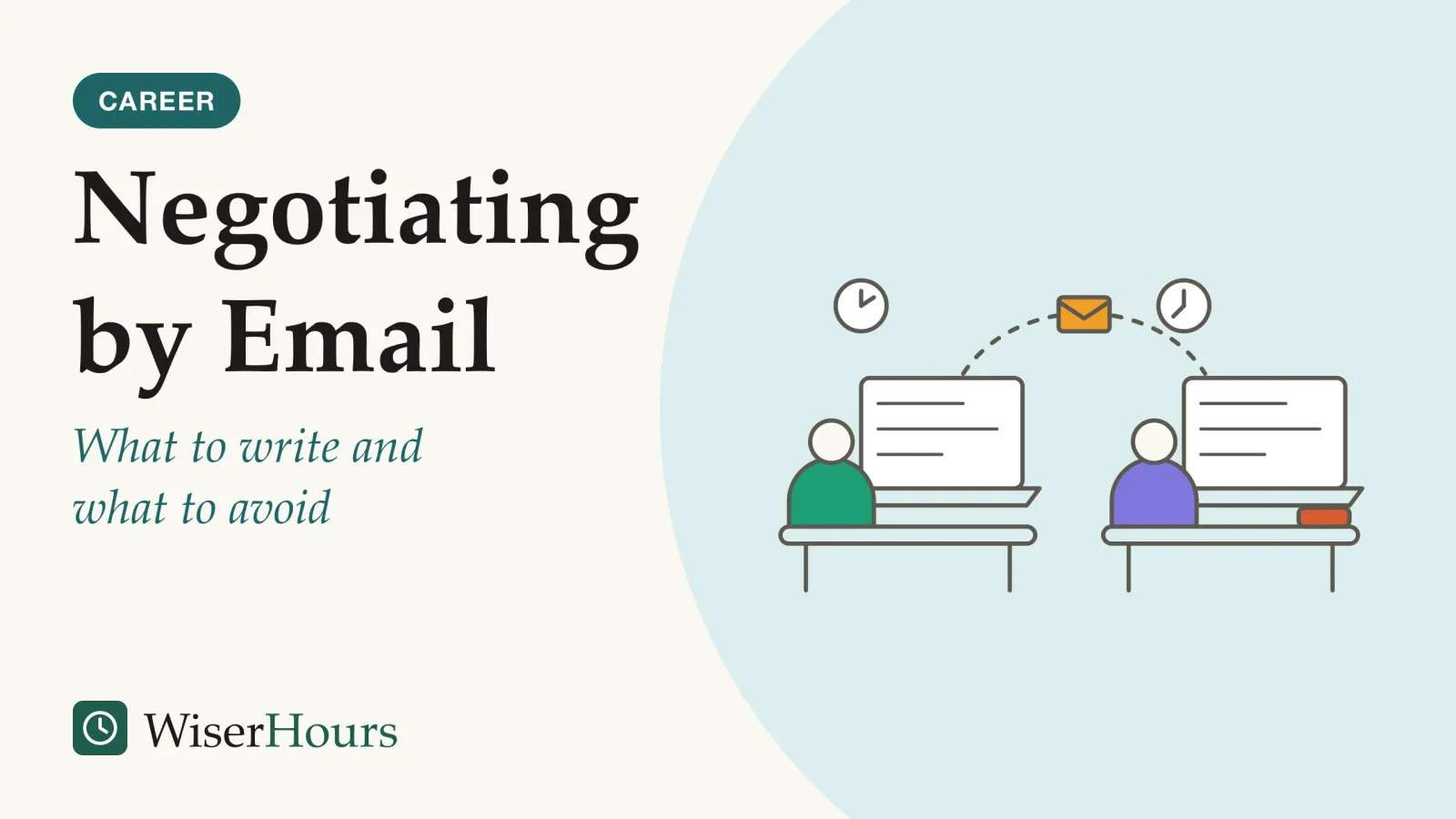
A buyer types “Fine, let’s go with your number” and means relief. The seller reads it as grudging and starts to wonder whether the buyer will be difficult later. That gap is the whole problem with negotiating by email: it gives you time to think, room for exact figures and a record of every offer, but it strips out the tone of voice and small talk that build trust. The skill is writing for a reader who cannot hear you.
The channel itself matters less than many people fear. Ingmar Geiger of Aalen University in Germany pulled together 98 studies in a 2020 systematic reviewsystematic review: A review that fixes its question and its rules for including studies in advance, then searches out every study that fits and weighs them together. Some systematic reviews pool the results into a meta-analysis; others describe what the studies found without combining the numbers.Full entry in the glossary and found that face-to-face talks had a fairly consistent edge in only two areas over other channels: building trust and reading the other side accurately.1 For most other results, including whether a deal was reached at all, the studies disagreed, depending on who was negotiating and over what. Five moves give an email negotiation a better chance:
- Open with the person, then the purpose
- Send your proposal as one clear package
- Counter with a reason and a question
- Make every concession a trade
- Confirm the deal in a summary email
This guide covers the channel. For the basics, such as walk-away points and opening offers, start with how to negotiate in everyday life.
When negotiating by email helps
Email helps most when a deal has several moving parts and figures that must be exact, because writing lets you think before you answer, set out every term at once and keep a record. The Program on Negotiation at Harvard Law School (PON) lists sharing proposals, carefully worded replies, working across time zones and keeping written records of agreements as the jobs email does well, and notes that it spares you the pressure to answer on the spot.2
The reason is timing. Across a table, a surprising number demands a reaction before you have worked out what it means. In an inbox, you can check your budget, ask a colleague and reply tomorrow. Writing also changes the shape of offers: in a 2002 class comparison by Michael Morris and colleagues, US business students who bargained by email bundled several issues into one offer far more often than those who met face to face.3
- Myth
- Negotiating by email always ends in worse deals than meeting in person.
- Fact
- A 2020 systematic review found mixed results for deals and agreement rates; face to face had a fairly consistent edge only for trust and reading the other side.
That matters because deals are often won by trading across issues. A freelancer can write one line that covers the fee, the deadline, the number of revision rounds and when payment is due, and the other side sees at once where there is room to trade. Written figures also cannot be misheard: “fifteen” and “fifty” sound alike on a bad line, but not on a screen.
So let email carry the substance of a deal (the package, the numbers, the dates and the record), and write each figure with its currency and each date in full: “EUR 4,800” and “14 November”, not “4.8k” and “the 14th”.
Tone gets lost between sender and reader
The biggest risk in an email negotiation is that your words arrive in a different voice from the one you heard as you typed them, with none of the nonverbal cuesnonverbal communication: Communication without words, through facial expression, tone of voice, gesture, posture and eye contact. The popular claim that nearly all of a message's meaning is nonverbal is a misreading of two small experiments on judging feelings.Full entry in the glossary that soften a hard point in person. A 2005 set of five experiments led by US psychologists Justin Kruger and Nicholas Epley found that people believe they get their tone, sarcasm or humor across by email better than they actually do.4
The authors put this down to egocentrism. When you reread your own message, you hear it with the intention you had in mind, so a line meant as dry humor sounds funny to you and may sound blunt to the reader. A clearer version says the feeling out loud: “That works for us, and I’m glad we got there.”
Readers struggle as well. PON describes 2019 experiments by researchers in Germany and the US; in one, two trained coders reading the same email negotiations agreed on which emotion a writer was expressing only about a fifth of the time.2
PON’s advice follows: name feelings instead of hinting at them (“I’m feeling concerned about the timeline” rather than “Is this really your best offer?”), check in when a reply seems off, and switch to a call when emotions run high.2
A no is easier to type, and trust is harder to build
Email also makes refusal cheap and trust harder to win. M. Mahdi Roghanizad and Vanessa Bohns, working in Canada and the US, measured the refusal side in the first of two 2017 experiments: students asked strangers to fill in a questionnaire, and about 7 in 10 of those asked in person agreed, against about 2 in 100 of those emailed.5 The students had expected similar success both ways. In the authors’ reading, the gap is about trust: an email from a stranger looks suspicious and draws little sympathy.
Those were favors asked of strangers, not negotiations, so the figures do not transfer to a deal with someone you know, but negotiation studies point the same way. A 2003 study by US researchers Charles Naquin and Gaylen Paulson found that people bargaining online trusted each other less than people meeting face to face, both before and after the talks, and wanted less contact afterwards, even though their deals were no worse (abstract only).6 In three later experiments, Naquin and US colleagues found people more willing to lie by email than on paper, and they felt more justified doing so (abstract only).7
Picture a first email to a landlord, supplier or new client: it starts with less goodwill than a conversation would, and a “no” costs the other side almost nothing to send. Before you ask for anything difficult, make yourself a real person to them: mention how you found them, refer to something specific they said or did, or ask for a short call first.
A short call before the emails builds goodwill
One tested fix for email’s chill is a few minutes of personal conversation before the emails start. A voice and a little shared chat turn a sender into a person, which is what a cold inbox strips away. Morris and his co-authors tried it in the second study of their 2002 paper, pairing business students from two rival US business schools.3
The study
Limited evidence
Five minutes of small talk, then a week of email
In a 2002 US study of 120 business students, 60 pairs negotiated the purchase of a company car by email over about a week. Half the pairs first had a 5-minute phone call about anything except the deal. Pairs who chatted felt more rapport, planned more trusting strategies and afterwards rated each other more warmly and expected a better working relationship. Deadlock was less common among them (about 41% against 61%), but that difference, and a small gain in joint points, were not statistically clear.3
Read it as a result about goodwill: the warmer feelings were statistically clear and the better deals were not, though the authors’ summary calls both better. Geiger’s review agrees, suggesting that a personal relationship, a positive writing style and comfort with email can make up for some of what text lacks.1 One newer study points the other way: in a 2015 US-German email simulation by Jennifer Parlamis and Ingmar Geiger, friendly chitchat did not improve one-off deals, while negotiators who dealt with time zones, language and unclear messages before they caused trouble reached more joint gain.8
Before an important email negotiation with someone new, ask for a short call or video chat and use it to agree how you will work. A line such as “Before we get into numbers, could we talk for a few minutes this week? It would help to put a voice to the name” costs little. PON also suggests agreeing ground rules, such as how long everyone has to respond.9

The sequence looks like this.
- 1Short calla few minutes, not about the deal
- 2Ground rulesreply times, time zones, language
- 3Emailsfull proposals, reasons, questions
- 4Summaryagreed terms, confirmed in writing
How to structure a negotiation email, step by step
A negotiation email works best as a short, complete proposal with one clear next step. General craft, such as subject lines and putting the request first, is covered in how to write a professional email; the steps below add what a negotiation needs. The sample lines are illustrations to adapt, not tested scripts.
- A line for the person: thanks, or a word about the last call, then what this email is for
- The whole proposal as one package: every term together, each figure with its currency, each date in full
- Your reason and a question: why you ask for what you ask, and an open question that invites theirs
- A trade, not a gift: any concession named as one and tied to what you would like in return
- The next step: when you will reply or what you need from them; when talks end, a summary of the agreed terms to confirm
1. Open with the person, then the purpose
One warm, specific sentence before business does some of the work of small talk. Then say what the email is for. “Thanks for sending the quote so quickly. I’d like to make this work, and I have two points on timing and price.”
2. Send your proposal as one clear package
Put every term you care about into one offer, so the other side can trade across them. Negotiators in the Parlamis and Geiger study who made offers covering several issues and pointed out shared and differing interests reached more joint gain.8 A single offer might read: “EUR 4,800 for the full project, delivery on 14 November, two rounds of revisions, half paid on signing.”
3. Counter with a reason and a question
A bare number reads as a demand; a number with a reason reads as a position you can discuss. Add an open question so the reply carries information, not just a figure. “That’s more than we budgeted, because similar work was quoted lower last month. What would need to change on scope or timing for you to come closer to EUR 4,000?” If a message makes you angry, draft the reply and send it the next morning.2
4. Make every concession a trade
In writing, a concession you do not label can be missed or pocketed. Deepak Malhotra, a Harvard Business School professor, suggests making clear what a concession costs you, spelling out what you expect back, and tying concessions to a specific move from the other side when trust is low.10 “We can move delivery to 30 November, which means reshuffling two other projects. In return, could you pay half on signing?”
5. Confirm the deal in a summary email
When you agree, write the terms down in one message and ask for confirmation. The written record is one of email’s strengths.2 PON also suggests a quick call or meeting when finalizing, to make sure everyone is on board.9 “To confirm what we agreed on today’s call: EUR 4,400, delivery on 30 November, two rounds of revisions, half on signing. Please reply to confirm, or tell me if I’ve got anything wrong.” For a contract with legal or large financial stakes, ask a lawyer in your country whether an email summary is enough or a signed document is needed.
Before you press send
Download PDF
Culture and language change what a clear email looks like
What reads as clear and efficient in one culture can read as blunt, or oddly vague, in another. The anthropologist Edward T. Hall described cultures as more high-context, where much meaning sits in relationships and unspoken cues, or more low-context, where people expect the message to be stated directly; the model is popular but has been criticized as lacking empirical support.11
Email removes much of the context that high-context communicators rely on. A one-line reply such as “The price is fixed. Please confirm by Friday” reads as efficient to one reader and as a snub to another, while a reply full of courtesies and “we will consider it” can sound like a yes to one side and a polite no to the other. The channel may also shift behavior differently by culture. In a 2012 paper led by Ashleigh Shelby Rosette, Hong Kong Chinese negotiators emailing US counterparts opened more aggressively and claimed more of the value, and in a second study Hong Kong negotiators did better by email than face to face (abstract only).12 Geiger’s review adds that most research on communication media comes from English-speaking countries and that non-native speakers can be at a disadvantage when talks run in a language that is not their own.1
In practice, mirror the other side’s formality and greeting style, keep sentences short and literal when either of you is writing in a second language, and leave out idioms and sarcasm, which travel badly between languages. When the stakes are high, ask someone who knows the other culture to read your draft.
What the email studies can and cannot tell you
Each row is a pattern from studies, mostly role-plays; expect exceptions.
| What it is | What the best evidence found | Evidence |
|---|---|---|
| Face to face versus other channels | Face to face had a fairly consistent edge only for trust and reading the other side; other results varied | Systematic review, 20201 |
| Tone in email | People thought their tone came through more clearly than it did | Five experiments, abstract only4 |
| A short call before emailing | Better feelings and working relationship; fewer deadlocks, not statistically clear | One US experiment with business students, limited3 |
| Asking by email versus in person | Far fewer people agreed to a favor asked by email | Two experiments with students, requests to strangers5 |
| Trust in online talks | Lower trust before and after, no worse deals | One study, abstract only6 |
The review is the firmest evidence: channels matter less than people assume, except for trust and reading the other side. Much of the research dates from the 2000s and used students in invented deals, so the five steps are good practice built on that research, not proven methods.
The bottom line
Use email for a complete package, exact figures and a written record, and pick up the phone when a thread turns tense or goes quiet. State your intentions plainly, make yourself known before you ask for anything hard, and close every deal with a summary the other side confirms in writing.
Frequently asked questions
How quickly should I reply to a negotiation email?
We found no study that sets an ideal reply time, and the time email gives you to think is one of its advantages, according to the Program on Negotiation at Harvard Law School. A practical middle way is to acknowledge a message the same day, say when you will send a full answer, and keep that promise, so the delay is more likely to read as care than as silence.
Should I use humor or emoji in a negotiation email?
Light humor may help; emoji are untested. Ingmar Geiger's 2020 review of communication-media studies reports one study in which email negotiations opened with a funny cartoon ended with more trust and higher joint gains, and another in which emails carrying a disclaimer footer were judged less trustworthy. The review reports no study of emoji, so follow the other side's lead.
How do I follow up when a negotiation email gets no reply?
Send one short follow-up that restates your last proposal and asks a specific question, then suggest a call. The Program on Negotiation notes that email negotiations appear to end in deadlock more often than talks in person, sometimes because one side simply goes quiet. A voice can find out whether the silence means no, not yet or a busy week.
Sources
- From Letter to Twitter: A Systematic Review of Communication Media in Negotiation. Geiger, I. (2020). Group Decision and Negotiation, 29, 207-250 (open access)
- Pros and Cons of Email Communication. Shonk, K. (2026). Program on Negotiation at Harvard Law School, 8 July 2026 (accessed 2026-09-28)
- Schmooze or lose: Social friction and lubrication in e-mail negotiations. Morris, M., Nadler, J., Kurtzberg, T. & Thompson, L. (2002). Group Dynamics: Theory, Research, and Practice, 6(1), 89-100
- Egocentrism over e-mail: Can we communicate as well as we think? Kruger, J., Epley, N., Parker, J. & Ng, Z.-W. (2005). Journal of Personality and Social Psychology, 89(6), 925-936
- Ask in person: You're less persuasive than you think over email. Roghanizad, M. M. & Bohns, V. K. (2017). Journal of Experimental Social Psychology, 69, 223-226
- Online bargaining and interpersonal trust. Naquin, C. E. & Paulson, G. D. (2003). Journal of Applied Psychology, 88(1), 113-120
- The finer points of lying online: E-mail versus pen and paper. Naquin, C. E., Kurtzberg, T. R. & Belkin, L. Y. (2010). Journal of Applied Psychology, 95(2), 387-394
- Facing an Email Negotiation? Take a Proactive Approach. PON Staff (2026). Program on Negotiation at Harvard Law School, 20 May 2026, on research by Parlamis, J. D. & Geiger, I. (accessed 2026-09-28)
- Adding Value to E-mail Negotiations. PON Staff (2010). Program on Negotiation at Harvard Law School, 8 November 2010 (accessed 2026-09-28)
- Four Strategies for Making Concessions in Negotiation. Malhotra, D. (2026). Program on Negotiation at Harvard Law School, 28 May 2026 (accessed 2026-09-28)
- High-context and low-context cultures. Wikipedia (accessed 2026-09-28)
- When cultures clash electronically: The impact of email and social norms on negotiation behavior and outcomes. Rosette, A. S., Brett, J. M., Barsness, Z. & Lytle, A. L. (2012). Journal of Cross-Cultural Psychology, 43(4), 628-643
How we researched this
The sources behind this guide were found and read in September 2026. It rests on a 2020 systematic review of 98 studies on communication media in negotiation and the full texts of two experiments (2002 and 2017), plus the abstracts of four further studies from 2003 to 2012, practice articles by the Program on Negotiation at Harvard Law School and the Wikipedia entry on high- and low-context cultures. Its chief limitation: much email-negotiation research uses role-plays with students, mostly in English-speaking countries.
Keep reading
Your Walk-Away Point: How to Know When a Deal Isn't Worth Taking
Work out your walk-away point in 4 steps: list your alternatives, pick the best real one, turn it into a number, and write it down before you talk.
How to Respond to a Lowball Offer Without Losing the Deal
A lowball offer is an opening move, not an insult. 5 steps and sample wording to reply without countering off their number or losing the buyer.
The Five Negotiation Styles: Which One Do You Default To?
The 5 negotiation styles, from competing to accommodating: where the Thomas-Kilmann model comes from, a quick self-check, and when each style fits.

How to Prepare for a Negotiation in 30 Minutes
How to prepare for a negotiation in 30 minutes: 6 timed steps, from a target and a limit to a fair price range and your first two sentences.