Negotiation Anxiety: How to Stay Calm When the Stakes Feel High
Lab studies link nerves to lower offers, faster replies and early exits. 5 ways to stop negotiation anxiety setting your price, and the evidence for each.

Negotiation anxiety rarely makes people pushy. Its pull is toward the exit: the racing heart before you ask for a repair, a lower price or more time reads as a signal to get the conversation over with, and the quickest way out is usually to ask for less. Researchers at the Wharton School measured that pull. In four experiments published in 2011, US students made to feel anxious before bargaining expected less, opened with lower offers, answered faster, quit sooner and ended up with less money.1 The research points to five habits that work against that pull:
- Do the homework early, while the nerves still help
- Call the feeling excitement, and expect a small effect
- Rehearse the conversation before it counts
- Script your opening line and your first response to pressure
- Slow the pace once the talking starts
The basics of walk-away points, offers and trades are in the research-backed guide to negotiating. This guide is about the feeling that gets in the way of using them.
Why negotiation anxiety is so common
Negotiation anxiety is common because a negotiation packs uncertainty, possible conflict and a visible chance of losing into a single conversation. When Alison Wood Brooks and Maurice Schweitzer of the Wharton School surveyed adults at a US train station, about 6 in 10 ranked anxiety as the feeling they would expect most before negotiating with a stranger. The authors define anxiety as a response to new situations that could turn out badly, and almost every negotiation could: you might upset the other person, get a poor deal, or both. Anxiety also differs from anger in the urge it creates. Anger pushes people to escalate a conflict; anxiety pushes them to escape it.1
Picture a nurse who has decided to ask for a schedule change after months of night shifts. She knows her case is fair, yet on the morning of the meeting she rehearses apologies rather than arguments. The request has not changed; the conversation has just become close and personal.
So expect the feeling, and do not read it as evidence that you should not ask. Nerves are an ordinary response to an uncertain conversation, and the person across the table may well feel them too.
Anxious negotiators ask for less and leave sooner
Anxious negotiators try to end the talk quickly, and it costs them. Brooks and Schweitzer made some participants anxious with film music or a film clip, left others in a neutral mood, and compared how each group bargained.1
The study
Moderate evidence
Brooks and Schweitzer, 2011: what anxiety did to bargaining
Students made to feel anxious expected to earn less, made lower first offers, replied to offers more quickly and, in a bargaining game where either side could walk out at any moment, left earlier. In a chat negotiation over a phone shipment, they took home less money than students in a neutral mood. Anxiety made no clear difference to what people hoped for, only to what they expected to get.1
At a real table, this is the person who planned to ask for a better price and hears themselves say “whatever you think is fair” a minute in. As the Spotlight’s last line says, anxious students still wanted a good deal but had stopped believing they would get one, and lower expectations partly explained their smaller earnings.1 The anxiety came from film music and clips rather than the negotiation itself, which the authors call a conservative test, and the tasks were short, with small sums at stake. Nobody has measured how big the effect is when a real salary or rent is on the line.
- A lower first offer: anxious negotiators expected less and opened lower
- A quick reply: they answered offers faster
- An early exit: they quit a bargaining game sooner
- A target on paper: written before the talk, when nerves can drive preparation
- A deliberate pause: time to think before answering
- Staying in the room: the talk ends when the deal is worth it, not when the feeling peaks
The fourth experiment points to a way out. Students told, falsely, that they had scored near the top of a negotiation aptitude test did not quit the game earlier when anxious; those told they were average did.1 So self-efficacyself-efficacy: A person's belief in their ability to carry out a particular task or reach a particular goal. It is specific to the task, so someone can feel capable at work and unsure with money, and it goes with how readily people start and keep going.Full entry in the glossary, confidence in your own ability to handle the task, blunted the urge to escape. You cannot give yourself fake test scores, but you can build the real thing.
How to stay calm in a negotiation: five habits that slow the rush
No study read for this guide tested these five habits together, and none was tested for its effect on anxiety during a negotiation. Read them as ways to counter the specific behaviors anxiety produced in the experiments: low expectations, hurried answers and early exits.
1. Do the homework early, while the nerves still help
Anxiety felt a week or a month before a negotiation can be useful, according to Brooks. Writing for Harvard’s Program on Negotiation, she describes how worrying well in advance can push people to prepare, while anxiety felt immediately before or during the talk harms performance.2 The aim is to spend the worry early, on work that lowers it later.
Preparation also builds the confidence the fourth experiment pointed to: knowing a fair price range, your fallback and your first ask makes the conversation partly familiar. Someone asking a contractor to lower a quote feels different with two competing quotes in hand than with a hunch.
When you notice a knot in your stomach about a coming conversation, treat it as a cue to open a notepad and write your target and fallback.
2. Call the feeling excitement, and expect a small effect
Renaming the racing heart as excitement is a quick way to work with nerves instead of against them, though the evidence is mixed. Brooks’s reasoning is that nerves and excitement are both states of high arousal, so changing the label asks less of you than forcing your body to slow down, yet in an online survey in her 2014 paper, “calm down” was by far the advice people would give themselves.3
In that paper’s experiments, students who said “I am excited” out loud, or read a short message saying so, reported feeling more excited and performed better at karaoke, a short speech and a math test than comparison groups; in the speech and math studies, the comparison group had been told to stay calm.3
Two later papers shrink the promise. In 2024, Michel Bosshard and Patrick Gomez, researchers in Switzerland, pooled 35 randomized studies of reappraisal and similar messages and found a small gain in performance, smaller still after correcting for possibly missing studies. Only one of those studies used a negotiation, a small salary-negotiation exercise; the rest used speeches, exams and similar tasks.4 A 2025 US direct replicationreplication: Running a study again with fresh data and the same method, to see whether the original result comes back. A finding that fails to replicate is not automatically wrong, but it stops being something you can lean on.Full entry in the glossary of the speech study found the excitement boost again, but judges scored those speeches no higher than the comparison group’s.5
Culture adds a caveat for readers worldwide. In a 2018 study in the journal Emotion, European Americans applying for a job wanted to convey excitement more, and calm less, than Chinese participants in Hong Kong did.6 If calm is the state you value, a label such as “I’m ready” may sit more comfortably than “I’m excited”, though no study here tested that wording.
Waiting for a supplier to call back about a late delivery, pulse up, is a small test. Saying “I’m excited to sort this out” costs nothing, but the replication suggests it may not change how well you do. Try it once before a small conversation, and drop it if it feels false.
3. Rehearse the conversation before it counts
Practice is the researchers’ own suggestion, though their experiments did not test it. Brooks and Schweitzer proposed that courses, simulations and training could reduce anxiety by making negotiating feel routine rather than new, and by raising negotiators’ belief in their own ability.1
Practice can be small. Ask a friend to play the landlord and push back twice, so the first “no” you hear is not the one that counts. Ask about a discount on a small purchase, where a refusal costs nothing. Each ordinary conversation makes the next one feel less new.
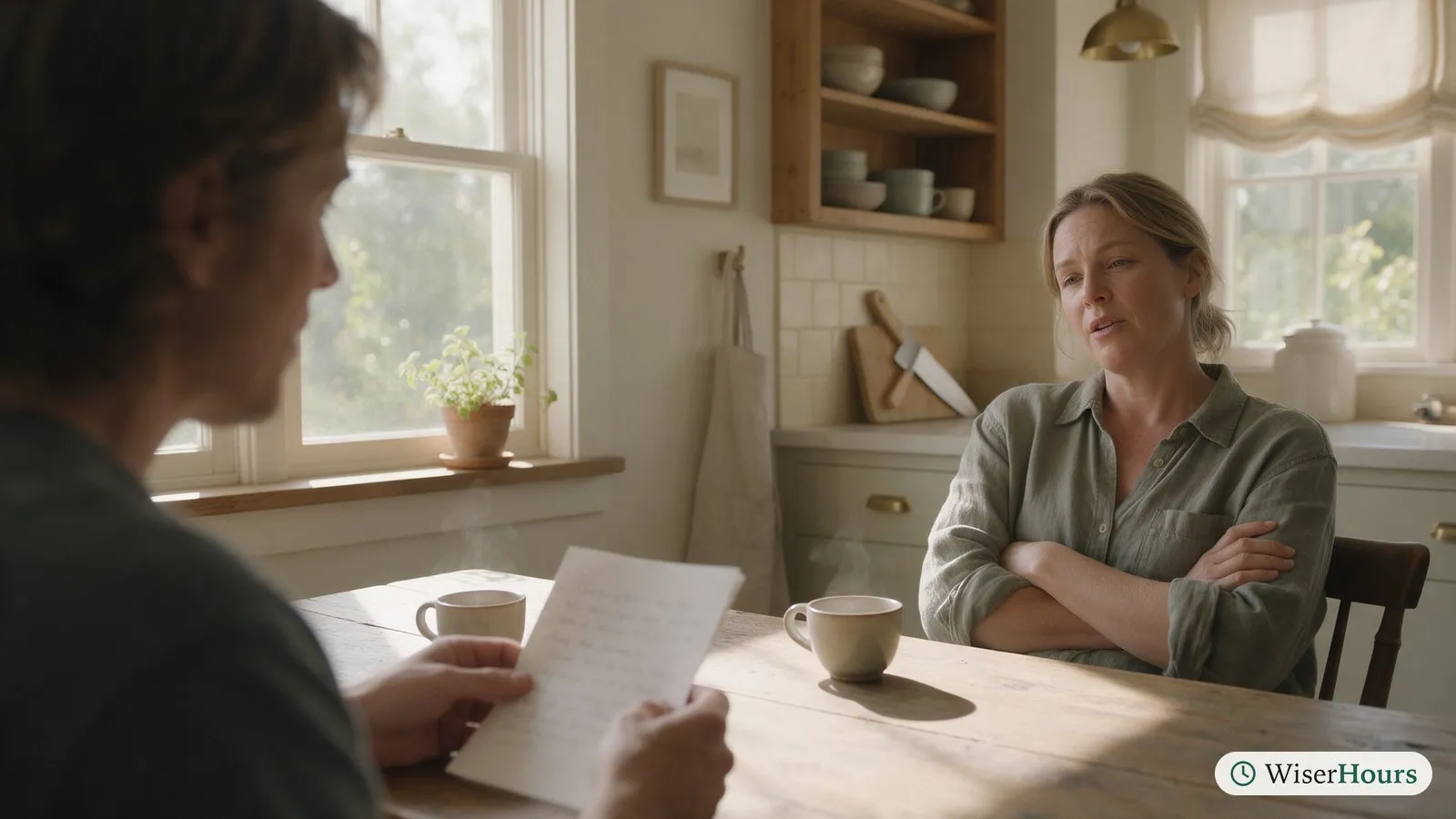
The evidence here is thin: it rests on the researchers’ reasoning and on the fourth experiment, where confidence came from false feedback rather than practice. Treat rehearsal as a reasonable bet that nobody has yet put to a proper test.
4. Script your opening line and your first response to pressure
A blank mind is most likely at two moments: your first sentence and their first push-back. Writing both responses in advance, as an if-then plan, gives you something to say. Researchers call this an implementation intentionimplementation intention: A plan in if-then form that ties a specific action to a specific situation, such as 'if it is nine o'clock, then I open the report.' It hands the decision about when and where to act to the situation itself.Full entry in the glossary: a plan in the form “if this happens, then I will do that”.
Paschal Sheeran and colleagues pooled 642 tests of such plans in a 2025 meta-analysismeta-analysis: A study that combines the results of earlier studies on the same question into one overall estimate. Pooling makes the estimate more precise, but it cannot repair the studies it pools: a meta-analysis of surveys is still survey evidence.Full entry in the glossary, reporting a medium-sized effect on feelings such as anxiety and stress. They also found strong evidence of publication biaspublication bias: The tendency for studies with striking or statistically significant results to be published, while quieter ones stay in the drawer. Since the missing studies are mostly the unimpressive ones, a pooled result tends to overstate the effect until it is corrected.Full entry in the glossary, with small studies reporting good news overrepresented; after a statistical adjustment for it, the average benefit across all outcomes was small.7 In three 2007 negotiation experiments with German students, adding an if-then plan such as “if I receive a proposal, then I will make a fair counterproposal” helped negotiators pursue the fair or cooperative goals they had been given, even when the task’s framing made cooperation harder.8 That study measured goal pursuit, not anxiety.
Then build a short script around it, like the one below.
A script for a rent talk
Opening: “I’d like to stay, and I’d like to talk about the renewal terms.” If-then plan: “If the landlord says the increase is non-negotiable, then I will say I understand and ask what would make a longer lease worth it to them.” Rehearse both aloud once before you pick up the phone.
5. Slow the pace once the talking starts
In the 2011 chat experiment, anxious negotiators answered offers faster than those in a neutral mood, and a quick answer leaves no room to check the offer against your plan.1 Slowing down is the direct counter. Harvard’s Program on Negotiation recommends silence as a tool: it describes a lawyer who taught a junior banker to count to three silently before responding, and argues that a pause buys time to ask whether you are reacting emotionally and how the offer compares with your fallback.9
In practice, slowing down can mean repeating the offer back before replying, asking a question instead of answering at once, or saying “I’d like to think about that overnight.” No trial has checked any of the three; the pause itself comes from expert advice. For short techniques to settle your body in the moment, see ways to calm down quickly.
Six things to settle while the nerves are still early
Download PDF
The problem is well tested; the fixes less so
The harm anxiety does at the bargaining table rests on randomized experiments; most fixes come from nearby research or expert advice. Each row gives the strongest evidence found for this guide.
| What it is | What the best evidence found | Evidence |
|---|---|---|
| Feeling anxious before bargaining | Lower first offers, faster replies, earlier exits, less money | Lab experiments with US students, moderate1 |
| Believing you negotiate well | Anxious students quit no earlier when told they were strong negotiators | One lab experiment, limited1 |
| Calling nerves excitement | More excitement reported; better performance in 2014, not in a 2025 replication | Randomized experiments, mixed5 |
| Reappraisal messages in general | Small performance gain, smaller after correcting for missing studies | Meta-analysis of 35 randomized studies, moderate4 |
| If-then plans | Medium effect on anxiety and stress; small average effect overall after correction | Meta-analysis of 642 tests, moderate7 |
| Practice and pausing | Recommended by negotiation researchers and teachers; not tested for anxiety | Expert opinion29 |
The reappraisal and planning evidence comes mostly from speeches, math tests and other tasks, so its value at the bargaining table is an inference. Spend most of your effort on the habits aimed squarely at the measured behaviors: a written target against low expectations, and a pause against hurried answers.
When nerves are more than nerves
The World Health Organization’s 2026 fact sheet notes that anyone can feel anxious at times, and it separates that from anxiety disorders, in which fear and worry are intense, excessive and hard to control, usually persist for months, and disrupt daily life, often leading people to avoid what they fear.10 We grouped the tiers below ourselves; any service named is an example, and readers outside that country should look up their local equivalent.
- Now: if you have thoughts of suicide or self-harm, or fear you may act on them, contact your local emergency number first, or reach a crisis line in your country; US readers can phone or text 988.11 Call your local emergency number too if nerves come with chest pain or shortness of breath: MedlinePlus, from the US National Library of Medicine, lists both, and anxiety itself, among heart attack symptoms.12
- Soon: if worry about negotiations or other conversations is making you avoid work you need, disturbing your sleep or bringing on sudden surges of fear, see a doctor or mental health professional. WHO says people with symptoms of anxiety should seek care, and that effective treatments exist; psychological therapies based on cognitive-behavioral principles have the most evidence.10 If you have had sudden episodes of intense fear, our explainer on panic attacks versus anxiety attacks sets out what to watch for.
- Routine: if nerves before hard conversations are manageable but wearing, bring them up the next time you see your doctor anyway.
The bottom line
Negotiation anxiety does its damage by hurrying you: it lowers what you expect, speeds up your replies and makes leaving feel like relief. Spend the worry early on preparation, rehearse the hard sentences until they feel familiar, and build a pause into every answer. Calling the feeling excitement is worth a try, but the tools with more to them are a written target and time to think.
This article is general information, not medical advice. If you're worried about your health, talk to a doctor or another qualified professional.
Frequently asked questions
Is it easier to negotiate in writing if talking face to face makes me anxious?
Writing gives you time to think, but it does not switch anxiety off. In the first of Brooks and Schweitzer's 2011 experiments, students negotiated by instant message, and those made to feel anxious still opened lower, answered faster and earned less. If you choose text, keep the same habits: a target written in advance and a pause before you reply.
Should I tell the other side that I feel nervous?
No study read for this guide tested announcing your nerves. Brooks and Schweitzer suggested that noticing your own anxiety might help you correct for it, and in their 2011 chat experiment people facing an anxious counterpart earned more. Naming the feeling to yourself costs nothing; telling the other side is a choice to weigh against what they might do with it.
Why do small negotiations make me nervous too?
Anxiety does not need high stakes. Alison Wood Brooks of Harvard Business School, writing for Harvard's Program on Negotiation in 2026, notes that ordinary activities such as talking to others can make healthy adults nervous. A negotiation adds uncertainty and a chance of friction, so nerves over a small request are common and, on their own, not a sign that anything is wrong with you.
Sources
- Can Nervous Nelly negotiate? How anxiety causes negotiators to make low first offers, exit early, and earn less profit. Brooks, A. W. & Schweitzer, M. E. (2011). Organizational Behavior and Human Decision Processes, 115(1), 43-54
- Dear Negotiation Coach: Making a Deal When You Have Anxiety. PON Staff, answer by Alison Wood Brooks (2026). Program on Negotiation at Harvard Law School, 7 September 2026 (accessed 2026-09-28)
- Get excited: Reappraising pre-performance anxiety as excitement. Brooks, A. W. (2014). Journal of Experimental Psychology: General, 143(3), 1144-1158
- Effectiveness of stress arousal reappraisal and stress-is-enhancing mindset interventions on task performance outcomes: a meta-analysis of randomized controlled trials. Bosshard, M. & Gomez, P. (2024). Scientific Reports, 14, 7923
- Getting Excited About Public Speaking: A Replication. Poynter, M. & Smith Pasqualini, M. (2025). Psychology of Language and Communication, 29(1), 254-265
- Should job applicants be excited or calm? The role of culture and ideal affect in employment settings. Bencharit, L. Z., Ho, Y. W., Fung, H. H., Yeung, D. Y., Stephens, N. M., Romero-Canyas, R. & Tsai, J. L. (2019). Emotion, 19(3), 377-401 (online 2018)
- The when and how of planning: Meta-analysis of the scope and components of implementation intentions in 642 tests. Sheeran, P., Listrom, O. & Gollwitzer, P. M. (2025). European Review of Social Psychology, 36(1), 162-194
- Implementation intentions and the willful pursuit of prosocial goals in negotiations. Trötschel, R. & Gollwitzer, P. M. (2007). Journal of Experimental Social Psychology, 43(4), 579-598
- Silence in Negotiation: Why Saying Nothing Can Be Powerful. PON Staff (2026). Program on Negotiation at Harvard Law School, 21 September 2026 (accessed 2026-09-28)
- Anxiety disorders (fact sheet). World Health Organization, fact sheet dated 15 September 2026 (accessed 2026-09-28)
- 988 Suicide & Crisis Lifeline. 988 Suicide & Crisis Lifeline (US) (accessed 2026-09-28)
- Heart attack. MedlinePlus Medical Encyclopedia, US National Library of Medicine (review date 14 July 2024; accessed 2026-09-28)
How we researched this
Research took place in September 2026. It covered the full text of the 2011 experiments on anxiety in negotiation and the 2014 reappraisal study, a 2024 meta-analysis and a 2025 replication on reappraisal, a 2025 meta-analysis and a 2007 negotiation study on if-then plans, a 2018 study on culture and emotion (abstract only), Harvard Program on Negotiation articles, and WHO guidance on anxiety disorders. Main limitation: most evidence comes from short lab tasks with US or European students.
Keep reading
Your Walk-Away Point: How to Know When a Deal Isn't Worth Taking
Work out your walk-away point in 4 steps: list your alternatives, pick the best real one, turn it into a number, and write it down before you talk.
How to Respond to a Lowball Offer Without Losing the Deal
A lowball offer is an opening move, not an insult. 5 steps and sample wording to reply without countering off their number or losing the buyer.
The Five Negotiation Styles: Which One Do You Default To?
The 5 negotiation styles, from competing to accommodating: where the Thomas-Kilmann model comes from, a quick self-check, and when each style fits.
How to Prepare for a Negotiation in 30 Minutes
How to prepare for a negotiation in 30 minutes: 6 timed steps, from a target and a limit to a fair price range and your first two sentences.