How to Calm Down Quickly: Short Techniques and the Evidence Behind Them
How to calm down quickly: 5 short techniques graded by evidence, from slow breathing (12 trials pooled) to grounding, and who each may not suit.
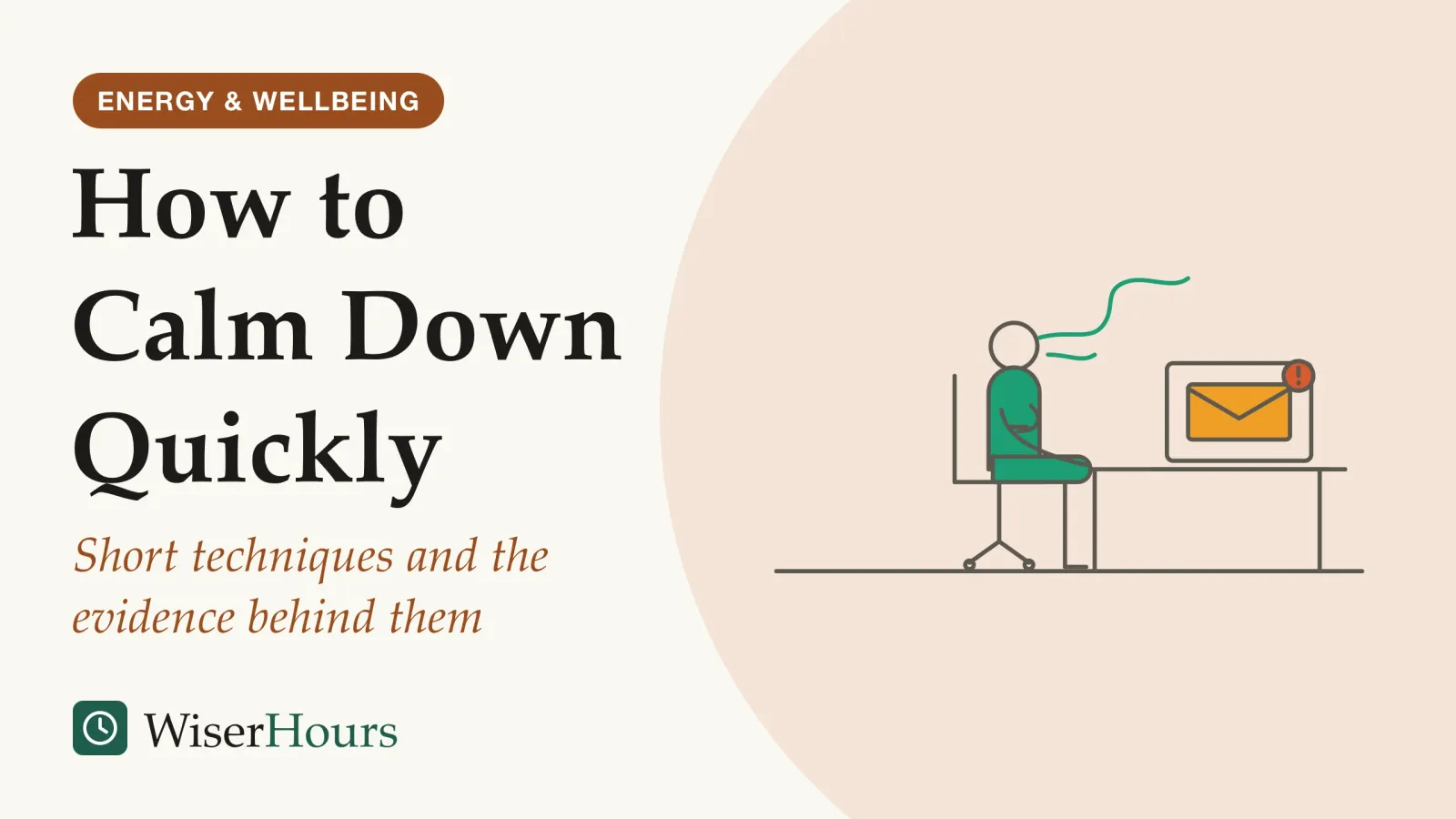
A sharp email from a client lands ten minutes before you are due on a call with them. Your pulse picks up, your shoulders rise, and the reply forming in your head is harsher than anything you would want on the record.
How to calm down quickly starts with the breath: slowing it is the short technique with the most trial evidence, and it needs no app, no quiet room and no special pattern. Pooling 12 randomized trials in 2023, a University of Sussex team led by Guy Fincham linked breathing exercises to lower self-rated stress than comparison groups, with a small-to-medium effect, and in an analysis split by pace the link held for slow techniques but not for fast ones.1
If slow breathing does not fit the moment, the other techniques below each fit into a few minutes. From best tested to least tested:
- Breathe more slowly than usual, gently and without holds
- Add a long out-breath with a cyclic sigh
- Call the racing heart excitement
- Tense and release one muscle group
- Name what you can see and hear
How to calm down quickly: what a few minutes can and cannot change
A few minutes of a calming technique can slow your breathing and heart rate and ease how tense you feel, but it will not switch off the whole stress responsestress response: The body's reaction to a demand or threat: a fast alarm through the nervous system that raises heart rate and alertness, followed by a slower wave of hormones that includes cortisol. It is useful in short bursts; the concern is when it stays switched on.Full entry in the glossary on the spot. Stress has two speeds, a fast nervous-system alarm and a hormone response that builds more slowly, as the guide to how the stress response works sets out, and trials of short techniques mostly measured breathing, heart rhythm and mood.
Breathing is the one part of that alarm you can steer on purpose. Sophie Laborde’s team in Germany pooled over 200 studies in 2022 and found that vagally mediated heart rate variability, a sign that the body’s calming branch is active, went up while people breathed slowly and stayed raised just after a session.2 That body of studies is why the breath comes first here.
Your feelings and your body will not always agree, though. A 2025 meta-analysis of lab stress tests, which asked healthy adults to give a speech in front of judges, found that how stressed people said they felt matched their heart rate and hormone readings only weakly.3 So you may feel steadier while your hands still shake, or see a calm pulse on your watch while your mind keeps racing.
Go back to the sharp client email. The goal of a quick technique is not to feel serene before the call starts. It is to think clearly enough to jot down your two main points and leave the angry sentence unsent. Judge any technique by that test rather than by a number on a wearable.
- Myth
- A breathing trick hacks your vagus nerve and resets your nervous system.
- Fact
- Slow breathing does shift heart rhythm measures tied to the vagus nerve, but the polyvagal theory behind most 'vagus nerve hacks' is disputed by autonomic researchers.
The “reset” language usually comes from polyvagal theory. In a 2023 review in Biological Psychology, the psychophysiologist Paul Grossman argued that the theory’s basic premises about how the vagus nerve evolved and works are not supported by the evidence.4 Slow breathing has trials of its own, so use it without the theory and treat any promised reset as marketing.
Five short techniques, from best tested to least
The five techniques below are low-risk habits tested mainly in healthy adults, not treatments for an anxiety disorder, and their evidence ranges from a meta-analysis of trials to none at all. Start with the first, and read the section on who they may not suit before you try any of them.
- 1Slow the breaththe best-tested start
- 2Add a cyclic sighif a long out-breath feels good
- 3Call it excitementwhen there is no time to settle
- 4Tense and releaseone muscle group at a time
- 5Ground in the roomif breath focus feels worse
Most people will not need all five: move down the list only when the one above does not fit the moment.
1. Breathe more slowly than usual
Slow breathing means taking fewer, gentler breaths than you normally would, without forcing them deep. The UK’s NHS gives an easy version: a gentle breath in, counting to 5 if that helps, then a gentle breath out to the same count, kept up for at least five minutes.5 No holds, no special ratio.
This is the technique the Fincham meta-analysis supports best, and its authors caution against hype: most of the pooled trials had a risk of biasrisk of bias: A rating of how much room a study's design, conduct and reporting leave for its result to be systematically wrong. It judges the method, not the motives of the researchers, and a high rating means the result may be off, not that it is.Full entry in the glossary problem of some kind, and Fincham himself is a trained breathwork teacher.1 The fair reading is that slow breathing tends to help a little to a moderate amount, on average, for self-rated stress.
You can do it with open eyes, sitting at a desk or standing on a bus. If counting to 5 feels like a strain, count to 3 or 4; the pace matters more than the number. Learn the count on a calm afternoon, so it is already familiar when your pulse jumps.
2. Add a long out-breath with a cyclic sigh
A cyclic sigh is two breaths in through the nose, the second a short top-up, followed by a long, slow breath out through the mouth. It is the one pattern that beat mindfulness on mood in a Stanford trial, led by Melis Yilmaz Balban, that ran for a month.
The study
Limited evidence
108 adults, 28 days: a long out-breath lifted mood more than mindfulness did
People were randomly assigned to cyclic sighing, box breathing, fast cyclic breathing or mindfulness meditation, and practiced for five minutes a day for a month. Every group felt better after its daily session, but the cyclic sighing group had a larger rise in positive mood than the mindfulness group. No group showed a shift in heart rate variability during sleep.6
The trial tested a daily habit, not a rescue in the middle of a stressful moment, so its support for the sigh as a quick fix is indirect. Each group was small. WHOOP donated the wrist straps used in the trial, and Andrew Huberman, the trial’s lead contact, took an advisory role with the company once data collection had ended.6 The equal-count pattern tested alongside it, box breathing, did no better than mindfulness on mood.
- Breathe in through the nosea comfortable, full breath
- A short top-up breath ina second, smaller sip of air
- A long, slow breath outthrough the mouth, longer than the two breaths in
The 4-7-8 pattern, with its long hold, has less behind it. A 2022 lab study of 43 healthy young adults in Thailand found lower heart rate and blood pressure after 4-7-8 breathing, including when participants were short of sleep, but it did not test stress or compare the pattern with plain slow breathing.7 If the sigh feels fussy, plain slow breathing is a sound choice.
3. Call the racing heart excitement
When there is no time to settle, telling yourself “I am excited” may serve you better than trying to force calm. Alison Wood Brooks of Harvard reported in 2014 that US participants who told themselves they were excited before karaoke, a speech or a tricky math test went on to feel more excited, and to score better, than participants who tried to calm themselves.8
The logic, as the paper frames it, is that anxiety and excitement are both high-energy states, so naming the feeling as excitement is a shorter step than dropping to calm.8 In the minute before you present to senior colleagues, nothing will slow a pounding heart. Saying “I’m excited” out loud or in your head fits the state you are already in. These were brief lab experiments in one paper, so test the idea on yourself rather than counting on it.
4. Tense and release one muscle group
A short round of muscle relaxation means tensing one area, such as the shoulders or hands, for a few seconds and then letting go while you breathe out. The full routine, area by area, is set out in progressive muscle relaxation for beginners.
The evidence comes from courses of practice, not from one quick round. A 2008 meta-analysis of relaxation training, led by Gian Mauro Manzoni in Italy, found that it eased anxiety across studies of adults, most of whom practiced over several weeks.9 A single squeeze-and-release at your desk borrows that skill, so learn the longer version first. Skip any area that hurts or is injured.
5. Name what you can see and hear
Grounding techniques, such as the 5-4-3-2-1 method of naming things you can see, touch, hear, smell and taste, move attention away from the body and out into the room. They are widely taught, but the research gathered for this article found no randomized trial of them in a stressful moment, so their evidence label is simply “untested”.
Untested is not useless, and grounding has one practical advantage: it asks nothing of your breath. If focusing on breathing makes you feel more anxious, as it can for some people, naming five blue objects in the room is a reasonable thing to try instead.
My quick calming kit
How well each quick calming technique is tested
Of the short techniques here, only slow breathing has pooled evidence from randomized trials behind it; the others rest on single trials, on courses of practice rather than quick use, or on no trials at all.
| Technique | What the best evidence found | Evidence |
|---|---|---|
| Slow breathing | Less self-rated stress than in comparison groups, small to medium effect | Meta-analysis of trials, moderate1 |
| Cyclic sighing | Larger daily rise in positive mood than mindfulness over a month | One small trial, limited6 |
| 4-7-8 breathing | Lower heart rate and blood pressure in one lab session | One small lab study, limited7 |
| Calling nerves excitement | Reported more excitement and better scores on lab tasks | Lab experiments in one paper, limited8 |
| Muscle relaxation | Less anxiety after courses of practice | Meta-analysis, moderate for courses, untested as one quick round9 |
| 5-4-3-2-1 grounding | No trial found in a stressful moment | Untested |
Read the ranking as a guide to where to start, not as a verdict on what will work for you. An “untested” label means nobody has measured a technique, not that it fails. With two minutes and a quiet corner before a meeting, slow breathing is the obvious first pick; already at the table with a tight chest, a muscle squeeze under the desk may be easier to use.
When a calming technique can backfire
Breathing techniques carry little risk for most people, but they may not suit pregnant people or anyone with glaucoma, seizures, a heart condition or a serious mental health condition, and breath focus can make some anxious people feel worse. Among those the Stanford team excluded were people who were pregnant or had heart disease, glaucoma, past seizures, psychosis or suicidal thoughts, so its results do not show how these groups respond.6
Panic deserves its own mention. The Stanford paper points out that breathlessness registers as a threat, one that people with panic disorder or high anxiety find harder to tolerate.6 If you have had a panic attackpanic attack: A sudden surge of intense fear or discomfort that peaks within minutes and brings physical symptoms such as a pounding heart, sweating or shortness of breath. Chest pain can also be a heart attack, so new or severe symptoms need urgent medical help.Full entry in the glossary, a long hold or a deliberate focus on the chest can set off alarm instead of calm; the difference between panic attacks and anxiety attacks is covered separately. Fincham’s group, too, advises clinicians to weigh for each person whether breathwork might make a mental or physical health problem worse.1
Overbreathing, taking breaths that are too quick or too deep, is the other trap: MedlinePlus names lightheadedness, dizziness and shortness of breath among its effects.10 If that happens, stop, breathe normally, and switch to grounding or a short walk. MedlinePlus also advises seeing a health professional if fast breathing is new to you, or if it continues or gets worse.10
Before you try breath holds
Pregnancy, glaucoma, panic disorder, or a heart, lung or seizure condition: with any of these, ask a clinician which technique suits you before trying breath holds. A calming technique belongs alongside treatment, not in its place.
A technique that settles one person can unsettle another, so a week of trying one tells you more about your own response than any ranking can.
Chest pain, a crisis, or stress that keeps returning: where to turn
No breathing technique is the right response to chest pain that might signal a heart attack or to thoughts of suicide: both are emergencies, and stress that keeps overwhelming you calls for a doctor. The tiers below group advice from MedlinePlus, the NHS and the 988 Lifeline by urgency; the services named are examples, so check your own country’s emergency and crisis services.
- Now: call your local emergency number for chest pain that might signal a heart attack, such as crushing or squeezing pain, pain spreading to the arm, jaw or back, or chest pain with sweating, nausea or shortness of breath. In the US, MedlinePlus says to call 911;11 in the UK, the NHS says to call 999.12 For thoughts of suicide or self-harm, call your local emergency number or a crisis line: in the US, call or text 988, or chat online, for the free, round-the-clock 988 Lifeline.13 In the UK, the NHS says to call 999 or go to A&E if a life is at risk; it also lists Samaritans (116 123) for anyone wanting to talk.14
- Soon: in the UK, the NHS recommends a GP appointment if you are finding stress hard to deal with or self-help is making no difference.15 The NHS also advises seeing a GP for symptoms of panic disorder, such as regular, unexpected panic attacks.16 Elsewhere, ask your family doctor or local health service.
- At your next appointment: mention it if breathing exercises leave you dizzy or panicky, or if you find yourself needing quick calming techniques many times a day.
The bottom line
Start with slow breathing, because it has the best evidence of any short technique: gentle, unforced breaths at a count you can keep, for at least five minutes when you have them. Add a cyclic sigh if the long out-breath suits you, call your nerves excitement when there is no time to settle, and keep grounding in reserve for moments when breath focus makes things worse. Practice on calm days, and treat chest pain or thoughts of suicide as emergencies.
This article is general information, not medical advice. If you're worried about your health, talk to a doctor or another qualified professional.
Frequently asked questions
Does 4-7-8 breathing help you fall asleep fast?
No trial found for this article shows that it does. The claim that 4-7-8 breathing brings sleep within a minute is popular online, but the small 2022 lab study from Thailand measured heart rate and blood pressure in young adults, not how quickly they fell asleep. A slow, comfortable breathing pattern at bedtime carries little risk for most people; long holds are optional.
Why do I still feel shaky after I have calmed down?
Because body and feelings do not settle in step. A 2025 meta-analysis pooling lab stress tests found that how stressed people said they felt matched their body measures only weakly, and stress hormones rise and fall more slowly than breathing. A lingering tremor after you feel calmer does not, on its own, mean the technique failed.
How often should I practice a calming technique?
The trials tested regular practice, not one-off rescues: in the 2023 Stanford trial, people practiced for five minutes every day for a month. Practicing when you are already calm, for example after lunch, makes the steps familiar, so they are easier to reach for when you are stressed. That last point is a sensible suggestion rather than a tested finding.
Sources
- Effect of breathwork on stress and mental health: A meta-analysis of randomised-controlled trials. Fincham, G. W., Strauss, C., Montero-Marin, J. & Cavanagh, K. (2023). Scientific Reports, 13
- Effects of voluntary slow breathing on heart rate and heart rate variability: A systematic review and a meta-analysis. Laborde, S., Allen, M. S., Borges, U. et al. (2022). Neuroscience & Biobehavioral Reviews, 138
- Physiological and psychological responses to acute stress: A meta-analysis of the 171 studies of Trier Social Stress Test including 8452 healthy adults. Gu, H., Lei, Y., Yao, Y., Chen, C. & Liu, C. (2025). Psychoneuroendocrinology, 180
- Fundamental challenges and likely refutations of the five basic premises of the polyvagal theory. Grossman, P. (2023). Biological Psychology, 180, 108589
- Breathing exercises for stress. NHS (UK), page last reviewed 12 June 2026
- Brief structured respiration practices enhance mood and reduce physiological arousal. Balban, M. Y., Neri, E., Kogon, M. M. et al. (2023). Cell Reports Medicine, 4(1)
- Effects of sleep deprivation and 4-7-8 breathing control on heart rate variability, blood pressure, blood glucose, and endothelial function in healthy young adults. Vierra, J., Boonla, O. & Prasertsri, P. (2022). Physiological Reports, 10(13)
- Get excited: Reappraising pre-performance anxiety as excitement. Brooks, A. W. (2014). Journal of Experimental Psychology: General, 143(3)
- Relaxation training for anxiety: a ten-years systematic review with meta-analysis. Manzoni, G. M., Pagnini, F., Castelnuovo, G. & Molinari, E. (2008). BMC Psychiatry, 8, 41
- Hyperventilation. MedlinePlus Medical Encyclopedia, US National Library of Medicine (review date 23 July 2024)
- Chest pain. MedlinePlus Medical Encyclopedia, US National Library of Medicine (review date 28 April 2026)
- Chest pain. NHS (UK), page last reviewed 8 August 2023
- 988 Suicide & Crisis Lifeline. 988 Suicide & Crisis Lifeline (US)
- Where to get urgent help for mental health. NHS (UK), page last reviewed 26 April 2023
- Stress. NHS (UK), page last reviewed 6 March 2026
- Panic disorder. NHS (UK), page last reviewed 22 August 2023
How we researched this
Sources came from a research dossier commissioned for this title and from sources used in related WiserHours articles on breathing, stress and panic. Systematic reviews and randomized trials published from 2008 to 2026 were preferred, with NHS, MedlinePlus and 988 Lifeline pages for safety advice. Main limitation: most trials tested daily practice in healthy young adults, not a single use in a stressful moment.
Keep reading
Panic Attack vs. Anxiety Attack: What's the Difference?
A panic attack peaks within minutes and brings at least 4 of 13 listed symptoms; an anxiety attack has no separate clinical definition. How to tell them apart.
Heart Rate Variability Explained: What HRV Can and Can't Tell You
Heart rate variability explained: what HRV measures, why breathing, age and time of day move it, what wearables miss, and what 58 biofeedback studies found.
How to Reduce Stress: 15 Everyday Habits With Evidence Behind Them
How to reduce stress: 15 everyday habits, from movement and sleep to email and news limits, sorted by how well research supports each one.
What Is Stress? How the Stress Response Works in Plain English
What is stress? How the fast and slow stress response works, which lab tasks 208 studies linked to the biggest cortisol rise, and when to see a doctor.