Assets vs. Liabilities: A Plain-English Guide to Your Personal Balance Sheet
Assets vs liabilities explained: where 7 tricky items go, from a mortgaged home to pay-later plans and tax bills, and a one-page balance sheet to fill in.

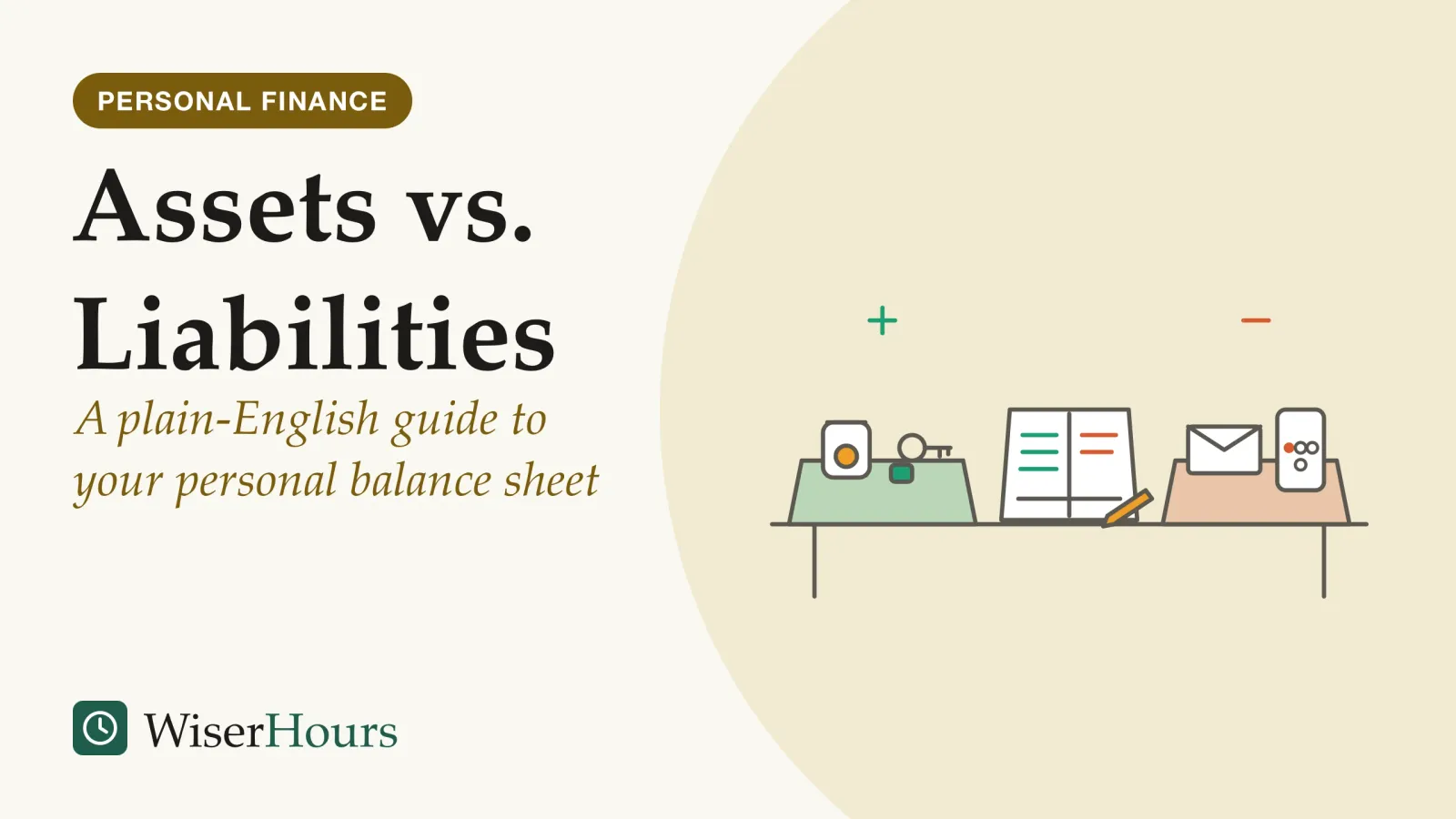
Assets vs liabilities comes down to one question about each thing in your finances: is it something of value that you own or are owed, or is it money you have to pay someone? Assets go in one column at what they are worth today, liabilities in the other at the balance still owed, and the gap between the totals is your net worthnet worth: Everything you own on a given day minus everything you owe that day. It is a snapshot of wealth rather than income, and much of it can be tied up in things that are hard to turn into cash, such as a home.Full entry in the glossary. Ohio State University Extension’s guide calls the finished page a financial snapshot of what you own and what you owe on a given date.1
Most items sort themselves. The trouble comes with things that are both at once, such as a mortgaged home, and with things people forget, such as a tax bill or a pay-later plan. Three habits settle most of them: one date for the whole page, each thing valued at what it would sell for that day, and a separate line for every loan, even one tied to something you own.
Assets vs liabilities: what is the difference?
An asset is a resource you control that is expected to bring you value, and a liability is an obligation to hand over value, usually money, in the future. Those are the accounting definitions used by the International Financial Reporting Standards (IFRS), the most widely used framework for company accounts, which defines an asset as a present economic resource controlled by the entity as a result of past events.2
Definition
An asset is something you own or are owed that has value today. A liability is money you owe someone, now or later. Assets minus liabilities, on one date, is your net worth.
Translated to a household, “present” means it exists now, so a raise you hope for next year is not an asset. “Controlled” means you can use it or sell it. “Past events” means something already happened to create it: you bought the shares, lent the money or paid into the pension.
A liability mirrors that: a present obligation, arising from past events, that is expected to take resources away from you when you settle it.3 A mortgage, a student loan and an IOU to a friend all qualify, because the borrowing has already happened. Next month’s rent does not, until it falls due; a rent payment you have missed does.
A phone bought last year on installments sits on both sides: the phone at what someone would pay for it now, the unpaid installments at their full remaining balance. If you have not yet added the two columns up, our guide to calculating your net worth step by step walks through the subtraction.
- Myth
- If I still owe money on something, it isn't my asset yet.
- Fact
- It is an asset at what it would sell for today. The money you owe on it goes in the other column.
Where “an asset puts money in your pocket” differs from accounting
The popular rule that an asset puts money in your pocket and a liability takes money out is associated with Rich Dad Poor Dad, the 1997 book by Robert Kiyosaki and Sharon Lechter.4 The rule measures cash flow, while the accounting definition measures value, so the two can sort the same item differently.
An asset, whether you’re working or not, is something that puts money in your pocket.
On that page, the Rich Dad Company treats a car and a home as liabilities, because each takes money every month in payments, fuel, taxes, insurance and upkeep.5 The cash-flow test asks what an item does to your income each month; the balance sheet asks what you would have left if you sold everything and paid every debt.
Both questions are useful when kept apart. A paid-off car is an asset that also costs money to run, so write its value in the asset column and its running costs in your budget. Whether a home earns its place as an asset in the cash-flow sense is a separate argument about running costs and plans; for turning assets into income, see our passive income and wealth building guides.
Personal assets and liabilities: examples, and where the awkward ones go
The common personal assets are cash, investments, retirement accounts, a home or other property, vehicles, valuable possessions and the cash value of some life insurance. The common liabilities are mortgages, car, student and personal loans, card balances, unpaid bills and taxes owed. The table follows US university extension guides from Ohio State and New Mexico State.
| Item | Column | Value to use |
|---|---|---|
| Cash, savings and investments | Asset | Balance or market value on the day1 |
| Workplace or personal pension pot | Asset | The amount that would still be yours if you left your job now6 |
| Home and other property | Asset | Estimated sale value, with no mortgage taken off6 |
| Car, furniture, valuables | Asset | The price a buyer would offer today6 |
| Cash-value life insurance | Asset | Cash surrender value, not the payout on death1 |
| Mortgage, loans, card balances, taxes and bills due | Liability | Amount owed on the day1 |
The home and the mortgage are two lines
Count the home and its mortgage as two separate lines. New Mexico State University’s guide says to list the home at its estimated value and not to subtract what you owe on it, because that debt goes under liabilities.6 Netting them first hides how much you borrowed, and the size of the loan is what you need to see.
The Federal Reserve’s household survey keeps the two apart in the same way.
The study
Moderate evidence
What US families owned and owed on homes and cars (Federal Reserve, 2025)
In the Federal Reserve’s 2025 Survey of Consumer Finances, about two-thirds of US families owned their home, and about 42 percent had debt secured by it. A vehicle was the most commonly held nonfinancial asset, owned by about 84 percent of families, while about 32 percent had a vehicle loan. The survey records each home and car at its value and each loan as a separate debt.7
These are US figures from one survey round, and ownership rates differ between countries. Wherever you live, if your largest asset and largest debt are the same house, keep them on separate lines.
Is a car an asset or a liability?
A car is an asset at the price a buyer would give you for it today, and any loan on it is a separate liability at its current balance. Ohio State’s guide notes that vehicles and most household goods lose value from the day they are bought, and suggests a used-car price guide for the figure.1
Take a car that would now sell for 14,000, with 16,000 still owed on its loan (round numbers in any currency). The car adds 14,000 to your assets and the loan 16,000 to your liabilities, so together they lower your net worth by 2,000, even though you drive the car every day. The gap can close as the loan is paid down, or last if the car loses value faster than the balance falls.
Pensions: count the pot you can see
A pension pot with a balance, such as a workplace defined-contribution plan or a personal pension, is an asset at the value shown in the table. A defined-benefit pension promises an income instead of holding a pot, and it is harder to value. The Fed’s survey leaves such promises out, along with US Social Security.7 Britain’s Office for National Statistics counts private pensions in household wealth, and found they accounted for just over a third of it in Great Britain from April 2020 to March 2022, second only to property. In June 2025 the ONS suspended the survey’s accredited status from this round while it works on quality.8
For your own sheet, list each pot at its current value and add a memo line for any defined-benefit promise, leaving the amount blank unless your scheme gives you one. Without that memo, a large share of your future income disappears from the page.
Life insurance: cash value or term
Only life insurance with a cash value counts as an asset, and only at its cash surrender value. The Fed’s survey values policies at their current cash value, not their death benefit, and leaves out term policies because they provide only a death benefit.7
A term policy can matter a great deal to your family and still add nothing to your balance sheet. A whole-life policy might pay a large sum on death but have a small surrender value in its early years, and the smaller figure is the one to write down. Our comparison of term and whole life insurance explains how cash value builds.
Money owed to you
Money you are owed is an asset when you expect to receive it. Ohio State’s form has a line for accounts receivable, which it describes as outstanding income you expect to receive.1
A tenancy deposit due back, a final paycheck, an unpaid invoice or a confirmed tax refund all qualify. A loan to a relative that you do not expect to see again is better left off, or written at the amount you realistically expect.
Pay-later plans and tax bills
Buy now pay later plans are loans, so the installments you still owe are liabilities, even when no interest is charged. The US Consumer Financial Protection Bureau’s 2022 report describes the typical plan as four equal installments, the first paid at checkout and the rest every two weeks.9 In the UK, the Financial Conduct Authority describes interest-free pay-later agreements as a form of credit, and has regulated many of them since 15 July 2026.10 Rules differ by country, but the unpaid installments are money owed everywhere.
Small plans spread across several apps are easy to miss, so open each app on the day you fill in your sheet; the risks are set out in our guide to pay-later plans.
Tax you currently owe and bills already due belong on the same side, as the table shows. A freelancer who has been paid for a year’s work but has not yet paid the tax on it holds part of that money for the tax authority, so the bank balance needs the tax bill beside it.
Count what an item would sell for today
Assets go on a personal balance sheet at what they would fetch if sold today to a willing buyer, and the price you paid drops out. Ohio State’s extension guide sets this rule, which lowers most figures for things you use because they usually lose value, and adds a caution: if much of what you own is in things that quickly lose value, your position is less secure than the total suggests.1
New Mexico State’s guide makes the point with furniture: your sofa may be special to you, but to a buyer it is just another piece of used furniture. It suggests listing only possessions with a high value, such as fine jewelry, artwork, antiques or a collection. A home, other property and investments can move the other way, and the guide names them as the assets most likely to appreciate, although none is certain to.6
Use a recent statement for accounts and investments, and an estimate you could defend for everything else, such as recent sale prices of similar homes nearby or a used-car guide. Note where each estimate came from, so you can use the same source next time.
How to lay out a personal balance sheet on one page
A personal balance sheet is a single page that lists everything you own and everything you owe on one date, with the difference at the bottom. Ohio State’s guide uses the same two-column layout, with assets on the left, liabilities on the right and net worth at the foot.1
- Date: one day for every balance and estimate on the page
- Assets: cash; investments and pensions; the home at its estimated sale value; the car and other things at what a buyer would pay; money you expect to be paid
- Liabilities: mortgage balance; car and other loans; card balances and pay-later plans; tax and bills due; any other debts, such as a loan against a life policy
- Net worth: total assets minus total liabilities, which can be below zero
Group each column so similar items sit together, as in the drawing, and keep a short notes line under the page for your rules, such as the source of your home’s value and how you treated any defined-benefit pension.
Filling in your one-page balance sheet
Debts can outweigh assets early on: New Mexico State’s guide says young couples can end up with a negative net worth while they are still establishing a home.6 A negative total marks a starting point to measure from next year.
Who can help when the figures worry you
Three situations call for outside help, ordered here by urgency (the ordering is ours; each route comes from the body named).
- Straight away, if money worries lead to thoughts of suicide or self-harm: phone your local emergency number or a crisis line where you live. US readers can also call or text 988, the Suicide & Crisis Lifeline listed by the National Institute of Mental Health, and dial 911 when a life is in danger.11
- Within weeks, if repayments on the liability side have grown beyond what your income covers. The US CFPB describes credit counseling organizations as mostly non-profit groups whose advice is free or costs little.12 For UK readers, GOV.UK points to MoneyHelper as a source of information on debt management and free debt advisory services.13 In other countries, a debt charity or a government money-advice service is the usual first stop.
- Before acting on the page, for example cashing in a life policy, moving a pension or taking a loan secured on your home, when a regulated adviser can weigh your own circumstances. UK readers can use the FCA’s Firm Checker to see whether a firm has permission for the service it is offering.14 Readers elsewhere can search their own financial regulator’s register.
The bottom line
The awkward items stop being awkward once each one is split into what it is worth today and what you still owe on it: the home and its mortgage, the car and its loan, the policy and any loan against it. Put the two columns on one page, write the date and your rules underneath, and fill in the same layout again next year so the figures can be compared.
This article is general education, not financial advice. For decisions about your own money, speak to a qualified, regulated adviser.
Frequently asked questions
Is my house an asset?
In the accounting sense, yes: the home goes on the asset side at its estimated sale value and the mortgage goes on the liability side at its balance, as US university extension guides advise. Whether a home is a good use of money, or an asset in Rich Dad Poor Dad's cash-flow sense, is a separate debate that turns on its running costs and your plans.
Is an unused credit card limit a liability?
No. Only money you owe counts. Ohio State University Extension's net worth guide lists the amount you owe on each credit card as a liability, so a card with a large limit and a zero balance adds nothing to the liability side. The balance you have run up does count.
Should couples make one personal balance sheet or two?
Either can work. New Mexico State University's extension guide says married couples combine each other's assets and liabilities in one statement. Partners who keep money separate may find two sheets clearer, with joint accounts and joint debts listed on both and marked as shared. Whichever you choose, keep the same approach each time.
Sources
- Preparing a Net Worth Statement. Stehulak, N. (2016). Ohio State University Extension (US), fact sheet HYG-5245
- Asset. Wikipedia, accessed 24 October 2026 (quoting the IFRS Conceptual Framework)
- Liability (accounting). Wikipedia, accessed 24 October 2026 (quoting the IASB framework)
- Rich Dad Poor Dad. Wikipedia, accessed 24 October 2026
- Assets vs. Liabilities: The Difference is Life Changing. Rich Dad Personal Finance Team (22 August 2024). The Rich Dad Company (company publication)
- How to Calculate Your Net Worth. Jorgensen, B. (revised October 2018). New Mexico State University Cooperative Extension Service (US), Guide G-230
- Changes in U.S. Family Finances from 2022 to 2025: Evidence from the Survey of Consumer Finances. Board of Governors of the Federal Reserve System (US) (October 2026). Aladangady, A., Bricker, J., Chang, A. C., Goodman, S., Li, G., Moore, K. B., Reber, S., Henriques Volz, A. & Windle, R. A.
- Household total wealth in Great Britain: April 2020 to March 2022. Office for National Statistics (UK), statistical bulletin, 24 January 2025
- Buy Now, Pay Later: Market trends and consumer impacts. Consumer Financial Protection Bureau (US), September 2022
- Buy now pay later. Financial Conduct Authority (UK), accessed 24 October 2026
- Suicide Prevention. National Institute of Mental Health (US), last reviewed August 2026
- What is credit counseling? Consumer Financial Protection Bureau (US), accessed 24 October 2026
- Options for dealing with your debts. GOV.UK (UK government), accessed 24 October 2026
- How to check a firm or individual is authorised. Financial Conduct Authority (UK), accessed 24 October 2026
How we researched this
We read these sources in October 2026: net worth guidance from two US university extension services, the accounting definitions of assets and liabilities as summarized by Wikipedia from the IFRS framework, the Federal Reserve's report on its 2025 Survey of Consumer Finances, the ONS 2025 wealth bulletin for Great Britain, regulator pages from the US CFPB and the UK FCA, and the Rich Dad Company's own page on its definition. Main limitation: no study compares ways of sorting personal items, so the sorting guide rests on official guidance and accounting conventions.
Keep reading
Net Worth by Age: Why Comparison Charts Mislead
Net worth by age from the Fed's 2025 survey and Britain's ONS, medians beside means, and five reasons comparison charts mislead.
What Is Net Worth? How to Calculate Yours Step by Step
How to calculate net worth in 5 steps, with a worked example, and why the US Fed and the UK's ONS disagree on whether pensions belong in it.
Dividend Reinvestment Explained: How Payouts Compound Over Time
How dividend reinvestment grows a holding: a hypothetical example where 100 shares become about 219 in 20 years, plus the tax, records and risks to know.
Renting vs. Buying Your Home: The Wealth-Building Case for Each
Renting vs buying: US owners' median net worth is about 43 times renters', yet much of that gap reflects who buys. What decides which builds more wealth.