Dividend Reinvestment Explained: How Payouts Compound Over Time
How dividend reinvestment grows a holding: a hypothetical example where 100 shares become about 219 in 20 years, plus the tax, records and risks to know.

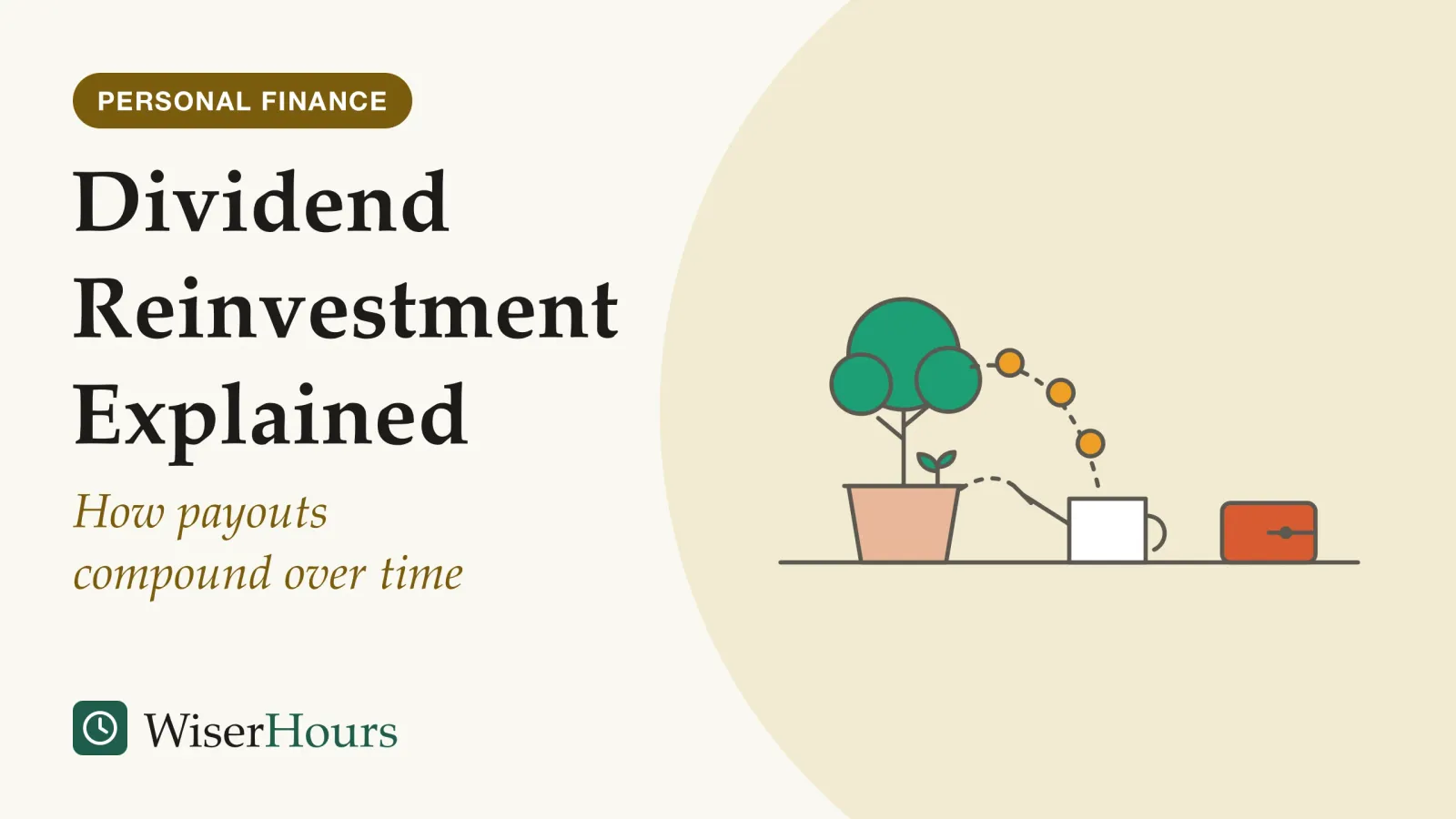
Reinvesting a dividend changes little on the day it happens. The payout leaves the share and comes straight back as more shares, so before any fee or tax the holding is worth about what it was before. The difference shows up later, because the next dividend is paid on a larger number of shares, and the one after that on more again.
Dividend reinvestment means using each dividend to buy more of the same stock or fund instead of taking it as cash. FINRA, the body that oversees US brokers, says every payout leaves the owner two options: keep the money as cash, or have it buy additional shares.1 Over years, reinvested payouts compound, since each new share earns its own dividend. The cost is that reinvested dividends are usually still taxed in a taxable account, every purchase adds a record to keep, and the money is not there to spend. Payout dates and what a dividend is worth on the day belong to our explainer on dividend dates and income, and the starting point is the basics of how a dividend is paid. This page follows what happens when the payouts go back in.
How does dividend reinvestment work?
Dividend reinvestment works through one of two routes: a company’s own dividend reinvestment plan, or an automatic setting at your broker. FINRA explains that a plan buys shares with the dividends a company pays instead of sending you cash, and that you may also be able to ask your brokerage firm to reinvest dividends on shares held there. Company plans are usually run for the company by a transfer agent, a firm that keeps its shareholder records.1
Definition
Dividend reinvestment is using each dividend a holding pays to buy more of that same holding, automatically, instead of receiving the payment as cash.
Investor.gov, the US SEC’s investor site, says joining a company plan means signing an agreement with the company, and suggests finding out from the company or your broker if a fee applies.2 Funds work the same way: mutual funds usually let investors take their dividends and distributions as cash or reinvest them in more shares of the fund.3
Plans can buy whole or fractional shares, so a payout too small for a whole share can still be invested in full. Some plans charge nothing, while others charge fees or commissions.4
- 1The holding pays a dividendcash per share you own
- 2The plan or broker buys moreat that day's price, fractions included
- 3The holding growsmore shares, each due the next dividend
Then repeat from “The holding pays a dividend”
Before switching it on, find out who runs the reinvestment, what it costs per purchase, and whether you can take part of each payout in cash.
Do reinvested dividends compound?
Reinvesting dividends does compound, as long as the payouts continue: each reinvested dividend adds shares, and those shares earn the next dividend too. The figures below are our own arithmetic and entirely hypothetical. It assumes a share price that never moves, a dividend that never changes, no tax and no fees, so that the only thing growing is the share count.
The holding starts with 100 shares priced at US$50, and each year the company pays a dividend equal to 4 percent of that price. The first payout buys a few new shares; the next payout is paid on the larger holding, so it buys slightly more, and so on.
| Year (hypothetical) | Shares held if every dividend is reinvested | Dividend paid that year | Value at US$50 a share |
|---|---|---|---|
| 1 | 104.0 | US$200 | US$5,200 |
| 2 | 108.2 | US$208 | US$5,408 |
| 5 | 121.7 | US$234 | US$6,083 |
| 10 | 148.0 | US$285 | US$7,401 |
| 20 | 219.1 | US$421 | US$10,956 |
Someone who takes the cash instead still holds 100 shares at the end, plus the dividends collected along the way. Even counting that cash, the reinvesting owner finishes year 20 about US$2,000 ahead, and that gap is the compoundingcompound interest: Interest worked out on the original amount plus the interest already added to it, so the total grows faster over time. It works for savers and against borrowers, whose unpaid interest itself starts to attract interest.Full entry in the glossary: dividends earned on shares that earlier dividends bought.
- Start: 100 shares, and the same 100 for the owner who takes the cash (dashed line)
- Year 10: about 148 shares if every dividend is reinvested
- Year 20: about 219 shares; the growth speeds up because each new share earns its own dividend
The rate matters more than the habit. At a hypothetical 2 percent yield the share count grows by about half over 20 years; at 6 percent it more than triples. Those are rates for illustration, not forecasts. Real dividends can be cut or stopped, share prices can fall so the holding loses value, and tax paid along the way slows the growth.
Growth is slow at first and faster later, so reinvesting tends to suit money left alone for many years. How much compounding adds comes down to how long the money stays in; the wider maths of growth on growth is in our guide to how compound interest grows money.
What changes when the share price moves
Real prices move, and a falling price changes the share count in the opposite direction. The same dividend buys more shares when the price is low and fewer when it is high, the effect Wikipedia’s entry on DRIPs compares to buying a fixed amount at regular intervals, known as dollar-cost averaging.4
In the example above, a year in which the price halved would let the same dividend buy twice as many shares. The share count would jump, but the holding would be worth less, because every share, old and new, now trades at half the price. If the price later recovers, those extra shares make the reinvesting owner’s recovery faster; if it never does, they are more shares of a cheaper holding.
The share count is not the result, though. What you end up with is the share count times the price, and the price depends on the business. Reinvesting into a company whose shares keep falling buys more of a falling asset, and a dividend that is cut slows the share count too. Watch the value of the holding and what the company earns, alongside the number of shares.
Are reinvested dividends taxed?
Reinvested dividends are usually taxed in a taxable account as if you had taken the cash. In the US, IRS Publication 550 (the edition for 2025 returns) says that if you use dividends to buy more stock at its fair market value, you must still report the dividends as income.5
- Myth
- Reinvested dividends are not taxed until you sell, because you never received the cash.
- Fact
- In a taxable account they usually count as income in the year they are paid. The IRS says US investors must report them; readers elsewhere should check their own tax rules.
The same US publication goes further. If a plan lets you buy shares at a discount, the income to report is the fair market value of the shares, not the lower price you paid, and any service charge taken from your dividends also counts as dividend income, though it may be deductible.5 All taxable dividends count as ordinary dividends, and those that also count as qualified are taxed at the lower capital-gains rates; the payer says which on the tax form it sends you, the IRS explains.6
For the UK tax year starting 6 April 2026, GOV.UK says dividends covered by your Personal Allowance or a £500 dividend allowance are tax-free, dividend income above that is taxed at the rate for your Income Tax band, and dividends from shares in an ISA are not taxed.7 The guidance makes no exception for dividends that are reinvested.
Tax-sheltered accounts change the picture. In the US, the same IRS publication says its rules do not apply to investments held in IRAs and other qualified retirement plans, and points to separate publications for the tax on money taken out of them.5 Inside a UK ISA, the dividends are not taxed. Readers elsewhere should look up how their own tax authority handles this, because both the treatment of reinvested dividends and the accounts that shelter them differ.
The tax on a reinvested dividend has to be paid from money you did not receive, so plan for the bill in a taxable account.
Every reinvestment is a new purchase to record
Each reinvested dividend buys new shares at that day’s price, and each purchase has its own cost. That cost, your cost basis, decides how much gain you report when you sell. FINRA’s US guidance says the cost basis of a stock generally includes reinvested dividends, and its worked example shows why that matters.8
The study
Strong evidence
FINRA's cost-basis example: the reinvested dividends that are easy to tax twice
In FINRA’s US example, an investor buys stock for US$1,000, reinvests US$400 of dividends over two years and sells for US$1,500. Counting the reinvested dividends gives a cost basis of US$1,400 and a taxable gain of US$100. Forgetting them leaves a gain of US$500, which counts the reinvested dividends a second time. FINRA adds that without adequate records you may have to rely on your broker’s figure, or even treat the cost basis as zero.8
US brokers must report cost basis for many securities, but FINRA says that may not apply to shares bought, or moved between firms, before the reporting rules began in 2008, so your own records still matter.8 The US rules also offer a shortcut and add a wrinkle. You can choose an average basis for shares acquired after 2011 through a DRIP and left with a custodian. And when fund distributions are reinvested, Publication 550 says each new share’s holding period begins the day after it was bought, so one sale can produce both short-term and long-term gains.5
Other countries pool instead. For UK taxpayers, HMRC’s 2026 helpsheet HS284 holds shares of the same class in the same company in a single pool of cost, after same-day and 30-day matching rules, so each reinvested purchase adds to one running total.9 The Canada Revenue Agency’s 2025 capital gains guide uses an average cost for identical properties, and its mutual fund example recalculates that average each time distributions are reinvested.10
The volume adds up even when the rules are simple. Wikipedia’s entry gives an example of 15 plans paying quarterly for ten years, which leaves more than 600 separate purchases to track.4 Keep every annual statement from your plan or broker, and check the cost basis your broker reports against them before you sell.
Reinvesting can tilt a portfolio toward one holding
Dividend reinvestment buys more of whatever paid the dividend, so over time it can concentrate money in a few holdings. Investor.gov’s guide to asset allocation warns that some investments grow faster than others, pushing a portfolio out of line with your goals, and describes rebalancing as the way to stop it overemphasizing one category and return it to a comfortable level of risk.11
The tilt is strongest with single shares. An investor who owns a high-paying utility stock and two growth stocks that pay little will see the utility’s share count climb year after year while the others stand still. Each reinvestment is a small, automatic decision to own more of the one company, and nobody reviews it.
An alternative is to let dividends land as cash in the account and then put that money where the portfolio needs it, turning each payout into a small rebalancing purchase. The trade-off is that the money waits uninvested until you act, and spreading it may mean more trades and fees. More on why a mix of holdings lowers risk is in our explainer on diversification.
If one holding has grown past the share of your portfolio you meant it to have, sending its dividends elsewhere is one way to slow the tilt without selling.
Should I reinvest dividends or take cash?
Whether to reinvest dividends or take the cash depends on what the money is for. Reinvesting tends to suit long-term savings you will not touch for years, in a holding you still want more of; taking cash suits money you need to live on, or a holding that already makes up a large part of what you own.
In practice, many investors take the cash. In an observational study of trading behavior, finance researchers Samuel Hartzmark and David Solomon, writing in the Journal of Finance in 2019, state in their abstract that investors rarely reinvest dividends and trade as though dividends were an income source of their own, steady and apart from the share price.12 That may suit people who need the money. For anyone else, letting dividends pile up as idle cash can give up compounding like that in the hypothetical example above.
Before you switch reinvestment on or off
A retiree drawing on a portfolio might take dividends as cash to cover bills, while someone decades from retirement, saving in a sheltered account, might reinvest all of it. Both choices can be reasonable, and the same person can make different choices for different accounts. Dividends taken as cash are one of the income sources discussed in our guide to what counts as passive income.
Who can answer a reinvestment or tax question
Once your own tax return and accounts are involved, general rules run out. A tax professional, or the published guidance of your tax authority, can tell you how reinvested dividends are treated in your country and which cost-basis method suits your records. For decisions about your own portfolio, a regulated or fee-only adviser can weigh reinvesting against your goals and taxes.
Check the adviser before the advice. Investor.gov warns that people without a licence or registration are behind much US investment fraud, and its lookup tool confirms whether a professional holds one.13 The FCA’s Firm Checker lets UK readers confirm that a firm is allowed to provide the service it is selling.14 Elsewhere, the national financial regulator usually keeps a public list of authorised firms.
The bottom line
Dividend reinvestment turns each payout into more shares, and the growth builds on itself only for as long as the dividends keep coming and you leave the money in. In a taxable account you will usually owe tax on dividends you never received as cash. Before switching it on, decide whether you need the income and how big the holding already is, and keep every statement so that the same dividend is not taxed twice when you sell.
This article is general education, not financial advice. For decisions about your own money, speak to a qualified, regulated adviser.
Frequently asked questions
What is a DRIP?
A DRIP, or dividend reinvestment plan, is a program run by a company, usually through a transfer agent, that uses your cash dividends to buy more of its shares instead of paying you. FINRA notes that many brokers offer a similar automatic setting for shares held with them. Investor.gov, the US SEC's investor site, advises checking whether either charges a fee.
Can I stop reinvesting dividends at any time?
It depends on the plan. Wikipedia's entry on DRIPs notes that some plans let you receive some or all dividends as cash instead of reinvesting them in full, and that if a plan is discontinued, your shares usually stay in book-entry form, with any fraction kept or refunded by check. Read the plan's documents or your broker's reinvestment settings before the next payment date.
Do funds reinvest dividends the same way as shares?
Mutual funds usually give investors a choice, Investor.gov says: the fund can pay out its dividends and distributions, or use them to buy more shares in the fund. Some funds instead keep the income inside the fund, a different design that a fund's documents describe. Either way, a reinvested distribution in a taxable account usually still counts as income.
Sources
- Stocks. Financial Industry Regulatory Authority (FINRA, US); accessed 24 October 2026
- Stocks - FAQs. US Securities and Exchange Commission, Investor.gov; accessed 24 October 2026
- Mutual Funds. US Securities and Exchange Commission, Investor.gov; accessed 24 October 2026
- Dividend reinvestment plan. Wikipedia; accessed 24 October 2026
- Publication 550 (2025), Investment Income and Expenses. Internal Revenue Service (US), for use in preparing 2025 returns; page last reviewed 30 April 2026
- Topic no. 404, Dividends and other corporate distributions. Internal Revenue Service (US), page last reviewed 8 October 2026
- Tax on dividends. GOV.UK (UK government), rates for 6 April 2026 to 5 April 2027; accessed 24 October 2026
- Cost Basis Basics. Financial Industry Regulatory Authority (FINRA, US), 16 April 2024; accessed 24 October 2026
- HS284 Shares and Capital Gains Tax (2026). HM Revenue and Customs (UK), Self Assessment helpsheet, updated 6 April 2026
- Capital Gains - 2025 (T4037). Canada Revenue Agency, guide T4037(E) Rev. 25; accessed 24 October 2026
- Beginners' Guide to Asset Allocation, Diversification, and Rebalancing. US Securities and Exchange Commission, Investor.gov; accessed 24 October 2026
- The Dividend Disconnect. Hartzmark, S. M., and Solomon, D. H. (2019). Journal of Finance, 74(5), 2153-2199
- Check Out Your Investment Professional. US Securities and Exchange Commission, Investor.gov; accessed 24 October 2026
- How to check a firm or individual is authorised. Financial Conduct Authority (UK); accessed 24 October 2026
How we researched this
This guide rests on official investor and tax guidance read in October 2026: Investor.gov and FINRA (US), IRS Publication 550 for 2025 returns and IRS Topic 404 (US), GOV.UK and HMRC's helpsheet HS284 (UK) and the Canada Revenue Agency's guide T4037 (Canada), plus Wikipedia for general plan features and the abstract of one finance study. The share-count example is our own hypothetical arithmetic. Main limitation: tax rules come from three countries only, and no study measures how reinvesting affects ordinary investors' long-term results.
Keep reading
How Dividend Income Works: From Payout Dates to a Regular Income Stream
How dividend income works: the 4 dates that decide who is paid, why share prices fall by about the payout, and how steady dividends stay when profits fall.
Assets vs. Liabilities: A Plain-English Guide to Your Personal Balance Sheet
Assets vs liabilities explained: where 7 tricky items go, from a mortgaged home to pay-later plans and tax bills, and a one-page balance sheet to fill in.

Renting vs. Buying Your Home: The Wealth-Building Case for Each
Renting vs buying: US owners' median net worth is about 43 times renters', yet much of that gap reflects who buys. What decides which builds more wealth.
Net Worth by Age: Why Comparison Charts Mislead
Net worth by age from the Fed's 2025 survey and Britain's ONS, medians beside means, and five reasons comparison charts mislead.