Six Sigma Explained for Beginners: What It Is and When It Fits
Six Sigma targets 3.4 defects per million chances, but its real content is a way to run projects. What it adds, what firm studies found, and where it fits.

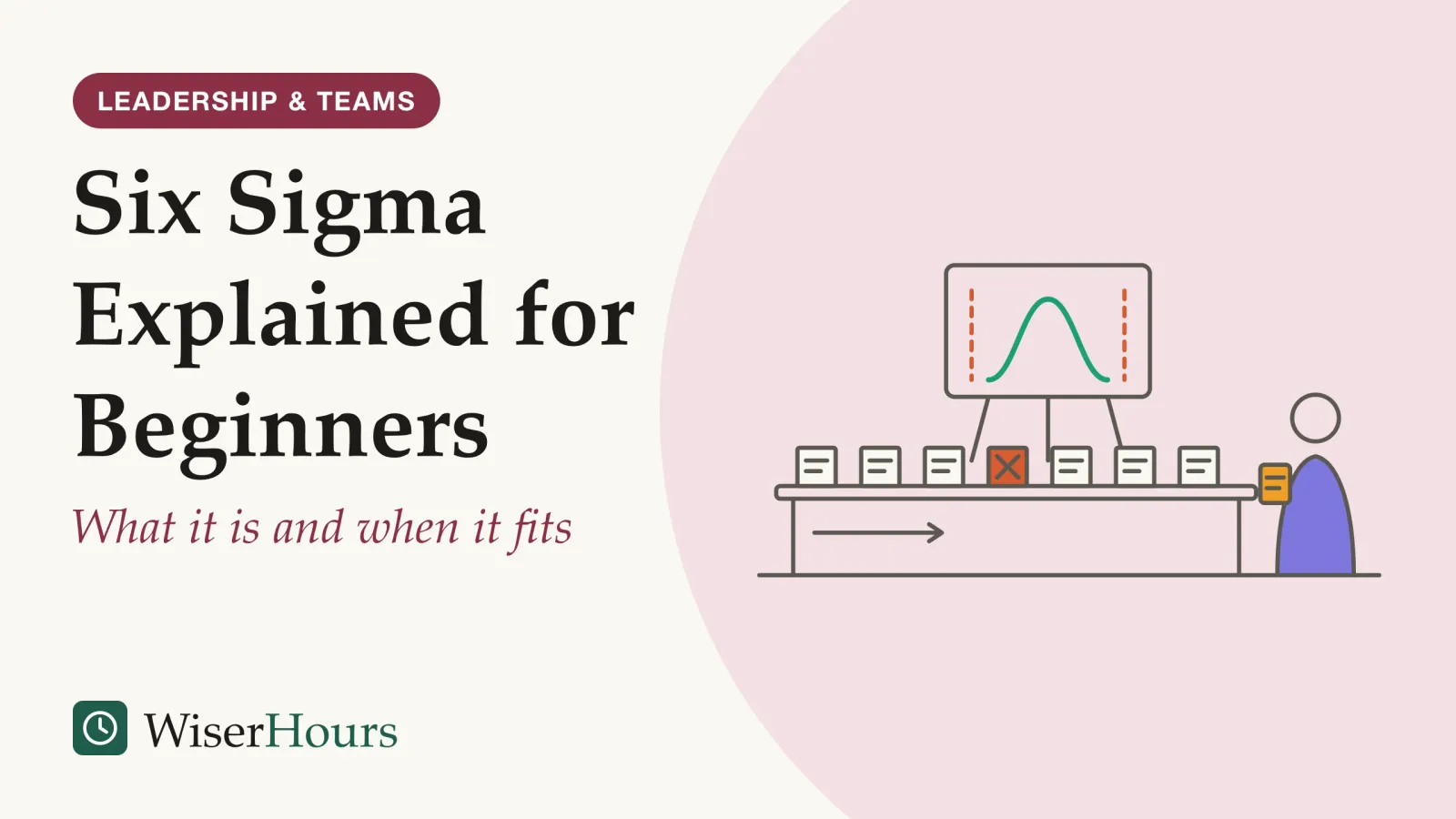
Six Sigma is named after a statistical target, but the research suggests the target is not what sets it apart. In practice, Six Sigma is a disciplined way of running improvement projects: trained project leaders, a fixed five-phase method and hard numbers, all aimed at making a process so consistent that defects become rare. It began at Motorola and has spread well beyond factories.1 A 2012 study in the Journal of Operations Management, comparing firms that adopted Six Sigma with similar firms that did not, linked adoption to better return on assets, mostly through lower indirect costs.2 Whether it fits your team depends less on the statistics than on the kind of work you do. And you can find out cheaply: one project on one repetitive process, led by one person with protected time, before anyone buys training (the last section shows how).
This guide builds on a general introduction to what process improvement is and how teams test changes and goes deeper on one method.
Definition
Six Sigma is a structured approach to process improvement that cuts variation in how recurring work gets done. Trained specialists run it as projects, follow a fixed method and judge success by measured defects and costs.3
Why it is called Six Sigma: a process far from its limits
The name is a statistical target. Sigma is the symbol statisticians use for standard deviation, a measure of how widely results spread around their average. A process runs “at six sigma” when the customer’s limits, the points beyond which a result counts as a defect, sit six standard deviations from the process average, as Weiyong Zhang, Arthur Hill and Glenn Gilbreath explain in a 2009 review.3
At that distance, defects are very rare. The textbook figure is 3.4 defects per million opportunities, and it already assumes the process average may drift by up to 1.5 standard deviations over the long term. The figure is a very high standard, set far beyond what industry typically achieved when Motorola coined it.3
- Wide spread: results often land beyond the customer’s limits, and every one that does is a defect
- Narrow spread, same average: the limits sit many standard deviations away, so defects become rare: the idea behind the name
A simple way to see why the method cares about spread rather than the average: customers feel the extremes. Take a finance team that pays suppliers. If invoices are paid on time on average, but the spread is wide, some suppliers still wait far too long, and those are the ones who call. Narrowing the spread fixes their experience; moving the average barely touches it.
There is a catch in the fine print. The rate counts “opportunities”, every chance for something to go wrong, rather than finished items. Listing more opportunities in a process lowers the rate without improving a single result, and the reviewers warn that the term has never been carefully defined.3
The practical lesson: judge a process by its defective units as well. Late payments per hundred invoices is a number that is much harder to flatter than a rate per million opportunities.
What a Six Sigma program adds to older quality methods
Six Sigma’s tools and techniques largely come from older quality management; what it added is a structure for running improvement work, according to two 2008 studies in the Journal of Operations Management. Xingxing Zu and colleagues named three practices that set it apart (a structure of improvement roles, a structured improvement procedure and a focus on metrics), and their survey of 226 US manufacturing plants found them distinct from traditional quality management.4
Roger Schroeder and colleagues, working separately, drew the same line: little in the toolkit is new, while the organizational structure around it had not been seen before.5 For managers, Zu’s survey adds that the three practices complemented traditional quality management instead of replacing it.4
Each practice does a specific job. The roles make improvement somebody’s actual work: full-time project leaders called Black Belts, trained staff called Green Belts, and senior executives who act as champions and help choose projects.3 The procedure is DMAIC, short for define, measure, analyze, improve and control.1 Zhang and colleagues describe it as a revised version of the plan-do-check-act loop, with the control phase as probably its only real addition, and note that Six Sigma is unusually strict in requiring every project to follow it. The metrics mean each project is audited on the benefits it promised and delivered, usually in money.3 Belts and the five DMAIC phases will each get their own guide in this category.
Picture an insurer’s claims team where one claim in ten comes back for missing documents. Without the structure, the fix is a reminder email and good intentions. With it, a named project leader defines the defect, measures how often it happens and at which step, tests a change, and then sets up a control, such as a required field, so the gain survives once attention moves on. That last step shows the method’s habit of treating a held gain as part of the project, not an afterthought.
What happened to firms that adopted Six Sigma
The best available evidence on Six Sigma’s results comes from studies that follow companies before and after adoption and compare them with similar companies that did not adopt. Two such studies appeared in 2012 in the Journal of Operations Management. The larger, by Morgan Swink and Brian Jacobs, found gains, but concentrated in fewer places than a headline figure might suggest.2
The study
Limited evidence
Where the gains showed up: 200 adopting firms set against look-alikes
The authors report strong evidence of a positive impact on return on assets, compared with matched firms. Most of it came from significant cuts in indirect costs; significant gains in direct costs and asset productivity were not evident, and sales growth improved only slightly. Differences between manufacturing and service firms were negligible.2
The payoff showed up in indirect costs, broadly the overhead around the core work, more than in the direct costs of the work itself. In an accounts-payable team, for example, the direct work is entering and paying invoices; the overhead is the second approval, the supervisor chasing exceptions and the calls from suppliers asking where their money is. The main caveat is that nobody assigned Six Sigma at random: firms chose to adopt it, and firms making that choice may have been changing in other ways too. Matching on prior results, industry and size narrows that gap without closing it.
A second study pointed the same way. Scott Shafer and Sara Moeller followed adopting firms over a decade, against control groups, and found that the gains came mainly through how efficiently employees were deployed; they saw no gain in asset efficiency and no sign that Six Sigma harmed performance.6
So if you try Six Sigma, look for the payoff in staff time and overhead (fewer checks, fewer corrections, fewer escalations) and track those alongside the defect rate. Do not expect new equipment to work harder or sales to jump.
Further reading
Deming's classic on reducing variation and on the improvement cycle that DMAIC later revised: the older quality thinking Six Sigma builds on.

As an Amazon Associate WiserHours earns from qualifying purchases.
Six Sigma in hospitals: many projects, little proof
Health care has produced a large published record of Six Sigma projects, yet reviews of that literature find mostly case studies, few of which test their results.1 A 2010 review by Jami DelliFraine and colleagues found that fewer than one in five published articles on Six Sigma and Lean in health care reported any outcomes, and called the evidence of better care very weak.7
A 2020 systematic reviewsystematic review: A review that fixes its question and its rules for including studies in advance, then searches out every study that fits and weighs them together. Some systematic reviews pool the results into a meta-analysis; others describe what the studies found without combining the numbers.Full entry in the glossary of Six Sigma in health care, covering two decades of articles, found the case study to be the most common method, with projects aimed mainly at reducing time, costs and errors.8 A 2016 review of reviews of Lean and Six Sigma in acute care rated the overall quality of the evidence poor to fair.9
Why does this matter outside hospitals? A case study describes one project, often written up by the team that ran it, usually with no comparison group. Outside health care, Shafer and Moeller likewise noted a large body of anecdotal evidence on Six Sigma’s benefits but very little systematic research.6 The method’s own vocabulary gives you a sharper test for such success stories. Ask for the count of defective items per hundred before and after the project, not a sigma level, and for evidence that the gain lasted once the control phase was in place. A story that can show neither is something to test on your own process, not a result to expect.
When Six Sigma fits, and when it does not
Six Sigma fits repeatable work that moves through the same steps, where a defect can be defined and counted, in an organization that can spare people to run projects. The 2016 review of reviews concluded that Lean and Six Sigma are better suited to processes that follow a linear sequence of events.9
A likely reason is that the method needs something stable to measure. Compare a payroll team, which runs the same cycle every month and can count every wrong payslip, with a team exploring a new product, where many attempts are expected to fail and nobody can yet say what a defect is. The first gives DMAIC a baseline, a defect and enough repetitions to see a change; the second gives it none of those.
The firm studies add conditions. In Swink and Jacobs’s data, the benefit was smaller in firms that already had a mature quality system, and in service firms it tracked how well they were doing financially before adoption.2 A 2015 follow-up by Brian Jacobs and colleagues found that later adopters gained more, on average, than early ones. Waiting tended to pay when firms were large, were financially healthy before adopting, sold mainly to other businesses or worked in slow-moving industries; under the opposite conditions, adopting early appeared to work better.10
The clearest mismatch is with exploratory work. Mary Benner and Michael Tushman argue that process management programs such as Six Sigma favor incremental improvement and tend to crowd out exploratory innovation; in their own study of firms in the paint and photography industries, more process management went with a shift of patents away from new domains.11 That study measured ISO 9000 certification, a related quality program, not Six Sigma itself. Their proposed answer is to keep process programs structurally separate from the units doing the exploring.11 Those teams may be better served by methods built for open-ended problems, such as design thinking.
| Your situation | How well Six Sigma fits | What the evidence suggests |
|---|---|---|
| High-volume work that follows the same steps, such as claims, invoicing or lab tests | Good fit | Reviews in acute care found the methods better suited to linear sequences of steps9 |
| A mature quality system is already in place | Expect smaller gains | Benefits were weaker in firms with prior quality certification2 |
| A large firm, mainly business customers, or a slow-moving industry | Adopting after others can pay more | Each of these conditions favored later adopters in a 2015 firm study10 |
| New products, research or strategy work | Poor fit; keep it separate | Process programs favor incremental over exploratory innovation11 |
| No one can be freed to lead projects | Borrow tools, skip the program | The role structure is one of the practices that sets Six Sigma apart4 |
A small team can still borrow the ideas without the program: define a defect from the customer’s side, measure the spread and hold gains with a control. The full apparatus of roles and certification makes most sense where there is enough repeated work to keep it busy.
How to test Six Sigma on one process before committing
A sensible way to find out whether Six Sigma suits your organization is to run one project on one high-volume process, with one person given real time to lead it, and to judge it on the overhead it removes. That mirrors where the firm studies found the gains.2
Choose the process by the fit conditions above: frequent, step by step and visible to a customer. Define a defect from that customer’s side, as a late, wrong or incomplete item (for an accounts-payable team, “an invoice paid after its due date”), and count defective units per hundred rather than a rate per million opportunities.3 Before changing anything, record the spread as well as the average for a few weeks, since the spread is what the method tries to shrink.
Then run the project through the five phases and finish with the control phase, which Zhang and colleagues see as the main step DMAIC adds to the older plan-do-check-act loop, to hold the process at its new level.3 At the end, compare rework, checks and escalations with the baseline, and decide whether a second project is worth the time. If the answer depends on one enthusiastic person, that tells you something too.
The bottom line
Six Sigma is less a statistical formula than a way to organize improvement: a named person, a fixed method and a measured result. Firm-level studies, which are observational, link it to lower indirect costs and better use of staff rather than dramatic growth, and the health-care evidence is mostly case studies. It fits repeatable work with a clear definition of a defect; for exploratory work, keep it at a distance.
Frequently asked questions
Who invented Six Sigma?
Engineers at Motorola developed Six Sigma in the 1980s, driven by the high cost of poor quality in its production processes, according to a 2009 review by Weiyong Zhang, Arthur Hill and Glenn Gilbreath. In the 1990s it spread to other large companies, including AlliedSignal (now Honeywell), GE and 3M, and GE added many new practices along the way.
Can Six Sigma be used outside manufacturing?
Yes. In the 2012 study of adopting firms by Morgan Swink and Brian Jacobs, differences in Six Sigma's effects between manufacturing and service firms were negligible. Hospitals use it widely too, mostly to cut time, costs and errors, though reviews of that health-care work describe the evidence as weak and built mainly on case studies.
Is Six Sigma the same as total quality management?
Not quite. A 2008 survey of 226 US manufacturing plants by Xingxing Zu and colleagues found that three Six Sigma practices (the role structure, the structured improvement procedure and the focus on metrics) were distinct from traditional quality management practices, and that they complemented those practices in improving performance rather than replacing them.
How long does a Six Sigma project take?
There is no fixed length. As one guide, Zhang, Hill and Gilbreath's 2009 review notes that a person training as a Green Belt typically completes a project within three to six months alongside about two weeks of training. Black Belts, the full-time leaders, take two more weeks of training and complete a more complicated project.
Sources
- Six Sigma in Health Literature, What Matters? Hernández-Lara, A. B., Sánchez-Rebull, M. V. & Niñerola, A. (2021). International Journal of Environmental Research and Public Health, 18(16), 8795
- Six Sigma adoption: Operating performance impacts and contextual drivers of success. Swink, M. & Jacobs, B. W. (2012). Journal of Operations Management, 30(6)
- Six Sigma: A Retrospective and Prospective Study. Zhang, W., Hill, A. V. & Gilbreath, G. H. (2009). Conference paper, POMS 20th Annual Conference, Orlando
- The evolving theory of quality management: The role of Six Sigma. Zu, X., Fredendall, L. D. & Douglas, T. J. (2008). Journal of Operations Management, 26(5)
- Six Sigma: Definition and underlying theory. Schroeder, R. G., Linderman, K., Liedtke, C. & Choo, A. S. (2008). Journal of Operations Management, 26(4)
- The effects of Six Sigma on corporate performance: An empirical investigation. Shafer, S. M. & Moeller, S. B. (2012). Journal of Operations Management, 30(7-8)
- Assessing the Evidence of Six Sigma and Lean in the Health Care Industry. DelliFraine, J. L., Langabeer, J. R. & Nembhard, I. M. (2010). Quality Management in Health Care, 19(3)
- Quality improvement in healthcare: Six Sigma systematic review. Niñerola, A., Sánchez-Rebull, M. V. & Hernández-Lara, A. B. (2020). Health Policy, 124(4)
- Lean and Six Sigma in acute care: a systematic review of reviews. Deblois, S. & Lepanto, L. (2016). International Journal of Health Care Quality Assurance, 29(2)
- Performance effects of early and late Six Sigma adoptions. Jacobs, B. W., Swink, M. & Linderman, K. (2015). Journal of Operations Management, 36
- Reflections on the 2013 Decade Award—“Exploitation, Exploration, and Process Management: The Productivity Dilemma Revisited” Ten Years Later. Benner, M. J. & Tushman, M. L. (2015). Academy of Management Review, 40(4)
How we researched this
We searched Crossref, Europe PMC, PubMed and publisher pages in September 2026 for definitions of Six Sigma, studies comparing adopting firms with matched non-adopters, and systematic reviews of Six Sigma in health care, where many Six Sigma projects are published. Sources date from 2008 to 2021. Main limitation: most of the outcome studies were available to us only as abstracts, and none is a randomized trial.
Keep reading
Root Cause Analysis Explained: Steps, Tools, and Common Mistakes
Root cause analysis step by step: the tools, why five whys falls short, and the fix teams skip. In one review, 2 of 21 studies could partly show a safety gain.
Value-Stream Mapping: A Step-by-Step Guide With a Worked Example
Value stream mapping in 7 steps, worked through on an invoice-approval example, plus what reviews find and the step most published maps skip.
What Is Process Improvement? A Plain-English Guide for Managers
Why does the same mistake keep happening? What process improvement means, the 4-step plan-do-study-act loop, and what makes the gains last.