Is Your Attention Span Really Shrinking? What the Research Says
The 8-second goldfish attention span was never measured. Decades of concentration tests show no decline in adults; what changed is how we use screens.

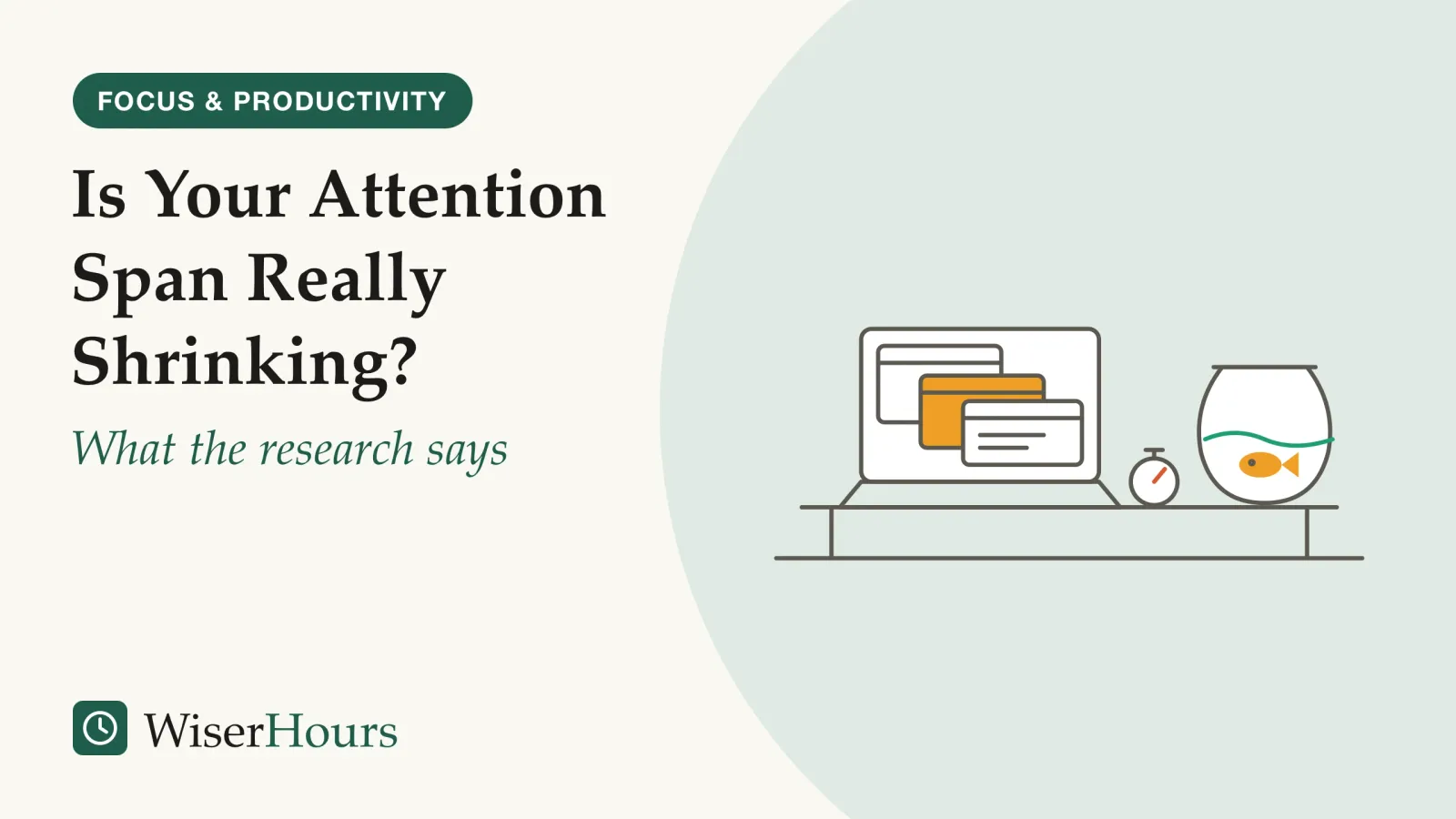
The famous number about attention span, 8 seconds, one second less than a goldfish, has never been traced to a study.1 It comes from a slide in a 2015 Microsoft Canada report for advertisers, which said the average human attention span had fallen from 12 seconds in 2000 to 8 seconds in 2013 and credited those numbers to a website; the report’s own research did not measure them.2
Is your attention span really shrinking? Not in the way the goldfish story claims. There is no single attention span to measure, and on the longest run of test data we have, adults’ ability to concentrate is not falling. A 2024 University of Vienna review of three decades of scores on a standard concentration test found that adults tested more recently scored slightly higher, not lower.3 What has changed is how often we switch between things on screens, and how quickly public topics come and go. So if your focus feels shorter, look at your screens and your setup before you worry about your brain.
Where the 8-second goldfish statistic came from
The 8-second figure did not come from Microsoft’s own research.1 Its 2015 report rested on online attention games played by 2,000 Canadians and brain recordings of a smaller group, but the slide with the shrinking figures and the goldfish carried a single credit: a website called Statistic Brain.2
In 2017, Simon Maybin of the BBC’s statistics program More or Less followed that credit. Statistic Brain named the Associated Press and a biotechnology center at the US National Library of Medicine as its sources; neither could find any record of research behind the numbers, and his attempts to reach the website came to nothing. Attention researchers he asked had no idea where the numbers came from, and a fish behavior researcher told him that goldfish are a standard animal for studying learning and memory.1
Nor could its games have yielded a figure in seconds. They sorted people into thirds, low, medium and high attention, relative to one another, and tested everyone once.2 A single snapshot like that is cross-sectionalcross-sectional: Describes a study that measures everyone in its sample at a single point in time. Because the possible cause and the outcome are recorded together, it can show that two things occur together but not which of them came first.Full entry in the glossary: it can show that two things go together in one group of people, but not that anything declined between 2000 and 2013.
- Myth
- The average human attention span fell to 8 seconds, shorter than a goldfish's.
- Fact
- The figure was credited to a statistics website, not measured, and no research behind it has been found. Goldfish are a standard animal for studying learning and memory.
Why did it spread? A precise number with a date looks measured, and this one confirmed something many people already felt. The habit worth building is simple: before you repeat an attention statistic, ask what task the attention was paid to, and which earlier measurement it is being compared with. The goldfish claim has no answer to either question.
What an attention span is, and why it has no single number
Psychologists do not measure one attention span that a person carries from task to task. They measure attention on particular tasks, and how long someone stays with a task depends on what it demands and what the person brings to it. That is why Gemma Briggs, a psychologist at the Open University, told the BBC that an average attention span means little.1
It’s very much task-dependent. How much attention we apply to a task will vary depending on what the task demand is.
You can see this in any ordinary week. The same person who drifts away from a quarterly report within minutes can follow a two-hour film, or a tense negotiation, without once checking the time. Nothing about their brain changed between the two. The task changed.
When researchers do test sustained attention, they usually score accuracy on a short, demanding task, not seconds until the mind wanders. In one of the largest studies, published in 2015 by Francesca Fortenbaugh and colleagues, more than 10,000 unpaid volunteers on the TestMyBrain.org website watched photos of cities and mountains fade one into the next for 4 minutes, pressing a key for cities and holding back for the rarer mountains. Ability on the test peaked in the early 40s and then declined gradually, though people who volunteer online are not a random sample of anyone.4
Even the best-known real-world figure, that students stop listening 10 to 15 minutes into a lecture, does not hold up. Neil Bradbury’s 2016 review (we read its abstract only) found scant primary data behind it, and found that the most often cited source barely discusses attention at all. It concluded that attention varies more between teachers than between teaching formats.5
For your own work, then, the useful question is not how long your attention span is, but which tasks lose you, and under which conditions.
Are attention spans getting shorter? Three decades of test scores
The best test of a decline is to compare people who took the same attention test in different years, and that comparison points the other way for adults. Denise Andrzejewski, Elisabeth Zeilinger and Jakob Pietschnig of the University of Vienna did it for the d2 Test of Attention, a pencil-and-paper test that has been used in research for decades.3
The d2 test is a race against a clock. Each line is a row of the letters d and p with small dashes above and below, and you cross out every d that has exactly two dashes, with a short time limit per line. A study that pools every published use of such a test, noting the year each group was tested, is called a cross-temporal meta-analysismeta-analysis: A study that combines the results of earlier studies on the same question into one overall estimate. Pooling makes the estimate more precise, but it cannot repair the studies it pools: a meta-analysis of surveys is still survey evidence.Full entry in the glossary. If attention were collapsing, later groups should score worse.
The study
Limited evidence
What 31 years of a pencil-and-paper test show
Adults tested in later years scored somewhat higher on concentration performance, the test’s main score for selective and sustained attention; the effect was small by the usual standards. Children showed no clear change in concentration but made more errors, and the authors read their faster, less careful style as a more impulsive way of taking the test.3
The main caveat is robustness. When the authors repeated the analysis using only samples from Germany, Austria and Switzerland, the adult gain was no longer clear, and the samples were groups that researchers happened to recruit, not all of them representative of any population.3 So the honest reading is modest: the best long-run data show no collapse in adults’ capacity to concentrate on a demanding task, though that falls short of proof that attention is improving.
A counterpoint comes from studies of media multitasking. A 2018 review by Melina Uncapher and Anthony Wagner reports that, on balance, heavy media multitaskers, people who juggle many media streams at once, perform worse on a number of thinking tasks, often ones that demand sustained attention. Yet many studies find no gap at all, and which causes which is still unknown.6
If focusing feels harder than it used to, then, the likelier explanation is what surrounds the task, not a worn-out capacity. That is good news, because surroundings and habits are easier to change than a brain.
Further reading
Gloria Mark's own account of the screen-switching studies this article cites, and how she suggests working with attention rather than against it.
As an Amazon Associate WiserHours earns from qualifying purchases.
What has shrunk is time on one screen
The measure that does look shorter today is how long people stay on one screen before switching, a habit rather than an ability. In 2004, Víctor González and Gloria Mark of the University of California, Irvine reported that 14 office workers they shadowed at one US investment management company spent a little over 2 minutes with any tool or document before switching.7
Twelve years later, Mark and colleagues, three of them from Microsoft Research, installed logging software on the computers of 40 volunteers at a large US tech company for about two and a half working weeks, in a study funded by the US National Science Foundation. On average, people stayed on one screen for 47 seconds before switching. Shorter stretches went with lower ratings of their own productivity when each workday ended.8 In a podcast interview published by the office-furniture maker Steelcase, Mark describes the change in her own words as two and a half minutes in 2004 falling to 47 seconds since around 2016, and says other researchers using logging software have found similar figures.9
Those numbers need two cautions. The methods differ: the 2004 figure came from researchers shadowing people and recording each activity, the later one from software recording every change of window. And both studies are small and each drew on a single workplace. What they measure is behavior, not capacity: flicking to a spreadsheet to check one figure counts as a switch, even when it serves the work.
- Concentration on a standard test: adults tested more recently scored slightly higher, not lower
- Time on one screen before switching: shorter in recent workplace logging studies than in early office observations
- Attention a topic gets from the public: rises and falls faster than it used to, across several media
So the shortening lives in how we use screens, which is the part you can change. What each switch costs you is covered in the true cost of an interruption, and the habits with the best evidence for longer stretches of work are in a six-step guide to concentrating.
Why everything feels faster: collective attention
Public topics now rise and fall faster than they used to, which is a second, separate trend. Philipp Lorenz-Spreen and colleagues, in a 2019 study in Nature Communications, found that the most popular hashtags on Twitter worldwide held a place in the top 50 for an average of 17.5 hours in 2013 but 11.9 hours in 2016.10
The same speed-up showed in the use of phrases in books over a century, movie ticket sales, Google searches and Reddit comments, though not in Wikipedia traffic or scientific citations. The authors’ model suggests the cause is supply: more content produced and consumed uses up the public’s interest in each topic sooner. They stress that this collective attention is distinct from attention in the psychologist’s sense, the way one person allocates mental resources.10
You have seen it at work. The industry story everyone discussed on Monday is forgotten by Thursday, not because anyone lost the ability to think about it, but because five newer stories arrived. If the churn leaves you feeling scattered, remember that the speed belongs to the feed. Short-form video and endless scrolling raise a different question, about individual brains, and it needs different evidence.
How to read the next claim about shrinking attention
Most claims about shrinking attention rest on one of several different measures, and they point in different directions. The table sorts the ones in this article by what was measured and how strong the evidence is.
| Claim | What the research found | Evidence |
|---|---|---|
| Human attention fell to 8 seconds, below a goldfish’s | Credited to a statistics website; no research behind it has been found | No research: marketing report21 |
| Adults are losing the ability to concentrate | Adults tested in later years scored slightly higher on a standard concentration test; not clear in German-speaking samples alone | Meta-analysis, limited3 |
| Students switch off 10 to 15 minutes into a lecture | Primary data do not support a fixed limit; teachers matter more than format | Review, limited (abstract read)5 |
| Heavy media multitaskers attend worse | Worse on some attention tasks, no difference in many studies; cause unclear | Review, mixed6 |
| People switch screens more often than they used to | Shorter stretches in a small 2016 logging study than in small 2004 observations; methods differ | Observational, limited78 |
| Public attention moves faster | Popular topics rise and fall faster on Twitter and in several other media | Observational, moderate10 |
The useful habit is to sort a claim into the right row before deciding what it means for you. A shorter time per screen says something about your working day. A test score says something about your capacity. A trending chart says something about the internet.
Five questions for any attention-span statistic
The bottom line
Your attention span is probably not shrinking, because there is no single attention span to shrink, and adults’ scores on a standard concentration test have not fallen in three decades of data. What has shortened is the time people spend on one screen before switching, and the time the public spends on any one topic. Both are habits and environments rather than damage, which means the most useful response is to change how your screens and your working day are set up, not to worry about your brain.
Frequently asked questions
Do goldfish really have a 9-second attention span?
No evidence supports it. When the BBC's statistics program More or Less checked the claim in 2017, fish behavior specialist Felicity Huntingford said goldfish can perform all the kinds of learning described in mammals and birds, and that scientists use them as a standard animal for studying how memories form. She called the goldfish's forgetful reputation an irony for that reason.
Did Microsoft's report find that social media shortens attention?
It found a link, not a cause. In Microsoft Canada's 2015 online games with 2,000 Canadians, 23 percent of people with high social media use landed in the top third for sustained attention, against 36 percent of those with low use. Everyone was tested once, the report was marketing research without peer review, and it also reported that heavier users had more short bursts of high attention.
Are children's attention spans getting shorter?
Not on the main score of one standard test. In the 2024 University of Vienna review of d2 concentration test results, children tested in later years showed no clear change in concentration but made more errors, with some signs of working faster. The authors read this as a more impulsive test-taking style and suggest that instructions stressing speed and low stakes may play a part.
Sources
- Busting the attention span myth. Maybin, S. (10 March 2017). BBC News, for BBC World Service's More or Less
- Attention spans (Consumer Insights, Microsoft Canada), archived copy. Microsoft Canada, Consumer Insights (Spring 2015). Company marketing research, not peer-reviewed
- Is there a Flynn effect for attention? Cross-temporal meta-analytical evidence for better test performance (1990–2021). Andrzejewski, D., Zeilinger, E. L. & Pietschnig, J. (2024). Personality and Individual Differences, 216, 112417
- Sustained attention across the life span in a sample of 10,000: Dissociating ability and strategy. Fortenbaugh, F. C., DeGutis, J., Germine, L., et al. (2015). Psychological Science, 26(9), 1497-1510
- Attention span during lectures: 8 seconds, 10 minutes, or more? Bradbury, N. A. (2016). Advances in Physiology Education, 40(4), 509-513
- Minds and brains of media multitaskers: Current findings and future directions. Uncapher, M. R. & Wagner, A. D. (2018). Proceedings of the National Academy of Sciences, 115(40), 9889-9896
- “Constant, constant, multi-tasking craziness”: Managing multiple working spheres. González, V. M. & Mark, G. (2004). Proceedings of CHI 2004, 113-120
- Neurotics can't focus: An in situ study of online multitasking in the workplace. Mark, G., Iqbal, S. T., Czerwinski, M., Johns, P. & Sano, A. (2016). Proceedings of CHI 2016, 1739-1744
- Our 47-Second Attention Span With Gloria Mark (S5: EP3) Transcript. Steelcase, Work Better podcast, season 5, episode 3 (interview with Gloria Mark; transcript undated, page updated November 2024)
- Accelerating dynamics of collective attention. Lorenz-Spreen, P., Mønsted, B. M., Hövel, P. & Lehmann, S. (2019). Nature Communications, 10, 1759
How we researched this
We traced the 8-second claim to the archived 2015 Microsoft Canada report and a 2017 BBC investigation, then searched Crossref, Europe PMC and publishers' sites in September 2026 for studies measuring attention over time. Nine of ten sources were read in full and one, a 2016 review of attention in lectures, as an abstract only, which the article flags. Main limitation: no study has tracked the same people's attention on the same task across decades.
Keep reading
How to Focus: A Research-Backed Guide to Concentrating on What Matters
How to focus: 6 steps ranked by evidence, from if-then plans (642 experimental tests) to batched alerts, plus signs poor focus needs a doctor.
Does Listening to Music Help You Focus? What Studies Show
Does music help you focus? On dull tasks it can, but lyrics disrupt reading about as much as speech, a 2018 review of 65 studies found.
Deep Work for Beginners: How to Start With Just One Hour a Day
Deep work for beginners in 5 steps: one protected hour a day, a task chosen the night before, an if-then start, alerts off and a closing note on your next move.
The True Cost of an Interruption: What Happens in Your Brain
An interruption costs you 3 ways: a slower restart, more slips and drift. What happens in your brain, and what research says cuts the cost.