Table Topics: Practice Questions and Drills for Off-the-Cuff Speaking
Table Topics practice: how a one-to-two-minute turn is timed, 30 original questions sorted by type, and 4 timed drills for practicing alone or in a club.

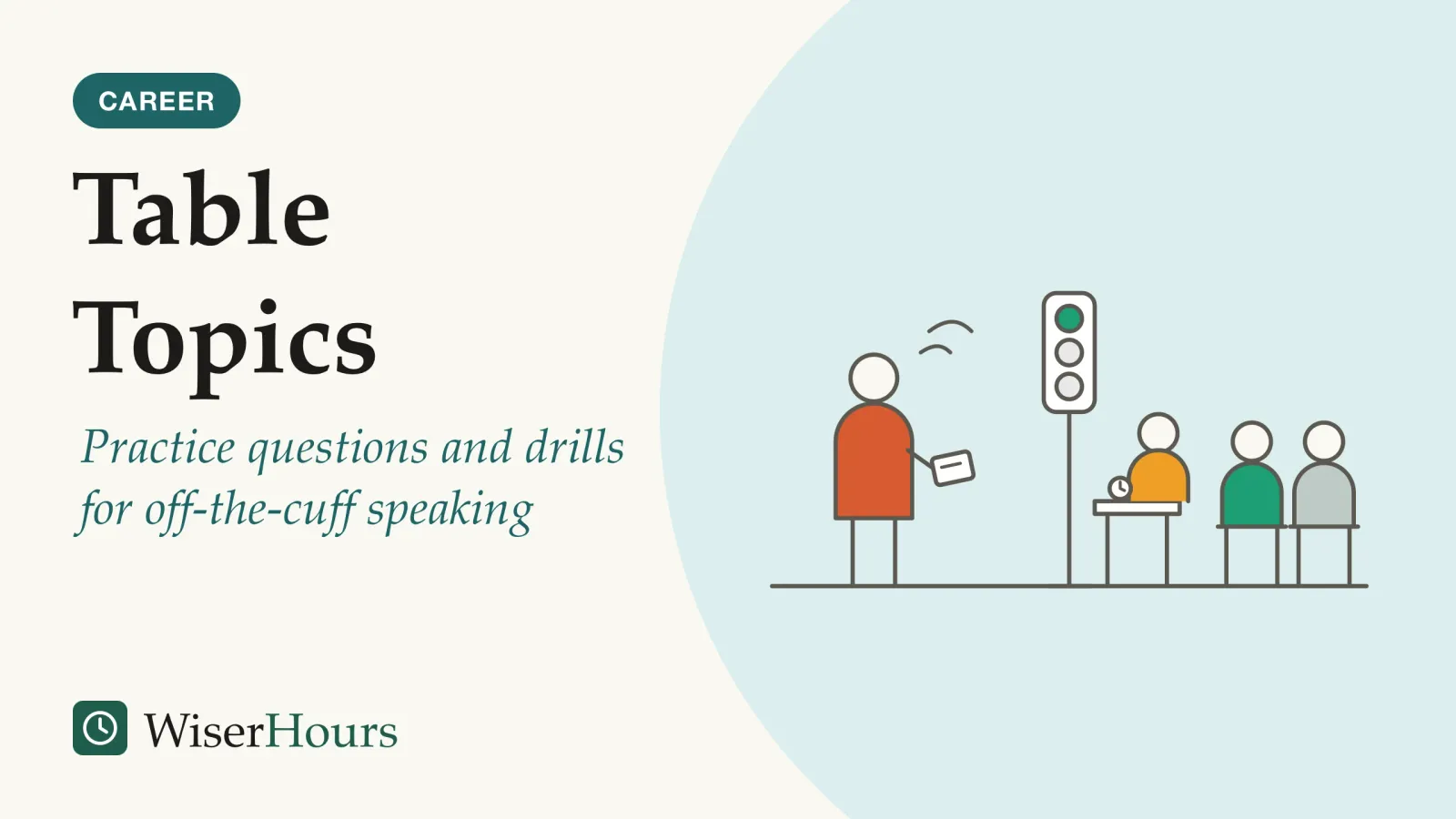
Table Topics is the impromptu-speaking exercise at the heart of a Toastmasters meeting: a Topicsmaster reads out a question nobody has seen (“Should every meeting end five minutes early?”), calls a name, and that member has one to two minutes to answer while a Timer waits to hold up a green card. You cannot know the question in advance, yet most of what makes a turn hard can be practiced. The method in this guide has five parts:
- Learn how a turn is timed, so the lights stop surprising you
- Answer the question in your first sentence
- Back it with one reason and one example, then close
- Practice with a mixed bank of questions, sorted by type
- Record a few answers and review them against the clock
What are Table Topics in Toastmasters?
Table Topics is a long-standing part of the Toastmasters meeting in which members answer an impromptu question or topic, usually after the prepared speeches. Toastmasters International describes it as training to organize your thoughts quickly; the Topicsmaster calls on people at random, and each answer should be clear, succinct and one to two minutes long.1
The Topicsmaster picks the questions before the meeting. Toastmasters asks them to choose topics that let speakers offer opinions, to give members without another speaking role a chance to talk, and to stick to general subjects nobody needs special knowledge for.2 The organization’s December 2025 fact sheet reports more than 13,800 clubs in nearly 150 countries, which puts a club within reach of many readers.3
The skill transfers well beyond the club. A turn is a scaled-down version of the moments when a manager asks for your view without warning, and the guide to impromptu speaking frameworks covers how to shape those answers at work. This page stays with the exercise itself: the clock, the questions and the drills. For prepared talks, browse the public speaking guides.
How long is a Table Topics speech?
A Table Topics answer runs one to two minutes. Toastmasters’ official Timer script tells speakers to keep their remarks to no more than two minutes and sets three signals: green at one minute, yellow at 1:30, red at two.4 Some clubs hold up cards and some use lights; the timings are the same.
- Green at 1:00: you have reached the minimum; keep going
- Yellow at 1:30: start your closing sentence
- Red at 2:00: the end of the time at a club meeting
- Contest cutoff at 2:30: in contests, finishing under 1:00 or over 2:30 disqualifies
Signal times from the Toastmasters Timer script; the contest cutoff from the Toastmasters Speech Contest Rulebook (2026-2027). The flag after yellow is this guide's suggestion.
Contests are stricter. Toastmasters’ Speech Contest Rulebook for July 2026 to June 2027 keeps the same three signals but disqualifies a Table Topics contestant who speaks for less than one minute or more than two minutes 30 seconds, and no signal marks those extra 30 seconds.5 At an ordinary meeting, the Timer’s log simply records each speaker’s time and whether it was within time.4
The green card is the useful one to plan around. Before it appears, you have not yet met the minimum, so a 40-second answer that stops dead feels short even when it is good. Between green and yellow is the comfortable middle, and the yellow card is your cue to start closing. A speaker who aims to finish soon after the yellow card has room for a slow start and still lands before red.
The same clock shapes the session. A 2022 Toastmaster article suggests a Topicsmaster subtract a few minutes for opening and closing remarks, then divide the remaining time by three: two minutes per answer plus one for each changeover.6 A 20-minute slot with 2 minutes of remarks leaves 18, enough for about six speakers.
How do you answer a Table Topics question?
Experienced members writing in the Toastmaster magazine describe a simple order for a Table Topics answer: give your answer or opinion at the start, support it with a point or an example from your own life, and finish by restating it. Christopher Cox, a past Table Topics finalist writing in the Toastmaster magazine, advises skipping the long introduction and answering at the start.7
Starting with your opinion also calms the first seconds, because you already know what you think. A Toastmasters club officer in England quoted in the 2022 article gives that reason directly, and Stanford lecturer Matt Abrahams, quoted alongside her, suggests treating the turn as a conversation instead of a performance.6 In his own Stanford writing, Abrahams warns that aiming for greatness gets in the way of doing well, and advises simply getting the task done.8
Cox’s other advice is to take the first small idea that arrives and start talking about it, and to find the rest of your points while you speak.7
Even if it’s just a little idea, start talking about it.
A personal example does a lot of the work. Cox notes that a reply drawn from your own experience is easier to give and often sounds more heartfelt.7 Asked “Should every meeting end five minutes early?”, a member might say: “Yes, and I’d make it a rule. Last month our planning meeting ran over, and three of us walked late into a client call. Five spare minutes would have prevented that. So, end early, every time.” That answer has four sentences and takes well under half a minute aloud; slowing down and adding a second example carries it past the green light.
- 1Answeryour opinion in the first sentence
- 2Reasonone reason it is true for you
- 3Examplea moment from your own life
- 4Restatethe answer again, then hand back
A longer answer can follow PREP (point, reason, example, point), which the impromptu-speaking guide sets out. For closing, a Toastmasters member quoted in the 2020 magazine article says to avoid tired lines such as “Glad that’s over”.9 Recap your answer in one sentence and hand back to the Topicsmaster.7
- Myth
- There is no way to prepare for Table Topics, because you never know the question.
- Fact
- Members prepare the material and the habit: they follow the news, think about the meeting theme and practice with questions from past meetings.
Good Table Topics questions, sorted by type
Good Table Topics questions are short, open enough for an opinion and answerable by anyone in the room without special knowledge. Toastmasters’ guidance for Topicsmasters asks for topics that invite opinions on non-specialized themes, and adds a rule: never ask two people the same question unless you want opposing views.2
Two more tests come from the 2022 article: match the question to the speaker’s experience, with easy topics for guests and new members, and watch for cultural or language barriers, relating the topic to the speaker’s own life where you can.6 A district-hosted list compiled by Mark LaVergne, a past international director, after a 2005 workshop, shows how varied the formats can be, from holiday themes to a grab bag of objects to captionless pictures.10
The 30 questions below are our own, written for clubs anywhere and for solo practice. Mix types in a session so nobody gets three opinion questions in a row.
Easy warm-ups for guests and new members
- What small thing made your week better?
- Which dish would you cook for a visitor to your country, and why?
- Where do you go when you need to think?
- What is the best advice you ignored?
- Which app on your phone would you keep if you could keep only one?
- What did you want to be as a child?
Story questions
- Tell us about a plan that fell apart and turned out better.
- Describe a trip that took far longer than expected.
- Tell us about a stranger who helped you.
- Describe the first money you ever earned.
- Tell us about a mistake you are now glad you made.
- When were you wrong about someone?
For a story question, the guide to short stories in presentations explains how to build a story around one real moment.
Opinion questions
- Should every meeting end five minutes early?
- Is it better to arrive early or exactly on time?
- Should schools teach every child to cook?
- Are handwritten notes better than typed ones?
- Should city centers be closed to cars?
- Is working from home better for some jobs than others?
Work questions
- How would you explain your job to a 10-year-old?
- What would you do differently in your first week at a new job?
- Which regular meeting would you cancel, and what would replace it?
- A colleague asks for honest feedback on a weak idea. What do you say?
- Describe a good manager in one sentence, then defend it.
- Your project is a week late. Give the team the update now.
Wild cards
- You are mayor for one day. What is your first decision?
- Sell us the object nearest your left hand.
- Umbrellas can talk. What do they complain about?
- You get one extra hour a day that nobody else gets. How do you spend it?
- Explain the rules of a sport you have never played.
- Propose a toast to the humble paper clip.
How can I practice Table Topics alone? Four timed drills
You can practice Table Topics alone with three tools: a list of questions, a phone timer and a recording app. Members quoted in the Toastmaster magazine suggest writing down questions from past meetings to reuse later, silently answering each topic that goes to someone else, and practicing with a partner who gives you feedback.9
Set the timer to vibrate at one minute, 1:30 and two minutes so it mirrors the Timer’s cards. The four drills below are our suggestions, built from that advice; no study has checked them as a set.
1. The first-sentence drill
Draw a question, pause for a breath and say only your first sentence, which must answer the question. Then draw the next one. Ten questions take about five minutes, and the drill trains the habit of answering at the start. A sentence that a listener could repeat back passes; “Well, that’s an interesting question” fails.
2. One point, one example
Answer a question in about a minute with four parts: your answer, one reason, one example from your own life, and your answer again. Stop when the first vibration arrives. Once that feels easy, add a second example and aim to finish between the 1:30 and two-minute alerts.
3. The random word
Open a book at any page, point to a noun and connect it to one of the work questions within a minute (“Deadlines are like this kettle…”). The drill borrows from the grab-bag and proverb formats in LaVergne’s list, where speakers talk about whatever they draw.10 It trains the move a wild-card question demands: making a link fast and committing to it. Swap the work questions for opinion ones once the link comes easily.
4. Record and review
Record three answers in a row on your phone, then play them back once with the timer visible. Check where your answer appears, when you closed relative to the alerts, and whether pauses filled up with “um” (the guide to filler words explains how to train them down). Hearing yourself is uncomfortable at first; older research on speech classes is the closest evidence on whether it helps.
The study
Limited evidence
Watching your own speech on tape: Bourhis and Allen's 1998 review of 12 studies
John Bourhis and Mike Allen pooled experimental studies of students in public speaking courses who received feedback on videotapes of their own speeches. Video feedback was linked to better speech content, more speaking skill and better test scores, with no statistically significant rise in anxiety.11
That meta-analysismeta-analysis: A study that combines the results of earlier studies on the same question into one overall estimate. Pooling makes the estimate more precise, but it cannot repair the studies it pools: a meta-analysis of surveys is still survey evidence.Full entry in the glossary is old, small and about full speech courses, and we saw just its abstract. It supports watching your own recordings as part of practice; it does not show that solo playback of one-minute answers improves Table Topics. Reviewing with a club partner keeps you closer to the setup the studies examined.
A 15-minute solo Table Topics session
Running a Table Topics session in a club or team
A Topicsmaster’s main job is to give as many people as possible a turn and to keep the session on time, according to the 2022 Toastmaster article on both sides of Table Topics.6 Both depend on planning who gets called, and in what order.
Bill Brown, who answers members’ questions in the Toastmaster magazine, sorts the agenda into three columns before the meeting: people with no role, people with minor roles such as Timer, and people with major roles. He calls on the first column first, because members who most need practice rarely volunteer, and Topicsmasters who pick at random tend to choose strong speakers.12 The 2022 article adds two habits: wait until a few members have spoken before inviting a guest, and try giving the question first and then naming the speaker, so everyone in the room thinks of an answer.6
Feedback turns a round into training. Some clubs add a Table Topics evaluator who gives short, quick comments on each answer, according to the 2020 magazine article.9 For variety, a 2020 article for Topicsmasters suggests themes such as quirky holidays, fake book covers and unusual laws.13
How much of this advice is tested?
Most Table Topics advice comes from experienced members and speaking coaches, and no trial has put Table Topics practice itself to the test. No controlled study of the exercise appeared in our searches.
| Advice | What supports it | Evidence |
|---|---|---|
| Keep answers to one to two minutes | The organization’s own timing for club meetings; a convention, not a finding | Official guidance4 |
| Answer at the start, then support it | Advice from experienced members and coaches; no comparison studies found | Expert opinion7 |
| Practice often, alone and with others | Repeated by members across many articles; untested | Practitioner consensus9 |
| Record and review your answers | Video feedback in speech courses was linked to better speeches in 12 older studies | Meta-analysis, limited11 |
The bottom line
Of everything here, answering the question in your first sentence does the most for a Table Topics turn, because the reason, the example and the close all hang on it. Pick ten questions from the list above, set your phone to vibrate at one minute, 1:30 and two minutes, and run the first-sentence drill this week. Then record three full answers and check where you started and where you stopped.
Frequently asked questions
Can guests take part in Table Topics?
Yes, if they want to. Toastmasters International says visiting a club meeting is free, and the Toastmaster magazine advises Topicsmasters to ask guests first, accept a no with a friendly 'maybe next time', and explain the timing system before giving a guest a topic. Watching a few members answer first is a good way to see how a turn works.
Can you prepare for Table Topics?
Partly. Members quoted in the Toastmaster magazine suggest following the news, checking the meeting theme on the agenda and thinking of related stories, and keeping three stories ready that fit many situations. You cannot know the question, but you can arrive with material and a habit of starting with your answer.
Is it acceptable to change the subject in a Table Topics answer?
Within reason, yes. Toastmasters members quoted in the Toastmaster magazine suggest that if you freeze, you mention the question and move smoothly to another topic, or take the contrary point of view. Christopher Cox, writing in the same magazine, adds that while you buy time you can talk about something loosely related until an idea arrives.
Sources
- Table Topics Speaker. Toastmasters International, Club Meeting Roles (accessed 24 October 2026)
- Topicsmaster. Toastmasters International, Club Meeting Roles (accessed 24 October 2026)
- Toastmasters International Fact Sheet. Toastmasters International media center, fact sheet 2025 (accessed 24 October 2026)
- Timer Script and Log (Item 675E). Toastmasters International, club meeting role resource, rev. September 2019 (accessed 24 October 2026)
- Speech Contest Rulebook, July 1, 2026 to June 30, 2027 (Item 1171). Toastmasters International, rev. December 2025 (accessed 24 October 2026)
- The Two Sides of Table Topics. Lewis, G. (2022). Toastmaster magazine, Toastmasters International, January 2022
- 10 Tips for Terrific Table Topics. Cox, C. (2017). Toastmaster magazine, Toastmasters International, July 2017
- Be Better at Spontaneous Speaking. Abrahams, M. (2017). Insights by Stanford Business, Stanford Graduate School of Business
- Spontaneous Speaking. Beach, P. (2020). Toastmaster magazine, Toastmasters International, October 2020
- 101 Ideas for Great Table Topics. LaVergne, M., compiler (2005 workshop, District 46). Hosted by Toastmasters District 6 (accessed 24 October 2026)
- The role of videotaped feedback in the instruction of public speaking: A quantitative synthesis of published empirical research. Bourhis, J. & Allen, M. (1998). Communication Research Reports, 15(3), 256-261
- Table Topics Dilemmas, Solved! Brown, B. (2025). Toastmaster magazine, Toastmasters International, January 2025
- Creative Tips for the Topicsmaster. Clark, S. (2020). Toastmaster magazine, Toastmasters International, October 2020
How we researched this
We read Toastmasters International's role pages, its Timer script, its 2026-2027 Speech Contest Rulebook, its fact sheet and five Toastmaster magazine articles on Table Topics (2017 to 2025), a district-hosted list of Table Topics ideas, and Matt Abrahams's Stanford GSB writing on spontaneous speaking, then searched for studies of impromptu-speaking practice and video feedback. We found no trials of Table Topics practice; the one review we cite was read in abstract only. The 30 questions are our own.
Keep reading
Impromptu Speaking: Frameworks for Thinking on Your Feet
Impromptu speaking without rambling: 6 frameworks matched to real moments, a short spoken example of each, ways to buy time and a weekly practice drill.
Canva for Presentations: Strengths, Limits, and When to Use It
Canva for presentations: what it does well, where it falls short (offline, data, PowerPoint export), when to use it, and 7 steps to present without surprises.
Storytelling in Presentations: A Step-by-Step Guide
Storytelling in presentations in 6 steps: build a short work story, place it beside your data, and see what research on stories does and does not show.
How to Open a Presentation: 10 Ways to Start Strong
How to start a presentation: the 3 jobs of the first minute, 10 openings with short examples for meetings, conferences and toasts, and 4 starts to avoid.