Asynchronous Communication Explained: Working Together Without Being Online Together
Asynchronous communication means replies can wait. Remote work shifted over 61,000 US Microsoft staff toward it, a study estimated. When to write or talk.

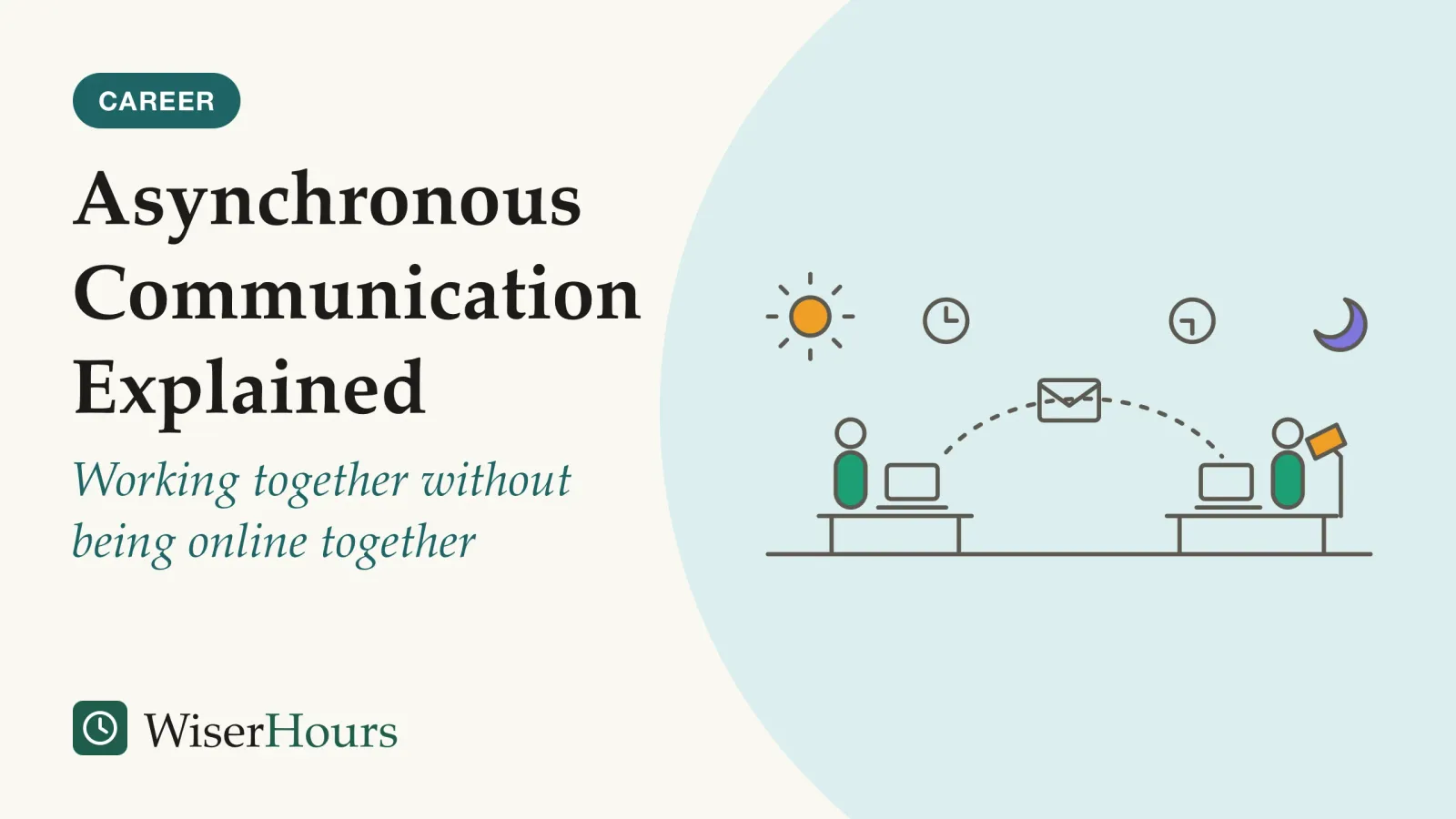
A message becomes asynchronous the moment nobody expects an answer to it right away. That is the whole idea of asynchronous communication: you send an update, a question or a document, and the other person reads and answers when it fits their own work. Email, comments on a shared file and recorded walkthroughs are typical. Its opposite, synchronous communication, needs everyone present at once, as in a meeting or a call.
The practical version fits in three habits: put updates in writing, talk through anything that needs agreement, and say in each non-urgent message when you need an answer.
Remote work makes the choice unavoidable, because the hallway conversation is gone. In a 2022 study of more than 61,000 Microsoft employees in the US, the authors estimate that company-wide remote work in 2020 cut synchronous communication, raised asynchronous communication and left people’s collaboration networks more siloed.1 If the vocabulary of remote, hybrid and distributed work is new to you, start with what remote and hybrid work actually mean; this guide looks only at how people who rarely share a room can still work together.
What is asynchronous communication?
Asynchronous communication separates sending from answering, so each person decides when to attend to a message. Media synchronicity theory, set out by the information-systems researchers Alan Dennis, Robert Fuller and Joseph Valacich in 2008, describes synchronicity as a shared pattern of coordinated behavior among people working together, which some media support better than others.2
Definition
Asynchronous communication is communication in which the sender does not expect an immediate reply, so people can read, think and respond at different times. Synchronous communication needs everyone present at the same moment.
That is why one app can do both jobs. A chat message answered within seconds while both people watch the screen is, in practice, a conversation. A recorded screen walkthrough that a colleague watches the next morning is asynchronous, even though it uses video.
Here is how that plays out. A designer posts three versions of a landing page to a team channel at 10 a.m. If the team expects comments by the end of the next day, everyone can look when they have a quiet moment, and the designer keeps working. If the manager replies “thoughts?” at 10:05 and waits, the same channel has turned into a meeting without a calendar invite.
The practical test: instead of asking whether your team is “doing async”, ask how quickly people believe they must answer each kind of message. That belief, more than the software, sets how your day feels.
After going remote, one large company leaned toward asynchronous messages
At Microsoft, a team led by Longqi Yang estimated that company-wide remote work in 2020 shifted people’s communication from synchronous toward asynchronous channels, a change that came with a move the pandemic forced, not a communication policy anyone chose. In the same study, published in Nature Human Behaviour, people’s networks also became more static after the move, with fewer bridges between different parts of the company.1
The design was a quasi-experimentalquasi-experimental: Describes a study that compares a group that got something with a group that did not, where the researcher did not do the assigning: a policy, a rollout or people's own choices did. Because the groups were not formed at random, they may have differed before it started.Full entry in the glossary: some employees already worked remotely before the pandemic, which let the authors separate the effect of everyone going remote from the other disruptions of 2020. Their conclusion is that the changes may make it harder for employees to find and share new information across the company.1 Two caveats matter. It is one technology company in the first months of the pandemic, and most of the authors worked at Microsoft, studying Microsoft’s own staff.
The study counted who communicated with whom, not why, but the pattern is not hard to imagine. In an office, a question to someone on another team often starts as a chance meeting at the coffee machine. At home, you would have to write to them, and it is easier to write to the colleagues you already know. The loose contacts that bring in fresh information fade, the pattern described in how weak ties spread new information.
The practical lesson: asynchronous by default is not the same as asynchronous by design. If your team went remote and simply kept working, the switch happened anyway. Decide on purpose which conversations still deserve live time, and who outside your immediate team you would lose touch with if nobody arranged it.
Write to share information, talk to settle what it means
Written, delayed messages suit passing information along, and live conversation suits agreeing on what it means, according to media synchronicity theory. Dennis and colleagues call the first process conveyance and the second convergence, and they argue that most tasks involving more than one person need both, so teams communicate better when they use a mix of media rather than one.2
- Conveyance: passing information along so others can take it in; the theory holds that less synchronous media, such as a written update, suit it better
- Convergence: agreeing on what the information means; the theory holds that more synchronous media, such as a call, suit it better
The reason is what each process asks of people. A status update only has to be read and understood, and writing lets the reader take it in at their own pace and come back to it later. Agreeing on a direction needs quick back-and-forth: a question, a correction, a “that’s not what I meant”, each shaping the next. Spread that across written replies, and a short conversation can stretch over several days.
Tone is the other trap. In a 2005 set of experiments by the psychologists Justin Kruger and Nicholas Epley with colleagues, people emailing short statements, some sarcastic and some serious, overrated how well readers would tell the two apart; in one experiment with university students, readers did no better than chance, while listeners did much better.3 The writer hears their own tone; the reader sees only the words. That is one reason guidance on writing a professional email warns against humor that relies on tone of voice, and why feedback and disagreement go wrong so easily in writing.
A newer study adds a caution about creative work. In 176 student teams studied by Mayssa Rishani and colleagues, teams that communicated more asynchronously tended to be less creative, and the authors traced the link to less thorough discussion of what each member knew.4 It is one study of students, known to us only from its abstract, and it shows an association rather than a cause. Still, it fits the theory: taking turns in writing suits delivering work better than building on each other’s ideas.
A simple rule puts that into practice: when a thread passes three rounds of “just to clarify”, switch to a call, then write down what you agreed so the people who missed it can catch up in their own time.
Further reading
A World Without Email: Reimagining Work in an Age of Communication Overload
Newport argues that unscheduled back-and-forth messaging fragments the working day, and sets out ways for a team to agree how and when it communicates.
Writing for Busy Readers: Communicate More Effectively in the Real World
Two researchers' rules for writing messages people can act on without coming back with questions, the stand-alone kind this article recommends.
As an Amazon Associate WiserHours earns from qualifying purchases.
Most messages carry a hidden deadline
Most written messages carry an unstated deadline, and readers tend to guess it is sooner than the sender meant. Laura Giurge and Vanessa Bohns, in experiments published in 2021, called this the email urgency bias: people who receive a non-urgent work email outside normal working hours overestimate how quickly the sender expects an answer.5
The study
Moderate evidence
Off-hours email looks more urgent to the reader than to the sender
Across six main and two supplemental studies, people who pictured or recalled receiving a non-urgent work email on an evening or weekend expected to need to reply faster than people who pictured or recalled sending one expected. The gap went with lower well-being and more stress. In the final study, a sentence at the end of the email saying the matter was not urgent left no clear gap for off-hours emails.5
The authors put it down to a difference in perspective. The sender knows the question can wait until Tuesday; the receiver sees only a message from a colleague on a Saturday and has to guess. Within normal working hours the evidence was mixed, with the gap appearing in some studies and not others, and most studies asked people to imagine an email rather than tracking real inboxes, so nobody yet knows how large the effect is in a real working week.5
The authors draw the practical conclusion themselves:
the need to explicitly communicate non-urgent expectations.
The note the researchers tested simply said the matter was not urgent and could be answered whenever convenient. In practice, you might write “No rush: any time before Thursday’s review is fine.” Adding a date goes one step beyond what was tested, but it costs the sender a few words and spares the reader a guess. A late-evening message from a manager deserves the same line, although the authors list the relative power of sender and receiver as a question for future research, so how seniority changes the bias is untested.
Fewer interruptions are the payoff, if replies can wait
The main thing asynchronous communication buys is uninterrupted time, and it only does so when people are allowed to leave messages unread for a while. In a 1999 field study of one software team, Leslie Perlow saw engineers struggling to finish their own work because colleagues kept interrupting them; protected quiet time helped the team, in her account, but its effect had mostly faded when she returned months later.6 The story of that experiment, and why it faded, is told in the guide to time blocking.
Perlow was not studying asynchronous tools, but her engineers show the logic. Most of the interactions they logged were helpful but could have been planned for later, yet almost all happened on the spot.6 A question asked in person or by instant message interrupts at once. Moving such questions to a channel people check at set times turns many small interruptions into one short batch, and what an interruption costs you explains why each break is more expensive than it looks.
Checking less often may help individuals too. Kostadin Kushlev and Elizabeth Dunn found in 2015 that a week of checking email only three times a day came with less daily stress than a week of unlimited checking, a result the guide on how to focus weighs with its caveats.7
- Myth
- Moving conversations from meetings to chat automatically gives people more focus time.
- Fact
- Written messages protect focus only if people are free to read them later. If every message needs an answer within minutes, chat interrupts much like a tap on the shoulder.
What to watch for: if your team moved from meetings to chat and nobody feels calmer, check the reply expectation. A channel where everyone watches for new messages all day is synchronous communication with worse tone.
Setting team rules for replies, channels and live time
Asynchronous communication works when a team agrees in advance which messages can wait, how long they can wait, and when people talk live instead. We found no trial of a full “async-first” team policy, so the rules below come from the studies above and are suggestions to test, not proven recipes.
| Kind of message | Better default | Why |
|---|---|---|
| Status update, announcement, background reading | Written, read when convenient | Passing information along suits less synchronous media2 |
| Feedback where tone matters | A short conversation first, then a written note | Senders overestimate how well tone comes across in email3 |
| Disagreement, or a goal nobody agrees on yet | Live discussion, then a written summary | Agreeing on meaning suits more synchronous media2 |
| Open-ended idea generation | At least some live discussion | In one study, student teams that communicated more asynchronously tended to be less creative4 |
| Non-urgent question outside working hours | Written, saying when it needs an answer | Readers overestimate the urgency the sender intended5 |
Two further habits follow from the same evidence. Write messages that stand alone: name the request, the date you need it and what happens if nobody answers, so the reader does not have to come back with questions. And keep a little shared live time, because in the Microsoft data, networks grew more siloed as live contact fell.1
Here is what that can look like in an illustrative agreement for a small product team. Updates go in the project channel and need no reply. Questions carry a reply-by date and get an answer by then. Anything needed the same day goes by direct message with “today” in the first line. A half-hour call twice a week takes whatever the threads could not settle, and someone posts the outcome afterwards. The exact times matter less than writing them down, for the reason the urgency-bias experiments give: a reader left to guess tends to guess a sooner deadline than the sender meant, at least for messages sent after hours.5
Other guides in this cluster, still to come, will go further into writing things down so you are not the bottleneck, handing work across time zones and showing colleagues when you are available.
The bottom line
Asynchronous communication lets people work together without being online together, but only when the team says how fast replies are needed. Put updates and reference material in writing, settle disagreements and feedback in conversation, and add one line to non-urgent messages saying when you need an answer. The evidence is thin on whole-team policies, so treat your rules as a trial and adjust them.
Frequently asked questions
Is email synchronous or asynchronous?
Email is usually asynchronous, because the sender does not expect the reader to be there when it arrives. A channel becomes synchronous when people expect an immediate answer, whatever the tool. In media synchronicity theory, which Alan Dennis and colleagues set out in 2008, synchronicity means people working together in a shared, coordinated pattern, and media differ in how well they support it.
Is team chat asynchronous communication?
Team chat can be either. A message answered within seconds while both people are online works like a conversation; the same message read an hour later is asynchronous. Teams get the benefits of asynchronous communication only when they agree which messages can wait, for example by saying in the message when it can wait, as Laura Giurge and Vanessa Bohns suggest in their 2021 research on email.
Does asynchronous communication slow projects down?
It can, and we found no study that measures the net effect. Waiting for a reply adds delay when a decision needs several rounds of questions, and in one 2025 study of student teams, groups that worked more asynchronously tended to be less creative. Written updates save time when information only needs to be passed on, which media synchronicity theory predicts. The evidence is too thin to give a net figure.
What are examples of asynchronous communication at work?
Common examples are email, comments on a shared document, a project update posted to a team channel, a recorded video walkthrough and a ticket in a task tracker. Each lets the reader take in the message later. The same tools become synchronous when people are expected to answer while the sender waits, which is why teams benefit from saying how fast replies are needed.
Sources
- The effects of remote work on collaboration among information workers. Yang, L., Holtz, D., Jaffe, S., Suri, S., Sinha, S., Weston, J., Joyce, C., Shah, N., Sherman, K., Hecht, B. & Teevan, J. (2022). Nature Human Behaviour, 6(1), 43-54
- Media, Tasks, and Communication Processes: A Theory of Media Synchronicity. Dennis, A. R., Fuller, R. M. & Valacich, J. S. (2008). MIS Quarterly, 32(3), 575-600
- Egocentrism over e-mail: Can we communicate as well as we think? Kruger, J., Epley, N., Parker, J. & Ng, Z.-W. (2005). Journal of Personality and Social Psychology, 89(6), 925-936
- When Do Teams Communicate More Asynchronously to Support Their Members' Multiteaming? Rishani, M., Hoever, I. J. & van Dierendonck, D. (2025). Small Group Research, 56(6), 950-986
- You don't need to answer right away! Receivers overestimate how quickly senders expect responses to non-urgent work emails. Giurge, L. M. & Bohns, V. K. (2021). Organizational Behavior and Human Decision Processes, 167, 114-128
- The Time Famine: Toward a Sociology of Work Time. Perlow, L. A. (1999). Administrative Science Quarterly, 44(1), 57-81
- Checking email less frequently reduces stress. Kushlev, K. & Dunn, E. W. (2015). Computers in Human Behavior, 43, 220-228
How we researched this
Research for this guide came from Crossref, PubMed, Europe PMC and journal pages in September 2026, looking for workplace research on asynchronous and synchronous communication, expected reply times and remote collaboration; experiments and large field datasets came first. Sources date from 1999 to 2025. The chief gap: we found no trial of an asynchronous-first team policy. Three papers were available to us only as abstracts, and nothing beyond those abstracts is used.
Keep reading
Return-to-Office Mandates: What the Research Says About Productivity and Retention
Studies find no clear gain in firm performance after return to office mandates; a 2024 trial found two home days a week cut resignations by a third.
Proximity Bias Explained: Why Out of Sight Can Mean Out of Mind
Proximity bias favors the people a manager sees. In a Chinese trial published in 2015, home workers were promoted less for equal performance. Here is why.
Remote, Hybrid, and Distributed Work: What the Terms Actually Mean
Remote vs hybrid work, defined. In the year to August 2026, 26% of US full-time employees were hybrid and 12% fully remote. Why surveys count differently.