Foods That Help You Sleep (and Foods That Hurt): What the Evidence Supports
Foods that help you sleep, graded: a 2016 review found food trials too small for firm conclusions. What kiwi, tart cherry, fish and fiber show.

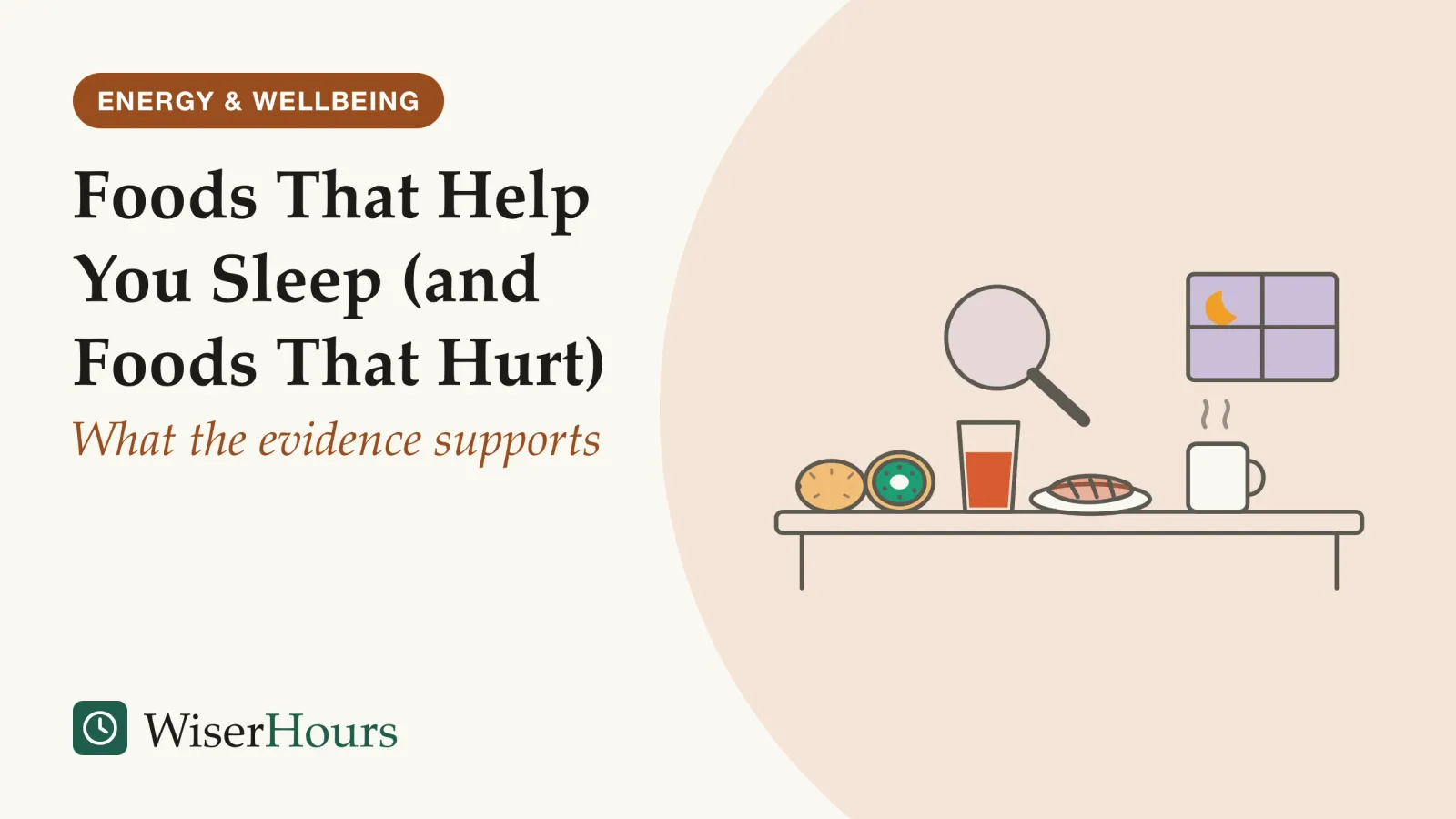
Most of the trials behind the famous sleep foods could fit in a classroom. The kiwifruit advice rests on two dozen adults in Taiwan, the salmon advice on 95 men at a single US facility. A 2016 review in Advances in Nutrition by Marie-Pierre St-Onge and colleagues at Columbia University in the US examined milk, fatty fish, tart cherry juice and kiwifruit, and found the studies too varied, short and small for firm conclusions.1
No single food has strong evidence as a sleep aid. The closest thing to foods that help you sleep is a whole way of eating, rich in fiber, fruit and vegetables and lighter on sugar and saturated fat, with no big meal, caffeine or alcohol close to bedtime. Ranked by how well each option has been tested:
- A fiber-rich, plant-heavy eating pattern, such as a Mediterranean-style diet: linked to better sleep in many observational studies and a small lab study.
- Tart cherry: a handful of small randomized trials that disagree.
- Kiwifruit: a few small studies; the best known had no comparison group.
- Fatty fish: one trial in which the comparison group’s sleep got worse while the fish group’s held steady.
- Milk and dairy: small, often low-quality studies with mixed results.
- Nuts, seeds, oats, turkey and bananas: recommended for nutrients such as tryptophan or magnesium, and absent from the food trials in the 2016 review.
The habits that do most for sleep start with a steady wake time rather than food, and the evidence on magnesium for sleep covers the seeds, nuts and greens on these lists.
Why no single food works like a sleeping pill
No single food works like a sleeping pill because sleep-related compounds such as tryptophan and melatonin arrive in small amounts alongside everything else on the plate, and the 2016 Advances in Nutrition review found that the sleep studies it examined had not measured how much tryptophan could reach the brain.
Tryptophan, an amino acid, is the raw material for serotonin and melatonin, but it competes with other amino acids to enter the brain. In animal studies, high-carbohydrate, low-protein meals raised the brain’s share of tryptophan compared with higher-protein meals, which suggests a protein-rich turkey dinner may be a poor delivery route, and no human sleep study in the review measured this balance. Melatonin in food has a dose problem: in one trial, older adults who drank half a liter a day of melatonin-rich night-time milk showed no rise in blood melatonin.1
Expectation is the other trap. People know when they are eating salmon or kiwi, so food studies cannot hide the treatment the way a pill trial can; the authors of the best-known fish study call blinding “hardly possible” in food trials.2
- Myth
- Turkey and warm milk make you sleepy because they are full of tryptophan.
- Fact
- Other amino acids in protein-rich food compete with tryptophan to reach the brain, and in one trial melatonin-rich milk did not raise blood melatonin.
When a list says a food “contains melatonin” or “is rich in tryptophan”, read that as the reason someone tested it, then look for what the test found.
Do kiwis help you sleep? One small study carries the claim
Kiwis may help some poor sleepers, though the evidence is thin. The 2011 study behind the advice, from Taipei Medical University in Taiwan, had no comparison group beyond each person’s own sleep before the kiwi, and the kiwifruit company Zespri International funded it.
The study
Limited evidence
Kiwi nights looked better, with nothing to compare them against
Researchers asked 24 adults who reported sleeping badly to eat two green kiwifruit an hour before bed every night for four weeks. Wrist activity monitors recorded nearly an hour more sleep a night than in the three days before they started, and sleep diaries showed they fell asleep faster and woke less. The authors note that without a placebo or crossover design they could not measure how much came from expectation.3
A before-and-after gain like this could come from any change people believe in, so it justifies a proper trial without proving the fruit works. A small 2023 crossover trial in young men in New Zealand, supported in kind by Zespri, compared one evening’s kiwifruit with water: dried kiwifruit improved some self-rated measures, such as morning alertness, while fresh kiwifruit made no clear difference to them.4
- Before: sleep measured over a few days, with no food change yet
- After: the same people after weeks of eating the food every night
- Missing comparison group: without one, expectation or time could explain the change. Bar heights are illustrative, not data
If you like kiwi and it agrees with you, two after dinner cost little. Keep a short sleep diary for two weeks before and two weeks during the change, so you judge it on more than a good first night.
Tart cherry has small trials, and they disagree
Tart cherry, mostly tested as Montmorency cherry juice or concentrate, has a handful of small randomized trials with mixed results. A 2025 systematic review by researchers in Iran and Australia found seven trials, three of which reported better sleep, and called the evidence limited and varied.5
In a 2010 US pilot trial in older adults with insomnia, two weeks of a tart cherry juice blend reduced insomnia severity and time awake at night compared with a placebo drink, but not the time taken to fall asleep or total sleep; the juice maker, CherryPharm, paid for the whole study.6 A 2024 US trial of capsules in adults with overweight or obesity, funded by the Cherry Marketing Institute, an industry body, found no effect on any sleep measure.7
Concentrates and capsules are often sold as supplements, which raises a safety question. In the US, the FDA does not review supplements for effectiveness before sale and, in 2022 guidance, warns that some can change how medicines are absorbed, broken down or excreted.8 In the EU, food supplements come under a 2002 directive whose harmonised lists cover vitamins and minerals.9 Rules differ by country, so readers elsewhere can check with their national food or medicines regulator.
Before you buy a tart cherry concentrate or capsules
Show the label to a pharmacist if you take any prescription or over-the-counter medicine, if you are pregnant, if you breastfeed, or if the product is meant for a child. The US FDA (2022) advises talking to a health professional before combining supplements with medicines.
Fatty fish: in the salmon study, the meat group slept worse
Fatty fish rests on one notable trial, which shows less than the headlines suggest. In a 2014 study led by Norwegian researchers at the University of Bergen, 95 men at a secure forensic psychiatric facility in the US ate either Atlantic salmon or chicken, pork or beef three times a week through the winter. Time to fall asleep grew longer in the meat group, and the salmon group reported better daily functioning. The University of Bergen and Haukeland University Hospital funded the study, with the salmon donated by Skretting ARC.2
The 2016 review reads the sleep result cautiously: because the fish group’s sleep stayed about the same, it is fairer to say the meat meals may have worsened sleep than that fish improved it. The men also had little daylight, which may have mattered for vitamin D, so the finding travels poorly to most readers.1 Salmon can stay on the menu, but this trial gives no reason to add it for sleep.
Foods that help you sleep work as a pattern
Across the whole day, eating more fiber and less sugar and saturated fat is linked to deeper, less broken sleep, which makes the overall pattern the closest thing nutrition research has to a sleep food. The clearest test is a small 2016 US inpatient study by St-Onge’s team, funded by the National Institutes of Health.
In it, 26 healthy adults ate a fixed, balanced menu in a sleep lab, then chose their own food for a day. After eating what they liked, falling asleep took them longer and they had less deep (slow-wave) sleep. More fiber went with more deep sleep, a higher share of calories from saturated fat with less of it, and more sugar with more brief awakenings. With one self-chosen day of data, these are links rather than proof, and the authors say diet as a sleep treatment still needs testing.10
Studies of everyday diets agree. A meta-analysis published in 2025 by a team from Harvard Medical School (US) and the University of Murcia (Spain) pooled 62 studies of children and adults and found that those who slept enough or slept well were more likely to eat a Mediterranean-style diet. Studies of this kind cannot separate cause from effect, and the authors cite earlier work hinting that the link runs both ways.11
It’s better to focus on overall healthy dietary patterns throughout the day rather than focus on a specific food or drink to improve sleep.
The pattern the sleep research favors matches general healthy-eating advice: more fruit and vegetables, whole grains for their fiber, and vegetable oils in place of saturated fat.1 A day built that way might start with oats and fruit, add beans and vegetables to lunch, and end with a moderate dinner of fish or chicken with brown rice, with fewer cookies and sweet drinks in the evening.
Which sleep foods have the best evidence?
Every food on the usual lists rests on limited evidence from small, short studies, several of them funded by the industry that sells the food.
| Food or pattern | What the best evidence found | Evidence |
|---|---|---|
| Fiber-rich diet, lower in sugar and saturated fat | In 26 US adults in a sleep lab, more fiber went with more deep sleep and more sugar with more awakenings; NIH-funded | Observational analysis within a small lab study, limited10 |
| Kiwifruit | Sleep improved after four weeks in Taiwanese adults with sleep complaints, with no comparison group; Zespri-funded | Uncontrolled study, limited3 |
| Tart cherry | Of seven small trials, three reported better sleep; doses, length of use and participants varied widely | Systematic review of small trials, limited5 |
| Fatty fish | In 95 men at a US secure facility, sleep onset worsened with meat meals and held steady with salmon | Trial, limited2 |
| Milk and dairy | 14 studies from 1972 to 2019 gave mixed results; funded by the Japan Dairy Association | Systematic review, limited13 |
What foods should you avoid before bed?
The foods and drinks with the clearest case against them at night are caffeine sources, alcohol, and large, fatty or spicy meals close to bedtime. The US National Heart, Lung, and Blood Institute (NHLBI), in guidance last updated in 2022, advises against heavy or large meals in the few hours before bed, alcoholic drinks before bed, and caffeine from coffee, tea, caffeinated soda and chocolate.14
Coffee is the obvious culprit, and how late caffeine affects sleep depends on the dose and on how fast your body clears it. The UK’s NHS insomnia page (reviewed 2024) lists alcohol, caffeine and nicotine among the most common causes of insomnia, and its self-help advice is to keep alcohol, tea and coffee out of the last 6 hours before bed and to skip a big meal late at night.15
Fatty and spicy foods, along with coffee, alcohol, chocolate and tomatoes, are common heartburn triggers, and symptoms are often worse lying down, the NHS says; for people with reflux it advises leaving 3 or 4 hours between the last meal and bed.16 A nurse coming off a late shift who eats a large curry with a sugary soda at 11 p.m. has stacked several risks at once: a big meal, spice, sugar and possibly caffeine, all just before sleep.
What is the best thing to eat before bed?
If you are hungry at bedtime, a light snack is fine under the NHLBI’s advice, and the best choice is a small one you already know sits well with you.14
Your usual habits matter too. In an older study described in the 2016 review, people who normally ate within an hour of bedtime slept best after a malted milk drink, while those who did not slept best after an inactive capsule, and the authors concluded that eating habits shape how bedtime food affects sleep.1 A habitual late snacker may do better with a small, familiar snack; someone who never eats after dinner has little reason to start.
A light option could be a kiwi or two, a small pot of yogurt, a bowl of oats or a slice of wholegrain toast. A warm drink such as milk is fine if it calms you, though the dairy evidence above is mixed.
Evening eating for better sleep
Sleep problems that a change of diet will not fix
Months of bad nights, loud snoring, gasping at night or heavy daytime tiredness call for a doctor’s visit, whatever you eat. We sorted UK NHS advice by urgency; readers elsewhere can use their own country’s services.
- Now: if a food sets off sudden swelling of the lips, mouth or throat, trouble breathing or sudden confusion, call your local emergency number (999 in the UK, 911 in the US, 112 across the EU), because the NHS lists these as signs of a serious allergic reaction, and any food can cause one.17
- Soon: see a GP or family doctor if better bedtime routines have not worked, bad nights have continued for months, or it leaves you struggling to get through the day.15 Pauses in breathing during sleep, gasping or choking noises, or constant daytime exhaustion are signs of sleep apneasleep apnea: A condition in which breathing repeatedly stops and starts during sleep, often with loud snoring, gasping and daytime sleepiness. It needs a sleep test and a doctor to diagnose; a phone or watch alert can prompt a test but cannot rule it in or out.Full entry in the glossary that the NHS says a GP should see.18 An overview of common insomnia types and their causes makes useful reading beforehand.
- At your next appointment: mention any supplement you take for sleep, tart cherry products included, so it can be checked for clashes with your other medicines.
The bottom line
The whole day’s eating matters more for sleep than any one bedtime food, so build meals on fiber, fruit and vegetables, go easy on sugar and saturated fat, and keep big meals, caffeine and alcohol away from bedtime. Kiwi or tart cherry is a cheap experiment if you enjoy them; track your sleep for two weeks, and run any concentrate or capsule past a pharmacist. If bad nights have run for months, see your doctor.
This article is general information, not medical advice. If you're worried about your health, talk to a doctor or another qualified professional.
Frequently asked questions
Does warm milk help you sleep?
Warm milk has little direct evidence behind it. A 2020 Japanese systematic review of 14 dairy studies, funded by the Japan Dairy Association, concluded that dairy may help sleep, but results were mixed and the studies often small and of poor quality. Older studies described in a 2016 Advances in Nutrition review tested malted milk drinks, which add wheat, malted barley, sugar and vitamins. If a warm drink calms you and sits well, there is little reason to drop it.
What foods help you fall asleep faster?
No food reliably shortens the time it takes to fall asleep. In one small study of 12 healthy young men, described in a 2016 Advances in Nutrition review, a high-glycemic-index rice dinner eaten 4 hours before bed shortened the time to fall asleep compared with a low-glycemic-index dinner or the same meal 1 hour before bed. The same review warns that simple sugars may disturb later sleep.
How long should I try a food before deciding whether it helps my sleep?
There is no tested answer. Most food trials described here ran from one evening to a few weeks, so a fair personal test takes at least a couple of weeks. Keep a simple sleep diary for two weeks before and two weeks during it, change nothing else if you can, and remember that expecting a food to help can itself make nights feel better.
Sources
- Effects of Diet on Sleep Quality. St-Onge, M.-P., Mikic, A. & Pietrolungo, C. E. (2016). Advances in Nutrition, 7(5), 938-949
- Fish Consumption, Sleep, Daily Functioning, and Heart Rate Variability. Hansen, A. L., Dahl, L., Olson, G., Thornton, D., Graff, I. E., Frøyland, L., Thayer, J. F. & Pallesen, S. (2014). Journal of Clinical Sleep Medicine, 10(5), 567-575
- Effect of kiwifruit consumption on sleep quality in adults with sleep problems. Lin, H.-H., Tsai, P.-S., Fang, S.-C. & Liu, J.-F. (2011). Asia Pacific Journal of Clinical Nutrition, 20(2), 169-174
- Acute effects of fresh versus dried Hayward green kiwifruit on sleep quality, mood, and sleep-related urinary metabolites in healthy young men. Kanon, A. P., Giezenaar, C., Roy, N. C., McNabb, W. C. & Henare, S. J. (2023). Frontiers in Nutrition, 10, 1079609
- The Effect of Tart Cherry on Sleep Quality and Sleep Disorders: A Systematic Review. Barforoush, F., Ebrahimi, S., Abdar, M. K., Khademi, S. & Morshedzadeh, N. (2025). Food Science & Nutrition, 13(9), e70923
- Effects of a tart cherry juice beverage on the sleep of older adults with insomnia: a pilot study. Pigeon, W. R., Carr, M., Gorman, C. & Perlis, M. L. (2010). Journal of Medicinal Food, 13(3), 579-583
- Commonly Used Dose of Montmorency Tart Cherry Powder Does Not Improve Sleep or Inflammation Outcomes in Individuals with Overweight or Obesity. Tucker, R. M., Kim, N., Gurzell, E., et al. (2024). Nutrients, 16(23), 4125
- Mixing Medications and Dietary Supplements Can Endanger Your Health. U.S. Food and Drug Administration (content current as of 2 June 2022)
- Food supplements. European Commission, Directorate-General for Health and Food Safety (EU)
- Fiber and Saturated Fat Are Associated with Sleep Arousals and Slow Wave Sleep. St-Onge, M.-P., Roberts, A., Shechter, A. & Choudhury, A. R. (2016). Journal of Clinical Sleep Medicine, 12(1), 19-24
- Sleep and the Mediterranean diet: A systematic review and meta-analysis. Arab, A., Lempesis, I. G., Garaulet, M. & Scheer, F. A. J. L. (2025). Sleep Medicine Reviews, 80, 102071
- Foods That Help You Sleep. Sleep Foundation (US), updated 5 August 2025
- The Effects of Milk and Dairy Products on Sleep: A Systematic Review. Komada, Y., Okajima, I. & Kuwata, T. (2020). International Journal of Environmental Research and Public Health, 17(24), 9440
- Healthy Sleep Habits. National Heart, Lung, and Blood Institute, National Institutes of Health (US), last updated 24 March 2022
- Insomnia. NHS (UK), page last reviewed 19 March 2024
- Heartburn and acid reflux. NHS (UK), page last reviewed 20 November 2023
- Food allergy. NHS (UK), page last reviewed 20 August 2026
- Sleep apnoea. NHS (UK), page last reviewed 11 May 2026
How we researched this
In October 2026 we searched Europe PMC and PubMed for trials and reviews of specific foods and dietary patterns in relation to sleep, read the full text of every paper we cite (older studies appear as the 2016 review describes them) and checked each study's funding. We compared general advice from the US NHLBI and FDA, the UK NHS, the European Commission and the Sleep Foundation. The research dates from 2010 to 2025. Most food trials are small, short and cannot be blinded.
Keep reading
How Late Is Too Late for Coffee? Caffeine's Half-Life and Your Sleep
Caffeine's half-life is about 3 to 7 hours in adults, so an afternoon coffee is still working at bedtime. How dose, timing and your body set your cutoff.
Sleep and ADHD: Why Winding Down Is Harder and What May Help
ADHD and sleep: a late body clock, a busy mind, stimulant timing, restless legs or apnoea. What a 13-study review measured, and habits that may help.
How to Fix Your Sleep Schedule After Holidays, Travel, or a Bad Week
How to fix your sleep schedule: keep one wake time, get morning light, dim evenings and shift about an hour a day. A 5-day plan for a 2 to 3 hour slide.
Why You Wake Up at 3 AM: Common Causes, What to Do, and When to See a Doctor
Why do I wake up at 3am? Sleep runs in 80- to 100-minute cycles with brief wakings between them. The real causes, what to do, and when to see a doctor.