Why You Wake Up at 3 AM: Common Causes, What to Do, and When to See a Doctor
Why do I wake up at 3am? Sleep runs in 80- to 100-minute cycles with brief wakings between them. The real causes, what to do, and when to see a doctor.

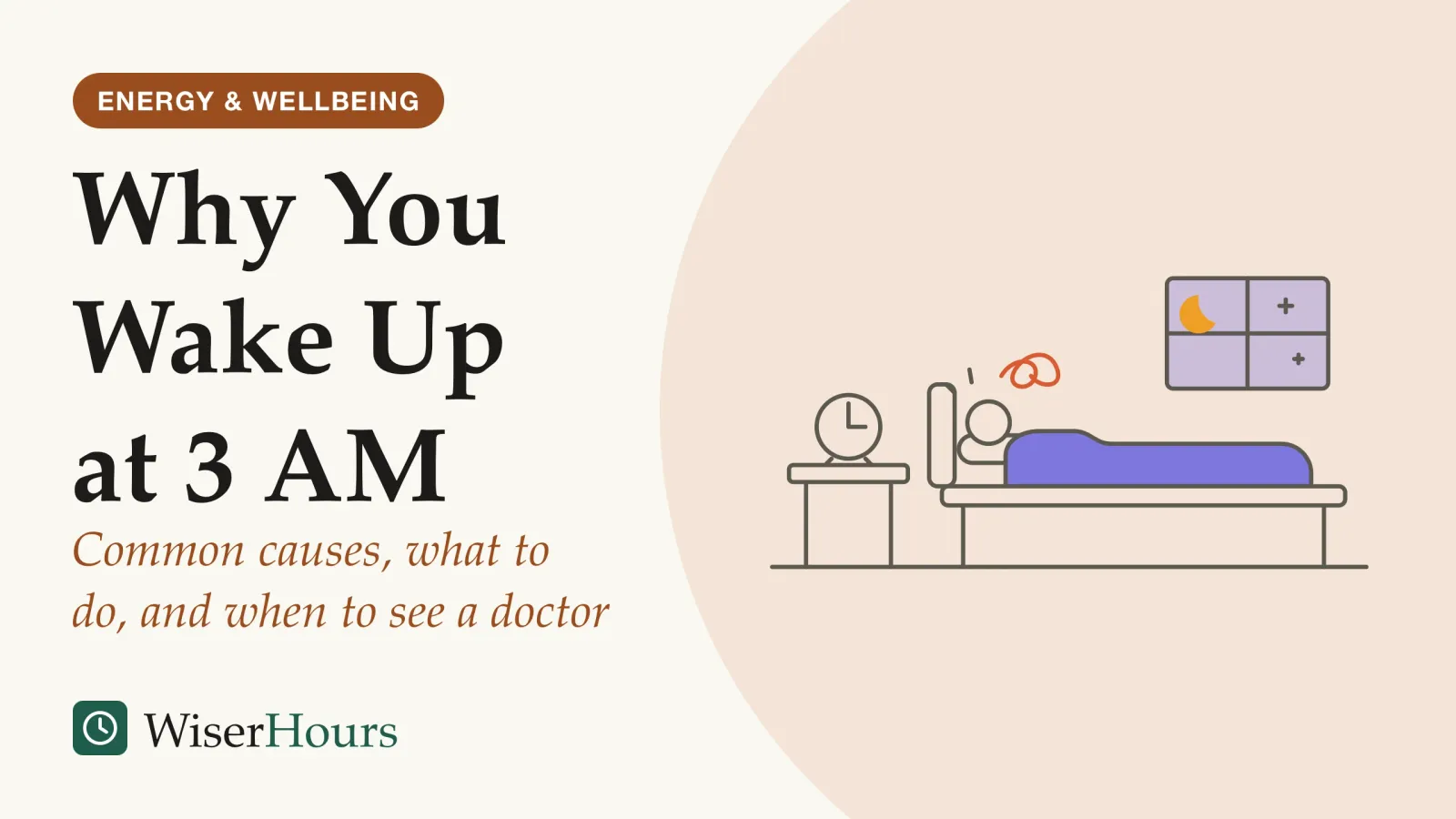
The room is dark and the clock says 3:04. A minute ago you were asleep; now tomorrow’s first meeting is playing in your head, and you are counting the hours to the alarm.
So why do I wake up at 3am? Often you surface briefly between sleep cycles, as many sleepers do, and something keeps you up: a worry, an evening drink, a full bladder, or now and then a health problem worth checking. The hour itself is not special. For anyone asleep by late evening, that hour falls in the lighter, later part of the night, with much of the deep sleep already behind them. What helps in the moment:
- Hide the clock and let sleep come.
- Get up if sleep has not returned in about 20 minutes.
- Put the worry on paper.
- Keep your usual wake-up time.
Why do I wake up at 3am? Sleep gets lighter as the night goes on
The shape of a night’s sleep explains it. The US National Heart, Lung, and Blood Institute (NHLBI) describes a night as four to six cycles of non-REM and REM sleep, each lasting 80 to 100 minutes, and says you may wake up briefly between cycles. You usually spend more time in deep sleep early in the night and have more REM sleep later.1
- Early cycles: you usually spend more time in deep sleep early in the night
- Between cycles: a cycle runs about 80 to 100 minutes, and you may wake briefly at the end of one
- Later cycles: less deep sleep and more REM sleep, the stage in which dreaming usually happens
- Reading the drawing: bands from top to bottom are awake, REM, light and deep sleep; bedtime is on the left and morning on the right. The shape is illustrative, not real data
Put that on a clock. Asleep by 11 p.m., you have had much of the night’s deep sleep by the small hours, and you cross into a new cycle every hour and a half or so. A brief waking there is ordinary, and staying asleep gets harder with age, the NHLBI notes, as brain cells that promote sleep are lost in normal aging.2 What changes the night is whether you notice a waking, check the time and start thinking.
Many websites tie 3 a.m. waking to a cortisol “spike.” In fact, cortisolcortisol: A hormone made by the adrenal glands that helps regulate energy, blood pressure and the body's response to stress. Its level follows a daily rhythm, high on waking and low at night, so a single reading says little on its own.Full entry in the glossary typically follows a daily rhythm: a 2015 review from Brazil describes it bottoming out near midnight, starting to rise a few hours after you fall asleep, and climbing to a peak in the morning.3 That rise belongs to a typical night, not to one fixed hour.
- Myth
- Waking at 3 a.m. means your cortisol spikes at that hour, or that the time carries a hidden meaning.
- Fact
- On a typical night, cortisol starts rising a few hours after sleep begins and keeps climbing toward morning, as part of the body's daily rhythm. We found no study showing that 3 a.m. itself means anything.
The clock time is a quirk; the better questions are why you stayed awake and how often it happens.
Is it normal to wake up in the middle of the night?
Yes. Population surveys find that waking in the night is very common, and that waking alone, without trouble getting back to sleep, is rarely linked to problems the next day. A large US telephone survey gives the clearest answer.
The study
Moderate evidence
Waking is common; getting back to sleep is what matters
Maurice Ohayon and colleagues at Stanford University interviewed a representative sample of 8,937 adults in California, New York and Texas. About a third said they woke in the night at least 3 nights a week, and fewer than half of those had trouble getting back to sleep. People who woke once or twice a night without that trouble were nearly indistinguishable, in sleep quality and sleep time, from people who did not wake regularly. Trouble getting back to sleep was what went with shorter, poorer sleep and problems during the day. As a one-off self-report survey, it shows associations, not causes. Funding came from the US National Institutes of Health, private foundations and an educational grant from the drug maker Sanofi-Aventis.4
A companion cross-sectionalcross-sectional: Describes a study that measures everyone in its sample at a single point in time. Because the possible cause and the outcome are recorded together, it can show that two things occur together but not which of them came first.Full entry in the glossary survey by Ohayon in France, the UK, Germany, Italy and Spain found a similar share of frequent night waking, according to its abstract, the only part read.5
Picture two people who both wake at 3 a.m. One is asleep again within minutes; the other lies awake until five, going over money and work. In the survey’s terms only the second has trouble getting back to sleep, the pattern that went with worse days. So judge your nights by how long you stay awake: a waking you barely remember is normal, while lying awake for an hour most nights is worth acting on.
Stress, alcohol and a full bladder: the everyday causes
Long 3 a.m. wakings often have an ordinary explanation. NHS guidance in the UK names stress and worry, alcohol, caffeine, heavy meals, an uncomfortable room and some medicines among the reasons people sleep poorly, and says stress or anxiety can leave your body more alert and your mind full of worrying thoughts.6
At 3 a.m. nothing interrupts those thoughts, so a passing thought about a deadline becomes ruminationrumination: Repetitive, passive dwelling on problems, feelings or their causes and consequences, without moving toward a solution. It is linked to depression and anxiety, and when it is about work it can keep the job on your mind long after the working day ends.Full entry in the glossary: the same problem replayed without getting closer to a plan. The waking was brief and normal; the worry is what stretches it out.
- 1A brief wakingbetween two sleep cycles
- 2A look at the clockand a sum of the hours left
- 3A worry takes holdthe same problem, replayed
- 4Awake for an hourthe waking has become the problem
Alcohol can help you drop off and still cost you the second half of the night. A 2013 review of studies in healthy volunteers found that alcohol, at every dose tested, made the first half of sleep more settled but increased disruption in the second half (its abstract, not the full text, was read).7 If your wakings cluster after a couple of glasses of wine at dinner, the timing may be no coincidence.
A full bladder is the third common culprit. MedlinePlus, the US National Library of Medicine’s consumer health service, says the body normally makes less urine at night, and that evening fluids, caffeine or alcohol with dinner, bladder infections, an enlarged prostate, pregnancy, diabetes and water pills (diuretics) can change that. It also links frequent night-time urination to sleep apnea, and says to contact a health professional if it lasts several days or comes with pain, burning or blood.8
Before suspecting anything unusual, look at the day before the bad night. Jotting down each evening what you drank, how late, and what was on your mind may show a pattern within a week or two.
Is waking up at 3am a sign of anxiety or depression?
It can be one sign, but on its own it proves nothing. The NHS lists disturbed sleep, including waking very early in the morning, among the symptoms of depression, alongside continuous low mood, losing interest in things that used to bring pleasure, and feeling hopeless.9 It also lists difficulty sleeping among the symptoms of generalised anxiety disorder, an anxiety disorderanxiety disorder: A mental health condition in which worry or fear is persistent, out of proportion to the situation and hard to control, and gets in the way of daily life. It differs from ordinary anxiety, which passes, and it is diagnosed by a clinician.Full entry in the glossary in which worry is difficult to rein in and affects daily life.10
What separates a symptom from a bad patch is the company it keeps. Waking at 3 a.m. after a stressful week, while your days still feel like your own, differs from waking early most mornings with a heavy mood that lasts all day. The NHS threshold for seeing a GP is depression symptoms that last most of the day, every day, for more than 2 weeks.9
If night waking ever brings thoughts of suicide or self-harm, those thoughts matter far more than the lost sleep; the help section below says where to turn.
Medical causes worth ruling out: sleep apnea, reflux, menopause and medicines
A few health problems wake people repeatedly, and each has signs of its own beyond the waking. Someone who snores loudly, wakes many times and nods off in afternoon meetings has a different problem from someone who wakes once to use the bathroom.
sleep apneasleep apnea: A condition in which breathing repeatedly stops and starts during sleep, often with loud snoring, gasping and daytime sleepiness. It needs a sleep test and a doctor to diagnose; a phone or watch alert can prompt a test but cannot rule it in or out.Full entry in the glossary comes first. The NHS describes breathing that stops and starts during sleep, gasping, snorting or choking noises, loud snoring and waking up a lot, with tiredness or a morning headache by day. Because the signs happen while you sleep, it suggests asking someone to watch.11
Acid reflux is often worse after eating and when lying down, the NHS says. It suggests not eating within 3 or 4 hours of bed and raising the head of the bed with blocks rather than extra pillows, and advises seeing a GP for heartburn on most days, or with food getting stuck or unexplained weight loss.12
In perimenopause and menopause, trouble getting to sleep or staying asleep is a recognized symptom, which the NHS notes may be worse with night sweats.13
Medicines can affect sleep too. If you suspect one, the NHS advice is to check the leaflet’s side effects and speak to a GP or pharmacist. Talk to one of them before changing or stopping a prescribed medicine.6
What to do when you wake at 3am and cannot get back to sleep
These steps come from NHS sleep-habit guidance for adults; if you work nights or care for someone through the night, they may need adapting to your hours.
1. Hide the clock and let sleep come
The NHS suggests keeping clocks out of view, placing your phone face down and not trying to force sleep: when you are comfortable and resting, you may fall asleep naturally.14 Counting the hours until the alarm only adds pressure to a waking that might otherwise pass.
2. Get up if sleep has not returned in about 20 minutes
Once around 20 minutes have passed without sleep, the NHS suggests getting up, sitting somewhere comfortable and doing something relaxing, such as reading or listening to quiet music, and returning to bed only once drowsiness comes back. The idea, which sleep clinicians build on in stimulus control (below), is to keep bed from becoming the place where you lie awake and fret. Leave the phone alone: the same NHS advice warns that screen light can make it harder to fall asleep.14
Getting up safely
If you are unsteady on your feet, have mobility problems or take sleeping pills, getting up in the night carries a risk of falling. The American Academy of Sleep Medicine notes that this kind of advice may need adapting for safety in those groups, so check with your doctor what is safe for you.15
3. Put the worry on paper
Writing worries down can help you manage them, the NHS says, and if you often worry in bed, it suggests listing the next day’s tasks before sleep.14 A 3 a.m. thought then has somewhere to go.
4. Keep your usual wake-up time
Sleeping late after a rough night feels like repair, but the NHS advises keeping similar bed and wake times every day, even on days off, because routine helps your body know when it is time to sleep.14
If you wake at 3 a.m.
Several steps echo stimulus control, a technique sleep clinicians use to rebuild the link between bed and sleep; the American Academy of Sleep Medicine’s 2021 US guideline lists among its instructions leaving the bed when sleep will not come and a fixed wake-up time each morning. Alone, it gets a conditional recommendation on low-quality evidence; the strong recommendation goes to the full package of cognitive behavioral therapy for insomnia (CBT-ICBT-I: Cognitive behavioral therapy for insomnia: a structured program that changes sleep schedules, habits and the thoughts that keep people awake, delivered over several sessions. Guidelines recommend it as the first treatment for chronic insomnia, and parts of it need a clinician's guidance.Full entry in the glossary), which in most of the studies behind it was delivered by a trained professional.15 The European Sleep Research Society’s 2023 guideline likewise names CBT-I the first treatment to try for long-running insomnia at any adult age, whether delivered face to face or through a digital program.16
These are treatments, not tonight’s to-do list. If wakings have become a regular pattern, read when short-term insomnia turns chronic, and what drives it; for the daytime side, see habits that help a whole night’s sleep.
Night waking and your doctor: what is urgent and what can wait
Most 3 a.m. wakings need nothing more than the steps above. The tiers are our grouping; the advice in each comes from the source cited.
- Now: if night waking brings thoughts of suicide or self-harm, or you feel you might not be safe, call your local emergency number. US readers: 988 (call or text) reaches the Suicide and Crisis Lifeline listed by the National Institute of Mental Health, and 911 is for life-threatening situations.17 For UK readers, NHS guidance is 999 or A&E when a life is at risk, and Samaritans answer on 116 123.18 Across the EU, 112 reaches the emergency services free of charge.19 Chest pain that starts suddenly and does not ease, spreads to the arm, neck, jaw or back, or arrives with sweating, sickness or breathlessness can be a heart attack rather than heartburn: NHS advice in the UK is to call 999, and elsewhere that means your local emergency number.20
- Soon (days to weeks): book a doctor if your breathing stops and starts in sleep, you gasp, snort or choke, or you are worn out every day, and bring the person who noticed if you can. Where sleep apnea with heavy daytime sleepiness is confirmed, the NHS says not to drive until the tiredness is under control; UK drivers may need to tell the DVLA, and driving rules differ elsewhere.11 The same goes for the other signs above: low mood most of the day for more than 2 weeks, night-time urination that persists or hurts, and heartburn on most days.
- Routine: NHS advice is to see a GP when better sleep habits have made no difference, sleep has been poor for months, or it is wearing down your ability to cope day to day.21 Raise suspected menopause symptoms and possible medicine side effects too, and bring a week or two of notes on your nights.
Readers elsewhere: find your country’s crisis line and emergency number before a bad night. More guides are in our sleep section.
The bottom line
Waking in the small hours is usually the normal seam between two sleep cycles. What deserves attention is what follows the waking: how long you lie awake, how often it happens, and whether stress, alcohol, a full bladder or a health problem keeps turning a brief waking into a long one. Keep the clock out of sight, get up if sleep will not come, and see a doctor if the wakings bring gasping, low mood or months of tired days.
This article is general information, not medical advice. If you're worried about your health, talk to a doctor or another qualified professional.
Frequently asked questions
Do people wake up more at night as they get older?
Yes, on average. The US National Heart, Lung, and Blood Institute says brain cells that promote sleep are lost with normal aging, which makes it harder for older adults to stay asleep, and that older adults usually sleep less and wake earlier. Waking more often with age is common, but daytime sleepiness, gasping in sleep or low mood are still worth raising with a doctor.
Can sleeping pills stop me waking up in the night?
Not as a lasting fix. The UK's NHS says pharmacy sleep aids cannot cure insomnia, should be used for 1 to 2 weeks at most and may make you drowsy, which can affect driving, and that GPs now rarely prescribe sleeping pills because of side effects and the risk of dependence. Products and rules differ by country, so ask a doctor or pharmacist before taking anything for sleep.
Should I look at my phone if I wake up in the night?
NHS advice points away from it. It suggests keeping clocks out of view, putting your phone on silent and face down, and avoiding phones and other screens for an hour before bed, because their light can make it harder to fall asleep.
Sources
- How Sleep Works: Sleep Phases and Stages. National Heart, Lung, and Blood Institute, National Institutes of Health (US), last updated 24 March 2022
- How Sleep Works: Your Sleep/Wake Cycle. National Heart, Lung, and Blood Institute, National Institutes of Health (US), last updated 24 March 2022
- Interactions between sleep, stress, and metabolism: From physiological to pathological conditions. Hirotsu, C., Tufik, S. & Andersen, M. L. (2015). Sleep Science, 8(3), 143-152
- Using difficulty resuming sleep to define nocturnal awakenings. Ohayon, M. M., Krystal, A., Roehrs, T. A., Roth, T. & Vitiello, M. V. (2010). Sleep Medicine, 11(3), 236-241
- Nocturnal awakenings and difficulty resuming sleep: their burden in the European general population. Ohayon, M. M. (2010). Journal of Psychosomatic Research, 69(6), 565-571
- Sleep problems. NHS Every Mind Matters (UK)
- Alcohol and sleep I: effects on normal sleep. Ebrahim, I. O., Shapiro, C. M., Williams, A. J. & Fenwick, P. B. (2013). Alcoholism: Clinical and Experimental Research, 37(4), 539-549
- Urinating more at night. MedlinePlus Medical Encyclopedia, US National Library of Medicine, review date 1 July 2025
- Symptoms: Depression in adults. NHS (UK), page last reviewed 5 July 2023
- Generalised anxiety disorder (GAD). NHS (UK), page last reviewed 22 October 2024
- Sleep apnoea. NHS (UK), page last reviewed 11 May 2026
- Heartburn and acid reflux. NHS (UK), page last reviewed 20 November 2023
- Symptoms of menopause and perimenopause. NHS (UK), page last reviewed 19 May 2026
- How to fall asleep faster and sleep better. NHS Every Mind Matters (UK)
- Behavioral and psychological treatments for chronic insomnia disorder in adults: an American Academy of Sleep Medicine clinical practice guideline. Edinger, J. D., Arnedt, J. T., Bertisch, S. M., et al. (2021). Journal of Clinical Sleep Medicine, 17(2), 255-262
- The European Insomnia Guideline: An update on the diagnosis and treatment of insomnia 2023. Riemann, D., Espie, C. A., Altena, E., et al. (2023). Journal of Sleep Research, 32(6), e14035
- Suicide Prevention. National Institute of Mental Health, National Institutes of Health (US), last reviewed August 2026
- Where to get urgent help for mental health. NHS (UK), page last reviewed 26 April 2023
- 112: the EU's emergency phone number. European Commission, last updated 23 June 2026
- Chest pain. NHS (UK), page last reviewed 8 August 2023
- Insomnia. NHS (UK), page last reviewed 19 March 2024
How we researched this
We read the sleep pages of the US National Heart, Lung, and Blood Institute and the UK's NHS, the full text of the American Academy of Sleep Medicine's 2021 insomnia guideline, two population surveys of night waking from the US and five European countries, and reviews on cortisol and on alcohol and sleep, in October 2026. Practical steps come from public-health advice; treatments are described, not prescribed. Main limitation: no study has examined 3 a.m. as a clock time, and some sources were read as abstracts only.
Keep reading
Insomnia Explained: Types, Common Causes, and When to See a Doctor
Insomnia is trouble sleeping when you had the chance to sleep. What the 3-night, 3-month line means, what causes it, and when to see a doctor.
Sleep and ADHD: Why Winding Down Is Harder and What May Help
ADHD and sleep: a late body clock, a busy mind, stimulant timing, restless legs or apnoea. What a 13-study review measured, and habits that may help.
Foods That Help You Sleep (and Foods That Hurt): What the Evidence Supports
Foods that help you sleep, graded: a 2016 review found food trials too small for firm conclusions. What kiwi, tart cherry, fish and fiber show.
How to Fix Your Sleep Schedule After Holidays, Travel, or a Bad Week
How to fix your sleep schedule: keep one wake time, get morning light, dim evenings and shift about an hour a day. A 5-day plan for a 2 to 3 hour slide.