How to Fix Your Sleep Schedule After Holidays, Travel, or a Bad Week
How to fix your sleep schedule: keep one wake time, get morning light, dim evenings and shift about an hour a day. A 5-day plan for a 2 to 3 hour slide.

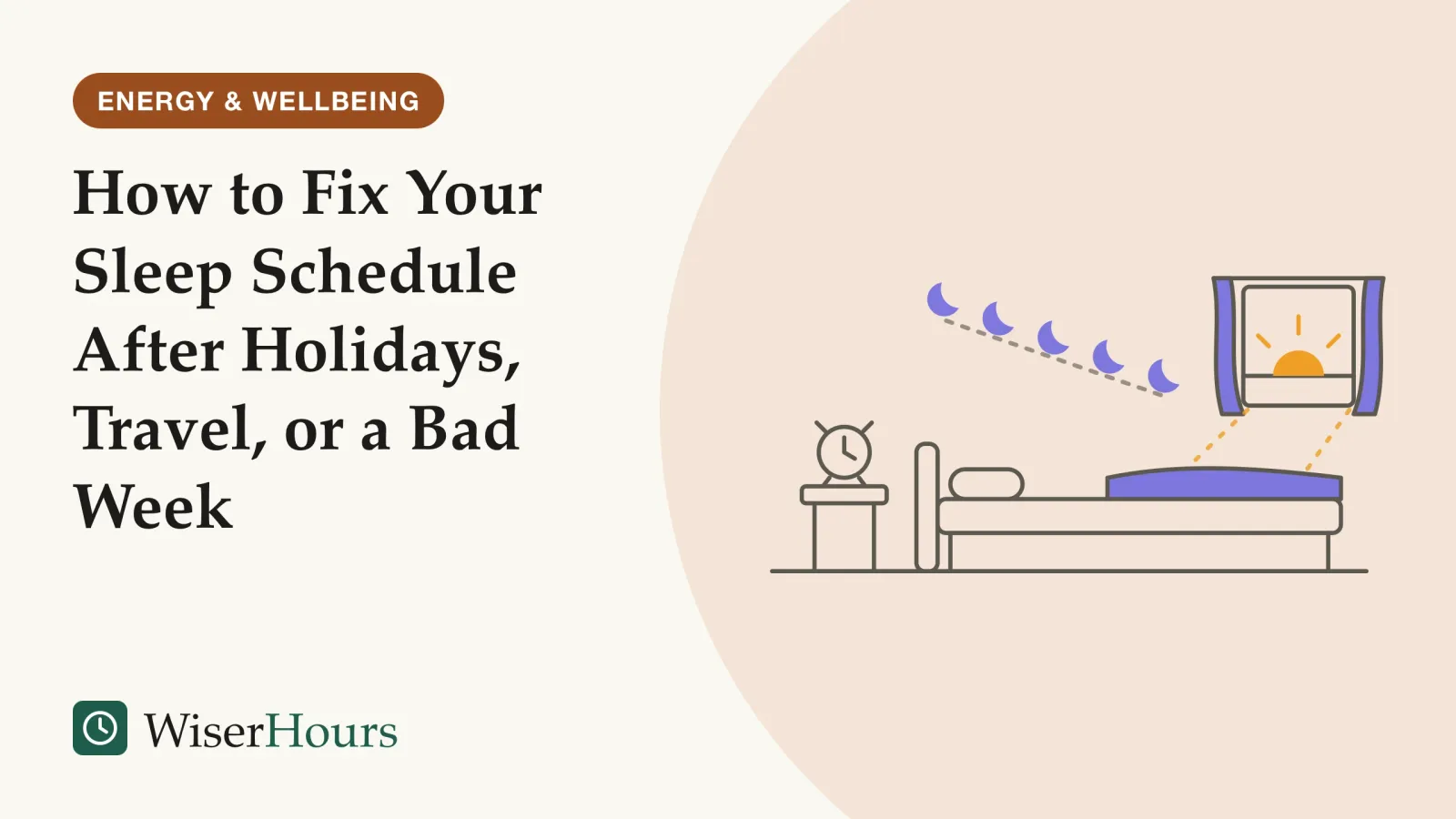
Going to bed early is the weakest move when you want to fix your sleep schedule after a holiday, a trip or a week of late nights. The body clock that decides when you feel sleepy is reset mainly by light, and your best handle on it is the time you get up and step into daylight. So the plan starts with the alarm.
These five steps are how to fix your sleep schedule:
- Set one wake-up time and keep it every day.
- Get bright light within the first hour after waking.
- Dim the lights for the last hour before bed.
- Move about an hour a day, not all at once.
- Keep naps short and early.
These are everyday habits for healthy adults whose timing has slipped, not a treatment for a sleep disorder or a plan for night shifts. For the wider basics, see our evidence-based guide to sleeping better.
Why a few late nights move your body clock
Your body clock runs on a cycle slightly longer than a day, and light reaching your eyes resets it every morning, according to Australia’s Sleep Health Foundation.1 Late, bright evenings and dark late mornings let it drift later, and the foundation notes that for some people even a few late nights in a row can shift its timing.2
The reason is that the same light acts differently depending on when it arrives. The American Academy of Sleep Medicine’s 2015 US guideline sums up the research this way: in the evening, before the body’s overnight low point, light shifts the clock later, while light after that point, in the morning, shifts it earlier.3 The low point usually falls in the early hours, a few hours before you would naturally wake.4
Picture two weeks off: phones in bed until well past midnight, blinds down until mid-morning. Each late evening adds light at the “push later” time, and each dark morning removes it from the “pull earlier” time. By the first workday, lying down at your old bedtime can feel like trying to sleep in the afternoon.
So you cannot simply decide to feel sleepy at your old time again; you have to move the clock back. If you suspect you are naturally a late type, how chronotypes work and how to place yourself explains why some people slide later more easily than others.
How long does it take to fix a sleep schedule?
Expect the clock to move earlier by roughly an hour a day, and often less. Body-clock researchers Charmane Eastman and Helen Burgess use the classic average from travel studies, roughly an hour a day for moving the clock earlier against an hour and a half for moving it later, which helps explain why drifting late takes little effort and coming back is slow.4 In practice, a holiday that left you three hours late will not be undone in one Sunday; at an hour a day, plan on three or four mornings.
The best direct test comes from their lab in Chicago, US.
The study
Limited evidence
Light or no light: what moved the clock in a 2003 Chicago lab trial
Twenty-eight healthy adults had their sleep times brought forward by 1 hour a day for 3 days. Those who sat near a bright light box for the first hours after waking moved their body clocks about 1.5 to 2 hours earlier; those kept in ordinary indoor light moved about half an hour.5
The alarm and the light work as a pair: shifting your sleep times without bright morning light moved the clock far less. The setting limits the finding, with young, healthy volunteers, a light box on a desk and the clock measured by a hormone test rather than by how people felt at work.
A 2005 follow-up from the same lab tried 2 hours a day instead of one. By the third day the clock had fallen behind the schedule and volunteers had trouble falling asleep, a problem the one-hour group did not have.6 For a schedule that slid 2 or 3 hours late, that points to several days of steady mornings. Take that as a rough guide: we found no trial that has timed a holiday reset at home.
How to fix your sleep schedule in five steps
The steps below are general habits from public-health bodies, in the order you would start them. None of them needs equipment.
1. Set one wake-up time and keep it every day
In its insomnia self-help advice (reviewed 2024), the UK’s NHS suggests getting up at the same time every day and going to bed only when you feel sleepy, and it warns against sleeping in after a bad night.7 The US National Heart, Lung, and Blood Institute (NHLBI), in advice updated in 2022, adds that weekend sleep times should stay within about an hour of weekday ones.8
That answers a common question: is it better to wake up early or go to bed early? Wake up early. You control the alarm, while sleepiness at an earlier bedtime only arrives once the clock has moved, so an early night on day one often means lying awake. Once you are back on track, count back from your alarm to find your lights-out time.
Bedtime calculator
Lights out by 10:55 pm
Includes a fixed 20-minute allowance for falling asleep.
2. Get bright light within the first hour after waking
Morning light is the signal that pulls the clock earlier. Australia’s Sleep Health Foundation advises plenty of light in the morning: open the curtains and have breakfast next to a brightly lit window.2 In practice that might mean walking part of the commute, drinking your coffee on a balcony or working by a window for the first hour. On dark winter mornings, sit by the brightest window you can reach.
3. Dim the lights for the last hour before bed
The NHLBI advises keeping the hour before bed quiet and steering clear of bright artificial light from screens such as a TV or computer, which it says may tell the brain to stay awake.8 A small crossover trialcrossover trial: A trial in which each participant receives every condition being compared, one after another in random order, often with a gap between them. Because people are compared with themselves, fewer are needed, but the design only suits effects that wear off.Full entry in the glossary in Boston, US, shows why. Twelve young adults read for about 4 hours before bed on a light-emitting tablet or from a printed book, five evenings each. After the tablet evenings their body clocks ran more than 1.5 hours later than after the book evenings, and they took longer to fall asleep.9
That was a heavy dose in a very dim lab room, so a short scroll is likely to matter less, although nobody measured that. What carries over is the direction: turn lamps down, lower screen brightness and save the bright overhead lights for the morning.
4. Move about an hour a day, not all at once
Bring the alarm forward by about an hour a day until you reach your target, then hold it. In the Chicago studies an hour a day kept sleep and the clock together, while 2 hours a day left people lying awake.6 If you are still wide awake an hour after lights-out, stay at the same times for an extra day instead of pushing on.
5. Keep naps short and early
A long afternoon nap takes away the sleepiness you need at your new bedtime. The NHLBI puts the adult limit at 20 minutes, and for anyone who finds it hard to fall asleep at night it suggests fewer naps or moving them earlier in the afternoon.8 For people with insomnia, the NHS goes further and advises against napping during the day.7 The same logic applies to a late coffee, and how long caffeine stays in your system helps you set a cutoff.
Your reset, day by day
A 5-day plan for a schedule that slid 2 to 3 hours late
The plan below takes someone who drifted to roughly 1:30 a.m. to 9:30 a.m. over a holiday back to 11 p.m. to 7 a.m. It applies the one-hour-a-day step from the 2003 Chicago trial, where its side effects were small, but it is a worked example rather than a tested protocol.5 Each morning includes bright light within the hour, and each evening a dim last hour.
- Day 1Alarm 8:30 a.m.; lights out about 12:30 a.m., once sleepy
- Day 2Alarm 7:30 a.m.; lights out about 11:30 p.m.
- Day 3Alarm 7:00 a.m., the target; lights out about 11 p.m.
- Days 4-5Hold 7:00 a.m.; at a weekend, no later than about 8:00
Coming home from a holiday, start two or three days before it ends, so your first workday falls on day 3 or later. Put demanding work and long drives later in the week where you can. If the slide came from crossing time zones, the direction of travel changes which light helps, and the jet lag guide to timed light covers that case.
- In bed and asleep
- The hour before lights-out, lamps low and screens dimmed
- Bright light soon after the alarm, outdoors or by a window
The article's worked example, not measured values: the alarm moves about an hour a day until it reaches the target, then holds.
Should you pull an all-nighter to reset your sleep schedule?
No. Staying up all night can leave you tired enough to crash early the next evening, but we could find no study that has tried it as a reset, and the body clock is moved by light, not by exhaustion. What an all-nighter reliably adds is sleep loss. In a 2000 Australian study of 39 transport workers and soldiers, after 17 to 19 hours awake, performance on some tests matched or fell below that at a blood alcohol level of 0.05 percent.10
For someone who woke at 7 a.m., that point arrives between midnight and 2 a.m., long before the all-nighter is over, and a long recovery nap the next afternoon can make the following bedtime harder. If you have already done it, do not drive while drowsy, keep tomorrow’s alarm, and use what one lost night adds to your sleep debt to plan the catch-up.
- Myth
- Pulling an all-nighter resets a broken sleep schedule.
- Fact
- It piles on sleep loss and impairs you the next day. Morning light after a fixed alarm is what moves the body clock earlier.
Does melatonin help reset your sleep schedule?
Melatonin can move the body clock, but the guideline support covers a diagnosed condition, not a few late nights. The American Academy of Sleep Medicine’s 2015 US guideline gives a weak recommendation for timed melatonin in adults with delayed sleep-wake phase disorder, a long-lasting late body clock. It rated the evidence low and called its three trials contradictory. In one small trial the guideline describes, the authors reported that taking melatonin earlier relative to the body’s own evening rise went with a larger shift, which is why timing is planned with a clinician rather than treated like a sleeping pill.3
The rules change from country to country. The US National Center for Complementary and Integrative Health explains, in a 2024 update, that the US treats melatonin as a dietary supplement, which the Food and Drug Administration regulates less strictly than a drug, whereas several other countries class it as a prescription-only drug. It adds that some products do not contain what their label states. The same center tells anyone on other medicines to speak to a health professional first, says medical supervision is needed for people with epilepsy and those taking blood thinners, points out that safety in pregnancy and breastfeeding has barely been studied, and warns that it may cause daytime drowsiness in older people.11
As of 2026, the NHS says melatonin is available on prescription only in the UK.12 In any other country, ask a pharmacist how melatonin is sold where you live before buying it.
Which parts of the reset rest on solid evidence?
| What it is | What the best evidence found | Evidence |
|---|---|---|
| Bright morning light with a one-hour-a-day shift | Clock moved about 1.5 to 2 hours earlier, against about half an hour without bright light | Randomized lab trial, 28 adults, limited5 |
| Bright screens late in the evening | Later body clock and longer time to fall asleep than with a printed book | Crossover lab trial, 12 adults, limited9 |
| Timed melatonin for a diagnosed late clock | Weak recommendation for adults | Guideline (US, 2015), weak3 |
| An all-nighter as a reset | Not tested; 17 to 19 hours awake impaired some test scores | Gap; one small study of 39 workers and soldiers10 |
When a schedule will not reset: who should get checked
Most slides from a holiday or a bad week respond to steady mornings. Drowsiness that puts you at risk needs action now, and sleep times that refuse to shift, or months of poor sleep, deserve a doctor. We grouped the advice of the bodies named below into three tiers; outside the UK, the US and Australia, take the same questions to your own health service.
- Now. The NHS advises against driving while you feel sleepy.7 If you grow drowsy at the wheel, Australia’s Sleep Health Foundation says to pull over somewhere quiet.13
- Soon. See a doctor if your sleep times will not move despite steady habits and the timing is hurting your life or safety, especially if you sleep normally when free to choose your hours; that pattern fits delayed sleep-wake phase disorder, and a doctor may ask for a sleep diary and refer you to a specialist.2 The NHS also suggests seeing a GP (a family doctor) when new sleep habits have not helped, when the problem has lasted months, or when it is making it hard for you to cope; the main types and causes of insomnia explain what a doctor will look for.7 If you work shifts and still cannot sleep in the day or adapt to the roster, the NHLBI suggests talking with your doctor.8
- Routine. If your schedule slides after every holiday or you are thinking about melatonin or a light box, mention it at your next routine check-up or to a pharmacist.
The bottom line
Fix the wake time first. Set one alarm, get into bright light soon after it, keep the last hour of the evening dim, and move about an hour a day until you reach your target. A schedule that slid a few hours late usually needs several days, and if it will not move after steady effort, see a doctor.
This article is general information, not medical advice. If you're worried about your health, talk to a doctor or another qualified professional.
Frequently asked questions
Is it OK to sleep in at the weekend while I am resetting?
Keep any lie-in short. The US National Heart, Lung, and Blood Institute advises a gap of no more than about an hour between weekday and weekend sleep times, since late nights followed by late mornings at weekends can upset the body clock's rhythm. During a reset, a long Saturday morning in a dark room removes the morning light that was pulling your clock earlier, so an earlier night is the safer way to catch up.
Do I need a light box to reset my body clock?
Usually not for a short slide. Australia's Sleep Health Foundation suggests opening the curtains and eating breakfast by a brightly lit window, and the US National Heart, Lung, and Blood Institute recommends getting outdoors daily when you can. A sleep specialist may suggest a light box for a diagnosed delayed body clock, though a 2015 US guideline found too little evidence for light therapy alone, so ask a doctor first.
What if I sleep badly one night during the reset?
Keep the alarm where it is. The UK's NHS advises against sleeping in after a bad night and says to keep your usual sleeping hours instead. If you need a nap, the US National Heart, Lung, and Blood Institute suggests capping it at 20 minutes for adults, and napping earlier in the afternoon if falling asleep at night is a problem. Postpone driving if you feel drowsy.
Does this reset plan work for night-shift workers?
Not as written, because it assumes you wake in the morning. Australia's Sleep Health Foundation advises shift workers to go to bed at the same time each day where possible, keep the bedroom cool and dark, and favors rosters that rotate forward from morning to afternoon to evening to night. The US National Heart, Lung, and Blood Institute adds bright light at work and caffeine only early in the shift.
Sources
- Body Clock. Sleep Health Foundation (Australia), fact sheet dated 12 January 2024
- Delayed Sleep Phase Syndrome (DSPS). Sleep Health Foundation (Australia), fact sheet dated 2 February 2024
- Clinical Practice Guideline for the Treatment of Intrinsic Circadian Rhythm Sleep-Wake Disorders: Advanced Sleep-Wake Phase Disorder (ASWPD), Delayed Sleep-Wake Phase Disorder (DSWPD), Non-24-Hour Sleep-Wake Rhythm Disorder (N24SWD), and Irregular Sleep-Wake Rhythm Disorder (ISWRD). An Update for 2015. Auger, R. R., Burgess, H. J., Emens, J. S., et al. (2015). Journal of Clinical Sleep Medicine, 11(10)
- How To Travel the World Without Jet Lag. Eastman, C. I. & Burgess, H. J. (2009). Sleep Medicine Clinics, 4(2)
- Preflight Adjustment to Eastward Travel: 3 Days of Advancing Sleep with and without Morning Bright Light. Burgess, H. J., Crowley, S. J., Gazda, C. J., Fogg, L. F. & Eastman, C. I. (2003). Journal of Biological Rhythms, 18(4)
- Advancing Circadian Rhythms Before Eastward Flight: A Strategy to Prevent or Reduce Jet Lag. Eastman, C. I., Gazda, C. J., Burgess, H. J., Crowley, S. J. & Fogg, L. F. (2005). Sleep, 28(1)
- Insomnia. NHS (UK), page last reviewed 19 March 2024
- Healthy Sleep Habits. National Heart, Lung, and Blood Institute (US), last updated 24 March 2022
- Evening use of light-emitting eReaders negatively affects sleep, circadian timing, and next-morning alertness. Chang, A.-M., Aeschbach, D., Duffy, J. F. & Czeisler, C. A. (2015). Proceedings of the National Academy of Sciences, 112(4)
- Moderate sleep deprivation produces impairments in cognitive and motor performance equivalent to legally prescribed levels of alcohol intoxication. Williamson, A. M. & Feyer, A.-M. (2000). Occupational and Environmental Medicine, 57(10)
- Melatonin: What You Need To Know. National Center for Complementary and Integrative Health (US), last updated May 2024
- About melatonin. NHS (UK), page last reviewed 13 February 2023
- Shift Work. Sleep Health Foundation (Australia), fact sheet dated 12 January 2024
How we researched this
We searched Europe PMC and PubMed Central and read official pages from the AASM, NHS, NHLBI, NCCIH and Australia's Sleep Health Foundation in October 2026, preferring guidelines and controlled lab trials of shifting the body clock. Sources date from 2000 to 2024. Every source was read in full apart from a 2000 Australian sleep-loss study (abstract only). Main limitation: the trials that shifted the body clock were small lab studies in healthy young volunteers, and no trial has put a home reset plan after a holiday to the test.
Keep reading
Chronotypes Explained: Are You a Lark, an Owl, or Somewhere in Between?
Most people are neither larks nor owls. How chronotypes are measured, what 351 gene regions, age and light do to them, and what owl headlines omit.
Sleep and ADHD: Why Winding Down Is Harder and What May Help
ADHD and sleep: a late body clock, a busy mind, stimulant timing, restless legs or apnoea. What a 13-study review measured, and habits that may help.
Foods That Help You Sleep (and Foods That Hurt): What the Evidence Supports
Foods that help you sleep, graded: a 2016 review found food trials too small for firm conclusions. What kiwi, tart cherry, fish and fiber show.
Why You Wake Up at 3 AM: Common Causes, What to Do, and When to See a Doctor
Why do I wake up at 3am? Sleep runs in 80- to 100-minute cycles with brief wakings between them. The real causes, what to do, and when to see a doctor.