Team Metrics That Backfire: Goodhart's Law at Work
Goodhart's law says a measure stops measuring well once it becomes a target. Where it came from, a documented bank case, and 5 safeguards for team metrics.

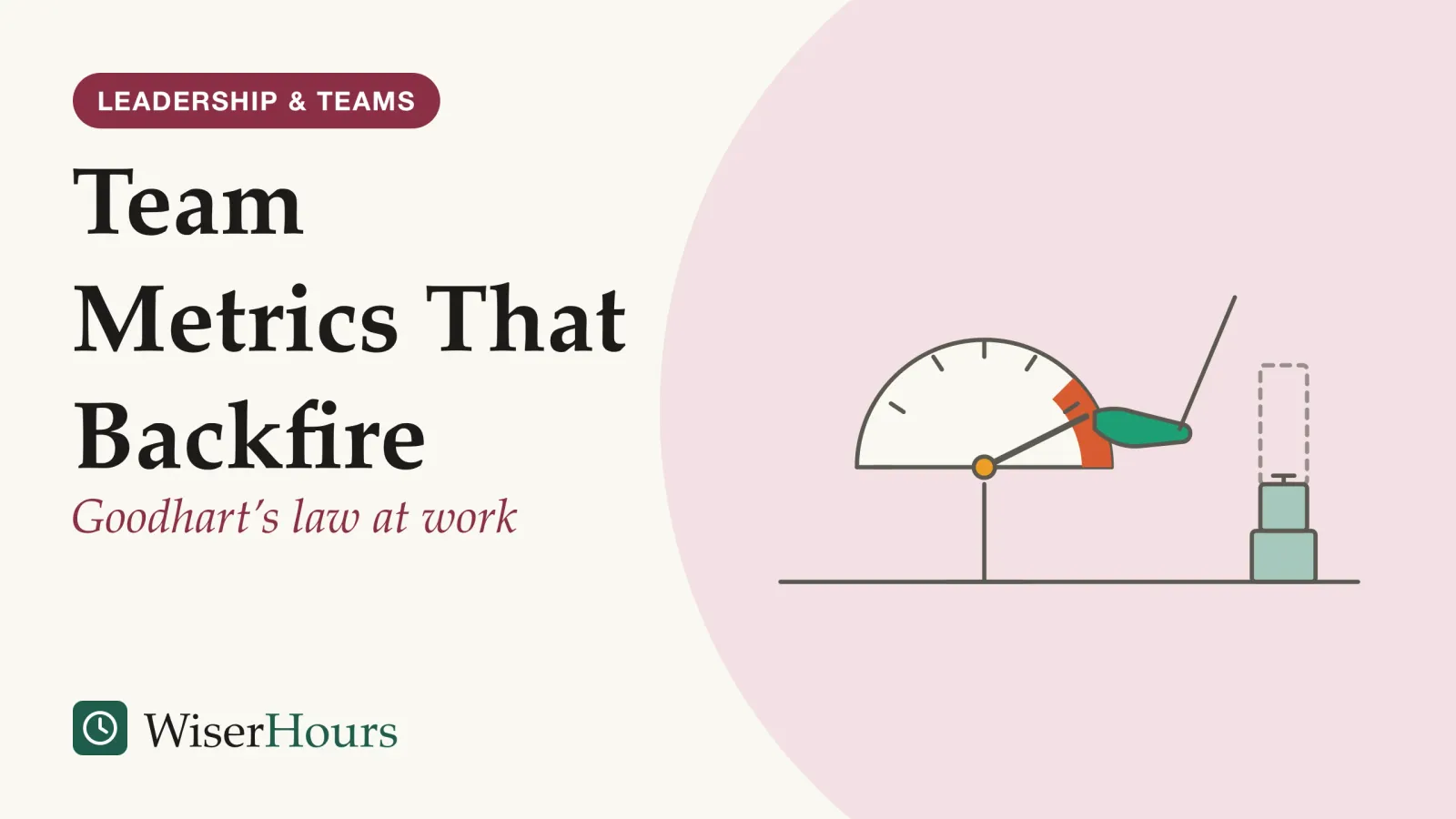
Wells Fargo, a large US bank, wanted its staff to sell each customer more products, so it set sales goals and paid incentives for new accounts. Thousands of employees met the goals by opening accounts that customers had not authorized, the US Consumer Financial Protection Bureau found in 2016.1 The account counts rose. What they were meant to show, customers who wanted more of the bank’s products, was missing from those accounts.
That pattern has a name. Goodhart’s law says that when a measure becomes a target, it ceases to be a good measure: once people are rewarded or judged on a number, they find ways to move the number that do not move the goal behind it.2 In two 2012 experiments with graduate business students acting as managers, those paid on a single measure of a strategy were more likely to treat that measure as the strategy itself than those paid on several measures.3
Design around the pressure: pair each number with a check on what it can hide, reward results rather than activity, keep some measures out of bonuses and rankings, and talk about gaming openly.
What is Goodhart’s law in simple terms?
Goodhart’s law says a number that describes performance well gets worse at it once people are pushed to hit it. It is named after the British economist Charles Goodhart, who made the point in a 1975 article on UK monetary policy.2
Definition
Goodhart’s law is the observation that a measure loses its value as a guide once people are rewarded or punished for hitting it, because they learn to move the number without moving what it stood for.
A metric is useful because it moves with something you care about but cannot see directly, such as customer trust or code quality. That link holds only while nobody steers the number on purpose. Put a bonus or a ranking on it and people look for the cheapest way to raise it.
Suppose a support team’s target is tickets closed per day. Agents close tickets before the fix is confirmed and split one customer’s issue into three. Closures climb, and so do repeat contacts.
The useful habit is to ask, before you attach any reward to a number, what is the quickest way someone could raise it without doing the real work. Metrics are one input among many in how effective teams work, and trouble starts when they crowd out the rest.
Where the famous wording comes from
Goodhart’s original 1975 sentence was technical: any observed statistical regularity, he wrote, will tend to collapse once pressure is placed on it for control purposes. He was writing about UK monetary policy, in a paper for a Reserve Bank of Australia conference.2 Goodhart worked at the Bank of England from 1968 to 1985, so he wrote it from inside a central bank.4
The snappier version came later, from outside economics. In a 1997 paper on audit in British universities, the anthropologist Marilyn Strathern wrote the line almost everyone now quotes. She credited the label “Goodhart’s law” to the educationalist Keith Hoskin, and her own example was degree grades: the more a good grade becomes an expectation, the worse it gets at telling students apart.5
When a measure becomes a target, it ceases to be a good measure.
Goodhart described markets responding to policy, and Strathern described universities responding to audit. If gaming appears in your team, look first at what the measure rewards, not at who took the shortcut.
Goodhart’s law vs Campbell’s law, and Kerr’s “rewarding A while hoping for B”
Campbell’s law, from the US social scientist Donald Campbell in 1979, says the more a quantitative indicator is used for social decisions, the more it is exposed to corruption pressures and the more it distorts the activity it was meant to monitor. Goodhart’s law stresses that the number loses information; Campbell’s adds that the work itself gets bent.6
Campbell’s example was school testing: achievement tests can be good indicators under normal teaching, but once scores become the goal of teaching, they lose that value and distort the teaching.7 Versions of his idea date to 1969, so it may even have come first.2
The workplace version comes from the management scholar Steven Kerr, who in 1975 described reward systems that pay for one behavior while the rewarder hopes for another. His updated 1995 list of common follies includes hoping for teamwork while rewarding individual effort. One cause he named was a fascination with simple, quantifiable standards, which he wrote may work in highly predictable areas but displace goals almost everywhere else.8
Together they give a practical test. Goodhart asks whether your number still means what it did. Campbell asks whether chasing it is changing the work. Kerr asks what behavior the number actually pays for, as opposed to the behavior you hoped for. A team that hits a velocity target by splitting work into smaller tickets fails all three.
A documented example at work: sales goals at Wells Fargo
The best-documented workplace case of a target corrupting the work is the US Consumer Financial Protection Bureau’s 2016 consent order against Wells Fargo. The regulator found that employees opened unauthorized accounts and moved customers’ money to meet sales goals and earn incentive pay; the bank settled without admitting or denying the findings.1
The study
Limited evidence
Sales goals at Wells Fargo, 2011 to 2015, in a US regulator's findings
The bank’s own analysis, cited in the order, found that between 2011 and 2015 employees opened about 1.5 million deposit accounts and applied for about 565,000 credit cards that customers may not have authorized. Some staff moved money from customers’ existing accounts into new ones so the accounts would count under the incentive program. The bank fired roughly 5,300 employees over these practices and was ordered to pay a 100 million US dollar penalty.1
A single case shows the mechanism can run at scale, not how often it does. Beyond the firings, the order required an independent review of whether the bank’s performance management and sales goals were consistent with preventing these practices.1 The regulator treated the goals as part of the problem.
In a 2019 Harvard Business Review article, Michael Harris and William Tayler argued that Wells Fargo had let its cross-selling number replace the strategy it served, building long-term customer relationships.9 Few teams face fraud, but the small version is easy to recognize in a meeting that, over time, discusses only the number.
Surrogation: when managers mistake the number for the goal
Surrogation is the term accounting researchers Jongwoon Choi, Gary Hecht and William Tayler gave in 2012 to managers losing sight of the strategy a measure represents and acting as though the measure were the strategy. Their two experiments, with graduate business students, found incentive pay made this worse, especially pay tied to a single measure.3
Surrogation differs from gaming. A gamer knows the number is not the goal and exploits the gap. A manager who surrogates no longer sees the gap, so they can raise the measure while working against the strategy, in good faith.
Two follow-up findings point to fixes. In 2013 lab experiments by the same authors, business students who chose the strategy surrogated less, while those who only deliberated on it did not.10 In a 2019 experiment, Jeremiah Bentley had experienced chess players bet on games in progress while paid on an imperfect measure; those who could write explanations of their bets to their boss distorted their decisions less and surrogated less.11
The evidence here comes from laboratory experimentslaboratory experiment: An experiment run under conditions the researchers set up and control, often with students doing short tasks. Control makes cause and effect easier to pin down, but the tasks are simpler than real life, so results do not always carry over to work or home.Full entry in the glossary, mostly with students, and one paper was read in abstract only, so treat it as a direction. For a team, it points to three habits: let people help choose the goal a metric serves, track more than one measure of it, and ask for a sentence of explanation alongside the number.
Is the cobra effect story true?
Probably not as told. The “cobra effect”, named by the economist Horst Siebert in 2001, rests on a colonial anecdote about bounties for dead cobras in British India leading people to breed them, and a 2025 archive investigation found no contemporary record of anyone doing so.12
The investigation, by the Friends of Snakes Society, an Indian snake-conservation group, traced a real bounty in the Madras Presidency from 1872. A newspaper in 1873 reported only that breeding “was alleged”, and in 1887 the Bombay Natural History Society, asked directly, called breeding cobras for rewards highly improbable.13 The group is an advocacy body, but it lists its archive sources.
A better-documented bounty story exists. In Hanoi in 1902, under French colonial rule, a bounty paid per rat’s tail, and officials soon reported tailless rats running loose; the historian Michael Vann found the episode in colonial archives.14
- Myth
- The cobra effect is a well-documented case of people breeding cobras for a bounty.
- Fact
- The breeding was rumored, not recorded; a 2025 archive search found no evidence of it, while the Hanoi rat-tail bounty of 1902 is documented.
When you explain the risk to your team, use documented cases. Colorful tales make metric problems sound like rare comic disasters.
Which targets backfire, and which hold up
Targets are most likely to backfire when hitting the number is easier than improving the work and when people are just short of the line. In a 2004 laboratory experiment, Maurice Schweitzer and colleagues found people with unmet goals were more likely to behave unethically than people told to do their best, and most of all when they were just short of the goal.15
That held with and without money attached to the goal, so the pressure of a specific target may be enough on its own.15 For a team, the risky moment is a quarter’s end when it is slightly behind.
Goodhart’s law describes a tendency. Studying all 155 hospital trusts in England, Steven Kelman and John Friedman found that a target that no emergency patient wait more than four hours was followed by dramatic improvements in waits from 2003 to 2006, with no evidence of the dysfunctional side effects others had hypothesized.16 Reviewing English health-service targets of the same era, Gwyn Bevan and Christopher Hood examined evidence of gaming under what they called a regime of “targets and terror”.17
Targets tend to work when the measure sits close to what people want and is hard to fake, and to fail when it is a distant proxy with heavy rewards attached.
Five safeguards for setting team KPIs
You cannot remove the pressure that bends metrics, but you can design around it. Each safeguard below traces back to one of the findings above.
Pair every metric with a check on what it can hide
For each number, add one that would get worse if the first were gamed: tickets closed with reopened tickets, features shipped with defects found later. Paying on several measures of a strategy rather than one reduced surrogation in the 2012 experiments.3
Reward results someone outside the team would notice
Activity counts such as hours, meetings held and messages answered are easy to raise without helping anyone, which is the gap Kerr warned about.8 Prefer measures closer to the result: problems solved for a customer, work that stayed fixed.
Keep some measures for learning only
Goodhart’s point was that a number collapses once it is used for control.2 Keep a few measures that inform team discussions but carry no bonus, ranking or penalty, and say so openly.
Let the team choose the goal, and ask for a sentence with each number
People who chose the strategy surrogated less in one set of lab experiments.10 The chance to explain decisions in words reduced surrogation in another.11 A short “what this number does not show” line in each review costs little.
Review gaming openly
A metric being bent is bad news, and people share bad news only when speaking up feels safe, which is where psychological safety in the team comes in. Ask each quarter how someone could hit the target without doing the work, and retire metrics that fail the test.
| Safeguard | What the best evidence found | Evidence |
|---|---|---|
| Several measures instead of one | Pay tied to multiple measures led to less surrogation than pay tied to one | Two lab experiments with business students, 2012; limited3 |
| A say in choosing the goal | Students who chose the strategy surrogated less; only deliberating on it made no clear difference | Lab experiments with business students, 2013; limited10 |
| Written explanations with the numbers | Explaining bets to a boss reduced distortion and surrogation among chess players | One experiment, 2019; limited (abstract only)11 |
| Care near a deadline | Unmet specific goals were linked to more unethical behavior, most when people were just short | One lab experiment, 2004; limited (abstract only)15 |
| Targets close to the real outcome | A four-hour emergency wait target in England was followed by shorter waits, with no evidence of the side effects others had predicted | Observational, all 155 trusts in England; limited (abstract only)16 |
Run this on any metric that carries a reward
The bottom line
Once a reward hangs on one number, people start steering the number and lose sight of the goal, as a US bank’s sales goals and lab studies of people acting as managers both show. Keep the goal written down in words, track it with more than one number, hold some measures back from rewards, and ask your team regularly how the numbers could be fooled.
Frequently asked questions
Who was Charles Goodhart?
Charles Goodhart is a British economist who worked at the Bank of England from 1968 to 1985 and at the London School of Economics. He made the observation now named after him in a 1975 conference paper on UK monetary policy, not about workplaces.
Does Goodhart's law mean you should stop measuring your team?
No. Goodhart's law warns about attaching strong rewards or penalties to a single number. Donald Campbell, who described the same problem, still valued indicators; his point was that the more decisions hang on one indicator, the more pressure there is to bend it. Measures used for learning, and read alongside judgement, keep more of their value.
Is Goodhart's law the same as the Lucas critique?
No, though they are close relatives. Shortly after Goodhart's 1975 paper, the Lucas critique of 1976 argued that it is naive to predict the effect of a policy change only from relationships seen in past data. Goodhart's law is the broader adage, now applied to targets of every kind.
Sources
- Consent Order, In the Matter of Wells Fargo Bank, N.A. (2016-CFPB-0015). Consumer Financial Protection Bureau, United States (2016)
- Goodhart's law. Wikipedia (accessed 2026-10-06)
- Lost in translation: The effects of incentive compensation on strategy surrogation. Choi, J., Hecht, G. & Tayler, W. B. (2012). The Accounting Review, 87(4)
- Charles Goodhart. Wikipedia (accessed 2026-10-06)
- 'Improving ratings': audit in the British University system. Strathern, M. (1997). European Review, 5(3)
- Assessing the impact of planned social change. Campbell, D. T. (1979). Evaluation and Program Planning, 2(1)
- Campbell's law. Wikipedia (accessed 2026-10-06)
- On the folly of rewarding A, while hoping for B. Kerr, S. (1995, updated reprint of the 1975 article). Academy of Management Executive, 9(1)
- Surrogation. Wikipedia (accessed 2026-10-06)
- Strategy selection, surrogation, and strategic performance measurement systems. Choi, J., Hecht, G. & Tayler, W. B. (2013). Journal of Accounting Research, 51(1)
- Decreasing operational distortion and surrogation through narrative reporting. Bentley, J. W. (2019). The Accounting Review, 94(3)
- Perverse incentive. Wikipedia (accessed 2026-10-06)
- The Cobra Effect: Colonial Misinformation Masquerading as Economic Theory. Friends of Snakes Society, India (2025)
- Great Hanoi Rat Massacre. Wikipedia (accessed 2026-10-06)
- Goal setting as a motivator of unethical behavior. Schweitzer, M. E., Ordóñez, L. & Douma, B. (2004). Academy of Management Journal, 47(3)
- Performance improvement and performance dysfunction: An empirical examination of distortionary impacts of the emergency room wait-time target in the English National Health Service. Kelman, S. & Friedman, J. N. (2009). Journal of Public Administration Research and Theory, 19(4)
- What's measured is what matters: Targets and gaming in the English public health care system. Bevan, G. & Hood, C. (2006). Public Administration, 84(3)
How we researched this
Primary sources were read where they could be fetched: Strathern's 1997 paper, Kerr's 1995 reprint and the US CFPB's 2016 consent order in full; the 2012 and 2013 surrogation papers in their authors' versions; the other experiments and the English health-service studies in abstract only. Wikipedia and a 2025 archive investigation were used for background on Goodhart's 1975 wording and the cobra anecdote. Main limitation: the workplace evidence is mostly lab experiments and single documented cases.
Keep reading
Conway's Law: Why Your Products Mirror Your Org Chart
Conway's law: systems copy the communication structure of the teams that build them. The 1968 wording, what 4 studies found, and how to use it.
Psychological Safety in Teams: What Amy Edmondson's Research Found
Psychological safety is a team's shared belief that speaking up is safe. What Edmondson's 1999 study, a later meta-analysis and the open questions show.

15 Team-Building Activities That Aren't a Waste of Time
15 team building activities sorted by purpose, with time, group size and remote options. Goal and role work has the best evidence; skip forced fun.
Social Loafing: Why People Do Less in Groups and How to Prevent It
Social loafing is the drop in effort when work is pooled. What research since the 1880s found, why it happens, and 3 evidence-based ways to prevent it.