The Eisenhower Matrix: How to Separate Urgent From Important
Four boxes, two questions: how to sort a to-do list with the Eisenhower matrix in 10 minutes, what each box is for, and what Eisenhower really said.

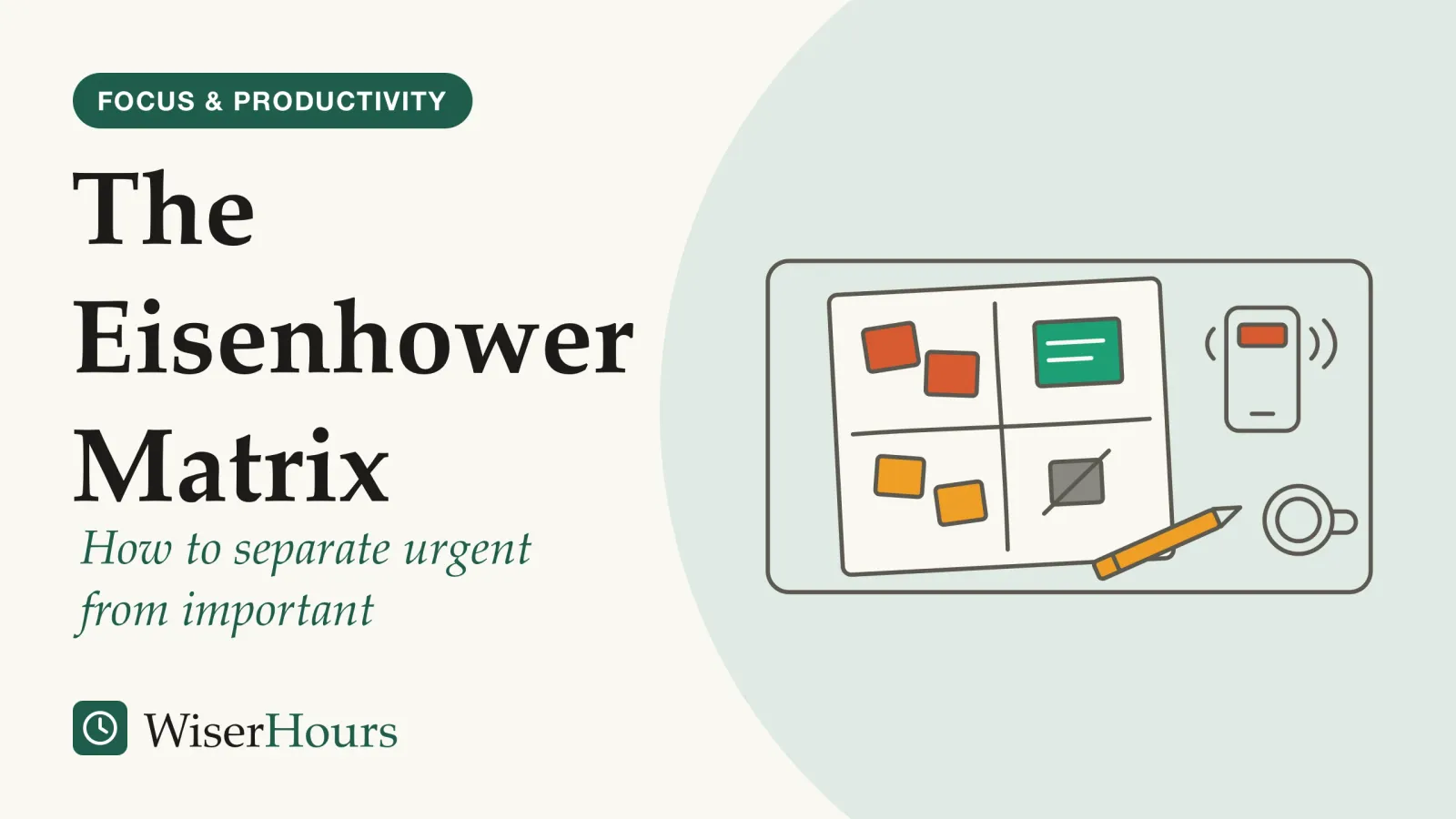
By nine on a Tuesday morning the list runs to twenty-odd lines: a payroll question that is holding up a colleague’s pay, a passport that expires before a trip in six weeks, two meeting invitations, a supplier’s “last chance” email and a folder clean-up nobody asked for. The phone has already rung twice.
The Eisenhower matrix sorts a list like that with two separate questions, must this happen soon and does it change anything that matters, and gives each of the four resulting boxes its own job: do it now, give it a time, hand it off or shrink it, or drop it. No controlled test of the grid itself has been found, but it targets a habit that has been tested: across five experiments reported in 2018, people more often took a task worth less when it simply came with a shorter window to finish.1 To sort a real list in about ten minutes:
- Put every open task on one page
- Star what matters before you check dates
- Question each urgent label: whose deadline is it?
- Place each task in a box and give the box its job
- Book one important task nobody is chasing
Prefer to watch? The video covers the same ground as this article.
The matrix works best on top of a few basic habits, such as giving important work a set time and place. Readers who are new to all of this can begin with a beginner’s guide to managing time, which covers those habits first.
What goes in each of the four boxes: work and home examples
Each box of the Eisenhower matrix comes from two yes-or-no judgments made separately. In Wikipedia’s summary of Covey’s version, urgent and important tasks are done first, important tasks that are not urgent are planned, urgent tasks that are not important are delegated, and tasks that are neither are eliminated.2 The 2018 researchers’ definitions sharpen both questions: urgency means a short window to act, importance means a large outcome.1
Holding the two questions apart is the whole exercise. A task can be pressing and trivial, or valuable and weeks away, and the feeling of pressure blurs the difference.
- Left column: urgent. Top row: important.
- I. Urgent and important: do it now, yourself
- II. Important, not urgent: give it a time in your calendar
- III. Urgent, not important: hand it off, shrink it or batch it
- IV. Neither: drop it, or say no
Urgent and important is the box of real deadlines with real consequences: a system that is down, a signature a client call depends on, a form due today for your child’s school trip, or a tax filing date. Deadlines and penalties vary from one country to the next, so confirm the ones that apply to you. Do these yourself, now.
The important but not urgent box holds the work that shapes next month: planning the next quarter, learning a skill your role will need, fixing the gutter before the rainy season, renewing a passport before a trip that is still weeks away. FranklinCovey, the company that sells Covey’s training, argues this is where time pays back most, naming planning, learning, creative thinking and renewal.3 Left alone, these tasks drift into the first box, and the passport becomes an emergency.

Urgent but not important work is loud and short-lived: most chat pings, a meeting invitation where you would only listen, a colleague’s “quick question” that someone else could answer, a sale ending tonight on something you did not plan to buy. These feel pressing because of the window, not the outcome.
The box for tasks that are neither covers the rest: tidying folders you rarely open, a third pass over a finished slide, an hour of scrolling. Dropping them costs little.
How to sort a to-do list with the Eisenhower matrix in ten minutes
For a list of about twenty items, a full sort takes roughly ten minutes if you judge quickly and resist starting any task mid-sort. That figure is our own estimate. The five steps below use the Tuesday list from the opening as an illustration.
1. Put every open task on one page
Pull everything from your inbox, chat, notebook and head onto one list, work and home together. Write each item as something you can do (“email Sam the draft budget”), not a topic (“budget”). A task you cannot see is a task you cannot sort.
2. Star what matters before you check dates
Go down the list once and ask only: does this move a goal I care about this month, or protect someone who depends on me? Star the ones that do. This pass comes first on purpose. Judging payoff before deadlines is a rough everyday version of the payoff reminder in the experiments described further down.1
3. Question each urgent label: whose deadline is it?
Now mark what feels urgent, then challenge each mark. Ask what would break if it waited until tomorrow, and whose deadline it is. Much urgency belongs to someone else’s plan. Covey’s phrase for the alternative is being driven by your own principles rather than “by the agendas and forces surrounding you”.3 A request that can sit for a day without harm is not urgent, whatever its subject line says.
4. Place each task in a box and give the box its job
Draw a cross on a sheet of paper, or use four headings in a notes app, and move each task. On the Tuesday list, the payroll question goes top left, the quarterly plan and the passport go top right, the two invitations and the supplier’s email go bottom left, and the folder clean-up goes bottom right.
Then give each box its job. Top left gets done today, in order of what would break first. Top right gets a time. Bottom left gets handled in the cheapest way available, which the next section covers. Bottom right gets crossed off, out loud if needed.
5. Book one important task nobody is chasing
Before you close the list, put one top-right task in your calendar for this week, with a start time and a first step. This is the box the matrix exists to protect, and no alarm will ever raise it for you.
The ten-minute sort
Download PDF
What to do with each quadrant when the textbook answer does not fit
The textbook answers are do, schedule, delegate and delete, and Wikipedia’s summary of the Eisenhower method adds that tasks in the first two boxes are done personally.4 Two of those answers break down for many people.
Delegation assumes someone to delegate to. A freelancer, a junior employee, a parent with no help at home or a one-person team often has nobody. The real job of the bottom-left box is to spend less of your best time on it, and there are other ways to get there: shrink the task (a two-line reply instead of a full one), batch it (clear messages in two or three fixed slots a day instead of as they land), or renegotiate it (ask whether Friday works). These are our suggestions; none has been tested as part of the matrix.
“Delete” also assumes the choice is yours. Often the unimportant task was set by a manager or a client. There, deleting means a conversation, and the guide to declining requests at work without souring the relationship covers the wording.
The top-left box has its own trap. If it is full every week, important work is probably being left until it turns urgent; that reading is ours. Covey’s answer was to spend most of your time in the second box once the first is handled.2 So a crowded first box is a planning problem to fix next week.
Why urgent tasks win, and how the grid pushes back
Urgent tasks often win even when they are worth less, and 2018 experiments point to attention as the reason: a close deadline draws focus away from what a task pays. Meng Zhu, working with Yang Yang and Christopher Hsee, named this the mere urgency effect: choosing the urgent task over the important one even when it pays less and its time limit is no real constraint.1
The study
Moderate evidence
A short time window, a smaller bonus: how online workers chose
In one of the five experiments, online workers chose between two short typing tasks, one paying less. When the low-paying task was made to look urgent, about a third of workers picked it, against about one in ten when it was not. When both payoffs were restated at the moment of choice, the gap shrank to no clear difference.1
The stakes were cents, chocolates and gift-card lottery entries, and the tasks took minutes or less, so the experiments show a pull on choices, not a measured cost at work. A large independent replicationreplication: Running a study again with fresh data and the same method, to see whether the original result comes back. A finding that fails to replicate is not automatically wrong, but it stops being something you can lean on.Full entry in the glossary, run at the University of Nottingham (UK) and published in 2026, still found the pull in every test built to rule out rival explanations, though those tests weakened it.5 The authors of the 2018 paper propose that the short time window draws attention away from how much each task is worth.1
That mechanism is where the matrix earns its place. Asking “is this important?” as a question of its own is meant to bring the payoff back into view at the moment you choose, much as the reminder did in the experiment. A sale that ends tonight and a strategy note due next month look very different once you write down what each one is worth.
- Myth
- If a task feels urgent, it must be important.
- Fact
- Urgency is about the time window and importance about the outcome. In 2018 experiments, a spurious deadline was enough to pull people toward the lower-paying task.
In practice, write the payoff next to any task that feels pressing before you decide to do it; a one-line note is enough to make the comparison visible.
Where the Eisenhower matrix came from: a 1954 speech and a later grid
The Eisenhower matrix grew out of a 1954 speech, while the four-box grid is best known from Stephen Covey’s books decades later. Addressing the World Council of Churches in Evanston, Illinois, on August 19, 1954, President Eisenhower quoted “a former college president” he did not name.6
I have two kinds of problems, the urgent and the important. The urgent are not important, and the important are never urgent.
That much is documented. Quote Investigator, a site that traces the history of sayings, found this speech to be the earliest evidence of the line it knows of, and concluded that Eisenhower credited it to someone else; the popular versions with “seldom” in them may come from faulty retelling, or from Eisenhower using more than one version. It also says it does not know whether Eisenhower used the matrix himself.7 The Eisenhower Presidential Library in Kansas lists correspondence and drafts of the speech among its records.8 Nothing in the transcript describes a grid, quadrants or rules for sorting tasks.6
Covey set the grid out in The 7 Habits of Highly Effective People (1989) under the habit “Put first things first”, arguing that people should spend most of their time in the important but not urgent quadrant, while many spend too much in the two unimportant ones.92 His 1994 book First Things First, written with Roger and Rebecca Merrill, paired the same grid with a weekly planning worksheet, and Wikipedia’s summary describes it as a formulation attributed to Eisenhower.10
Judge the grid by what it does for your own list this week.
The grid is untested; the pull it targets is not
The matrix rests on expert opinion and a replicated finding about urgency, not on tests of the grid itself. A PubMed search run while preparing this piece (September 2026) found only commentaries and applications of the matrix, and no trial comparing people who use it with people who do not.
| What it is | What the best evidence found | Evidence |
|---|---|---|
| The urgent-versus-important line | Quoted by Eisenhower in 1954, credited to an unnamed college president | Documented speech6 |
| The four-quadrant grid | Set out by Covey in 1989 and 1994 as advice | Expert opinion210 |
| The pull of urgency | A short window drew people to tasks with lower payoffs; the 2026 replication still found it after added controls, in weaker form | Trials, moderate15 |
| Restating payoffs at the point of choice | The urgency gap was no longer clear | Trial, limited (a single online test)1 |
| The grid as a personal method | No controlled test found | Gap |
Two limits follow. Real tasks are not simply urgent or not, important or not, so borderline items will land in whichever box your mood picks. And the matrix sorts but does not rank: for ordering tasks inside a box, the guide to ranking tasks when everything feels urgent weighs each task’s payoff against the hours it needs. Treat the grid as a prompt to think, then settle close calls on purpose.
The bottom line
Stripped of the president’s name, the Eisenhower matrix is one useful question: what is this task worth, apart from when it is due? Star what matters before you look at dates, challenge every urgent label, and give one important task that nobody is chasing a place in this week’s calendar.
Frequently asked questions
How often should you redo an Eisenhower matrix?
Often enough that the boxes stay true, which for most people means a quick sort at the start of each day and a fuller one once a week. No study has compared schedules, so this is common practice rather than tested advice. Tasks move between boxes as deadlines approach, so a sort from last week will put some tasks in the wrong place.
Can a team use the Eisenhower matrix together?
Yes, and the useful part for a team is agreeing what counts as urgent. The 2018 mere urgency experiments by Zhu, Yang and Hsee were run with individuals, but the authors suggest that managers who turn attention from deadlines to outcomes should weaken the pull of urgency. A shared rule for which requests may interrupt focus time is one untested way to try that.
What if everything on my list seems important?
Then importance is being judged against too many goals at once. Choose the few outcomes you care about most this month and judge each task against those alone. What remains important after that test still needs ranking inside its box, for example by comparing its payoff with the hours it needs. No study has tested this refinement of the grid.
Sources
- The Mere Urgency Effect. Zhu, M., Yang, Y. & Hsee, C. K. (2018). Journal of Consumer Research, 45(3), 673-690
- The 7 Habits of Highly Effective People. Wikipedia, accessed September 2026
- Habit 3: Put First Things First. FranklinCovey, accessed September 2026
- Time management: Eisenhower method. Wikipedia, accessed September 2026
- Brief Commentary: An Independent Replication Study of the Mere Urgency Effect. Mills, R., Cubitt, R. & Starmer, C. (2026). Journal of Consumer Research, advance article
- Address at the Second Assembly of the World Council of Churches, Evanston, Illinois. Eisenhower, D. D. (August 19, 1954). The American Presidency Project, UC Santa Barbara
- What Is Important Is Seldom Urgent and What Is Urgent Is Seldom Important. Quote Investigator (2014, updated 2025)
- Dwight D. Eisenhower and Religion (subject guide). Dwight D. Eisenhower Presidential Library, Abilene, Kansas, US National Archives
- The Seven Habits of Highly Effective People: Restoring the Character Ethic (catalogue record). Covey, S. R. (1989). Simon and Schuster, New York; Open Library record, accessed 2026
- First Things First (book). Wikipedia, accessed September 2026
How we researched this
The history rests on the 1954 speech transcript, the Eisenhower Presidential Library's subject guide, Quote Investigator, Wikipedia and FranklinCovey pages; a September 2026 PubMed and Crossref search looked for any test of the matrix and for research on urgency in task choice. The 2018 experiments were read in full; the 2026 replication only in its abstract. Main limitation: no trial of the matrix as a method was found.
Keep reading
How to Prioritize Tasks When Everything Feels Urgent
How to prioritize tasks when everything feels urgent: why a heavy load pulls you to easy wins, and a 6-step triage by cost of delay and payoff per hour.
Eat the Frog: Should You Really Do the Hardest Task First?
Eat the frog says do your hardest task first. No trial has tested it, but 2 field studies of doctors point that way. When to wait, and how to pick a frog.
Parkinson's Law: Why Work Expands to Fill the Time You Give It
Parkinson's law began as a 1955 joke about civil servants. What time-limit experiments found, and why a famous deadline study was retracted in 2026.
Time Blocking: A Complete Guide With Templates
Time blocking gives each task its own slot on your calendar. What a 2018 study of planned workdays found, plus 6 steps and 3 day templates.