Parkinson's Law: Why Work Expands to Fill the Time You Give It
Parkinson's law began as a 1955 joke about civil servants. What time-limit experiments found, and why a famous deadline study was retracted in 2026.

Parkinson’s law holds that work expands so as to fill the time available for its completion. C. Northcote Parkinson wrote the line in 1955 as the opening joke of a satirical essay in The Economist about government departments that keep adding staff whatever their workload.1 Productivity advice later turned it into a rule for individuals: give a task less time and it will take less. Experiments since 1966 support a narrow version of that rule: people given more time than a task needs tend to take longer, and people working to tight time limits tend to work faster, though the tests are small, mostly decades old, and measured speed, not whether a tighter limit costs quality.23
In practice, that evidence supports three habits: size a time limit from the task rather than from the calendar slot, give freed-up time a named job before it drifts, and save tight limits for routine work with a clear finish. For the wider routine they fit into, such as budgeting time from your own track record, start with time management for beginners.
What Parkinson’s law originally said: a satire on the civil service
Parkinson’s law, as C. Northcote Parkinson set it out in The Economist in November 1955, was a joke about bureaucracy: the number of officials in a government department grows at a steady rate whether the work to be done rises, falls or disappears. The famous line about work filling time was only his warm-up.1
work expands so as to fill the time available for its completion
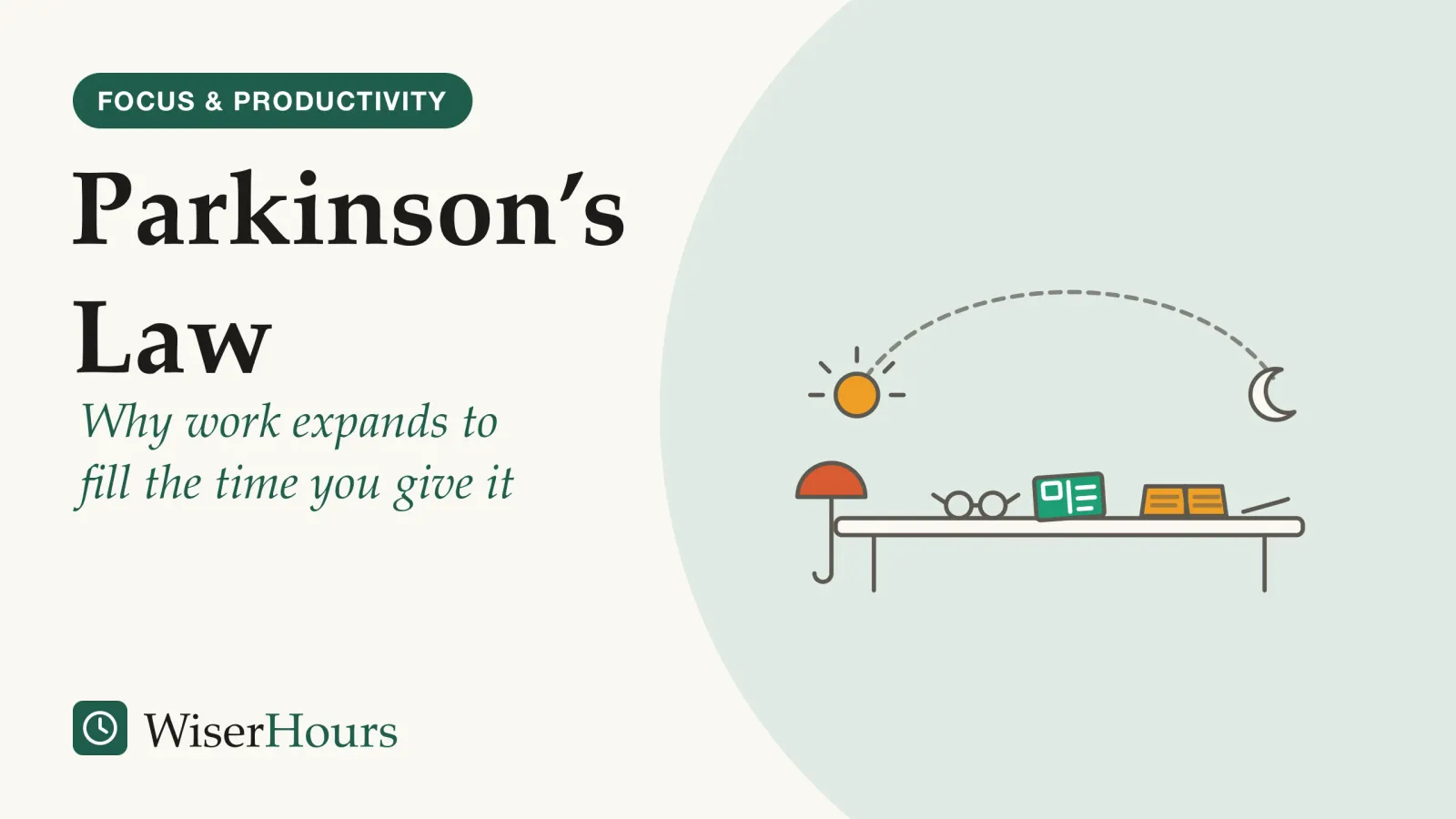
His illustration was an elderly lady who spends a whole day sending one postcard to her niece: an hour finding the card, another hunting for her spectacles, more time on the address and the wording, and a last debate about whether to take an umbrella to the postbox. A busy person, he wrote, would do the same job in about three minutes.1
The essay’s real target came next. Parkinson named two forces: an official wants to multiply subordinates rather than rivals, and officials make work for each other. His evidence was the British Admiralty, where officials grew from 2,000 in 1914 to 3,569 in 1928 while the navy itself shrank by about a third in men and two-thirds in ships. The detail that gets lost is that his officials were never idle: in his story, seven people take far longer to produce the letter one person would have written, and every one of them does their best.1 A 1999 paper that set out to test the law described Parkinson’s formulation as tongue-in-cheek but sincerely hostile to bloated bureaucracies.2
Think of a project that adds a coordinator, a weekly sync, then a report about the sync, while output barely changes. Read as organizational advice, the original says that when a team’s workload looks heavy, ask how much of it the team creates for itself before adding people.
How a joke about bureaucrats became personal productivity advice
Over the following decades, the opening line came loose from the staffing argument. Many management and sociology textbooks taught Parkinson’s law as an accepted principle, the authors of that 1999 paper found, even though scholars on neither side of the question could point to experimental tests of whether individuals slow down when given excess time.2
Self-help writers then recast it as a technique. In a 2007 talk at the South by Southwest festival, the talk that launched his book The 4-Hour Workweek, Tim Ferriss described Parkinson’s law as a task swelling in perceived complexity and importance in proportion to the time you allot it. His advice was to limit the time so that you limit yourself to what matters.4
- 1955Parkinson mocks growing government staff in The Economist
- 1966First lab test: spare time makes the next task slower
- 1967Bryan and Locke treat a time limit as a goal
- 1975Field test with logging crews
- 1999Students dally when later work is cancelled
- 2007Ferriss presents the law as a productivity tactic
- 2026A famous 2002 deadline study is retracted
Parkinson’s point was that expanded work looks like diligence, not slacking; Ferriss’s is that a shorter limit forces you to cut what does not matter. Only the second is a claim about your own pace, and it is the one the experiments below tested.
Timeboxing and time blocking build on the idea: decide the time first, then fit the work to it. If an extra hour changed how long the work took but not what it produced, the task expanded.
Does work expand to fill the time? What the excess-time experiments found
In laboratory experiments that began in 1966, people given more time than a task needed took longer over it or over the next similar task. The early tests told people how much time they had; the first test free of that hint, its authors say, came in 1999, in small studies of US college students on short tasks.2
The first test came from the social psychologists Elliot Aronson and Eugene Gerard. They arranged for some participants to be given, seemingly by accident, too much time for a task, while others got the minimum. On a second, similar task with no limit at all, those who had had spare time took longer.5 Aronson and D. Landy published a 1967 follow-up, titled as a replication and extension of the effect.6 In it, according to the 1999 team’s account, people told they had 15 minutes for the first task used about 11, while people told they had 5 used about 5.2
- Time allowed: the window the person was given for the first task
- Time used: with extra time, the work stretched to fill much of the window
- The next, similar task: worked at their own pace, it still took longer after the roomy first task
Those early studies had a weak spot: the experimenter’s announcements may have hinted how long people were expected to take. A 1969 study with 42 male undergraduates set out to remove that hint, drawing out the first task with a distracting confederate instead. People slowed that way spent more time on the first task, and more on the second once the confederate had gone.7 The 1999 team replied that it still announced times, so the early work never cleanly showed the effect; they also listed a 1973 paper titled as a failure to replicate.2
The study
Limited evidence
Brannon, Hershberger & Brock (1999), Psychonomic Bulletin & Review
Students expected to judge four sets of photos of faces. Those told, before starting the third set, that the fourth had been cancelled took longer over the third set than students in a control group: the authors called it dallying. The effect appeared again in two exact repeats, one only at borderline significance, and in a fourth study with a letter-counting task, where the extra time bought no gain in accuracy.2
Nobody in that design told the students how long to take, so the slowdown seems to come from knowing that time had been freed up. The students in the fourth study did not report slowing down or trying harder, so the drift seems to go unnoticed. These were short tasks in a lab, with students, and the repeats came from the same team, so scale is the main caveat.
A meeting booked for an hour that runs the full hour, though the agenda was done at 35 minutes, is an untested case. When a task frees up time, name what it is for before you drift into it.
Tight time limits and a faster pace: the deadline as a goal
Research by Edwin Locke and Gary Latham recast Parkinson’s law as a case of goal setting: people adjust their effort to how hard a task is meant to be, and a time limit is one way of setting that difficulty.8 Their 2002 review reports a quicker work pace under tight deadlines than under loose ones, in a lab study and at work.3
The lab work was Judith Bryan and Locke’s 1967 paper, Parkinson’s Law as a Goal-Setting Phenomenon.9 For the 1975 field test, Latham and Locke studied logging crews, 379 workers in all, during periods when the mills that bought their timber took deliveries on only one or two days a week. Crews produced at a higher rate under those restrictions than when there were none, though they had a strong reason to: owners and crews were paid by the piece, so they had an incentive to produce as much as possible while deliveries were open.8
The same review names the trade-off underneath. Faced with a hard goal, you can work faster and more intensely for a short time, or more slowly and less intensely for a long time. It also reports that specific, difficult goals consistently beat the instruction to do your best, which sets no clear standard, so almost any effort can count.3
Give yourself a whole day for a proposal, and every section gets the same careful polish. Give yourself two hours, and you have to decide early which three sections carry the argument. Use a tight, specific limit when pace is the bottleneck and the finish line is clear. As far as their published summaries show, these time-limit studies measured how long the work took or how much got done, not how good it was, so they say little about tasks where getting it right is the point.
Do self-imposed deadlines beat procrastination? The study that did not hold up
The best-known evidence that people can beat procrastination by setting their own deadlines no longer stands. Dan Ariely and Klaus Wertenbroch’s 2002 paper in Psychological Science was retracted by the journal on September 2, 2026.10
The paper had reported that people would impose costly deadlines on themselves, that those deadlines improved their work, and that some deadlines set by someone else worked better still.11 In a replicationreplication: Running a study again with fresh data and the same method, to see whether the original result comes back. A finding that fails to replicate is not automatically wrong, but it stops being something you can lean on.Full entry in the glossary published in July 2026, the economists Kyle Hyndman and Alberto Bisin repeated its proofreading study with adult students at a large US public university. Changing the deadlines had a negligible effect on performance, and evenly spaced deadlines set by the experimenters did not stand out.12
Separately, the researchers behind the Data Colada blog analyzed the original data files and concluded that the data for both main studies had been tampered with. Both authors then asked the journal to retract the paper, the post reports; Wertenbroch, the analysts say, never had access to the data.13
Two findings survive. People do want to bind themselves: the replication found demand for costly deadlines, Wertenbroch noted in a response published with the Data Colada analysis.13 And in an earlier field experiment with students recruited through a laboratory at New York University in the US, Bisin and Hyndman found strong demand for self-imposed deadlines, but the deadlines did not raise completion rates in that experiment.14 The part now unproven is that a self-set deadline helps.
- Myth
- Research shows that setting your own deadlines beats procrastination.
- Fact
- The best-known study was retracted in 2026, and a replication found that changing deadlines made a negligible difference to performance.
Treat a self-imposed deadline as a statement of intent, not a proven cure for putting things off, and judge it by whether your work changes. If it has not after a few rounds, tightening it further has no support in this research.
How to use Parkinson’s law without fooling yourself
Use Parkinson’s law as a prompt: set time limits from what the task needs, keep them for work where speed matters, and judge the result rather than the feeling of being busy. Each step below rests on the experiments above, but no study has tried the four together.
1. Set the limit from what the task needs
Calendars hand out time in default blocks, such as an hour for a meeting or an afternoon for a report. The excess-time studies suggest that whatever you are given tends to get used, so decide how long the task needs before you look at the slot.5 Mind the planning fallacyplanning fallacy: The tendency to underestimate how long your own tasks will take, even when you know similar tasks ran late before. Estimating from your track record on past tasks, rather than from the plan, tends to correct it.Full entry in the glossary too: estimates of your own tasks tend to run short, so base the limit on how long similar work took last time.

2. Make the limit specific and slightly tight
“Finish the summary by 11:30” gives you something to pace against; “get the summary done this morning” does not. That follows the goal-setting finding that specific, difficult targets beat doing your best. Tight means hard but possible: in the same review, performance leveled off or fell once a goal outran ability or people stopped committing to it.3
3. Give freed time a job, and re-time after a slow round
When a meeting is cancelled or a task finishes early, the excess-time experiments suggest what happens next: whatever you are working on slows down to fill the gap, and the slower pace can carry over to the next similar task.25 Keep a short list of next tasks so freed time has somewhere to go. If a weekly report took a leisurely afternoon during a quiet week, time the next one fresh instead of treating the afternoon as the new normal.
4. Keep tight limits away from work where quality is the point
Contract checks, safety reviews and hard creative problems are the tasks where a faster pace can cost you most, and the time-limit experiments described here timed the work rather than judging its quality. Locke and Latham’s review also notes that on a task that is new and complex for you, a hard performance goal can backfire.3 Give those the time the work needs, and apply tight limits to routine tasks with a clear finish.
The bottom line
Spare time does tend to get used, and work went faster under tight, specific limits in the lab and in at least one field study, but that research is small, old and measured speed, not whether tighter limits cost quality. The famous evidence that self-imposed deadlines beat procrastination was retracted in 2026. Set your next limit from what the task needs, and judge it by what it changes in the work.
Frequently asked questions
Is Parkinson's law the same as the planning fallacy?
No. Parkinson's law, from C. Northcote Parkinson's 1955 essay in The Economist, is about the time you are allowed: work stretches to use it. The planning fallacy is about the time you predict: people tend to guess too little time for their own work. The two can meet in one plan, so a time limit is safer when it comes from how long similar work took before than from a hopeful guess.
Does working to a tighter time limit lower the quality of work?
The classic time-limit studies cannot say: as far as their published summaries show, they measured how long people worked or how much they produced, not how good the work was. A 2002 goal-setting review by Edwin Locke and Gary Latham describes a trade-off between working faster and more intensely for a short time and working more slowly for longer. Keep tight limits for routine tasks with a clear finish.
Does Parkinson's law apply to meetings?
No study we found tested Parkinson's law on meeting length, so any link is an inference. Laboratory experiments from 1966 onward found that people given spare time on a task tended to use it, which suggests a meeting booked by default for an hour may fill the hour. A simple check is to set the length from the agenda and see whether the same decisions still get made.
Sources
- Parkinson’s Law. Parkinson, C. N. (1955). The Economist, November 19, 1955
- Timeless demonstrations of Parkinson’s first law. Brannon, L. A., Hershberger, P. J. & Brock, T. C. (1999). Psychonomic Bulletin & Review, 6(1), 148-156
- Building a practically useful theory of goal setting and task motivation: A 35-year odyssey. Locke, E. A. & Latham, G. P. (2002). American Psychologist, 57(9), 705-717
- The Lost Presentation That Launched The 4-Hour Workweek: “Secrets of Doing More with Less in a Digital World” from SXSW 2007 (transcript). Ferriss, T. (talk 2007; transcript posted 2021). The Tim Ferriss Show transcripts, tim.blog
- Beyond Parkinson’s law: The effect of excess time on subsequent performance. Aronson, E. & Gerard, E. (1966). Journal of Personality and Social Psychology, 3(3), 336-339
- Further steps beyond Parkinson’s Law: A replication and extension of the excess time effect. Aronson, E. & Landy, D. (1967). Journal of Experimental Social Psychology, 3(3), 274-285
- Beyond Parkinson’s law: III. The effect of protractive and contractive distractions on the wasting of time on subsequent tasks. Landy, D., McCue, K. & Aronson, E. (1969). Journal of Applied Psychology, 53(3, Pt. 1), 236-239
- Increasing productivity and decreasing time limits: A field replication of Parkinson’s law. Latham, G. P. & Locke, E. A. (1975). Journal of Applied Psychology, 60(4), 524-526
- Parkinson’s Law as a goal-setting phenomenon. Bryan, J. F. & Locke, E. A. (1967). Organizational Behavior and Human Performance, 2(3), 258-275
- Retraction: Procrastination, Deadlines, and Performance: Self-Control by Precommitment. Psychological Science (2026), 37(9), 665; retraction notice, September 2, 2026
- RETRACTED: Procrastination, Deadlines, and Performance: Self-Control by Precommitment. Ariely, D. & Wertenbroch, K. (2002). Psychological Science, 13(3), 219-224; retracted 2026
- Replication of “Procrastination, Deadlines, and Performance: Self-Control by Precommitment”. Hyndman, K. & Bisin, A. (2026). Psychological Science, 37(8), 557-571
- [138] Artificial Deadlines (Part 1): Evidence of Fraud in an Influential Study About Procrastination. Simonsohn, U., Simmons, J. & Nelson, L. (2026). Data Colada blog, August 31, 2026, with a response from K. Wertenbroch
- Present-bias, procrastination and deadlines in a field experiment. Bisin, A. & Hyndman, K. (2020). Games and Economic Behavior, 119, 339-357
How we researched this
We read C. Northcote Parkinson's 1955 Economist essay in full and searched Crossref, OpenAlex, PubMed, APA PsycNet and the web in September 2026 for experiments on excess time, time limits and deadlines, and for retraction records. Sources date from 1955 to 2026. Main limitation: the direct tests are small and mostly decades old; several papers, including the 2026 replication, were read only as abstracts or through later authors' accounts, and we found no systematic review.
Keep reading
Time Management for Beginners: Where to Start and What to Ignore
Time management for beginners: 5 habits roughly ranked by evidence, what a 158-study meta-analysis found, and the popular advice you can skip at first.
The Eisenhower Matrix: How to Separate Urgent From Important
Four boxes, two questions: how to sort a to-do list with the Eisenhower matrix in 10 minutes, what each box is for, and what Eisenhower really said.
How to Prioritize Tasks When Everything Feels Urgent
How to prioritize tasks when everything feels urgent: why a heavy load pulls you to easy wins, and a 6-step triage by cost of delay and payoff per hour.
Eat the Frog: Should You Really Do the Hardest Task First?
Eat the frog says do your hardest task first. No trial has tested it, but 2 field studies of doctors point that way. When to wait, and how to pick a frog.