Cash Stuffing Explained: Does Paying With Cash Really Cut Spending?
Cash stuffing puts spending money in labelled envelopes. A 2024 review of 71 papers finds people spend only slightly less with cash, and the gap is shrinking.

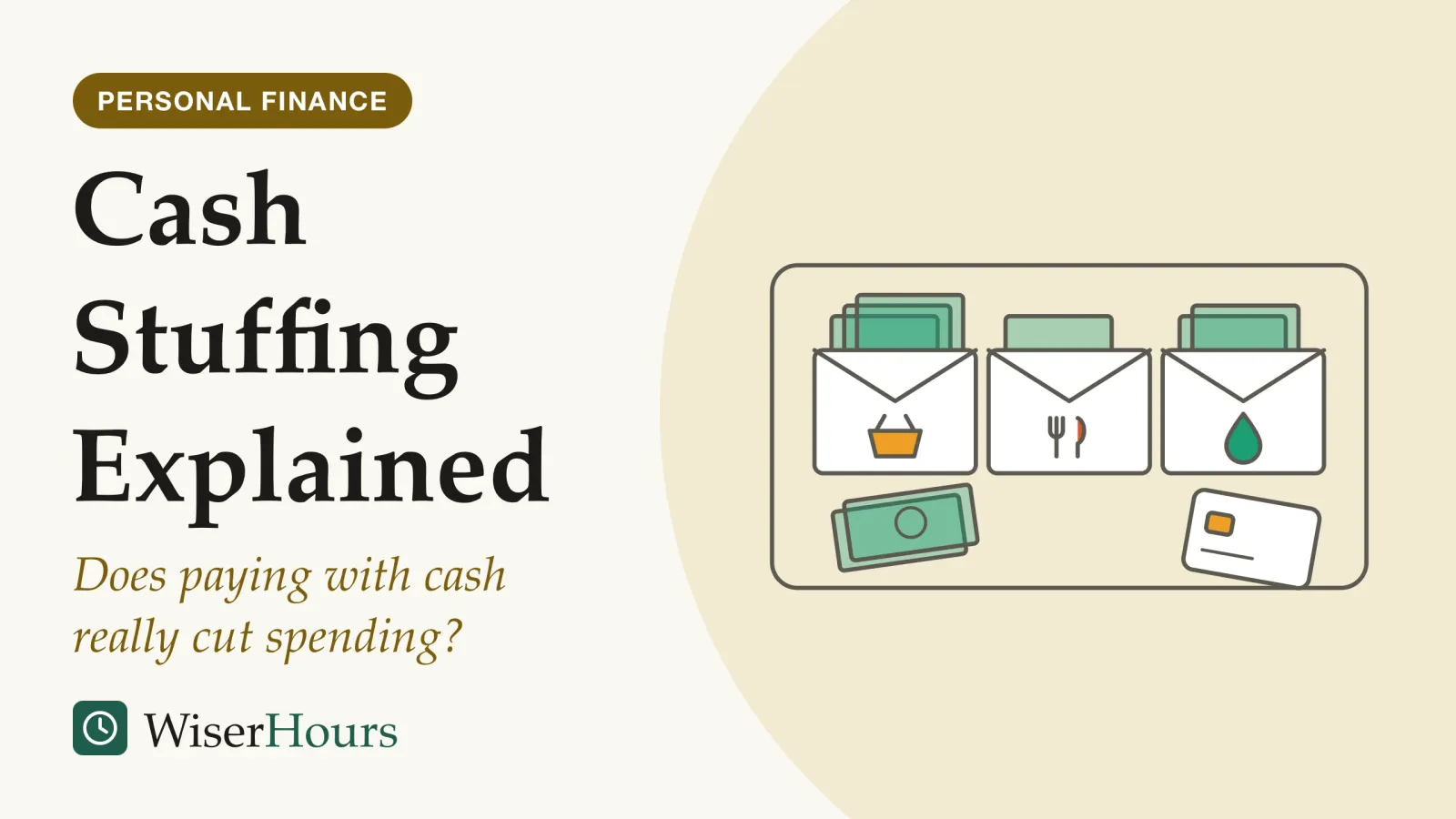
People spend a little less when they pay with cash than by card, on average. The surprise is how little, and how much the gap has shrunk as cards and phones became the everyday way to pay. That finding is the real test for cash stuffing, the budgeting method in which banknotes are counted into labelled envelopes.
Cash stuffing works on two ideas at once: the mild sting of handing over notes, and a hard limit written on each envelope. Research supports a small version of the first idea and offers some support for the second, but no study has tested cash stuffing itself. It can suit someone who overspends in a few flexible categories, provided the cash kept at home stays small.
It is one way to run a budget you have already drawn up (see setting up a budget from scratch); this article covers only the envelopes and their evidence.
How cash stuffing works, and why it is back
Cash stuffing is the social media name for the envelope system: the money for a period’s flexible spending is withdrawn in notes, divided among labelled envelopes, and each category is paid for only from its own envelope. The authors of a 2024 review of payment research point to cash stuffing as a TikTok trend that brings back envelopes earmarked for different categories of spending.1
A month of cash stuffing usually runs like this:
- Choose the few categories where spending varies and tends to run over, such as groceries, fuel or eating out. Rent and bills paid by transfer stay out of the envelopes.
- On payday, withdraw the planned amount for those categories and count it into envelopes, each marked with its category and amount.
- Take the matching envelope when you shop, and pay from it alone.
- When an envelope is empty, spending in that category stops until the next payday, unless you decide on purpose to move money across from another envelope.
- Before refilling, count what is left in each envelope and decide where it goes.
Government guidance uses a milder form of the same device. A 2017 tip sheet for financial educators from the US regulator known as the Consumer Financial Protection Bureau (CFPB) suggests writing a monthly amount for special occasions on an envelope, keeping the receipts inside it and taking any overspend out of the next month’s amount.2
Picture an eating-out envelope holding enough for four meals. After the third dinner you can see and feel that one meal is left, so the fourth invitation turns into a decision instead of a habit. The envelope shows the limit at the moment of spending, where a spreadsheet only reports it afterwards.
The pain of paying: why notes can feel different from a tap
Researchers call the discomfort of parting with money the pain of payment; a 2023 review in Psychology & Marketing defines it as the negative feeling people get when they realize they have lost, or will lose, some of their money.3 Cash stuffing bets that notes sharpen that feeling more than a tap of a card.
Feedback is a second reason. A 2017 CFPB report points out that card payments give less immediate feedback than a stack of money shrinking in your wallet, and that credit card users usually see the result only when the statement arrives.4 Memory widens the gap: in small 2001 studies, people recalled card spending less accurately than cash, one reason the research on tracking your spending favors statements over recollection.
Counting out notes for a new jacket means watching the pile go down; tapping a phone for the same jacket takes a second and leaves nothing behind. Only one puts the cost in front of you. Whatever you pay with, the lesson is to make the amount noticeable at the moment you spend it.
Cash versus card: what the classic experiments found
The studies behind the idea are mostly small experiments in which students or online volunteers bid on or priced single items. Several found that people offered more with a card than with cash; a careful recent attempt to repeat the credit card result did not.
The best known is a 2001 study by Drazen Prelec and Duncan Simester, run with genuine transactions of potentially high value. People told to pay by credit card were willing to pay more than those told to use cash, and the abstract, the only part of the paper available to us, says the effect may be as large as double. A credit card also lets you pay later, so part of that gap could reflect borrowing, though the authors judged that unlikely to be the whole story.5
A 2015 experiment in Denmark removed the borrowing: Emma Runnemark and colleagues gave 82 master’s students the same sum to bid for coffee and beer vouchers, and those told to pay by debit card bid more than those paying cash, though a group whose money was sent to their accounts rather than handed over as a banknote bid no more than the cash group.6 A 2008 set of experiments by Priya Raghubir and Joydeep Srivastava found, according to its abstract, that people also spent more with scrip, a kind of prepaid voucher, than with cash of the same face value, and that estimating expenses item by item weakened the credit card effect.7
The warning comes from Belgium. In a 2021 replicationreplication: Running a study again with fresh data and the same method, to see whether the original result comes back. A finding that fails to replicate is not automatically wrong, but it stops being something you can lean on.Full entry in the glossary study, Yunxin Liu and Siegfried Dewitte at KU Leuven ran four studies with 692 people and did not reproduce the credit card effect; their review of earlier work found the effect weaker in recent years and outside the US.8
- Myth
- Paying with cash cuts your spending in half.
- Fact
- Some early studies found gaps that large. Pooled research finds a small effect that has weakened over time, and one careful replication found none.
All of these measured single bids or purchases, so treat any striking percentage as the ceiling of a small experiment, not a forecast for your month.
Does paying with cash cut spending? What 71 papers add up to
A 2024 meta-analysis from the Journal of Retailing found that people spend a little more when they pay by card, phone or other cashless methods than with cash, but the effect is small and has weakened over the decades. Its authors call it the most comprehensive evidence assembled to date: a meta-analysismeta-analysis: A study that combines the results of earlier studies on the same question into one overall estimate. Pooling makes the estimate more precise, but it cannot repair the studies it pools: a meta-analysis of surveys is still survey evidence.Full entry in the glossary pooling dozens of studies like the ones above.1
The study
Moderate evidence
Cash against cards in 71 papers: the 2024 Journal of Retailing meta-analysis
Researchers at the universities of Adelaide and Melbourne, Australia, pooled comparisons of spending with cashless payments and with cash, including unpublished work. Cashless payments went with slightly higher spending on average, which the authors describe as a small effect. The gap was larger for purchases made to be seen, such as status goods, and disappeared for tips and donations. It was stronger in periods of economic growth and has weakened over time, which the authors link to people growing used to cards. Their tests suggested publication bias was unlikely to account for the finding, and no competing interests were declared.1
In everyday terms, a small effect adds up across a supermarket’s takings but can vanish in the ups and downs of one household’s week. It also concerns single purchases: whether a month of paying cash leaves more money at the end has not been measured. The authors still suggest that people who struggle with self-control use cash where possible, and say this fits the cash-stuffing trend.1 Treat cash as a small brake on spending, not a cure.
Labels and limits may matter more than the notes
Splitting money into labelled portions, which researchers call partitioning, has its own evidence, and it may be the part of cash stuffing doing the most work. In a 2011 field experimentfield experiment: An experiment run in a real setting, such as a workplace, shop or website, with people going about their ordinary lives, usually with random assignment. It shows how an effect plays out in practice, though often for one setting and one group at a time.Full entry in the glossary by Dilip Soman and Amar Cheema, construction laborers in rural India who were paid weekly in cash had part of their wages set aside in sealed envelopes, and those whose savings were split across two envelopes rather than one saved more. A 2014 review of the study gives the authors’ explanation: opening an envelope, or breaking a partition, brings a pang of guilt that makes the money harder to spend.9 The study measured saving by one group of workers paid in cash, so it shows what labelled envelopes can do, not that cash stuffing works for everyone.
- The feel of paying: in a 2024 meta-analysis, people spent slightly less with cash than with cashless payments; the gap is small and has shrunk over time
- The label and the limit: in a field experiment in India, workers saved more when their savings were split into two envelopes rather than one; whether labels without banknotes work as well is untested
The label and the limit do not need banknotes. Separate named accounts, or sub-accounts where your bank offers them, keep the partition and drop the cash risks, though no study found for this article tested whether they work as well as envelopes; that approach, digital envelope budgeting, is left for a separate guide. If the idea appeals, start with labels and limits, and add cash only for the categories where you want the extra brake.
What cash stuffing costs: theft, no protection and fewer shops taking cash
Cash in envelopes carries risks that a bank account does not: theft or loss, no deposit protection, no interest while inflation eats into it, and in some countries fewer shops that accept it. Each risk grows with the amount kept at home.
The CFPB warns that cash kept for emergencies can disappear through theft, loss or damage.10 Deposit insurance offers no cover either: in the US, the FDIC’s guidance, last updated in 2024, covers money deposited at insured banks and lists the contents of safe deposit boxes among the things it does not cover.11 Other countries run their own schemes with their own limits, so check yours. An envelope also pays no interest, and as the European Central Bank explains, inflation reduces the value of money over time.12
Acceptance is the last risk. In the European Central Bank’s 2024 survey, cash was still the most common way to pay in shops across the euro area, but its share was falling, and fewer companies accepted it than in 2021.13 Sweden is much further along: in the Riksbank’s 2025 survey of small businesses, about one in three did not accept cash.14 In the US, cash remained the third most used way to pay in 2025, according to the Federal Reserve’s 2026 diary report.15
The safer pattern is to keep only the current period’s spending money in envelopes and hold savings in an insured account; the guide to where to keep an emergency fund explains deposit protection in more detail. Before committing, check whether the shops you use most still take cash.
Who cash stuffing may suit, and a lower-risk way to test it
Cash stuffing is most likely to help someone who overspends in a few flexible categories, such as eating out, and lives where cash is still widely accepted. It fits less well if most of your spending happens online or cash is hard to get. The research offers a small average, not a rule, so test it briefly.
Testing envelopes for one month
This is a suggestion drawn from the studies above, not a tested program. Move one or two categories where spending runs over, such as eating out, to cash for a month and leave everything else as it is. At the end, compare each category’s total with the month before, and keep the envelopes only if the difference is worth the trips to a cash machine.
If cash is impractical, the same two ideas can be borrowed. Estimate planned spending item by item rather than as one lump sum, the approach that weakened the card effect in one of the 2008 experiments.7 The CFPB’s tip sheet for educators suggests checking balances before discretionary purchases, for example through text alerts or a banking app.2
How much weight each claim can bear:
| Claim behind cash stuffing | What the best evidence found | Evidence |
|---|---|---|
| Paying cash lowers spending | A small average effect across 71 papers, weakening over time; none on envelope budgeting | Meta-analysis, moderate1 |
| Card payers bid far more | Large gaps in some early studies of willingness to pay | Early experiments, limited5 |
| The card effect is reliable | Not reproduced in 4 studies with 692 people in 2021 | Replication, moderate8 |
| Labelled pots help | Laborers in India saved more when savings were split into two portions | Field experiment, limited16 |
When the envelopes keep running dry
Envelopes that run out well before payday, month after month, can point to an income or debt problem rather than a method problem, and free help exists. This ordering is WiserHours’ own, based on Australian, US and UK guidance; in other countries, try a debt service run by the government or a non-profit.
- Straight away: if rent, food or energy bills can no longer be paid, talk to a free debt adviser now. Australia’s Moneysmart tells anyone overwhelmed by debt to see a financial counsellor as soon as they can, free through the National Debt Helpline, since getting help early leaves more options open.17 If money trouble has led to thoughts of suicide or self-harm, contact your local emergency number now; in the US, 988 takes calls and texts around the clock, free and confidential.18
- Within weeks: if spending has outrun income for a month or two, book free debt advice. According to the CFPB, most credit counseling organizations in the US are non-profits, though some charge fees, and they can help you build a budget; it advises checking one with your state attorney general before signing up.19 In the UK, GOV.UK guidance lists MoneyHelper among the free sources of debt advice.20
- When you next review your plans: decisions shaped by your own finances, such as borrowing or investing, are worth taking to a qualified, regulated adviser before you act.
The bottom line
Cash stuffing rests on a real but small effect: people spend slightly less with notes than with cards, and the gap is narrowing. Its labelled limits may matter as much as the cash, and those work in a bank account too. If you try it, use cash for the one or two categories where you overspend, keep only the current period’s money at home, and judge it by your own totals after a month.
This article is general education, not financial advice. For decisions about your own money, speak to a qualified, regulated adviser.
Frequently asked questions
Does paying by phone count as cash or card for this research?
Phones count as cashless, and the evidence on them is thin. The 2024 Journal of Retailing meta-analysis found no clear difference between kinds of cashless payment taken one feature at a time, though credit cards went with a larger effect. A 2021 set of 4 studies from KU Leuven in Belgium found no clear difference between phone payments and cash in its online studies, though its lab study found one in basket value.
Is it safe to keep envelopes of cash at home?
It carries risks a bank account does not. The Consumer Financial Protection Bureau, a US regulator, warns that cash can be lost, stolen or destroyed, and in the US, FDIC deposit insurance (per its 2024 guidance) covers money deposited at an insured bank, not banknotes at home or in a safe deposit box. Keeping only the current period's spending money in envelopes limits what is at stake.
Can a shop refuse to take my cash?
Whether a shop may refuse cash depends on your country's law, so check your own rules. Refusals do happen: in the European Central Bank's 2024 survey, 6% of euro area consumers said cash had been refused at least once in the month before they were asked, and in Sweden, one in three small businesses the Riksbank surveyed in 2025 did not take cash.
Sources
- Less cash, more splash? A meta-analysis on the cashless effect. Schomburgk, L., Belli, A. & Hoffmann, A. O. I. (2024). Journal of Retailing, 100(3), 382-403
- Managing spending: Ideas for financial educators. Consumer Financial Protection Bureau (US), February 2017
- The pain of payment: A review and research agenda. Reshadi, F. & Fitzgerald, M. P. (2023). Psychology & Marketing, 40(8), 1672-1688
- Consumer Insights on Managing Spending. Consumer Financial Protection Bureau (US), February 2017
- Always Leave Home Without It: A Further Investigation of the Credit-Card Effect on Willingness to Pay. Prelec, D. & Simester, D. (2001). Marketing Letters, 12(1), 5-12
- Do consumers pay more using debit cards than cash? Runnemark, E., Hedman, J. & Xiao, X. (2015). Electronic Commerce Research and Applications, 14(5), 285-291
- Monopoly money: The effect of payment coupling and form on spending behavior. Raghubir, P. & Srivastava, J. (2008). Journal of Experimental Psychology: Applied, 14(3), 213-225
- A replication study of the credit card effect on spending behavior and an extension to mobile payments. Liu, Y. & Dewitte, S. (2021). Journal of Retailing and Consumer Services, 60, 102472
- Applying Insights from Behavioral Economics to Policy Design. Madrian, B. C. (2014). Annual Review of Economics, 6, 663-688
- An essential guide to building an emergency fund. Consumer Financial Protection Bureau (US), last updated 29 October 2025
- Understanding Deposit Insurance. Federal Deposit Insurance Corporation (US), last updated 1 April 2024
- What is inflation? European Central Bank, explainer
- Study on the payment attitudes of consumers in the euro area (SPACE) 2024. European Central Bank (19 December 2024)
- Payments Report 2026. Sveriges Riksbank (Sweden), March 2026
- 2026 Diary of Consumer Payment Choice. Federal Reserve Financial Services (US), 2026
- Earmarking and Partitioning: Increasing Saving by Low-Income Households. Soman, D. & Cheema, A. (2011). Journal of Marketing Research, 48(SPL), S14-S22
- Financial counselling. Moneysmart, Australian Securities and Investments Commission (last updated 9 September 2026)
- 988 Suicide & Crisis Lifeline. 988 Suicide & Crisis Lifeline (US)
- What is credit counseling? Consumer Financial Protection Bureau (US), last reviewed 2 August 2023
- Options for dealing with your debts. GOV.UK, UK government guidance
How we researched this
We searched Crossref, OpenAlex, Google Scholar and journal sites in September 2026 for experiments and meta-analyses comparing spending with cash and cashless payments, read central bank payment surveys from the euro area, Sweden and the US, and checked US regulator guidance. Sources run from 2001 to 2026. Main limitation: no study has tested cash stuffing itself, and most payment studies measure single purchases or bids, not monthly budgets.
Keep reading
How to Budget With Irregular Income: A Guide for Freelancers and Gig Workers
In a 2025 Fed survey, 58% of self-employed US adults said their income varied month to month. How to budget around a lean month, a buffer and tax.
Emergency Fund Basics: What It's For, How Big, and Where to Keep It
An emergency fund keeps a shock from becoming debt. Why 3 to 6 months is a rule of thumb, a smaller first target, and where the cash is protected.
How to Track Your Spending Without Losing Your Mind
How to track spending in 5 steps, from government money guides and from research linking regular progress checks to reaching goals.
How to Make a Budget: A Step-by-Step Guide for Beginners
How to make a budget in 6 steps from US, Canadian and Australian government guides, plus what 2022 research shows about why spending estimates run low.