How to Budget With Irregular Income: A Guide for Freelancers and Gig Workers
In a 2025 Fed survey, 58% of self-employed US adults said their income varied month to month. How to budget around a lean month, a buffer and tax.

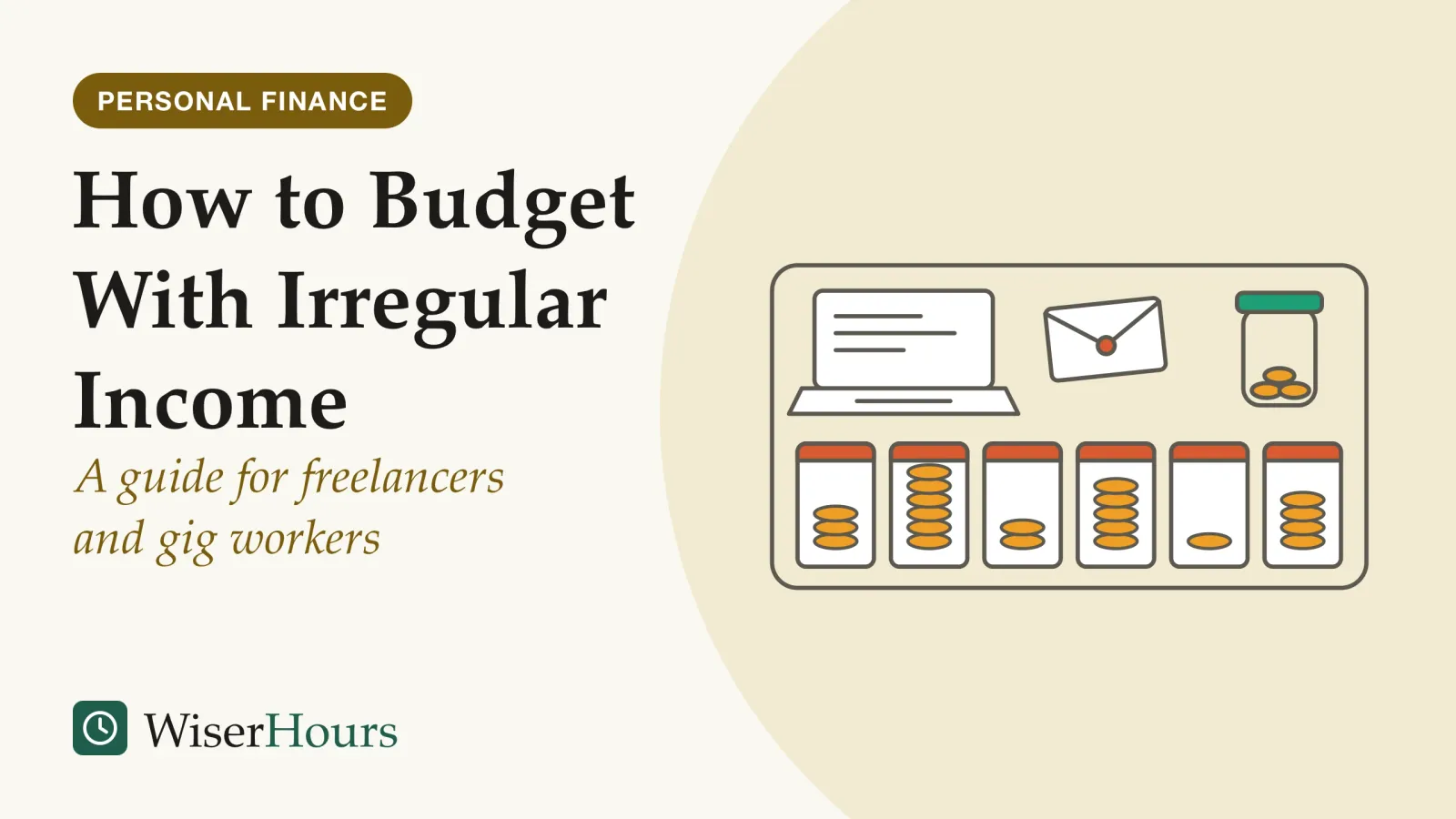
March brings a freelance illustrator three client payments at once, each for work invoiced a month or two earlier. April brings none. Averaged over the year, the income covers every bill; taken month by month, April’s rent depends on how much of March is still in the account. The case is illustrative.
Learning how to budget with irregular income means planning around a lean month instead of a typical one, then letting good months carry the lean ones. US consumer guidance describes the method in five parts:
- Find your baseline month
- Route all income through one holding account
- Take tax out first
- Rank bills for the lean months
- Skim the good months to refill the buffer
These build on the six steps of making a first budget, which assume a steady paycheck; this page covers what changes when it isn’t steady.
Uneven pay breaks a budget in its lean months
Among self-employed US adults, 58 percent told the Federal Reserve’s household survey for 2025 that their income varied from month to month, and 22 percent said they had struggled to pay bills in the past year because of it. For people working for someone else, the shares were far lower, at 28 and 10 percent.1
The trouble is timing. In its Your Money, Your Goals toolkit, the US Consumer Financial Protection Bureau (CFPB) notes that with irregular or seasonal income you may not know how much will arrive or when, while bills keep to their schedule. It names a second pull as well: when money does come in, the urge is to spend it straight away rather than hold some back for the thin months.2
An illustrative case combines the two. A delivery rider has busy summer weeks and a quiet January. A strong July feels like a raise, so a new phone contract and a pricier gym look affordable. Both bills then arrive every month, January included.
The survey finds a link rather than a cause: the self-employed people in it were more likely to have lower incomes, though the Board reports they were still more likely to face hardship from variable income once income was taken into account.1 For a budget, the useful test is whether the leanest months cover the costs, because a year’s total can hide them.
How far monthly pay moves, in bank data
Monthly income moves a lot for most US families, not only freelancers, according to the JPMorgan Chase Institute, the bank’s in-house research unit, which tracked the checking accounts of millions of families at JPMorgan Chase from 2013 to 2018. It is the bank’s own research: the method is published, but the report was not peer-reviewedpeer review: The checking of a study by independent experts, usually arranged by a journal, before it is accepted for publication. It screens for weak methods and unclear reporting, but reviewers rarely see the raw data, so passing it does not prove a finding is right.Full entry in the glossary.3
The study
Moderate evidence
JPMorgan Chase Institute, Weathering Volatility 2.0 (2019)
For the family at the median level of volatility, income changed by 36 percent from one month to the next, on average. On average, families had large swings (a month more than 25 percent above or below their usual income) in almost five months of the year, and spikes were about twice as common as dips. The researchers estimated that a family would need about six weeks’ worth of take-home income in cash to cover a month in which an income dip and a spending spike landed together, and 65 percent of families held less than that.3
Put plainly, for the average family in the data, a month well above or below normal was routine, not a rare shock. Most such months are spikes rather than dips, and spikes cluster in particular months: the authors point to tax refund season and year-end bonuses, and suggest saving hard in those months instead of setting aside a fixed percentage every month.3 The main limit is who was counted: customers of one bank, in data ending in 2018, covering families of every kind rather than the self-employed alone.
Two numbers are worth knowing before anything else, then: your leanest recent month, and how many weeks of pay your savings would cover.
How to budget with irregular income: pay yourself a steady salary
None of these steps has been tested in a trial. They are common methods drawn from US consumer guidance and the bank research above, and the right amounts depend on your own income, costs and tax position.
1. Find your baseline month
The baseline month is a cautious planning figure for income, usually the lowest month of take-home pay in a recent stretch. Penn State Extension, a US university extension service, describes using the lowest monthly income of the past six months as the figure to plan on, with the six-month average as a less cautious alternative.4
Use take-home pay after tax set-asides (step 3), not what clients are invoiced. Then check the baseline against your fixed costs: rent or mortgage, utilities, insurance, loan payments, food and transport. If the baseline covers them, a month as lean as that one would still pay them. If it doesn’t, you know the size of the gap before a lean month arrives, and that gap becomes the first thing the buffer must cover. A gap too wide for any buffer calls for the help routes at the end of this page.
Whichever figure you choose, write it down with the months it came from, so you can redo it when your work changes.
2. Route all income through one holding account
In the buffer-account method, every payment lands in one account first, and a fixed sum moves from it to your everyday account on the same date each month, much like a salary. The CFPB toolkit describes the principle: setting aside money in weeks or months with higher income so that bills can be paid on time when income drops or stops.2
The holding account turns an uneven income into a steady one for as long as its balance lasts. Its balance is also the plainest test of how safe you are: divide it by your monthly salary figure and you have the number of months you could keep paying yourself with no new work.
- The baseline month: plan fixed costs around a lean month from the past, a more cautious figure than the average
- Tax first: money for tax goes to one side before the rest is counted
- The holding account: all income lands here; good months fill it and lean months draw on it
- A steady amount: the same sum moves to everyday spending each month, for as long as the buffer lasts
3. Take tax out first
Self-employed income usually reaches you before any tax is deducted, so part of every payment is already owed to the tax authority. The rules below apply in the US and the UK as of 2026; in other countries, your national tax authority publishes its own.
- The IRS says that in the US, people in business for themselves generally need to make estimated tax payments, and it divides the year into four payment periods, each with a due date. You can pay weekly or monthly if that suits you, as long as enough is paid by the end of each period. If income arrives unevenly, the IRS says you may be able to lower or avoid an underpayment penalty by annualizing your income and making unequal payments.5
- In the UK, HMRC collects payments on account under Self Assessment: two instalments, due on 31 January and 31 July, each usually half of the previous year’s tax bill. They don’t apply when last year’s bill was below £1,000 (UK, as of 2026), or when over 80 percent of it was paid outside Self Assessment.6
A separate tax pot, filled from each payment before anything else, keeps that money out of the baseline. How big a share to set aside depends on your income and your tax rates, so the tax authority’s own tools or a qualified tax adviser are the places to size it. For the paperwork of starting out, see tax and contract checks for freelancing alongside a job.
The first UK tax bill can be larger than expected
In your first year of payments on account, GOV.UK explains, the January payment covers last year’s full tax bill plus the first instalment towards the next one. For someone new to self-employment, that single payment can come to one and a half times the previous year’s bill, as in GOV.UK’s own example, so the tax pot needs to be ready for it.6
Here are the first three steps for one person.
One freelancer's six months, worked through
Illustrative figures in 2026 US dollars, counted after the tax pot. Over six months, a freelance editor took home $2,400, $4,100, $3,000, $5,200, $2,700 and $3,800. The lowest month, $2,400, becomes the baseline, and fixed costs plus essentials come to $2,100, so the baseline covers them. Each month, $2,400 moves from the holding account to the everyday account. By the end of the six months, about $6,800 above the baseline has built up in the holding account: close to three months of pay at the baseline.
4. Rank bills for the lean months
Decide ahead of time what gets paid first when the holding account runs low. The CFPB toolkit suggests a cash flow budget that sets income against expenses week by week, to spot where you will fall short and to find costs you can cut back or postpone.2 Penn State Extension suggests covering fixed expenses before flexible ones, and turning some fixed costs into flexible ones where you can, such as a pay-as-you-go gym instead of a contract.4
Written down in a good month, the order turns a lean month into a list to follow rather than a decision made under stress.
5. Skim the good months to refill the buffer
When a month beats the baseline, the surplus stays in the holding account instead of flowing into spending. Once the buffer reaches its target, extra can go to other goals. After a lean stretch that drained it, rebuilding comes before any raise in your monthly salary figure.
The JPMorgan Chase Institute’s data show why this matters: good months tend to cluster in particular months, and even for the families whose income swung most, the chance to save may come only a few times a year.3 A cautious rule is to raise the salary figure only when the baseline itself has risen for several months, not after one strong month.
Setting up a budget for uneven pay
Tested, observed or advised: the evidence behind each method
Our searches found no randomized trial of any budgeting method for irregular income. Survey and bank data show that swings are common and linked to trouble paying bills; the methods come from consumer guidance.
| Method or claim | What the best evidence found | Evidence |
|---|---|---|
| Swings are common among the self-employed | A majority of self-employed US adults said income varied month to month (2025) | Observational, official survey1 |
| Swings are large and frequent for families generally | Large swings in almost five months a year in US bank data, 2013 to 2018 | Observational, company research, moderate3 |
| Plan on a lowest-month baseline | Described by a US university extension service; not tested | Expert guidance4 |
| Save in high-income months for lean ones | Recommended in the CFPB’s toolkit; consistent with the bank data’s pattern of clustered spikes | Expert guidance; observational23 |
| Set tax aside from every payment | Follows from US and UK instalment rules as of 2026 | Official rules56 |
Treat the steps as sensible defaults and test them against your own records. If six months of statements show the baseline covering fixed costs and the holding account growing, the method is working for you; if not, the same figures show which step to adjust.
When the lean months outlast the buffer: where to get help
Debt advice that is free or low-cost exists in the US and the UK. The ordering below is WiserHours’ own, drawn from US and UK government sources; in other countries, look to your own regulator for free debt advice and to your tax authority’s guidance.
- Now: when housing, food or utility bills can’t be paid, or a creditor has started taking action, seek free advice without waiting. The CFPB describes US credit counselingcredit counseling: Help with budgeting and debts from a trained counselor, which in the US usually comes from a non-profit organization and may include a debt management plan. Not every provider is non-profit or free, and some have defrauded people, so check fees and credentials first.Full entry in the glossary organizations as usually non-profit, offering help with money and debts that is free or low-cost, though fees may apply to some services.7 In the UK, the government’s guidance on dealing with debts sends people to MoneyHelper’s free debt advice services.8 Anyone having thoughts of suicide or self-harm alongside money worries can call or text the 988 Suicide & Crisis Lifeline in the US, or, if a life is in immediate danger, call 911.9 In the UK, Samaritans answers on 116 123; go to A&E or call 999 if a life is in danger, and in England, NHS 111 offers a mental health option.10 Elsewhere, dial your local emergency number.
- Soon: if the baseline keeps falling short of fixed costs month after month, or day-to-day spending has moved onto credit cards, contact a free debt adviser within weeks. Before signing up to anything, the CFPB suggests asking about set-up and monthly fees, and warns that some debt management plan providers have defrauded people.7
- Routine, before the next tax deadline: if you expect to underpay, read your tax authority’s guidance or talk to a qualified tax adviser before the payment falls due. In the UK, HMRC can be asked to reduce payments on account when you expect this year’s tax to be lower than last year’s, though interest is charged if the final bill turns out higher.6
The bottom line
When pay swings, the danger is concentrated in the lean months, and more than half of self-employed US adults told the Federal Reserve in 2025 that their income varied month to month. A budget built on a baseline month, a holding account and a tax pot is meant to turn uneven pay into a steady salary for as long as the buffer lasts. These are common methods rather than tested ones, so check them against your own figures, and ask for free advice early if the lean months start to outlast the buffer.
This article is general education, not financial advice. For decisions about your own money, speak to a qualified, regulated adviser.
Frequently asked questions
Should I budget on my average income or my lowest month?
Guidance differs, and no study compares the two. Penn State Extension, a US university extension service, describes both: planning on the lowest month of the past six gives a conservative figure, while the six-month average is an alternative. The lowest month protects fixed bills in a lean stretch; the average can leave a gap in any month that falls below it.
How often should an irregular-income budget be redone?
We found nothing that sets a best interval, so any rhythm is a starting point. The Consumer Financial Protection Bureau's toolkit suggests a cash flow budget that sets income against expenses week by week, which shows lean weeks before they arrive. A new client, a lost contract or a seasonal change in work is a good reason to redo the baseline.
Can a UK self-employed worker lower payments on account if income falls?
Yes, according to GOV.UK. If you know the tax you owe will be lower than last year, you can ask HMRC to reduce your payments on account, online or with form SA303. If you reduce them and the final bill turns out higher, HMRC charges interest on the difference (as of 2026).
Sources
- Economic Well-Being of U.S. Households in 2025. Board of Governors of the Federal Reserve System (May 2026). Survey of Household Economics and Decisionmaking, fielded October 2025
- Your Money, Your Goals: A financial empowerment toolkit. Consumer Financial Protection Bureau (US), June 2020
- Weathering Volatility 2.0: A Monthly Stress Test to Guide Savings. Farrell, D., Greig, F. & Yu, C. (October 2019). JPMorgan Chase Institute
- Budgeting with Irregular Income. Pulman, C. & Continenza, D. Penn State Extension (US), updated 22 April 2025
- Estimated taxes. Internal Revenue Service (US), page last reviewed or updated 28 June 2026
- Understand your Self Assessment tax bill: payments on account. GOV.UK, HM Revenue & Customs guidance (UK), accessed 24 September 2026
- What is credit counseling? Consumer Financial Protection Bureau (US), last reviewed 2 August 2023
- Options for dealing with your debts. GOV.UK, UK government guidance, accessed 24 September 2026
- Suicide Prevention. National Institute of Mental Health (US), last reviewed August 2026
- Where to get urgent help for mental health. NHS (UK), page last reviewed 26 April 2023
How we researched this
Sources read in September 2026: the Federal Reserve's Survey of Household Economics and Decisionmaking (2025 report), the JPMorgan Chase Institute's 2019 study of income volatility in bank-account data, the Consumer Financial Protection Bureau's Your Money, Your Goals toolkit, Penn State Extension guidance, and IRS, GOV.UK, CFPB, NIMH and NHS pages. The chief gap: no trial of any budgeting method for irregular income turned up, so the methods rest on consumer guidance.
Keep reading
Cash Stuffing Explained: Does Paying With Cash Really Cut Spending?
Cash stuffing puts spending money in labelled envelopes. A 2024 review of 71 papers finds people spend only slightly less with cash, and the gap is shrinking.
Emergency Fund Basics: What It's For, How Big, and Where to Keep It
An emergency fund keeps a shock from becoming debt. Why 3 to 6 months is a rule of thumb, a smaller first target, and where the cash is protected.
How to Track Your Spending Without Losing Your Mind
How to track spending in 5 steps, from government money guides and from research linking regular progress checks to reaching goals.
How to Make a Budget: A Step-by-Step Guide for Beginners
How to make a budget in 6 steps from US, Canadian and Australian government guides, plus what 2022 research shows about why spending estimates run low.