The Aha Moment: What Happens in the Brain During Insight
An aha moment is a sudden reframing of a problem. What brain studies, 4 accuracy experiments and a 2025 memory study show, and which parts are still thin.

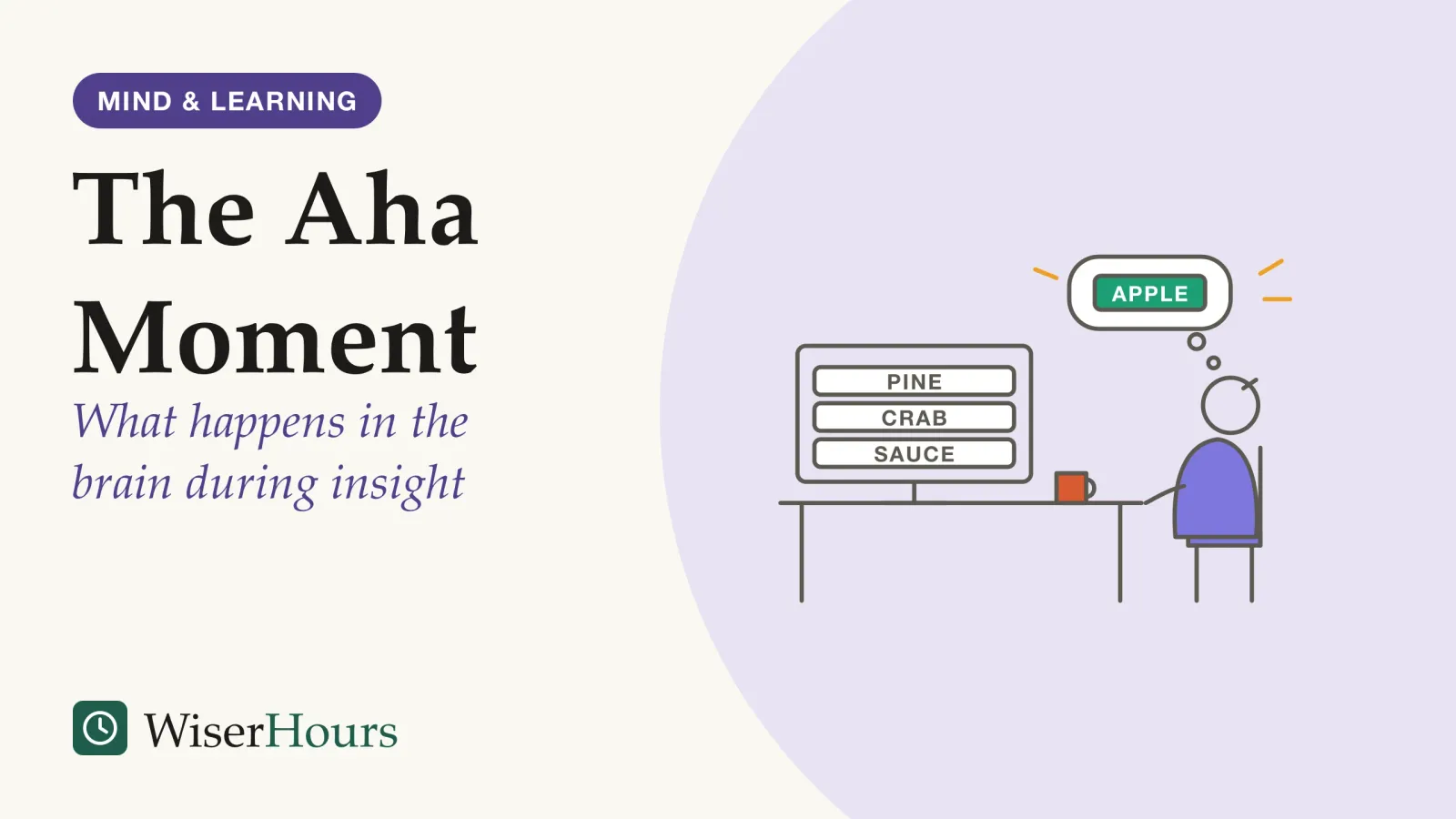
On lab puzzles, the answer that arrives in a flash tends to beat the answer you grind out. In four lab experiments run in the US and Italy, published by Carola Salvi and colleagues in 2016, answers people reported as sudden insights were correct more often than answers they had worked out step by step.1 That flash is the aha moment: seeing a problem in a new way, so that an answer you could not reach a moment ago appears all at once, feeling obvious and right. John Kounios and Mark Beeman define insight as a sudden reinterpretation that produces a nonobvious answer.2
Learn a problem well before you expect a flash, give your attention a calm moment turned inward (looking away from the screen counts), write down what arrives, and test it before acting on it, because a strong aha can still be wrong. Most of the brain evidence behind that advice comes from small samples.
Prefer to watch? The video covers the same ground as this article.
What is an aha moment, and how does it differ from analysis?
An aha moment is a solution or understanding that enters awareness suddenly and as a whole, usually with a feeling of certainty and pleasure, while analysis moves forward in visible steps. Kounios and Beeman’s 2014 Annual Review of Psychology paper adds that the same jolt can come from getting a joke, grasping a metaphor or suddenly seeing what a blurry picture shows.2
Definition
An aha moment (insight) is a sudden reinterpretation of a problem, situation or picture that brings a nonobvious answer into awareness all at once, rather than through conscious steps.
With analysis, you can report partial progress: two of three clues fit, so you are close. With insight, there is nothing to report until the answer is suddenly there. Salvi and her colleagues describe insight as an all-or-nothing arrival after processing you are not aware of, and analysis as a conscious search whose intermediate results you can see.1
The Gestalt psychologists were among the first to study insight: in a 1921 book, Wolfgang Köhler described a chimpanzee named Sultan who failed to reach a hanging banana, sat apart for a while, then suddenly stacked boxes and climbed them. The word eureka comes from an older story, of Archimedes leaping from his bath after working out how to test the king’s crown. That story first appears in a Roman writer nearly 200 years later and is now treated as legend.3
You have met both modes at work. Checking why two spreadsheet totals differ is analysis: you narrow it down cell by cell. Suddenly realizing that two colleagues are arguing because they mean different things by “launch date” is insight. Insight is one route to creative work, not the whole of it; how researchers define and test creativity is a broader question, and the creativity category gathers other idea methods. Noticing which mode you are in helps, because the two fail in different ways.
Catching insight in the lab: word puzzles and a button press
Researchers study the aha moment with short puzzles that can be solved either way, asking people after each answer whether it came suddenly or step by step. The workhorse is the compound remote associates problem, and Kounios and Beeman explain that it allows many trials in one session, which brain recordings need.4
Each problem gives three words, such as pine, crab and sauce, and asks for one word that makes a compound or familiar phrase with all three. The answer is apple: pineapple, crab apple, applesauce. Most solutions come within about 10 seconds. Solving it analytically is a search: try cake, find that crabcake works but pinecake does not, move on. Solving it by insight looks like nothing at all, and then apple. Anagrams are used in the same way.4
The key measurement is a self-reportself-report: A measure in which people describe their own behavior, feelings or circumstances, usually by answering a questionnaire. When the same person supplies both of the things being compared, shared habits of answering can make the link between them look stronger than it is.Full entry in the glossary. After each answer, people press a button to say whether it popped into mind or came from methodical testing, and Kounios and Beeman report that participants grasped the distinction straight away.4 That design makes the brain studies possible: one person’s answers to the same kind of puzzle can be sorted into insight and analysis trials and compared.
It is also the main weakness. Nobody can check a feeling of suddenness from the outside, and a quick lab puzzle is a long way from a stuck project. Behind any headline about “the brain’s aha signal” are people’s own labels for short word puzzles, which tells you how far to carry it.
What happens in the brain during an aha moment?
In the best-known study, a 2004 experiment by Mark Jung-Beeman, Kounios and colleagues, insight solutions were marked by extra activity in one right temporal area, seen both in brain scans and as a sudden burst in EEG recordings just before the answer.5
The study
Limited evidence
A right temporal burst, seen two ways (US, 2004)
People solved compound remote associates problems and said after each one whether it came by insight. In the fMRI experiment, insight solutions showed more activity in the right anterior superior temporal gyrus than step-by-step solutions. In the EEG experiment, a burst of high-frequency gamma activity appeared over the same area about 0.3 seconds before people pressed the button for an insight answer.5
The authors link that right temporal area to making connections between distantly related ideas when people read or listen, which fits puzzles whose answer must link three loosely related words. They also stress that all problem solving relied on a largely shared network, so the insight signal is one difference on top of a common base, not a separate creative brain.5
The recordings showed something earlier too. Shortly before the gamma burst, alpha activity rose over the right side of the back of the head, the part that handles vision. Alpha rhythms there are read as the brain turning down visual input, and Kounios and Beeman describe this as a “brain blink”: a covert version of what people do when they look away or close their eyes to think. Their account is that a weakly active answer gets a brief quiet moment in which to surface.4
These were small samples of young, right-handed native English speakers solving word puzzles.5 The brain-blink account is the authors’ reading of a result they had not expected.4 Pooled data do not single out that hotspot: a 2022 meta-analysismeta-analysis: A study that combines the results of earlier studies on the same question into one overall estimate. Pooling makes the estimate more precise, but it cannot repair the studies it pools: a meta-analysis of surveys is still survey evidence.Full entry in the glossary from China of 30 brain-scan studies of insight found the most consistent activity in frontal areas, the amygdala, a neighboring memory area and a parietal area, with no right temporal cluster.6 Looking away or closing your eyes while you search for an answer is not a lapse in focus, and on this account may help.
Before the puzzle appears: a brain state that favors insight
Brain activity before a problem even appears differs between problems later solved by insight and those solved step by step, according to Kounios and colleagues’ 2006 EEG and fMRI work, summarized in their 2009 review. They read the pattern as attention turned inward before insight and outward before analysis.4
Before problems later solved with insight, there was more activity over both temporal lobes and the anterior cingulate, a mid-frontal area linked to noticing competing ideas and switching attention. Before analytic solutions, visual areas were busier, as if people were bracing to stare at the screen. Mood may tilt the same balance. The review reports that people who arrived at the lab in a positive mood were more likely to solve problems by insight than people in a neutral or negative mood, and that anxiety seemed to have the opposite effect.4 These are correlations in small groups, and the mood finding came from one fMRI study, so treat them as hints rather than levers.
A project lead who has spent the morning on a scheduling clash keeps staring at the same calendar grid. The research points less to another hour of staring than to a calmer moment with her eyes off the grid, once she knows the problem well. Knowing it well comes first, because what the brain is “ready” for is a faint link among things already in memory.

Why do aha moments feel so certain, and are they right?
Aha moments probably feel certain because the answer arrives whole and fluently, and in lab puzzles that confidence is usually earned. In the 2016 experiments by Salvi and colleagues, insight answers were more accurate than analytic ones in all four experiments, across word, picture and mixed puzzles in English and Italian. In the first experiment, 38 US undergraduates solved remote associates problems against a 15-second limit.1
A sudden answer was wrong roughly 1 time in 16, a worked-out one more than 1 time in 5. The authors’ explanation is that insight is all-or-nothing: it either arrives complete or not at all, so people who rely on it tend to time out rather than guess. Analysis yields partial answers, and those partial answers become guesses when the clock runs down. The authors add that nobody yet knows whether this holds for complex real problems without a deadline.1
An aha can also be wrong. When Amory Danek and Jennifer Wiley asked 70 US undergraduates to explain magic tricks, some reported strong aha experiences for wrong explanations; correct answers did come faster and with stronger aha feelings, but the feeling was not a guarantee.7
In a larger study, Ruben Laukkonen and colleagues showed 3,000 US adults, in two samples matched to the US population, statements such as “people’s core qualities are fixed” at the same moment as they solved an anagram. Statements paired with an aha were rated as truer, even though the anagram had nothing to do with them.8
- Myth
- If an idea arrives with a strong aha, it must be right.
- Fact
- In lab puzzles, insight answers were correct more often than worked-out ones, but false insights exist, and statements seen during an aha were rated truer even when unrelated.
So treat a sudden answer to a well-defined problem as a strong lead, often better than a rushed guess. But the glow of certainty is a feeling, so before you act on something that matters, test the insight as you would test anyone else’s idea.
Insight solutions tend to stick in memory
Solutions that arrive with a strong aha are remembered better, in the studies so far. A 2025 Nature Communications study by Maxi Becker, Tobias Sommer and Roberto Cabeza found that such solutions were more often still remembered five days later, and linked that boost to activity in the hippocampus, a memory hub.9
The 31 adults, recruited in Berlin, identified objects in hard-to-read black-and-white pictures inside a brain scanner and rated each answer for suddenness, certainty and pleasure. High-insight answers were remembered better than low-insight ones, and the result held in a separate, preregisteredpreregistration: Filing a study's hypotheses and analysis plan publicly before the data are collected or examined. It stops a planned test from being rewritten once the results are in, so a reader can tell a real confirmation from a hunt through the data.Full entry in the glossary behavioral experiment. In the scans, strong insights went with a larger shift in how the object was represented in visual areas, plus activity in the amygdala and hippocampus, and both the shift and the hippocampal activity were linked to later memory.9
Earlier behavioral studies, the authors note, had linked insight to better long-term memory, sometimes after a single experience.9 A classic 1979 example by Pamela Auble and colleagues used sentences that made no sense until a cue word arrived, such as “the haystack was important because the cloth ripped” (cue: parachute).3 The brain-imaging side, though, is one study of visual puzzles in one city, and the authors list limits of their own, including an imperfect accuracy measure and few forgotten trials to compare.9
Anyone who teaches or trains can leave room for the click: a new colleague who works out why a process exists, with a well-placed hint, may keep that understanding longer than one who is simply told. For your own insights, the boost is not a filing system, so write the idea down anyway.
How can you have more aha moments?
The evidence supports a few conditions rather than a technique: know the problem well, give your attention room to turn inward, and check what arrives. None is a reliable switch.
That sequence echoes the classic account in which illumination follows preparation and a period away; the research on whether a break from a hard problem pays off covers the pause itself. The main claims hold up unevenly.
| Claim | What the best evidence found | Evidence |
|---|---|---|
| Insight answers are more often correct | Higher accuracy in all four experiments, in English and Italian, on lab puzzles with a deadline | Lab experiments, replicated within one paper; moderate1 |
| An aha feeling proves you are right | False insights occur; correct answers bring stronger aha feelings on average | One lab study of 70 people; limited7 |
| A right temporal burst marks insight | Seen in one small fMRI and one small EEG experiment on word puzzles; a 2022 pooled analysis of 30 scan studies found no right temporal cluster | Small lab studies, not confirmed by pooled data; limited56 |
| An inward-focused, positive state comes before insight | Distinct brain activity before insight trials; positive mood linked to more insight solutions | Small correlational studies, described in a review; limited4 |
| Insight solutions are remembered better | Better memory five days later, repeated in a preregistered behavioral experiment | One fMRI study plus a behavioral repeat; moderate9 |
For a stuck problem at work, that might mean writing the problem out in one sentence before lunch, eating away from your screen, and keeping a note open for whatever surfaces afterward. When an answer arrives whole, write it down, then test it.
Making room for an aha moment
The bottom line
An aha moment is real enough to measure: answers that arrive suddenly show a distinct brain signature in small studies, are usually right on lab puzzles, and appear to stick in memory. The certainty it brings is a strong hint, not proof. Learn the problem thoroughly, give your attention room to turn inward, and check the idea once it lands.
Frequently asked questions
Is an aha moment the same as a eureka moment?
Yes, the terms are used for the same experience. Psychologists also call it the eureka effect or insight: suddenly understanding a problem or idea that made no sense a moment before. The eureka name comes from the story of Archimedes in the bath, which is now thought to be fictional rather than a documented event.
Did Archimedes really shout eureka in the bath?
Probably not. The story first appears in the Roman writer Vitruvius, nearly 200 years after the supposed event, and the method he describes would not have worked for testing the king's crown. Archimedes did do important, original work on floating bodies, so the legend is attached to a real scientist, not a real moment.
Is insight a right-brain ability?
No. In the 2004 PLoS Biology study by Mark Jung-Beeman and colleagues, insight and step-by-step solutions relied on a largely shared network across the brain. The insight-specific signal was one extra burst of activity in a right temporal area. Having more activity in one region during one kind of puzzle does not make insight a right-brain trait.
Where did research on insight begin?
With the Gestalt psychologists about a century ago. In a 1921 book, Wolfgang Köhler described a chimpanzee, Sultan, who failed to reach a hanging banana, sat for a while, then suddenly stacked boxes and climbed them. Karl Duncker and Max Wertheimer continued the work. Brain recordings came much later: Kounios and Beeman note they were applied to insight only from the early 2000s.
Sources
- Insight solutions are correct more often than analytic solutions. Salvi, C., Bricolo, E., Kounios, J., Bowden, E. & Beeman, M. (2016). Thinking & Reasoning, 22(4)
- The Cognitive Neuroscience of Insight. Kounios, J. & Beeman, M. (2014). Annual Review of Psychology, 65, 71-93
- Eureka effect. Wikipedia (accessed October 2026)
- The Aha! Moment: The Cognitive Neuroscience of Insight. Kounios, J. & Beeman, M. (2009). Current Directions in Psychological Science, 18(4)
- Neural Activity When People Solve Verbal Problems with Insight. Jung-Beeman, M., Bowden, E. M., Haberman, J., Frymiare, J. L., Arambel-Liu, S., Greenblatt, R., Reber, P. J. & Kounios, J. (2004). PLoS Biology, 2(4), e97
- Uncovering neural distinctions and commodities between two creativity subsets: A meta-analysis of fMRI studies in divergent thinking and insight using activation likelihood estimation. Kuang, C., Chen, J., Chen, J., Shi, Y., Huang, H., Jiao, B., Lin, Q., Rao, Y., Liu, W., Zhu, Y., Mo, L., Ma, L. & Lin, J. (2022). Human Brain Mapping, 43(16), 4864-4885
- What about False Insights? Deconstructing the Aha! Experience along Its Multiple Dimensions for Correct and Incorrect Solutions Separately. Danek, A. H. & Wiley, J. (2017). Frontiers in Psychology, 7, 2077
- Irrelevant insights make worldviews ring true. Laukkonen, R. E., Kaveladze, B. T., Protzko, J., Tangen, J. M., von Hippel, W. & Schooler, J. W. (2022). Scientific Reports, 12, 2075
- Insight predicts subsequent memory via cortical representational change and hippocampal activity. Becker, M., Sommer, T. & Cabeza, R. (2025). Nature Communications, 16, 4341
How we researched this
We searched Europe PMC, PubMed, Crossref and publisher sites in October 2026 for reviews and experiments on insight, the aha experience, its brain correlates, its accuracy and its link to memory, from 2004 to 2025. We read the brain studies and accuracy experiments in full. Main limitation: the 2014 Annual Review by Kounios and Beeman could be read only as an abstract, and most brain evidence comes from small samples of young adults.
Keep reading
The Incubation Effect: Why Stepping Away Solves Problems
Setting a stuck problem aside helps on average in lab studies. When a break works best, what to fill it with, and 2 popular explanations that did not hold up.
How to Solve It: George Pólya's Four Steps, Still Useful Today
Pólya's How to Solve It in 4 steps: understand, plan, carry out, look back. The key questions, two worked examples and what later research adds.
Functional Fixedness: Why You Can't See the Obvious Solution
Functional fixedness explained: Duncker's candle problem step by step, 4 classic follow-up studies, everyday examples and ways to loosen it.
Six Thinking Hats: How to Look at a Problem From Every Angle
Six thinking hats, Edward de Bono's 1985 method: what each of the 6 colors covers, a sample meeting sequence with timings, and what the studies show.