Functional Fixedness: Why You Can't See the Obvious Solution
Functional fixedness explained: Duncker's candle problem step by step, 4 classic follow-up studies, everyday examples and ways to loosen it.

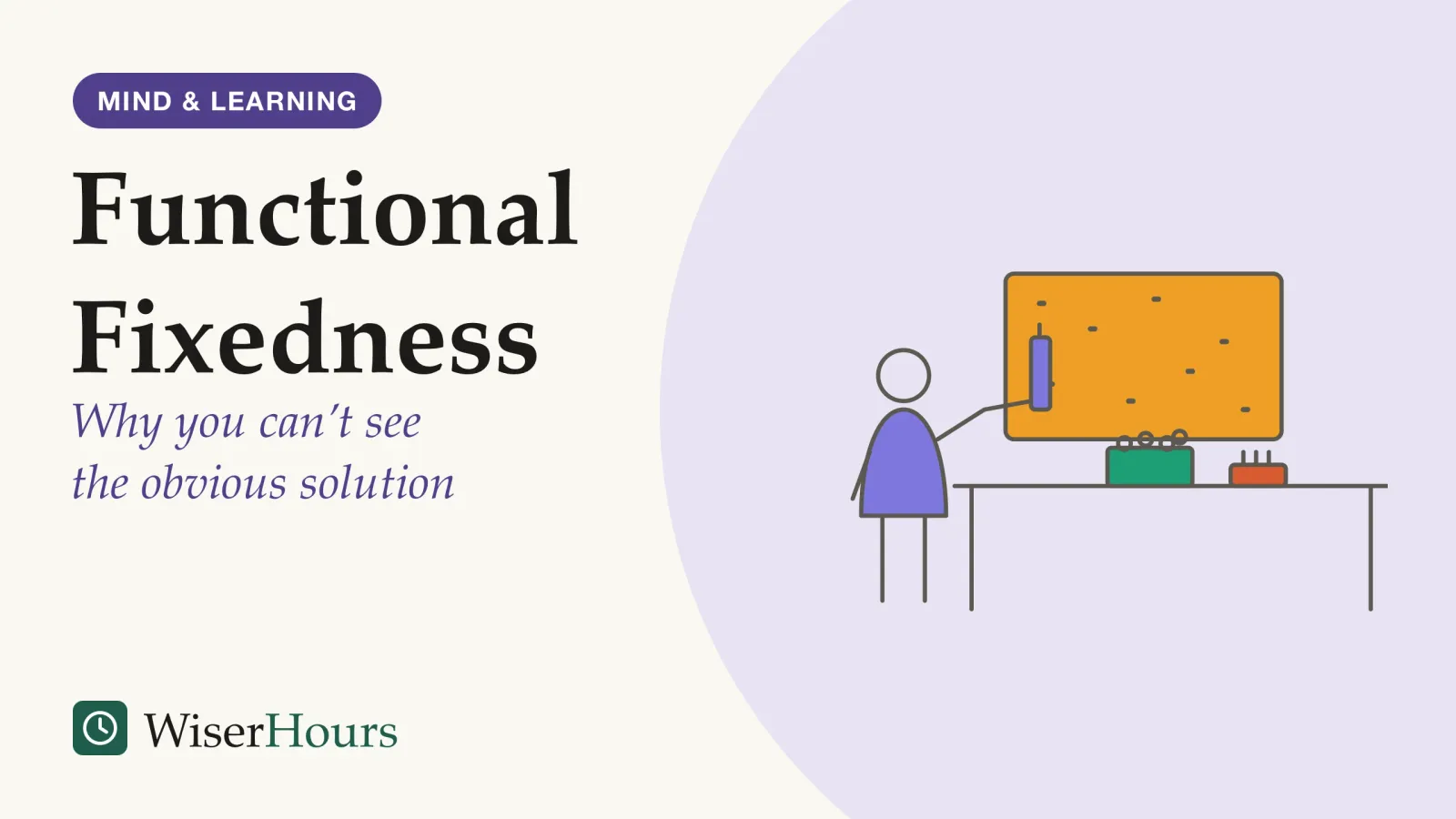
Give someone a candle, a box of thumbtacks and a book of matches, and ask them to fix the candle to a wall so that it burns without dripping wax on the table. The answer is the box, and it is hard to see while it is full of tacks. Functional fixedness is the name for that blind spot: the tendency to see a familiar object only in terms of its usual job, so the use a problem needs stays invisible even in plain view. The Gestalt psychologist Karl Duncker made the puzzle famous in his 1945 monograph On Problem-Solving.1 When Robert Adamson repeated the test at Stanford University in the US in 1952, about twice as many students solved it when the box came empty.2
Functional fixedness, defined
Functional fixedness is a cognitive biascognitive bias: A predictable way in which judgments depart from a standard such as logic or probability. Most are ordinary mental shortcuts applied in the wrong setting rather than defects, and some well-known ones have not held up when tested again.Full entry in the glossary that limits a person to using an object only in the way it is normally used, as Wikipedia’s entry defines it; Duncker described it as a mental block against using an object in the new way a problem requires. The idea comes from Gestalt psychology, a school that studied how people perceive whole situations. Wikipedia’s example is someone who needs a paperweight, holds a hammer, and does not think of the hammer because hammers are for nails.3
Definition
Functional fixedness is a mental block against using a familiar object in a new way: its usual function comes to mind first and hides the other uses a problem needs.
The OpenStax textbook Psychology 2e calls it the inability to see an object being used for something other than what it was designed for.4 It covers one narrow part of what creativity is and how psychologists measure it: one specific way a good idea fails to appear.
Seeing a box “as a container” is a way of perceiving it, and that perception shapes which moves seem possible. When you are stuck, the missing piece may already be in front of you, filed under a different job. Before looking for new materials, list the ones you have one by one and describe each by its shape and material, the habit behind the generic-parts technique described below.3
What is the candle problem? Duncker’s test step by step
The candle problem asks people to fix a candle to a wall so that it burns without dripping wax onto the table, using only a box of thumbtacks and a book of matches. Duncker first published it in German in 1935, and it became the standard test of functional fixedness.5
- A candle, a book of matches and a cardboard box full of thumbtacks lie on a table next to a wall or cork board.
- You are asked to attach the candle to the wall so that, once lit, it does not drip onto the table.
- Many people try to tack the candle straight to the wall, or melt wax to glue it on. Neither works.
- The solution is to empty the box, pin it to the wall with tacks, stand the candle in it and light it.
- The step people miss is the first one: they see the box as the thing that holds the tacks, so it does not register as a separate object they may use.5
Nothing is hidden and no special knowledge is needed. Filled with tacks, the box simply looks like part of the tack supply.
A student revising for an exam can remember the problem this way: the box is the solution, and its contents are the obstacle. In your own problems, list every object as its own item, including the containers, packaging and tools that come with the obvious materials.
Empty box versus full box: what Adamson’s replication found
The strongest classic evidence compares the same problem with the box full or empty. Robert Adamson repeated three of Duncker’s experiments at Stanford University because Duncker had run them with only 14 people under loosely described conditions, and he confirmed that a box already used as a container is much harder to see as a platform.2
The study
Moderate evidence
Full box or empty box? Stanford students, 1952
Robert Adamson gave 57 psychology students at Stanford University, in the US, three of Duncker’s problems with up to 20 minutes each. In the candle task, which used three candles and three boxes, 24 of 28 students (86%) solved it when the boxes lay empty on the table, against 12 of 29 (41%) when the boxes held the candles, tacks and matches. The group with pre-used objects was also slower on two other problems, one with a gimlet and one with paperclips. A US Office of Naval Research contract paid for the work.2
Nobody told the students what the box was for; they only saw it doing its usual job for a moment. The sample was small, all students at one US university in the early 1950s. Later studies with older children in England and Shuar adolescents in Ecuador found the same direction of effect, which suggests it is no quirk of one lab.67
The names given to the parts may matter as well. In a written version of the task given to Stanford students, Michael Frank and Michael Ramscar found that underlining words such as “box” raised the share who solved it from about a quarter to about half; the figures come from Wikipedia’s summary of this 2003 conference paper, which we could not open.3 When you hand a problem to a colleague, describe the parts separately rather than as a bundle.
The two-string problem and other classic tests
Norman Maier’s two-cord problem, from 1930 and 1931, hangs two cords from the ceiling too far apart to reach one while holding the other. The solution is to tie a heavy object to one cord and swing it like a pendulum, then catch it while holding the second cord.3
In a 1951 version by Herbert Birch and Herbert Rabinowitz, the only heavy objects on hand were an electrical switch and a relay. People who had just wired a circuit with the relay chose the switch as their pendulum weight, and most who had used the switch chose the relay; a comparison group of engineering students used both equally. Asked afterwards, people said the object they picked was plainly better suited to the job.3
People did not feel blocked; they felt they had made a sensible choice. A team that has used one database for invoices for years may never consider it for tracking support requests, and may give good-sounding reasons why it would not work.
Why young children show less functional fixedness
Five-year-olds appear to be immune. In a 2000 study at a primary school in Colchester, England, Tim German and Margaret Anne Defeyter found that 5-year-olds solved a box task no more slowly when they had seen the box used as a container, while 6- and 7-year-olds were clearly slowed. The authors interpret the change in terms of children’s developing ideas about what objects are for.6 In Wikipedia’s summary, by about age 7 children treat an object’s intended purpose as special.3 Fixedness looks like a side effect of useful knowledge. Knowing that boxes hold things helps you find the tacks quickly, and the same knowledge hides the box as a shelf.
- Myth
- Functional fixedness is a habit of people surrounded by specialized gadgets.
- Fact
- Shuar adolescents in Ecuador, whose villages have only a small set of manufactured objects, showed it too: they were slower to pick a spoon as a bridge after seeing it in a cup of rice.
Tim German and H. Clark Barrett tested that point in 2005 with 29 Shuar adolescents and young adults, hunter-horticulturalists in the Ecuadorian Amazon. In a story task where a spoon could bridge a river, those who first saw the spoon sitting in a cup of rice were slower to choose and use it.7 The authors call this preliminary evidence that fixedness is universal. Growing up with few manufactured objects did not prevent it, so plan for it: when a problem stalls, check your materials deliberately instead of waiting for a new use to occur to you.
Is functional fixedness a type of mental set?
Functional fixedness is a type of mental set. The OpenStax Psychology 2e textbook defines a mental set as persisting with an approach that worked in the past but is clearly not working now, and treats functional fixedness as the version that concerns objects.4
The difference lies in what gets stuck. A mental set can be about a method; fixedness is about what an object is for. Students often meet three neighbouring terms alongside it.
| Term | What gets stuck | Classic example |
|---|---|---|
| Mental set | An approach that worked before | Trying the usual locked door while other doors are open4 |
| Einstellung effect | A method learned on earlier problems | Abraham Luchins’s water jar puzzles, 1942: people kept a long formula when a short one would do8 |
| Functional fixedness | The usual use of an object | Duncker’s tack box, seen only as a container3 |
| Design fixation | Features of an example you were shown | Copying flawed parts of a sample design9 |
Psychologists also class the candle problem as an insight problem, one whose answer tends to arrive suddenly, without warning, once the solver breaks functional fixedness.10 The sudden “of course” when the box turns into a shelf is the subject of how sudden insight feels and what the brain does at that point.
Design fixation has the most direct lesson for work. In two experiments, Evangelia Chrysikou and Robert Weisberg found that people working on a lab design task tended to copy a flawed example, inappropriate parts included, even though they consulted the problem instructions, and that explicit instructions to avoid those parts reduced the copying.9 If you share an example to get a team started, say what not to copy.
Functional fixedness examples from everyday life and work
Everyday examples share one pattern: the needed object is in view but filed under another job. The most dramatic is from the Apollo 13 mission to the moon, which the OpenStax textbook uses to illustrate the concept.
After an explosion damaged the spacecraft, carbon dioxide began to build up, and the filters at hand did not fit. Engineers at Mission Control found a way for the crew to build a makeshift filter from spare plastic bags, tape and air hoses.4 NASA’s records describe it as an adapter made with duct tape so that the square canisters from the command module could be used in the lunar module.11
Smaller cases turn up at home and at work:
- A coin used to turn a screw on a battery cover, because no screwdriver is nearby.
- A cardboard box under a laptop to raise the camera for a video call.
- A shared spreadsheet, kept for budgets, reused as a simple sign-up sheet.
- A hotel ironing board pressed into service as a standing desk.
These are illustrations. In each, the object stayed the same and only its description changed, so when you are stuck, rename the thing in your hand by its shape and material.
How to overcome functional fixedness
One method has been tested directly on fixedness problems: Tony McCaffrey’s generic-parts technique, which breaks each object into parts and redescribes every part by shape and material until the description no longer suggests a use.3 In McCaffrey’s 2012 study in Psychological Science, people trained in it solved on average about two-thirds more problems than a control group, a result reported in its abstract (we could not obtain the paper).12
1. Break each object into generic parts
For each object, ask two questions: can this part be divided further, and does its name imply a use? If the name implies a use, redescribe it by shape and material. Wikipedia’s worked example takes a candle apart into wick and wax; “wick” implies burning, so it becomes “string”, and then “interwoven fibrous strands”, a description that no longer points to burning.3 Applied to the tack box, “box” becomes “a flat cardboard base with low walls”, which already sounds like a shelf.
2. Describe objects by shape and material
Names carry uses. Wikipedia’s article on the candle problem reports work by E. Tory Higgins and W. M. Chaires in which saying “box and tacks” instead of “box of tacks” helped people solve it.5 Write your materials list in plain physical terms: “a thin metal disc”, “a stiff rectangle of card”.
3. Unpack containers and lay things out separately
Adamson’s results point to a simple habit: take things out of what holds them.2 Spread physical materials out, and list non-physical resources, such as a tool, a report or a team, one by one rather than by department or system.
4. Ask someone from another field
Someone who does not know what your materials are usually for may not share your fixedness. In a study of 166 science challenges that large research companies broadcast openly to outside solvers, Lars Bo Jeppesen and Karim Lakhani found that winning solutions were more likely the further a solver’s own field lay from the problem’s field.13 It is observational evidence from one set of contests, read in the abstract, but it fits the lab findings. For deliberate ways to shift your own angle, such as random words and provocations, try Edward de Bono’s lateral thinking techniques.
5. Treat examples as starting points
Share an example with a note on what not to copy, the kind of instruction that reduced fixation in Chrysikou and Weisberg’s experiments, and ask for at least one idea that looks nothing like it.9
When the obvious solution will not appear
The bottom line
Many stuck problems contain a resource you have already filed under another job, the way the tack box gets filed under tacks. The next time you are stuck, list your materials one by one, describe each by shape and material, and ask someone outside your field what they see.
Frequently asked questions
Is functional fixedness a cognitive bias?
Yes. Wikipedia's entry classes it as a cognitive bias that limits a person to using an object only in the way it is traditionally used. The OpenStax Psychology 2e textbook files it under mental sets, the habits that keep people approaching a problem in a way that worked before. Both describe the same blind spot: the usual use of an object hides the one the problem needs.
Do rewards or deadlines make functional fixedness worse?
Possibly. In a 1962 experiment by Sam Glucksberg, summarized on Wikipedia, people offered cash prizes for speed did worse on the candle problem with the tacks inside the box than people offered nothing. With the box empty, the prize made no clear difference. One study cannot settle the question, but it suggests a prize for speed can backfire when the answer needs a new view of an object.
What is the barometer question?
A story popularized in the 1960s by Alexander Calandra, a US professor, about an exam that asked how to find a building's height with a barometer. The examiner expected an air-pressure calculation, and the student offered other correct answers, such as lowering the barometer on a rope and measuring the rope. Wikipedia presents it as an example of functional fixedness in exam design.
Who first studied functional fixedness?
Karl Duncker, a Gestalt psychologist, first published the candle problem in German in 1935, and the OpenStax Psychology 2e textbook calls his 1945 English monograph, On Problem-Solving, foundational research on functional fixedness. Norman Maier's two-cord problem, from 1930 and 1931, is older and was later adapted to study fixedness.
Sources
- On problem-solving. Duncker, K. (1945). Psychological Monographs, 58(5), Whole No. 270
- Functional fixedness as related to problem solving: A repetition of three experiments. Adamson, R. E. (1952). Journal of Experimental Psychology, 44(4), 288-291
- Functional fixedness. Wikipedia (accessed 24 October 2026)
- Psychology 2e, 7.3 Problem Solving. Spielman, R. M., Jenkins, W. J. & Lovett, M. D. (2020). OpenStax, Rice University
- Candle problem. Wikipedia (accessed 24 October 2026)
- Immunity to functional fixedness in young children. German, T. P. & Defeyter, M. A. (2000). Psychonomic Bulletin & Review, 7(4), 707-712
- Functional fixedness in a technologically sparse culture. German, T. P. & Barrett, H. C. (2005). Psychological Science, 16(1), 1-5
- Einstellung effect. Wikipedia (accessed 24 October 2026)
- Following the wrong footsteps: Fixation effects of pictorial examples in a design problem-solving task. Chrysikou, E. G. & Weisberg, R. W. (2005). Journal of Experimental Psychology: Learning, Memory, and Cognition, 31(5)
- Insight. Wikipedia (accessed 24 October 2026)
- Duct Tape (Working on the Moon). NASA, Apollo Lunar Surface Journal
- Innovation relies on the obscure: A key to overcoming the classic problem of functional fixedness. McCaffrey, T. (2012). Psychological Science, 23(3), 215-218
- Marginality and problem-solving effectiveness in broadcast search. Jeppesen, L. B. & Lakhani, K. R. (2010). Organization Science, 21(5)
How we researched this
We read the Wikipedia entries on functional fixedness, the candle problem, insight and the Einstellung effect, the OpenStax Psychology 2e textbook and the full texts of Adamson (1952) and German and Barrett (2005). Other studies from 1945 to 2012 were found through Crossref, OpenAlex and PubMed. Main limitation: German and Defeyter (2000), McCaffrey (2012), Chrysikou and Weisberg (2005) and Jeppesen and Lakhani (2010) were read as abstracts only, Duncker's 1945 monograph was not opened, and the Frank and Ramscar (2003) figures come from Wikipedia.
Keep reading

How to Solve It: George Pólya's Four Steps, Still Useful Today
Pólya's How to Solve It in 4 steps: understand, plan, carry out, look back. The key questions, two worked examples and what later research adds.
Six Thinking Hats: How to Look at a Problem From Every Angle
Six thinking hats, Edward de Bono's 1985 method: what each of the 6 colors covers, a sample meeting sequence with timings, and what the studies show.

Intrapreneurship Explained: Can Employees Act Like Founders Inside a Company?
Intrapreneurship means acting like a founder inside a company. Where the 1978 term came from, 2 famous examples checked, and what helps employee ventures.
Lateral Thinking: Edward de Bono's Techniques Explained
Lateral thinking, Edward de Bono's 1967 idea, explained: 4 of his techniques worked through on one problem, and what the thin evidence on training shows.