Morning Pages: Julia Cameron's Daily Practice and Whether It Helps Creativity
Morning pages are 3 longhand pages written first thing each day. No trial has tested them; nearby writing research finds small benefits. How to try them.

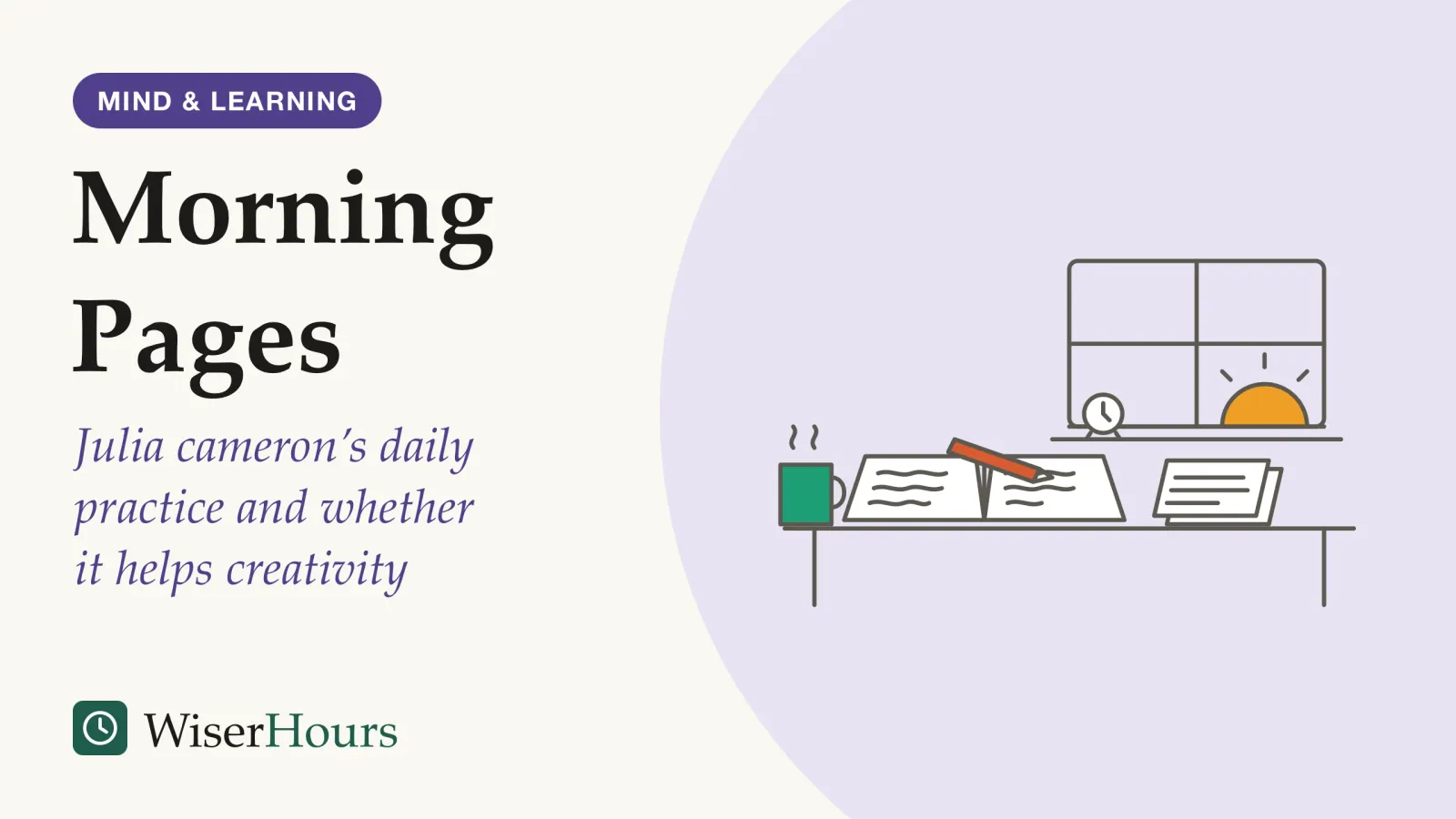
Julia Cameron first sold her book on creative recovery as photocopies in a local bookstore, under the title Healing the Artist Within. Jeremy Tarcher published it in 1992 as The Artist’s Way, a 12-week program whose daily assignment is a habit called morning pages.1
Morning pages are three pages of longhand, stream-of-consciousness writing done first thing in the morning, about anything at all and for your eyes only.2 No controlled study has tested them as such. Research on close cousins, writing about feelings and parking worries on paper, finds small average benefits from getting thoughts onto the page, which makes morning pages a reasonable two-week experiment with modest expectations. Whether they make anyone more creative also depends on what psychologists count as creativity, and on that question the evidence is thinnest.
To try them, write three pages (or set a 15-minute timer) before you open your phone, keep the pen moving when you run dry, close with one next step, and put the pages away unread. On day 14, read them once and decide whether to keep going.
What are morning pages?
Morning pages, in Julia Cameron’s description, are three handwritten pages of whatever crosses your mind, written as soon as you are up. Her site says there is no wrong way to do them, that they are not high art or even “writing”, and that you should not overthink them: fill three pages today and three more tomorrow.2
The pages are one of four tools Cameron calls the bedrock of creative recovery, alongside a weekly solo outing for fun (the “artist date”), two solo walks a week and a practice she calls writing for guidance.3 Her guidelines for Artist’s Way groups add two rules: never share your pages, and do not reread them until later in the course, if at all.4
Cameron did not invent the method. Dorothea Brande’s 1934 guide Becoming a Writer told readers to write as fast as they could for 15 minutes every morning, the writing teacher Peter Elbow championed “freewriting” in his 1973 book Writing Without Teachers, and Cameron popularized the method further with morning pages.5 Freewriting helps writers practice producing text without fear of censure, and the ban on rereading seems to rest on the same idea. If you try the pages, keep the rules that hold judgment back. The same split between making and judging runs through the research on what keeps writers stuck.
Why people say morning pages help
Julia Cameron’s own case for morning pages is that they clear the mind and steady the day, and she frames the whole program in spiritual terms: the book’s subtitle calls it a spiritual path to higher creativity, and she describes creative dreams as divine in origin.1 Her site sums up what the pages do in one line.
Morning Pages provoke, clarify, comfort, cajole, prioritize and synchronize the day at hand.
Without the spiritual frame, the case people make comes down to three claims. Writing worries down gets them out of your head, so the rest of the morning is clearer. Writing fast without rereading separates making from judging, so ideas reach the paper before the inner critic does. And doing it every day makes starting routine, which matters for anyone whose creative work stalls at the first line.
Research touches each claim from the side, and no study has tested any of them on morning pages. Pick the one you care about before you start, because it decides what your log should record.
Do morning pages work?
Nobody knows from direct evidence. A search of research databases in November 2026 turned up no controlled study of morning pages or of The Artist’s Way. The closest research is on expressive writing, where people put their deepest thoughts and feelings about an experience on paper. Psychologist James Pennebaker’s 1997 review in Psychological Science reported that, across ten years of such studies, gains in physical and mental health tended to follow the writing.6
Those studies usually asked for roughly 20 minutes per sitting on an emotional or traumatic subject, repeated a handful of times and often on back-to-back days, as Karen Baikie and Kay Wilhelm describe the method in a 2005 review written for clinicians.7 Three daily pages on no set topic is a looser, longer habit, so the results transfer only partly to Cameron’s method.
- Myth
- Morning pages are a proven way to become more creative.
- Fact
- Morning pages themselves have never been put to a controlled test. The evidence comes from related writing methods, and their average benefits are small.
A 2006 meta-analysis pooled well over a hundred randomized studies, and its verdict suggests how much a writing habit of this kind can do.
The study
Moderate evidence
How much does writing about yourself help? 146 randomized studies, pooled in 2006
In a meta-analysis for Psychological Bulletin, Joanne Frattaroli of the University of California, Riverside (US) combined 146 randomized studies in which people disclosed what they thought and felt about personal, meaningful matters. The average effect came out positive and statistically significant but small (an average r of .075), and its size shifted with several features of the studies.8
A gain that small shows up when thousands of people are averaged and may pass unnoticed in a single notebook. For low mood the picture is weaker still: a 2018 meta-analysis of 39 randomized trials from the University of Münster in Germany found no significant long-term effect of brief expressive writing on depressive symptoms in physically healthy adults.9 Early pages may sting a little, too. Expressive writing usually leaves people briefly more upset and lower in mood straight afterwards, and any benefits tend to come later.7
For creativity itself, the evidence is one small study. In a 2019 conference paper from SWPS University in Sopot, Poland, 60 people looked at unpleasant pictures and then either wrote about their feelings or described a typical day; the feelings group did better on a standard creativity test, the Alternative Uses Task, though their negative feelings lingered.10 The proceedings entry is a one-paragraph abstract, and the result has not been repeated, so treat any creative gain from your own pages as a hypothesis to check. A novelist who feels sharper after a week of pages cannot tell whether the pages, the earlier alarm or a lighter workload did it, which is why the trial below asks for a daily log.
Clearing your head: the working-memory and plan-making studies
The claim that writing clears your head has partial support from studies of working memoryworking memory: The small mental workspace that holds and handles the information you are using right now, such as a phone number you are about to dial. Its capacity is limited, which is why juggling several things at once quickly overloads it.Full entry in the glossary, the limited space in which you keep the thoughts you are using at this moment.
Two experiments with first-year students, published in 2001 by Kitty Klein and Adriel Boals of North Carolina State University (US), tested the idea. Students who wrote about their feelings on starting college, or about a negative experience, showed larger working-memory gains weeks later than students who wrote about trivial topics, and in the second study they also reported fewer intrusive thoughts. The authors’ explanation is that such writing cuts down intrusive and avoidant thinking about a stressor and so frees working memory. With about 35 students per group at one university, it is a promising lead from a narrow sample.11
Writing can also quiet the mind by settling what to do next. In lab experiments from Florida State University (US), reported by Masicampo and Baumeister in 2011, goals people had not finished kept intruding on an unrelated reading task, and letting them make specific plans for those goals removed the interference.12 If a worry keeps coming back to your pages, check whether it is an unfinished task that needs a plan.
A freelance designer whose pages circle an unpaid invoice every morning gets more from ending the page with “Email the client at 10 on Tuesday” than from a third page of irritation.
The evening version: worry postponement and bedtime lists
If mornings are impossible, an evening page has its own evidence. Worry postponement, a common part of cognitive-behavioral treatment for worry, asks people to note worries as they come and save them for a set time later in the day. A 2023 meta-analysis from Leiden University in the Netherlands pooled seven randomized trials and found that, compared with simply logging worries, postponement cut both the frequency and the duration of worrying by small amounts, over one week to a month.13
Delivery seems to matter. A Dutch online trial published in 2015, which asked people to save their worries for a half-hour slot in the early evening, found no benefit over logging alone; the authors contrasted it with earlier pen-and-paper versions and reported that participants found postponing hard.14 In a 2025 UK trial from the University of Leeds, adding if-then plans for when and how to worry cut daily worry time more than postponement alone, though sleep did not improve.15
In a small 2018 sleep-lab study, researchers at Baylor University (US) randomly assigned young adults to five minutes of writing at bedtime: one group listed what they still had to do in the next few days, the other what they had already completed. Those who wrote the to-do list fell asleep faster, and more specific lists went with faster sleep.16
How long should morning pages be?
Three pages, by hand, is the length Julia Cameron sets.2 No study has compared lengths, so three pages is a tradition with no measured advantage. Expressive-writing sessions in research usually last about 20 minutes, and Baikie and Wilhelm suggest capping sessions for patients there so the task does not feel overwhelming.7
A parent who has to leave the house at 7:30 can set a 15-minute timer instead.
Can you type morning pages?
You can, but you would be departing from the method: Julia Cameron specifies longhand.2 No study has compared typed and handwritten morning pages. The wider disclosure research suggests the medium matters little: a 2010 report of a US grief-writing trial notes that, in Frattaroli’s meta-analysis, people gained about as much whether they typed, wrote by hand or spoke.17
If handwriting is slow, painful or not possible for you, type, and copy the conditions the method relies on: a plain document, no fixing typos, no scrolling back and no rereading until the trial ends.
How to try morning pages for 14 days
A fair test of morning pages needs 14 days, one format that does not change and a one-line daily log. Nobody has trialled this routine as a whole; each step borrows from a different source above.
Choose one version and keep it
Decide pen or keyboard, three pages or a timer, morning or evening, and write the choice on the first page. Changing the format halfway makes the two weeks impossible to read.
Write without stopping, then put the pages away
Follow Cameron’s rules: anything goes, no wrong way, no sharing, no rereading. When you run dry, keep writing whatever comes next, as freewriting teachers advise.
End each session with one next step
If a task or worry keeps returning, close with a specific action and a time, the step that ended the interference from unfinished goals in the plan-making experiments.
Log one line a day, somewhere else
Note whether you started your creative work that day and any idea worth keeping. A single sentence in the style of a one-line-a-day journal will do, and it keeps you from rereading the pages themselves.
Reread once on day 14 and decide
Read the pages and the log together, then keep the practice, adapt it or drop it. If the pages leave you more upset day after day, stop sooner and use the routes in the next section.
| Practice | What the best evidence found | Evidence |
|---|---|---|
| Morning pages as Cameron sets them | No controlled study found; the case rests on Cameron’s account and readers’ experience | Expert opinion; gap2 |
| Expressive writing about feelings | Small positive average effect across well over a hundred randomized studies | Meta-analysis; moderate8 |
| One session of writing about feelings, then a creativity test | Better scores on the Alternative Uses Task than describing a typical day | One small experiment, conference paper; limited10 |
| Writing about a stressor and working memory | Larger working-memory gains than writing about trivial topics | Two small trials with students; limited11 |
| Saving worries for a set time | Small drops in worry frequency and duration | Meta-analysis of 7 trials; moderate13 |
Your 14 days of pages
When to stop the pages and get support
Morning pages are self-help. Baikie and Wilhelm’s review says expressive writing should add to proper medical or psychological care for people who need it, never replace it.7
- Now: if you might act on thoughts of suicide or self-harm, or cannot keep yourself safe, call your local emergency number. In the UK, the NHS lists 999 or A&E, and Samaritans on 116 123.18 In the US, the 988 Lifeline answers calls, texts and chats around the clock.19 Find A Helpline, an online directory, lists crisis lines for other countries.20
- Soon: if the writing leaves you more upset day after day, or worry is taking over your days, stop the pages and see a doctor or psychologist. For urgent but not life-threatening help in the UK, the NHS points to 111 or an urgent GP appointment; elsewhere, start with your own doctor or local health service.18
- Routine: if your pages keep returning to abuse or trauma, raise it with a therapist. The same review lists studies in which writing did worse than control writing, for adult survivors of childhood abuse and for eight veterans with post-traumatic stress disorder.7
The bottom line
Morning pages have no trials of their own, and the closest research finds that putting thoughts on paper helps a little, on average. Give them 14 days in one fixed form, close each session with a concrete next step, and keep them if your log shows more days on which you started your creative work.
This article is general information, not medical advice. If you're worried about your health, talk to a doctor or another qualified professional.
Frequently asked questions
What should I write in morning pages?
Anything that crosses your mind. Julia Cameron describes the pages as being about anything and everything, with no wrong way to do them and no need for good writing. The freewriting tradition they come from has one rule for blank moments: keep the pen moving and write whatever comes next, even if it is a complaint about having nothing to say.
Do I have to write morning pages as soon as I wake up?
Julia Cameron's method says first thing in the morning, but the time of day has never been tested for this kind of writing. The research closest to an evening version, on saving worries for a set time and on writing a to-do list at bedtime, found small benefits, so an evening page is a reasonable adaptation if mornings are impossible.
Should you reread your morning pages?
Not at first. Julia Cameron's guidelines for Artist's Way groups say not to reread the pages until later in the 12-week course, if a facilitator or your own judgment suggests it, and never to share them. Leaving them unread keeps the writing fast and private. Rereading once, at the end of a trial, is a sensible way to see whether they gave you anything worth keeping.
Are morning pages the same as journaling?
They are one kind of journaling with fixed rules: a set length, every day, no topic and no rereading. Expressive writing, the method most studied by psychologists, is different again: a few sessions of about 20 minutes about one emotional experience. A gratitude list or a one-line diary records the day; morning pages empty the mind before it starts.
Sources
- The Artist's Way. Wikipedia, accessed November 2026
- Morning Pages. Julia Cameron Live (archived 8 January 2024)
- Julia Cameron Live (home page). Julia Cameron Live, accessed November 2026
- FAQ: Guidelines for Artist's Way creative clusters. Julia Cameron Live, accessed November 2026
- Free writing. Wikipedia, accessed November 2026
- Writing About Emotional Experiences as a Therapeutic Process. Pennebaker, J. W. (1997). Psychological Science, 8(3), 162-166
- Emotional and physical health benefits of expressive writing. Baikie, K. A. & Wilhelm, K. (2005). Advances in Psychiatric Treatment, 11(5), 338-346
- Experimental disclosure and its moderators: A meta-analysis. Frattaroli, J. (2006). Psychological Bulletin, 132(6), 823-865
- Effects of expressive writing on depressive symptoms: A meta-analysis. Reinhold, M., Bürkner, P.-C. & Holling, H. (2018). Clinical Psychology: Science and Practice, 25(1), e12224
- Does Expressive Writing About Negative Emotions Influence Divergent Thinking? Osowiecka, M. & Sterczyński, R. (2019). Proceedings of the Annual Meeting of the Cognitive Science Society, 41
- Expressive writing can increase working memory capacity. Klein, K. & Boals, A. (2001). Journal of Experimental Psychology: General, 130(3), 520-533
- Consider it done! Plan making can eliminate the cognitive effects of unfulfilled goals. Masicampo, E. J. & Baumeister, R. F. (2011). Journal of Personality and Social Psychology, 101(4), 667-683
- Effects of Worry Postponement on Daily Worry: a Meta-Analysis. Dippel, A., Brosschot, J. F. & Verkuil, B. (2023). International Journal of Cognitive Therapy, 17(1), 160-178
- Reducing worry and subjective health complaints: A randomized trial of an internet-delivered worry postponement intervention. Versluis, A., Verkuil, B. & Brosschot, J. F. (2015). British Journal of Health Psychology, 21(2), 318-335
- Effects of worry postponement on daily worry and sleep: a randomised controlled trial. McCarrick, D. J., Prestwich, A., Ferguson, E. & O'Connor, D. B. (2025). Psychology & Health
- The effects of bedtime writing on difficulty falling asleep: A polysomnographic study comparing to-do lists and completed activity lists. Scullin, M. K., Krueger, M. L., Ballard, H. K., Pruett, N. & Bliwise, D. L. (2018). Journal of Experimental Psychology: General, 147(1), 139-146
- Effects of Directed Written Disclosure on Grief and Distress Symptoms Among Bereaved Individuals. Lichtenthal, W. G. & Cruess, D. G. (2010). Death Studies, 34(6), 475-499
- Where to get urgent help for mental health. NHS (UK), page last reviewed 23 October 2026; checked 2026-11-07
- 988 Suicide & Crisis Lifeline. 988 Suicide & Crisis Lifeline (US), accessed 2026-11-07
- Find A Helpline. Find A Helpline (ThroughLine), international directory of crisis lines, accessed 2026-11-07
How we researched this
We searched OpenAlex, Crossref, PubMed and the web in November 2026 for studies of morning pages, The Artist's Way, freewriting, expressive writing, plan making, worry postponement and bedtime writing, and read Julia Cameron's own pages and guidelines. Sources date from 1997 to 2025. Main limitation: no controlled study of morning pages exists, so every finding here comes from related practices, and nine research papers were read as abstracts only.
Keep reading
Wicked Problems: What to Do When There Is No Clean Solution
Wicked problems explained: Rittel and Webber's 10 features, tame and wicked examples, Grint's three problem types and 5 habits for making progress.
Rubber Duck Debugging: Why Explaining a Problem Out Loud Helps You Solve It
Rubber duck debugging explained: where the method comes from, 3 research ideas behind it, when talking backfires and 5 steps for any stuck problem.
How to Solve It: George Pólya's Four Steps, Still Useful Today
Pólya's How to Solve It in 4 steps: understand, plan, carry out, look back. The key questions, two worked examples and what later research adds.
Functional Fixedness: Why You Can't See the Obvious Solution
Functional fixedness explained: Duncker's candle problem step by step, 4 classic follow-up studies, everyday examples and ways to loosen it.