Wicked Problems: What to Do When There Is No Clean Solution
Wicked problems explained: Rittel and Webber's 10 features, tame and wicked examples, Grint's three problem types and 5 habits for making progress.

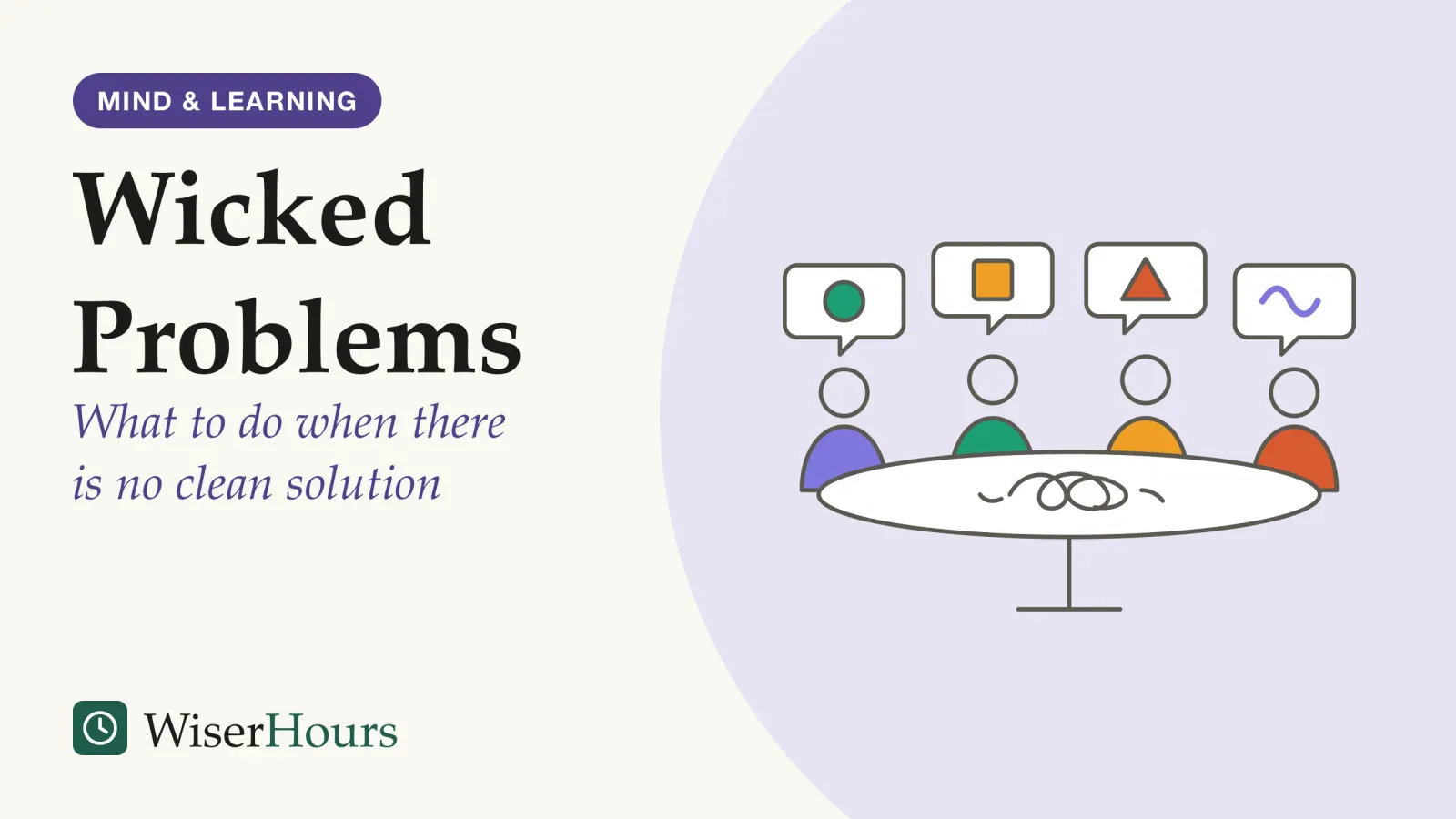
Some problems cannot be solved at all, only handled better or worse. Wicked problems are the ones where people disagree about what the problem is, every attempt changes it, and nobody can say when the work is done. The Berkeley professors Horst Rittel and Melvin Webber named them in 1973 and gave ten features that separate wicked problems from tame ones.1 What helps is working in rounds with the people involved: map how each group sees the problem, agree what better would look like, run small trials you can undo, review them together and settle for a mixed answer several groups can live with.
What is a wicked problem?
A wicked problem is one whose definition, causes and fixes are all disputed, so working on it keeps changing it. Rittel and Webber set it against the tame problems that science and engineering handle well, such as solving an equation or finding checkmate in five moves, where the goal is clear and so is the moment it has been reached.1
Definition
A wicked problem is a problem with no definitive description and no right answer: the people involved disagree on what it is, and each attempt to address it changes it.
The idea is older than their paper. In a 1967 journal editorial, the philosopher C. West Churchman credited Rittel with first describing wicked problems, though Churchman may have coined the phrase himself.2
- Myth
- A wicked problem is an evil or hopeless problem.
- Fact
- Wicked describes how hard a problem resists a clean answer. Wicked problems can still be made better or worse.
Rittel and Webber were writing about public planning, where the public was rejecting professionals’ plans for highways, schools and policing.1 Wicked problems are a hard test of what creativity is and does at work, because the hard part is agreeing on the question. If a problem at work keeps getting redefined every time you meet about it, that is the first sign you are dealing with one.
The 10 characteristics of wicked problems, in plain words
Rittel and Webber’s ten properties explain why step-by-step methods stall on wicked problems: understanding the problem and choosing a fix are the same activity, and nobody can test the result cleanly.1
- There is no definitive formulation: how you describe the problem depends on how you plan to fix it. Trace poverty to a weak economy and the fix is economic; trace it to missing skills and the fix runs through schools.
- There is no stopping rule. Work stops when time, money or patience runs out, never because the problem says so.
- Answers are judged good or bad by people with different interests, never as true or false.
- There is no quick or final test, because consequences ripple out for years and can outweigh the gains.
- Every attempt counts: you cannot build a freeway to see how it works and then easily correct it.
- Nobody can prove that every possible solution has been considered.
- Each one is essentially unique, so a fix that worked in one city may fail in the next.
- Each is a symptom of another problem: street crime can be read as a symptom of poverty, of moral decay or of too little opportunity.
- The explanation chosen decides the response, and people tend to pick the explanation that fits the actions they already favor.
- The planner has no right to be wrong. A refuted hypothesis is normal in science; a planner’s mistake lands on real people.1
Social problems are never solved. At best they are only re-solved–over and over again.
The first item clashes most with ordinary plans, which start by defining the problem. Rittel and Webber argued that with wicked problems you cannot first understand and then solve, because you cannot even search for information without some solution already in mind.1 Write down two or three rival descriptions of the problem before agreeing on one, because each description quietly selects its own solution.
The difference between a tame problem and a wicked problem
A tame problem can be complicated and still be tame: the Australian Public Service Commission notes that tame problems can be very technically complex, but they can be tightly defined and a solution can be worked through. A wicked problem stays disputed however much expertise is applied, because the difficulty is social as well as technical.3
Three everyday pairs show the line. On a team, fixing a broken report template is tame; deciding why a team keeps missing deadlines, when the manager blames planning and the staff blame shifting priorities, is wicked. In a city, repairing a burst water main is tame; reducing traffic congestion, which drivers, cyclists and shopkeepers each define differently, is wicked. In a family, choosing a care home from a shortlist is tame once everyone agrees on the criteria; deciding how to care for an aging parent when siblings live apart and want different things is wicked.
The line also moves. Keith Grint, a leadership scholar at Warwick Business School in the UK, notes that a broken leg is a tame problem in a hospital and a wicked one in a restaurant, where nobody has the skill or the tools to fix it: what kind of problem you have depends on where you sit and what you know.4 The Australian paper adds that many policy problems sit on a continuum, and it gives Australian tobacco control as one that grew tamer once governments and the public broadly agreed on the problem and the strategy.3
The Australian paper also warns against taming a wicked problem too early. Its example is childhood obesity: if the goal shrinks to removing unhealthy food from school canteens, the target can be met while some children skip lunch and buy junk food on the way home.3 Before you accept a neat measure for a messy problem, ask what people could do to hit the measure while the real problem gets worse.
Tame, wicked or critical: Keith Grint’s way to choose how to lead
Keith Grint added a third type, the critical problem or crisis, and tied each type to a form of authority. A crisis calls for command, which provides the answer; a tame problem calls for management, which provides the right process; a wicked problem calls for leadership, which asks the right questions and gets the group to take responsibility.4
| Problem type | Who acts | What they provide |
|---|---|---|
| Critical (a crisis) | A commander | A fast, decisive answer4 |
| Tame | A manager | A known process that has worked before4 |
| Wicked | A leader | Questions that get the group working on it together4 |
Grint calls this a rough guide, not a strict classification.4 In a 2020 think piece for the UK government’s National Leadership Centre, he estimates that tame problems make up about three-quarters of professional life, an estimate he offers without data.5
Grint also warns that decision-makers often frame a situation to justify the style they prefer, and that many become “addicted” to treating problems as crises, because decisive commanders get rewarded.4 A manager facing falling morale might announce a restructure within a week: it looks decisive, and it treats a wicked problem as a crisis. Before you act, name which of the three types you face and which one you would prefer it to be.
What the Australian government’s 2007 guide recommends
The Australian Public Service Commission’s 2007 paper, Tackling Wicked Problems, is a practical official guide to the idea. Its core advice is that wicked problems need thinking that grasps the big picture, work across organizational boundaries, real engagement with citizens and other stakeholdersstakeholder: In project management, anyone who can affect a project, be affected by it, or believe they are affected by it: an individual, a group or an organization. That includes users, suppliers and colleagues whose work changes, not only the people paying.Full entry in the glossary, and a willingness to adjust policies as experience accumulates.3
Drawing on the scholar Nancy Roberts, the paper sorts responses by who holds power. Authoritative strategies hand the problem to a few experts or officials: quick, but narrow. Competitive strategies let rival groups push their own solutions, which produces ideas and can end in stalemate. Collaborative strategies bring the parties together; the literature favors them where many people must change their behavior, though they are costly and the skills are scarce.3
The paper also asks officials to let on-the-ground feedback change policy, to use trials, prototypes and repeated iterations, and to accept that some attempts will fail or need adjusting.3 It was written for Australian public servants, but its trade-offs fit any group with a shared problem and divided power.
A company setting hybrid-work rules faces the same three choices: the leaders decide alone, each department sets its own rules, or managers and staff draft them together. Rules that need hundreds of people to change their habits point to the costlier collaborative route; an urgent detail, such as which office floor closes first, can still be settled by a few people. Split a wicked problem into the parts that need many hands and the parts a small group can decide quickly.
How do you solve a wicked problem? Five working habits
You do not solve a wicked problem; you make it better, in rounds, with the people who live with it. The five habits below draw on Rittel and Webber, the Australian guide and Grint. They are expert advice and case experience that no trial has tested head to head, and for the tame parts, a structured problem-solving method still does the job.
- 1Mapwho is involved, how each sees it
- 2Agree on bettera visible goal by a set date
- 3Trialsmall and easy to undo
- 4Reviewwith the same groups
Then repeat from “Map”
1. Map who is involved and how each defines the problem
List every group that affects the problem or is affected by it, with one sentence on how each would describe it. Rittel and Webber argued that the analyst’s world view is the strongest single factor in how a wicked problem gets explained.1 Side by side, the descriptions show where people are arguing about different problems. Interviewing the people closest to the problem, the habit at the heart of design thinking’s empathize stage, is one good way to fill in the map.
2. Aim for progress you can see
Agree what “better” would look like by a set date, since “solved” will never arrive. Grint suggests that the best hope is often to stem a problem rather than eliminate it.5 A family caring for a parent might aim for “no week without a visit and no missed medical appointment this quarter” instead of a perfect care plan.
3. Run small, reversible trials
Because every attempt at a wicked problem leaves traces, make the first attempts small and easy to undo.1 Grint argues that when you cannot know what will work, the approach must be reversible: keep what works and try something different when it does not.5 A city can paint a temporary cycle lane for a few months before pouring concrete; a team can trial a new meeting rhythm for a month before rewriting its whole process.
4. Keep learning loops running
Before a trial starts, agree how you will tell what it changed, and keep it running long enough to judge it. Grint warns against short-term changes that are never evaluated or sustained, and points to aviation’s “just culture”, where people are encouraged to report mistakes and the line between honest error and negligence is clear.5 A short review after each round, with people from your map, is enough to start.
5. Accept clumsy solutions that several groups can live with
A clumsy solution combines pieces from rival views of a problem instead of choosing the single most elegant one. Marco Verweij and colleagues argued in 2006 that successful responses to pressing social problems tend to combine contending perspectives, each of which sees something the others miss.6 Grint offers Boston’s Operation Ceasefire, which brought together police, prosecutors, federal agencies and a network of local churches, as an example.4
The study
Limited evidence
What happened to youth gun violence in Boston after Operation Ceasefire
Operation Ceasefire focused criminal justice attention on the small number of chronically offending, gang-involved young people responsible for much of Boston’s youth homicide. Anthony Braga and colleagues found the program was linked to significant falls in youth homicide, shots-fired calls and gun assaults, and a comparison with youth homicide trends in other large US and New England cities supported an effect unique to Boston.7
The Boston result is one city and one design, but a 2018 systematic reviewsystematic review: A review that fixes its question and its rules for including studies in advance, then searches out every study that fits and weighs them together. Some systematic reviews pool the results into a meta-analysis; others describe what the studies found without combining the numbers.Full entry in the glossary of 24 quasi-experimentalquasi-experimental: Describes a study that compares a group that got something with a group that did not, where the researcher did not do the assigning: a policy, a rollout or people's own choices did. Because the groups were not formed at random, they may have differed before it started.Full entry in the glossary evaluations also linked similar “focused deterrence” programs to a moderate overall fall in crime, with smaller effects in the more rigorous studies.8 The coalition did not last. According to Grint, the program was wound up in 2000 and gang violence re-emerged, and a later review described such collaborations as expensive and fragile.4 A clumsy coalition needs someone to hold it together after the first results.
Working on a wicked problem
When calling a problem wicked does more harm than good
The label has critics. A 2021 mapping review of 55 papers by Johanna Lönngren of Umeå University in Sweden and Katrien van Poeck of Ghent University in Belgium found that authors use the term inconsistently, give it many different meanings and often leave their assumptions unstated.9
The review also summarizes three criticisms from the wider literature. The tame-wicked split may be too sharp, treating the two as fundamentally different classes of problem. The term can be used rhetorically, to draw attention and money to a cause or to excuse a failure to deal with it. And calling a problem wicked may discourage people from trying at all.9
Keep the label narrow: use it only after checking a problem against the features above, and follow it with a next step. If a colleague uses “it’s a wicked problem” to end a discussion, ask which part could be tamed now.
The bottom line
Most problems at work are tame, and the label helps only for the few where people disagree about what the problem even is. For those, stop looking for the answer and start a cycle: map who is involved and how they see it, agree what better means, and run a small trial you can undo. Then review it with the same people and adjust before the next round.
Frequently asked questions
Who coined the term wicked problem?
Horst Rittel, who taught design at Berkeley, described the idea in a 1967 seminar, and the philosopher C. West Churchman wrote about it in a Management Science editorial that year. Wikipedia notes that Churchman may have coined the phrase itself. Rittel and the planner Melvin Webber set out the full ten-point description in 1973.
What is a super wicked problem?
It is a label proposed by the political scientists Kelly Levin, Benjamin Cashore, Graeme Auld and Steven Bernstein in a 2007 conference paper and a 2012 Policy Sciences article on climate change. According to Wikipedia's summary, a super wicked problem adds four traits: time is running out, no central authority is in charge, those trying to solve it also cause it, and some policies irrationally hold back future progress.
Is climate change a wicked problem?
Most writers on the subject treat it as one. The Australian Public Service Commission's 2007 paper lists climate change first among its examples, because people disagree about its causes and the best response, and because tackling it depends on individual behaviour and on every level of government. It describes three competing stories about climate change, none completely wrong and none completely right.
Why are they called wicked problems?
The word describes how hard the problems are, not anyone's morals. Rittel and Webber wrote that they meant wicked in a sense close to malignant, vicious like a circle, or tricky like a leprechaun, and that they did not mean to imply malicious intent. The Australian Public Service Commission uses the word for an issue highly resistant to resolution.
Sources
- Dilemmas in a General Theory of Planning. Rittel, H. W. J. & Webber, M. M. (1973). Policy Sciences, 4(2), 155-169
- Wicked problem. Wikipedia (accessed 7 November 2026)
- Tackling Wicked Problems: A Public Policy Perspective. Australian Public Service Commission (2007). Contemporary Government Challenges series, Commonwealth of Australia
- The cuckoo clock syndrome: addicted to command, allergic to leadership. Grint, K. (2010). European Management Journal, 28(4), 306-313
- Clumsy solutions for wicked problems: decision-making in uncertainty and the role of systems leadership. Grint, K. (2020). National Leadership Centre think piece, UK Government
- Clumsy solutions for a complex world: the case of climate change. Verweij, M., Douglas, M., Ellis, R., Engel, C., Hendriks, F., Lohmann, S., Ney, S., Rayner, S. & Thompson, M. (2006). Public Administration, 84(4), 817-843
- Problem-Oriented Policing, Deterrence, and Youth Violence: An Evaluation of Boston's Operation Ceasefire. Braga, A. A., Kennedy, D. M., Waring, E. J. & Piehl, A. M. (2001). Journal of Research in Crime and Delinquency, 38(3), 195-225
- Focused Deterrence Strategies and Crime Control: An Updated Systematic Review and Meta-Analysis of the Empirical Evidence. Braga, A. A., Weisburd, D. & Turchan, B. (2018). Criminology & Public Policy, 17(1), 205-250
- Wicked problems: a mapping review of the literature. Lönngren, J. & van Poeck, K. (2021, online 2020). International Journal of Sustainable Development & World Ecology, 28(6), 481-502
How we researched this
We read the full text of Rittel and Webber's 1973 paper, the Australian Public Service Commission's 2007 discussion paper, two pieces by Keith Grint and a 2021 mapping review of the wicked problems literature, plus Wikipedia's entry, in November 2026. Main limitation: the concept rests on expert argument and case studies rather than trials; Verweij and colleagues (2006) and both Boston policing evaluations were read only as abstracts.
Keep reading
Rubber Duck Debugging: Why Explaining a Problem Out Loud Helps You Solve It
Rubber duck debugging explained: where the method comes from, 3 research ideas behind it, when talking backfires and 5 steps for any stuck problem.
Functional Fixedness: Why You Can't See the Obvious Solution
Functional fixedness explained: Duncker's candle problem step by step, 4 classic follow-up studies, everyday examples and ways to loosen it.
Morning Pages: Julia Cameron's Daily Practice and Whether It Helps Creativity
Morning pages are 3 longhand pages written first thing each day. No trial has tested them; nearby writing research finds small benefits. How to try them.

How to Solve It: George Pólya's Four Steps, Still Useful Today
Pólya's How to Solve It in 4 steps: understand, plan, carry out, look back. The key questions, two worked examples and what later research adds.