Hanlon's Razor: Why You Shouldn't Rush to Assume Malice
Hanlon's razor: don't assume malice when a mistake explains it. Its 1980 origin, the bias it corrects, a 4-step routine and its limits.

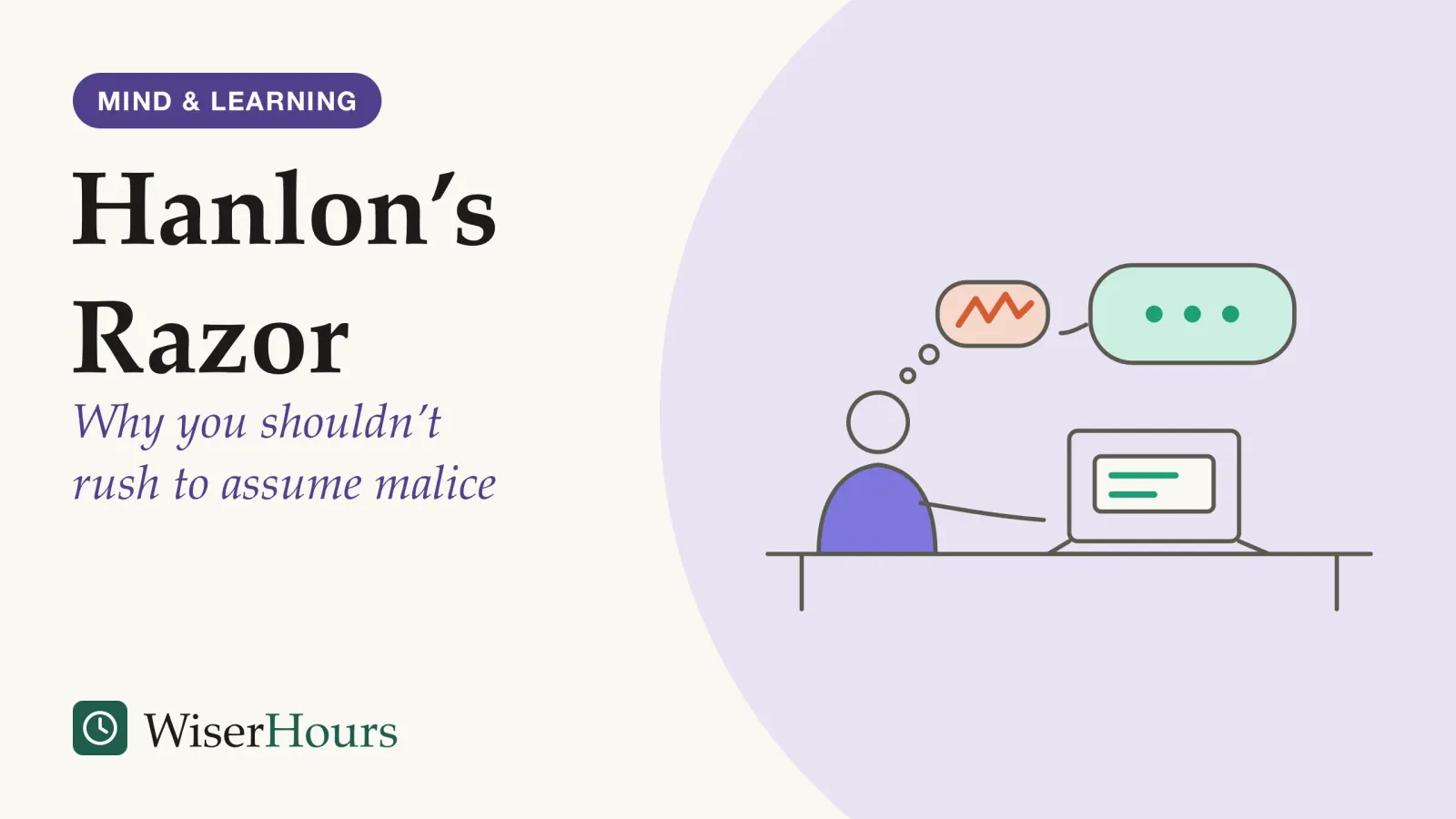
Hanlon’s razor is the rule of thumb that says: “Never attribute to malice that which is adequately explained by stupidity.” Before you decide someone meant to hurt you, check whether a slip, an oversight or something they did not know explains what they did.1 It is a habit of testing the innocent explanation before acting on the hostile one, not a claim that people never act in bad faith.
Intent is harder to read than most people assume. In a 2005 US experiment with university students, people reading short statements by email told sarcasm from sincerity no better than chance, while the writers expected to be understood.2 If a tone that obvious to the writer can vanish on the way, a curt reply or a missed deadline is weak evidence of ill will. Write down what happened, list the ordinary causes, and ask one neutral question before you send a sharp reply.
Hanlon’s razor meaning: a rule about motives
Encyclopaedia Britannica’s entry frames Hanlon’s razor as a reminder to give people the benefit of the doubt by considering other explanations for their actions before assuming they intend harm. It calls the adage a heuristicheuristic: A mental shortcut or rule of thumb that gives a quick, usually good-enough answer without weighing all the information. Heuristics often serve people well; they produce biases when used where they do not fit.Full entry in the glossary reasoning tool and gives a familiar example: a friend who does not answer your text may have a dead phone battery, not a grudge.1
Hanlon's razor, defined
Hanlon’s razor is a rule of thumb for judging other people’s actions: when a mistake, an oversight or missing information adequately explains what happened, do not conclude that someone meant harm.
Philosophers call rules like this razors because they cut unlikely explanations out of consideration. Hanlon’s, named with Occam’s razor in mind, applies the idea to human behavior.3 The site’s guide to when the simplest explanation wins with Occam’s razor covers the general rule and how the two differ; Hanlon’s version is narrower, about motives rather than any kind of cause. Both belong with the other thinking tools for everyday decisions.
The word “stupidity” is a joke book’s punchline, so read it as the everyday causes of trouble: haste, overload, a misread instruction, a message sent to the wrong thread. Swap the question “why would they do this to me?” for “what else would produce exactly this?”
How to use Hanlon’s razor: test the cheap explanation first
Used well, Hanlon’s razor becomes a short routine: describe what happened, list the ordinary explanations, run the cheapest test that would tell them apart, and respond to the effect whatever the motive turns out to be. The order matters because the innocent explanations are usually quick to check, while a wrong accusation is hard to take back.
Britannica’s entry makes the plain point that people sometimes do act with malicious intent, though such cases may be relatively uncommon, and that the razor spares you the negative emotions and hasty reactions that come with assuming malice.1 The four steps below are a suggested way to apply the rule, built on that caution and on the attribution research in the next section rather than tested as a package.
- A slip or oversight: the cheapest explanation to check, so check it first
- Missing information: they did not know what you know, or the message lost its tone
- Incentives and the system: people following the pressures they work under
- Intent to harm: tested last, but kept on the list when a pattern or real harm points there
1. Write down what happened, not what it meant
“She replied with one word” is a fact. “She is brushing me off” is a theory. Separating the two takes ten seconds and shows how much of your anger rests on the theory.
2. List the ordinary explanations before the dark one
Ask what else would produce exactly this: a slip, a busy day, missing information, a different priority, a tool that failed. Aim for three before you reply.
3. Run the cheapest test that tells them apart
Usually that is a neutral question: “I wasn’t on the invite for Thursday. Was that deliberate, or should I join?” A question like that leaves room for a candid reply and costs nothing if the reply is innocent. Where the stakes are low, the test can simply be waiting to see whether it happens again.
4. Respond to the effect, whatever the motive
Britannica’s entry points out that the razor does not make an action acceptable just because it came from carelessness rather than malice.1 A missed handover still needs fixing. Hanlon’s razor changes your tone and your first guess, not whether you raise the problem.
What Hanlon’s razor looks like at work and on the road
A manager sends the team a revised plan, and your part has vanished. The malicious reading says you are being sidelined. The razor asks for cheaper explanations first: an old version of the file, a merge that dropped a section, or a decision someone forgot to tell you about. One message (“My section isn’t in the new plan. Is that intended?”) separates them. A driver who cuts in front of you gets the same treatment: a missed mirror check or an unfamiliar exit is a likelier story than a personal grudge, and you will never meet them to find out.
Before you assume someone meant it
Why the malicious reading arrives first
People reach for the malicious reading quickly because of two tendencies psychologists have described: crediting behavior to character rather than circumstances, and reading hostility into acts whose intent is unclear. Both make the hostile story feel obvious before any checking has happened.
The fundamental attribution error, in the American Psychological Association’s dictionary, is the tendency to overestimate how much someone’s behavior reflects their lasting traits and to underweight the situation, such as financial or social pressure. The same entry adds that the tendency is more common in some societies than in others.4 Like other why the brain’s shortcuts sometimes turn into cognitive biases, it saves effort most of the time and misleads you in the cases that matter.
The second is narrower and closer to Hanlon’s target. Hostile intent attribution is the habit of reading hostility into another person’s act when the outcome is bad for you and the intent is ambiguous.5 Think of a shove in a queue, or a remark that could be teasing or contempt. Most of the research on it studies children, and a 2019 review from Utrecht University in the Netherlands brings it together.
The study
Moderate evidence
Reading hostility into ambiguous moments: a review of research on children
Across 111 studies with about 29,000 children, those who more often read hostile intent into ambiguous situations were also more aggressive. The average link was modest and far from uniform across studies, and it was stronger in more emotionally engaging situations; the largest link came from staged real-time interactions with a peer, though only two studies used them.5
The meta-analysismeta-analysis: A study that combines the results of earlier studies on the same question into one overall estimate. Pooling makes the estimate more precise, but it cannot repair the studies it pools: a meta-analysis of surveys is still survey evidence.Full entry in the glossary pools studies that measured how the two go together in children, so it cannot show that one drives the other. Adults show a similar pattern, with the same limit. A 2026 meta-analysis by researchers at Central China Normal University, pooling 40 studies and about 27,000 adults, found a moderate link between reading hostility into ambiguous cues and aggression; its authors say the causal implications need more evidence, and only its abstract could be read.6 In a 2006 study of drivers by psychologists at Clemson University in the US, blaming a recent incident on the road on a lasting trait of the other driver was linked to more anger and more aggressive behavior in all three kinds of incident studied.7 Only that study’s abstract could be read, and it does not describe the sample.
Tone also gets lost more easily than senders think. In the 2005 email experiment, writers were as confident that their tone would come across by email as by voice, even though their listeners did clearly better than their readers. The authors traced this to egocentrism: writers “hear” their own tone and struggle to picture a reader who cannot.2 That experiment was small and used US college students, but its point carries to any office. A message that reads as cold may have been typed between meetings. A colleague who left you off an invitation may have copied last month’s list.
The malicious reading tends to arrive first and to arrive with anger, which is exactly when you are least likely to check it.
Where the benefit of the doubt should end
Hanlon’s razor stops helping when the evidence no longer fits an innocent mistake: when the same harm repeats after you have raised it, when the behavior reliably benefits the person doing it, or when being wrong about intent would be costly. Britannica’s own caution is that people sometimes act with malicious intent, so that possibility has to stay on the list.1
The same harm keeps repeating
One missed task is a slip. The same missed task after two clear conversations is information. Cleveland Clinic’s health site describes weaponized incompetence as avoiding a task by claiming not to know how, or by doing it so poorly that someone else takes over. It notes that this is sometimes deliberate and sometimes not, that it shows up at work as well as at home, and that one lapse matters far less than a pattern.8
Incentives explain it better than either
Some behavior is neither malice nor stupidity. The management consultant Douglas Hubbard adapted the saying for consulting work in his 2009 book The Failure of Risk Management: never attribute to malice or stupidity what can be explained by moderately rational people following incentives in a complex system.1 A sales team that pushes deals through at the end of every quarter may not be careless or scheming; it may be paid that way. Then the useful response is to change the incentive, not to judge the people.
Being wrong would be costly
When an unexpected request involves money, passwords, safety or someone’s wellbeing, the cheap test is to verify through a channel you already trust before acting, not to assume good faith. Being charitable about motive never requires being careless about consequences.
The right-hand column is not a license to accuse. It tells you to change the test: name the pattern with dates, look at what the person gains, or take the question to someone with the authority to look into it. You can still be wrong about motive, which is why the conversation should stay about what happened and what needs to change.
Who came up with Hanlon’s razor?
The adage is credited to Robert J. Hanlon, an American who submitted it to Arthur Bloch’s Murphy’s Law Book Two, a 1980 collection of jokes about things going wrong. Britannica says the entry was credited to him when the book came out.1 Wikipedia notes that the book gave no indication of who Hanlon was.3
The name spread through programmers. In 1990 the line entered the Jargon File, a glossary of computer slang.1 The File’s entry says it turned up in email signatures and on the login banners of bulletin-board systems and commercial networks, and suggests the appeal came from working inside systems built by well-meaning but short-sighted people. It also points to a 2001 web post claiming the line was coined by a Robert J. Hanlon of Scranton, Pennsylvania.9 Quote Investigator later reported that the quotation researcher Mardy Grothe, for his 2011 book Neverisms, spoke to the widow and son of Robert J. Hanlon, a computer programmer at the Tobyhanna Army Depot in Scranton, and concluded that Hanlon should be credited with the 1980 wording.10
The idea itself is much older. In his 1774 novel The Sorrows of Young Werther, Goethe wrote that misunderstandings and neglect cause more trouble in the world than malice and wickedness do.1 The English novelist Jane West made a similar plea in 1812, and in Robert Heinlein’s 1941 story “Logic of Empire” a character accuses another of blaming villainy for conditions that come from stupidity.10 The Jargon File notes that Heinlein called the error behind it the “devil theory” of sociology.9 By 1996 the File was speculating that “Hanlon’s razor” might be a garbled “Heinlein’s razor”.3
- 1774Goethe: misunderstandings and neglect outdo malice
- 1941Heinlein names the “devil theory” in a story
- 1980Hanlon’s line appears in Murphy’s Law Book Two
- 1990The Jargon File carries it to programmers
- 2009Douglas Hubbard adds incentives to the rule
Hanlon’s razor is folk wisdom, a programmer’s entry in a joke book that echoes much older ideas. When you quote it, credit Robert J. Hanlon and the 1980 book rather than Napoleon or Heinlein, and let the routine above earn its keep on its own merits.
The bottom line
Before you decide someone meant harm, check whether a slip, an oversight or missing information explains what happened; that check is all Hanlon’s razor asks. The pull toward the malicious reading is real and arrives with anger, so the habit worth building is one neutral question before one sharp reply. Keep intent on the list, and stop extending the benefit of the doubt when a pattern, an incentive or real harm says the innocent story no longer fits.
Frequently asked questions
Is Hanlon's razor a logical fallacy?
No. Hanlon's razor is a heuristic, a rule of thumb for which explanation to consider first, not a rule of logic. Encyclopaedia Britannica notes that it must be applied cautiously, because people sometimes do act with malicious intent. Treating it as proof that nobody ever means harm would be its own mistake.
Did Napoleon say never attribute to malice what can be explained by incompetence?
There is no good evidence that he did. The Jargon File, the computer slang glossary that spread Hanlon's razor, says similar lines have been attributed to Napoleon on dubious evidence, and Wikipedia's article on the adage lists the Napoleon version as a misattribution. The documented wording comes from a 1980 joke book.
Does Hanlon's razor mean people are stupid?
No. The word stupidity is a joke book's punchline. In practice the rule points to ordinary causes: a slip, an oversight, a busy week or missing information. Britannica's entry describes it as a reminder to give others the benefit of the doubt by considering other explanations before assuming they intend harm.
Sources
- Hanlon's razor. Payne, L. and the Editors of Encyclopaedia Britannica (accessed 2026-10-11)
- Egocentrism over e-mail: Can we communicate as well as we think? Kruger, J., Epley, N., Parker, J. & Ng, Z.-W. (2005). Journal of Personality and Social Psychology, 89(6), 925-936
- Hanlon's razor. Wikipedia (accessed 2026-10-11)
- Fundamental attribution error. APA Dictionary of Psychology, American Psychological Association (updated 2023)
- Hostile Intent Attribution and Aggressive Behavior in Children Revisited: A Meta-Analysis. Verhoef, R. E. J., Alsem, S. C., Verhulp, E. E. & De Castro, B. O. (2019). Child Development, 90(5), e525-e547
- The Relationship Between Hostile Interpretation Bias and Aggression in Adults: A Systematic Review and Three-Level Meta-Analysis. Ye, Z., Yalikun, S., Isak, G., Li, Y., Du, X., Hu, J. & Ren, Z. (2026). Trauma, Violence, & Abuse (online ahead of print)
- Attributions and personality as predictors of the road rage response. Britt, T. W. & Garrity, M. J. (2006). British Journal of Social Psychology, 45(1), 127-147
- Are You Being Manipulated Through Weaponized Incompetence? Cleveland Clinic Health Essentials (2026, accessed 2026-10-11)
- Hanlon's Razor. The Jargon File, version 4.4.7, edited by Eric S. Raymond (2003), entry Hanlon's Razor
- Never Attribute to Malice That Which Is Adequately Explained by Stupidity. Quote Investigator (2016)
How we researched this
Sources were gathered in October 2026: Encyclopaedia Britannica, Wikipedia, the Jargon File and Quote Investigator for the history; the APA Dictionary of Psychology, a 2019 and a 2026 meta-analysis, a 2005 email experiment and a 2006 driver study, found through Europe PMC and web searches, for the psychology; Cleveland Clinic for weaponized incompetence. Main limitation: the attribution research is correlational and mostly studies children or students, and the 2026 review and the driver study were read in abstract only.
Keep reading

What Is Opportunity Cost? The Hidden Price of Every Choice You Make
What is opportunity cost? The value of the best option you give up. A simple formula, time and money examples, and a 5-step check before you decide.

Occam's Razor: When the Simplest Explanation Is Best and When It Isn't
Occam's razor says prefer the explanation with fewer unsupported assumptions. 4 worked examples, and when the simple story loses.
Mental Models Explained: A Beginner's Guide to Thinking Tools
Mental models have 2 meanings: the mind's inner simulations and a popular toolkit. What research says about which thinking tools carry over.
Hindsight Bias: Why Everything Seems Obvious After the Fact
Hindsight bias makes outcomes look predictable once you know them. Fischhoff's 1975 experiments, its three levels, and the one fix with evidence.