Mental Models Explained: A Beginner's Guide to Thinking Tools
Mental models have 2 meanings: the mind's inner simulations and a popular toolkit. What research says about which thinking tools carry over.

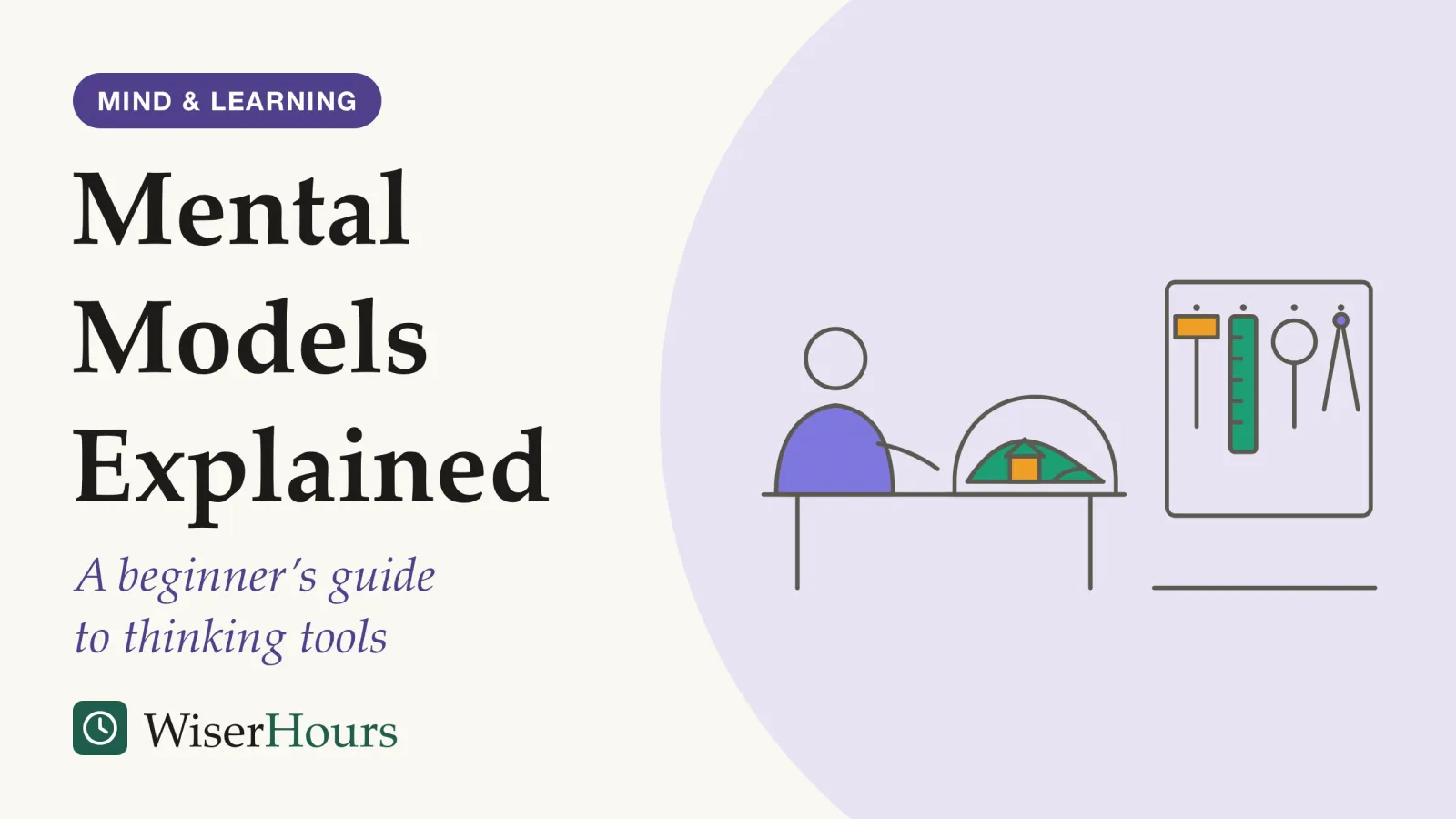
Reading the answer to a problem does not mean you will use it. In classic laboratory experiments on problem solving, most people who had just read the answer to a puzzle, dressed up as a different story, did not use it until someone told them the story was relevant.1 Owning a thinking tool and reaching for it at the right moment are separate skills, and that gap sits at the center of any honest guide to mental models.
The term has two meanings. In cognitive science, mental models are the working copies of the world your mind runs to predict what happens next, mostly without your noticing. In business writing, they are a collection of named thinking rules, from inversion to Occam’s razor, that people learn on purpose. The practical upshot for a beginner: learn a few tools well, each through a plain rule and two examples from unlike settings, rather than collecting many.
For the wider picture, read the fast and slow routes behind ordinary choices or browse the rest of the decision making and critical thinking guides.
The original meaning: a small world your mind runs forward
In cognitive science, a mental model is an inner representation of how some part of the world works, which the mind runs forward to predict and to reason. Philip Johnson-Laird, the psychologist who built the modern theory, traces the idea to Kenneth Craik, who proposed in 1943 that the mind carries a small-scale model of reality to anticipate events.2
Definition
A mental model is the mind’s working picture of how something behaves, which it runs forward to predict what will happen next and to work out what must be true.
Johnson-Laird’s theory says reasoning works by imagining possibilities. You picture the situations that fit what you know, and a conclusion holds if it is true in all of them. Because working memoryworking memory: The small mental workspace that holds and handles the information you are using right now, such as a phone number you are about to dial. Its capacity is limited, which is why juggling several things at once quickly overloads it.Full entry in the glossary is small, people tend to build one possibility, usually the one where things are as stated, and skip the others. His 2010 review argues that this explains why reasoning errors are predictable rather than random.2
- 1What you knowthe premises, or the plan as stated
- 2Worlds that fit iteach possibility the mind manages to picture
- 3A conclusionaccepted if it holds in every world pictured
- 4An error you could foreseewhen a world that also fits was never built
Here is how it looks at work. You tell a colleague that if the client signs off by Friday, the launch happens on Monday. The model in your head holds one world: sign-off arrives, clean and on time. Sign-off with changes, or sign-off on Monday morning, never gets built, so the plan has no slack for either.
Teams run models too. Pooling 65 studies in a meta-analysismeta-analysis: A study that combines the results of earlier studies on the same question into one overall estimate. Pooling makes the estimate more precise, but it cannot repair the studies it pools: a meta-analysis of surveys is still survey evidence.Full entry in the glossary from 2010, Leslie DeChurch and Jessica Mesmer-Magnus found that team cognition, the understanding of the work that members hold in common, was strongly linked to how well teams coordinated and performed. The data were correlations, so a shared picture may partly be a result of good teamwork rather than its cause.3 A support team where everyone knows who handles refunds routes a complaint in seconds; a team without that shared map passes it around.
When a plan surprises you, ask which possibility your model left out. Writing down two or three ways a situation could go forces your mind to build the worlds it would otherwise skip.
Munger’s latticework: the popular meaning of mental models
The popular meaning of mental models comes mostly from the investor Charlie Munger. In a 1994 talk at the University of Southern California’s business school, he argued that people should learn the big ideas from several disciplines and hang their experience on a latticework of models, rather than rely on one field’s tools.4
Online lists grew from that talk: inversion, second-order thinking, opportunity cost, Occam’s razor, the circle of competence, first principles. Each is a heuristicheuristic: A mental shortcut or rule of thumb that gives a quick, usually good-enough answer without weighing all the information. Heuristics often serve people well; they produce biases when used where they do not fit.Full entry in the glossary, a rule of thumb for a certain kind of problem.
Munger’s case is a practitioner’s argument, not a research finding. Its evidence is his own record and the records of people like him, and success stories come with survivorship bias: you hear from investors whose favorite models happened to pay off, not from the ones who used the same models and failed.
- Myth
- The more mental models you collect, the better you will think.
- Fact
- Knowing a rule and noticing when a situation calls for it are separate skills, and in lab studies the noticing is what usually fails.
The popular meaning does connect to the science. A named rule is a prompt to build a possibility you would otherwise skip: “what would make this fail?” makes you picture the failed version of the plan. Where the popular version goes wrong is treating the size of the collection as the skill, so that naming a model in a meeting stands in for doing the thinking it describes.
Treat each named model as a question to ask about one specific decision, and judge it by whether the answer changes what you do.
Knowing a thinking tool is not the same as noticing when it fits
Knowing a thinking tool and noticing that a problem calls for it are different skills, and the second is the one that fails. Mary Gick and Keith Holyoak showed it in 1980 with a medical puzzle and a war story.1
In the puzzle, a doctor must destroy a tumor with rays. Rays strong enough to kill the tumor also destroy the healthy tissue they pass through, and weaker rays do no harm but no good. The answer is to send many weak rays from different directions so they meet at the tumor. Before the puzzle, some students read about a general who could not march his whole army down one mined road, so he split it into small groups that converged on the fortress from every side.
The study
Moderate evidence
A tumor puzzle, a fortress story and one hint: Gick and Holyoak, 1980
Without the fortress story, about 10% of students found the converging-rays solution. After reading the story, about 30% used it without prompting. When told to use the story, about 80% solved the puzzle.1
The students had the solution in memory; what failed was finding it. Memory tends to search by surface features (armies, roads, fortresses) rather than by structure (a force too big for one route, so split it and converge). The obvious limit is the setting: a puzzle in a lab, solved by students with nothing at stake, and experts in their own field may do better.
You can see the same gap at work. A manager who learned about production bottlenecks in an operations course may never recognize her approval queue as one, because it is made of emails and signatures, not pallets and machines. The model is in her head. The situation does not look like the place she learned it.
So when you learn a model, write its rule once in words that belong to no particular field. “A single path is overloaded, so split the load and recombine” is easier to spot in an inbox than “send the army down several roads”.
Can a rule of thinking be taught?
Teaching a general rule of reasoning can carry over to everyday judgment, according to US experiments led by Richard Nisbett in the 1980s, but the carry-over is uneven. In a 1987 Science paper, Nisbett and colleagues concluded that even brief formal training in inferential rules, such as the statistical law of large numbers, may improve how people reason about everyday events.5
The law of large numbers says small samples are unreliable. Nisbett’s group found that people apply it readily to dice and lotteries and much less to judging a person from a single meeting, where the randomness is harder to see.5 That is the Gick and Holyoak problem again: the rule was known, but the situation did not announce itself as a case for it.
Cost-benefit rules gave a more hopeful result. These are the rules of microeconomics, such as ignoring money already spent and counting what an option gives up. In a 1990 US study, Richard Larrick, James Morgan and Nisbett examined people with extensive economics training and people randomly assigned to a brief lesson; in both groups, training changed how people reasoned and the choices they reported making.6 Reported choices are not observed ones, so the study shows a change in stated habits rather than in measured results.
The broadest test comes from education. A 2015 meta-analysis by Philip Abrami and colleagues pooled studies of teaching critical thinking in schools and universities and found a moderate average benefit: visible across a class, small for any single learner. Explicit teaching of thinking principles combined with subject content did best, and immersion in thought-provoking material without explicit teaching did least well.7
Whether the gains last is far less clear. A 2021 systematic review by the Dutch researchers J. E. Korteling and colleagues found only 12 studies of bias training that checked whether effects lasted, just one of which also tested a different task, and concluded there was not enough evidence that such training helps decisions in real life.8 The site’s guide to why knowing about cognitive biases rarely protects you covers that debiasing research in detail.
So learn a rule by its explicit statement, never by osmosis, and then practice it on examples from more than one part of your life.
Comparing two cases is what makes a model portable
People carry a thinking tool into new situations more often when they learn it by comparing two examples side by side than by reading one. In a 1983 follow-up, Gick and Holyoak found that students who read and compared two analogous stories were more likely to solve the rays puzzle than students who read only one.9
The comparison does the work because it strips away what the cases do not share. Two stories with different surfaces, one military and one about fire fighting, leave only their common structure standing, and that structure is what memory needs in order to find the idea later.
- One case: read alone, an idea stays tied to its surface: armies, roads, a fortress
- A second, unlike case: a different surface with the same logic underneath
- Compare them: what the two share is left standing: many small forces meeting at one point
- The new problem: the shared structure, not either story, is what memory can match to it
The effect held outside the puzzle lab. In a 1999 US study, Jeffrey Loewenstein, Leigh Thompson and Dedre Gentner had management students either compare two negotiation cases or read the same cases one at a time; those who compared them were more likely to use the underlying strategy in a later face-to-face negotiation.10
Say you want to use the outside view: start from how comparable past cases turned out before weighing what makes yours special. Read about it once and it stays an idea. Put a kitchen renovation that ran late next to a software project that ran late, write what they share (a first estimate built from the best case), and you have a pattern you might spot the next time someone hands you a timeline.
Which thinking tools have tested evidence
A handful of thinking tools have been tested in controlled studies: statistical rules, cost-benefit rules, comparing analogous cases, considering the opposite and imagining that an outcome has already happened. Most popular mental models have not been tested as taught tools at all, which leaves them unproven rather than wrong.
| What it is | What the best evidence found | Evidence |
|---|---|---|
| Small samples mislead (law of large numbers) | Brief training may improve its use on everyday problems, in US experiments | Trials, moderate5 |
| Cost-benefit rules | Training changed reasoning and reported choices, including after a brief randomly assigned lesson (US) | Trial plus survey, limited6 |
| Comparing two analogous cases | Helped people transfer a solution to a new problem | Trials, moderate9 |
| Considering the opposite | Reduced bias in judgments more than simply asking people to be fair | Trial, limited11 |
| Outside view (reference classes) | Large transport projects in 20 nations overran their budgets on average, the error the method targets | Observational, moderate12 |
| Imagining the outcome has happened | Treating an event as certain produced longer, more concrete explanations; forecast accuracy not reported | Trials, limited13 |
The rows are not equal. Considering the opposite comes from a 1984 study in which asking people to imagine the reverse result reduced biased judgment more than telling them to be fair.11 The outside view rests on evidence of the problem more than of the fix: Bent Flyvbjerg’s 2006 review of transport projects found rail schemes ran roughly 45 percent over budget on average.12 Prospective hindsight, the idea behind the popular pre-mortem, is often sold as a large gain in forecasting accuracy, but the 1989 experiments by Deborah Mitchell and colleagues measured the explanations people produced, not forecast accuracy: treating an event as certain made explanations longer and more concrete.13
For razors, inversion and first-principles thinking, the search behind this guide found no controlled test of the tool as taught. That is a gap, and a reason to treat those models as useful questions rather than proven methods. Tools that put your reasoning on paper, such as a weighted decision matrix for comparing options, have one practical advantage: someone else can check the working.
Before you adopt a named model, ask two things about it.
The bottom line
Learn fewer thinking tools, and learn each one twice: once as a plain rule, once through two unlike examples. Underneath the popular toolkit sits the mind’s own small simulation of how things work, and each named model is an attempt to improve that simulation on purpose. The research says knowing a tool is the easy half: people fail to notice when it applies, and comparing examples from different settings is the best-tested way to close that gap. Start with the few tools that have been tested, and treat the rest of the list as good questions, not proven methods.
Frequently asked questions
Who first described mental models?
The idea is usually traced to Kenneth Craik, a Scottish psychologist whose 1943 book The Nature of Explanation proposed that the mind carries a small-scale model of reality to anticipate events. Philip Johnson-Laird turned it into a theory of reasoning from the 1980s onward, and his 2010 review in the Proceedings of the National Academy of Sciences sets out that history.
Is a mental model the same as a framework or a checklist?
Not quite. A framework or checklist is a written procedure you follow, while a mental model, in the cognitive-science sense, is the picture of how something works that you reason with. A popular named model such as opportunity cost sits between the two: a rule meant to change the picture you hold. Richard Nisbett's 1987 experiments on teaching reasoning tested rules of that kind.
How many mental models should a beginner learn?
There is no research-backed number. The evidence points to depth over breadth: in Gick and Holyoak's experiments, knowing a solution did little until people saw that it applied, and comparing two examples helped them see it. Learning two or three rules well, each practiced on cases from different parts of your life, fits that evidence better than memorizing a long list.
What is a shared mental model at work?
A shared mental model is the understanding of the task and of each other that a team's members hold in common. A 2010 meta-analysis by Leslie DeChurch and Jessica Mesmer-Magnus, pooling 65 studies, found that this team cognition was strongly linked to coordination and performance. The data were correlations, so shared understanding may partly reflect good teamwork rather than cause it.
Sources
- Analogical problem solving. Gick, M. L. & Holyoak, K. J. (1980). Cognitive Psychology, 12(3)
- Mental models and human reasoning. Johnson-Laird, P. N. (2010). Proceedings of the National Academy of Sciences, 107(43)
- The cognitive underpinnings of effective teamwork: A meta-analysis. DeChurch, L. A. & Mesmer-Magnus, J. R. (2010). Journal of Applied Psychology, 95(1)
- A Lesson on Elementary, Worldly Wisdom as It Relates to Investment Management and Business (talk, 1994). Munger, C. T. In Poor Charlie's Almanack, ed. P. D. Kaufman. Stripe Press edition (2023)
- Teaching reasoning. Nisbett, R. E., Fong, G. T., Lehman, D. R. & Cheng, P. W. (1987). Science, 238(4827)
- Teaching the use of cost-benefit reasoning in everyday life. Larrick, R. P., Morgan, J. N. & Nisbett, R. E. (1990). Psychological Science, 1(6)
- Strategies for teaching students to think critically: A meta-analysis. Abrami, P. C., Bernard, R. M., Borokhovski, E., Waddington, D. I., Wade, C. A. & Persson, T. (2015). Review of Educational Research, 85(2)
- Retention and transfer of cognitive bias mitigation interventions: A systematic literature study. Korteling, J. E., Gerritsma, J. Y. J. & Toet, A. (2021). Frontiers in Psychology, 12, 629354
- Schema induction and analogical transfer. Gick, M. L. & Holyoak, K. J. (1983). Cognitive Psychology, 15(1)
- Analogical encoding facilitates knowledge transfer in negotiation. Loewenstein, J., Thompson, L. & Gentner, D. (1999). Psychonomic Bulletin & Review, 6(4)
- Considering the opposite: A corrective strategy for social judgment. Lord, C. G., Lepper, M. R. & Preston, E. (1984). Journal of Personality and Social Psychology, 47(6)
- From Nobel Prize to project management: Getting risks right. Flyvbjerg, B. (2006). Project Management Journal, 37(3)
- Back to the future: Temporal perspective in the explanation of events. Mitchell, D. J., Russo, J. E. & Pennington, N. (1989). Journal of Behavioral Decision Making, 2(1)
How we researched this
Research started from a commissioned evidence dossier and ran in September 2026 through Crossref and publishers' pages, beginning with Johnson-Laird's account of mental model theory and the classic analogy experiments, then moving to meta-analyses and reviews on teaching thinking skills and on team cognition. Sources run from 1980 to 2021. Main limitation: most of the transfer evidence comes from short laboratory or classroom tasks with students, so effects on real, high-stakes decisions are rarely measured directly.
Keep reading
The Dunning–Kruger Effect: What It Really Says and What It Doesn't
The 1999 Dunning-Kruger paper never drew 'Mount Stupid'. Statistics explain part of its pattern, but two 2021 studies of about 4,000 people each found a gap.
Groupthink: What It Is, Famous Examples, and How to Prevent It
Groupthink is a group's wish to agree overriding its judgment. Janis's 8 warning signs, the Bay of Pigs and Challenger, and what research says prevents it.
Analysis Paralysis: Why You Can't Decide and How to Get Unstuck
Analysis paralysis ties to hard trade-offs and fear of regret. Why choices stall, how solid the research is, and 5 ways to get unstuck.
How to Use a Decision Matrix: Comparing Options With Weighted Criteria
How to build a decision matrix in 6 steps: pick criteria that don't overlap, score one column at a time, weight the gaps, then test the winner.