Hindsight Bias: Why Everything Seems Obvious After the Fact
Hindsight bias makes outcomes look predictable once you know them. Fischhoff's 1975 experiments, its three levels, and the one fix with evidence.

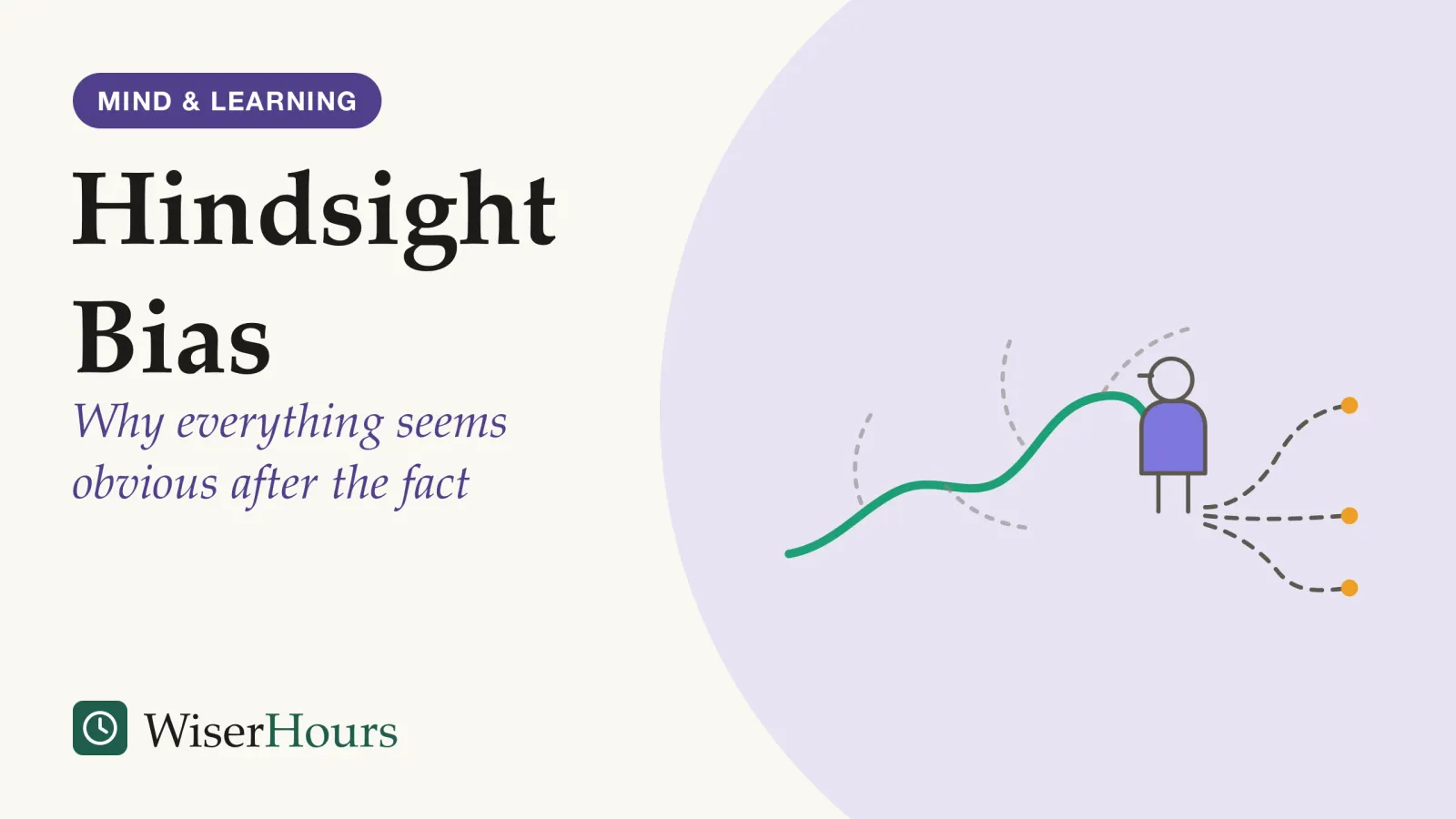
Tell people how an obscure 19th-century war ended and they rate that ending as more likely than people who were never told, even when the ending they heard never happened. In Baruch Fischhoff’s 1975 experiments, people told an outcome could not undo its pull when asked to answer as if they had never heard it.1 This is hindsight bias, the knew-it-all-along effect: a cognitive biascognitive bias: A predictable way in which judgments depart from a standard such as logic or probability. Most are ordinary mental shortcuts applied in the wrong setting rather than defects, and some well-known ones have not held up when tested again.Full entry in the glossary in which an outcome, once known, looks more predictable than it looked before. Psychologists Neal Roese and Kathleen Vohs define it that way in a 2012 review, and it shows up in election forecasts, medical diagnoses, court cases and annual reviews.2
The bias is mild when a sports fan replays a lost game and costly when it decides whether a colleague, a doctor or a defendant made a negligent mistake. The best-supported fix is to explain, before you judge a past decision, how two or three other outcomes could have happened.
The three levels of hindsight bias, from memory to self-belief
Roese and Vohs’s 2012 review in Perspectives on Psychological Science splits hindsight bias into three levels, each a separate error. The lowest level is memory distortion (“I said it would happen”), the middle level is inevitability (“It had to happen”), and the top level is foreseeability (“I knew it would happen”).2
Definition
Hindsight bias is the tendency to see an event, once its outcome is known, as more predictable than it was before, often with the feeling that you knew it all along.
The levels separate what you remember, what you believe about the world and what you believe about yourself. Memory distortion is a misremembered forecast: you rated a candidate’s chances at a coin toss in August and recall it as a near-certainty in November. Inevitability is a belief about events, that under the circumstances no other result was possible. Foreseeability is a belief about your own judgment, the sense that you personally could have called it. Roese and Vohs describe the levels as stacked, with beliefs at the top able to push down on the ones beneath.2
- Memory distortion: "I said it would happen": you misremember the forecast you made
- Inevitability: "It had to happen": the outcome now looks as if no other was possible
- Foreseeability: "I knew it would happen": you believe you personally could have seen it coming
Britannica’s entry gives an everyday version. Asked whether people prefer friends who are similar or different, most of us can argue either way: birds of a feather flock together, or opposites attract. Once a study supports one answer, it starts to look obvious, and the other line of reasoning drops out of view.3
The levels tell you what to check. A misremembered forecast is fixed by a written record. A sense that it had to happen calls for asking which other outcomes were live at the time. A sense that you saw it coming is the hardest to shift, because it flatters you.
In Fischhoff’s 1975 experiments, outcome knowledge would not switch off
Baruch Fischhoff, working with Israeli university students, published the experiments that started the field in 1975. Students read a short account of an unfamiliar event, such as a 19th-century war between British forces and the Gurkhas of Nepal, with four possible endings. Some were told nothing; others were told that one ending, picked by the experimenter, was what happened.1
The study
Moderate evidence
Fischhoff's four-ending experiments with Israeli students, 1975
In all 24 comparisons, telling students that an outcome had happened raised the probability they gave it, whether or not that outcome was the real one. Reporting an outcome roughly doubled the odds people gave it. Students also reweighted the facts in the passage to fit whichever ending they had been told.1
Only one of the four endings was real, so three of the four groups told an ending heard a false one; the rise cannot come from learning what happened. It comes from hearing that something happened. Two follow-up experiments made the result harder to excuse. Students asked to answer “as they would have had they not known the outcome” still leaned toward it, and students asked to guess how other students, who had not been told, had answered also assumed those students would have seen it coming.1
Fischhoff concluded that people were largely unaware of what the outcome had done to their judgment. In a related study by Fischhoff and Ruth Beyth, people forecast outcomes of President Nixon’s 1972 trips to China and the Soviet Union, then later tried to recall those forecasts; they remembered giving higher probabilities than they had to events they believed had happened.1
The effect has held up across decades of follow-up work. A 2004 meta-analysismeta-analysis: A study that combines the results of earlier studies on the same question into one overall estimate. Pooling makes the estimate more precise, but it cannot repair the studies it pools: a meta-analysis of surveys is still survey evidence.Full entry in the glossary by Rebecca Guilbault and colleagues pooled 95 studies and found a reliable hindsight effect; it was larger for almanac-style trivia questions than for real-world events or case histories.4 Instructions to set the outcome aside did little in Fischhoff’s second experiment; his explanation is that the outcome had already changed which facts looked important.1 When you look back at a call, work from a record made before the result, such as the original proposal or the meeting notes, and treat your memory of how things looked as suspect.
What causes hindsight bias?
Roese and Vohs trace hindsight bias to three kinds of input: memory, the feeling of how easily an outcome can be explained, and motives. People recall information that fits what they now know and build a story in which the ending makes sense; an easy story then feels like a predictable one.2
Memory updates itself. When you learn how a product launch went, the new fact links up with everything you already knew about the market, the team and the timing, and the details that fit the ending are strengthened while the rest fade. Their review notes that the bias grows the longer the gap between the event and the later judgment, as memory keeps the gist and drops specifics.2
- 1The outcome arrivesa launch flops, a hire leaves, a vote goes one way
- 2Memory updatesfacts that fit the ending grow stronger, the rest fade
- 3A story formsone cause explains the ending neatly
- 4Easy feels predictableit seemed obvious, so it must have been foreseeable
Sensemaking adds a plot. A launch that flopped acquires a cause, say a rushed design review, and the cause makes the flop feel inevitable.
Motives supply the rest. People want the world to feel orderly and predictable, and they want credit for good calls and distance from bad ones. The same review reports that several studies find less hindsight bias after bad outcomes, as “I never could have seen it coming” shifts blame away, though other studies find more.2
So when an explanation for a past event feels effortless, treat the ease as a warning. A neat story is a sign the outcome has been fitted to it, and says little about how predictable it was beforehand.
Why hindsight bias is a problem when you judge other people
Hindsight bias does its most expensive work when one person judges another’s decision after a bad result. Roese and Vohs open their review with a manager whose hire disappoints: a year later, senior management finds “warning signs” in the file and gives her a poor review for that one decision.2
Fischhoff’s third experiment showed the mechanism. People who knew the outcome assumed others without it would have seen it coming.1 That is the move in a blame-seeking post-mortem: the reviewer reads the old file knowing the ending, and the signals that pointed to it stand out, while the signals that pointed elsewhere look like noise.
Courts are a hard test, because negligence is judged after harm has happened. In a 1996 study by US psychologists, 297 community residents read the same case of a therapist treating a potentially dangerous patient; those told the patient became violent rated the violence as more foreseeable and the therapist’s actions as less reasonable.5 In a 1995 mock-trial study by US researchers, most people judging in foresight decided a flood was too unlikely to justify more precautions, and most people judging the same decision after a flood called it negligent.6
Medicine shows a close cousin. In a 1991 US study, 112 anesthesiologists rated matched versions of the same cases; when the outcome was switched from temporary to permanent injury, ratings of appropriate care fell sharply.7 The care was identical. Only the ending changed.
| What was judged | What changed the judgment | Evidence |
|---|---|---|
| Likelihood of historical and clinical outcomes | Being told one outcome happened, true or false | Randomized lab experiments, Israeli students, 19751 |
| A therapist’s care of a potentially dangerous patient | Learning the patient became violent | Experiment with 297 community residents, 19965 |
| A town’s flood precautions | Judging after a flood instead of before | Mock-trial experiment, 19956 |
| Appropriateness of anesthesia care | Permanent versus temporary injury in otherwise identical cases | 112 US anesthesiologists, 19917 |
When you review someone’s decision, start with a written account of what they knew and when, collected before anyone discusses the result. Judge the decision against that record, and test your verdict with one question.
Hindsight bias vs outcome bias: judging the decision by its result
Hindsight bias and outcome bias are close relatives that answer different questions. Hindsight bias distorts how predictable an outcome seemed; outcome bias distorts how good the decision looks, rating the same choice as better thinking when it worked out and worse when it did not. Jonathan Baron and John Hershey of the University of Pennsylvania showed outcome bias in five 1988 studies with undergraduates.8
Their participants judged medical decisions and money gambles made by others, knowing they had all the information the decision maker had. They still rated the thinking as better and the decision maker as more competent when the outcome was good. Those who were asked said outcomes should not count, yet their ratings showed outcomes counted anyway.8
The two biases feed each other. A bad result makes the ending look predictable, and a predictable ending makes the choice that missed it look careless. A sound decision is one that made sense given what could be known at the time; luck decides the rest, which is also why past spending should not drive the next choice, as the sunk cost fallacy shows from another side.
- Myth
- Seeing the warning signs afterward is just learning from experience.
- Fact
- Learning applies an outcome to your next decision. Hindsight bias applies it to a past one, judging people on what only became knowable later.
Roese and Vohs draw the line by timing. Knowledge from an outcome is useful for current actions and future plans; it misleads when aimed at a past moment, such as expecting a doctor to have seen in an old X-ray what only a later one revealed.2
How to reduce hindsight bias: imagine other endings, then write predictions down
The debiasing move with the most consistent support is to consider how things could have turned out otherwise, Roese and Vohs conclude. Explain how outcomes that did not happen could plausibly have happened, and stop at two or three, which they say works best; the alternatives loosen the single story the outcome built.2
In a 1988 study of 194 neuropsychologists, some read a case history knowing the correct diagnosis and had to list one reason why each possible diagnosis might be correct. Fewer of them showed hindsight bias than colleagues who were simply told the answer.9
There is a limit. In two 2002 studies by Lawrence Sanna and colleagues, people who listed two ways an event might have turned out otherwise showed no significant hindsight effect, while those asked for ten found it hard and showed more bias, which the authors attribute to the struggle suggesting there were few alternatives.10 Other remedies have failed. A debiasing step in the 1995 flood study made no significant difference, and the 2004 meta-analysis found that studies designed to reduce the bias did not show smaller effects.64
The memory level has a simpler guard: a record. Researchers measure memory distortion, the 2012 review explains, by comparing what people recall with a forecast they recorded earlier.2 You can do the same. Before a launch, a hire or a negotiation, write the outcome you expect and how sure you are; after it, compare.
In these studies the steps shrank the bias, and the evidence comes mostly from short lab tasks; whether they change real reviews and verdicts is less tested. Hindsight bias sits alongside the other systematic errors covered in how cognitive biases work as a class, and the wider set of guides to sounder decisions takes the thread further.
The bottom line
Knowing how a story ended changes how its beginning looks, and the damage is greatest when the decision being judged belongs to someone else. Before a review, a post-mortem or a verdict, write down what was known at the time, explain two other ways it could have turned out, and judge the decision against that record.
Frequently asked questions
What is an example of hindsight bias?
A sports fan who says the coach's fourth-quarter call was obviously wrong, but only after the play failed, is showing hindsight bias; Britannica's entry calls this the Monday morning quarterback. A larger example is the criticism after the September 11, 2001 attacks that counterterrorism agencies and the US military missed obvious warning signs, signs called obvious once the attacks had happened.
Does expertise protect against hindsight bias?
Not reliably. In their 2012 review, Neal Roese and Kathleen Vohs note that an early meta-analysis linked expertise to less hindsight bias, but a larger 2004 meta-analysis by Rebecca Guilbault and colleagues, with a tighter definition of expertise, found no relation. Experts may recall their own forecasts better, but knowing a field confers no blanket protection.
Does hindsight bias get stronger over time?
It tends to. Roese and Vohs report in their 2012 review that hindsight bias grows the longer the gap between the event and the later judgment. Their explanation is that memory rebuilds the past: concrete details blur over time and gist summaries take their place, and the gist is shaped by the outcome you now know.
Is hindsight ever useful?
Yes, when it points forward. Roese and Vohs argue that knowledge gained from an outcome is appropriate for current actions and future plans. The error comes when the same knowledge is used to judge a past moment, such as deciding that someone should have known what only became knowable later.
Sources
- Hindsight ≠ foresight: the effect of outcome knowledge on judgment under uncertainty. Fischhoff, B. (1975). Journal of Experimental Psychology: Human Perception and Performance, 1(3), 288-299; reprinted 2003 in Quality & Safety in Health Care, 12(4), 304-312
- Hindsight Bias. Roese, N. J. & Vohs, K. D. (2012). Perspectives on Psychological Science, 7(5), 411-426
- Hindsight bias. Inman, M. & the Editors of Encyclopaedia Britannica. Encyclopaedia Britannica (accessed October 2026)
- A Meta-Analysis of Research on Hindsight Bias. Guilbault, R. L., Bryant, F. B., Brockway, J. H. & Posavac, E. J. (2004). Basic and Applied Social Psychology, 26(2-3), 103-117
- Determinations of negligence and the hindsight bias. LaBine, S. J. & LaBine, G. (1996). Law and Human Behavior, 20(5), 501-516
- Ex post ≠ ex ante: Determining liability in hindsight. Kamin, K. A. & Rachlinski, J. J. (1995). Law and Human Behavior, 19(1), 89-104
- Effect of outcome on physician judgments of appropriateness of care. Caplan, R. A., Posner, K. L. & Cheney, F. W. (1991). JAMA, 265(15), 1957-1960
- Outcome bias in decision evaluation. Baron, J. & Hershey, J. C. (1988). Journal of Personality and Social Psychology, 54(4), 569-579
- Eliminating the hindsight bias. Arkes, H. R., Faust, D., Guilmette, T. J. & Hart, K. (1988). Journal of Applied Psychology, 73(2), 305-307
- When debiasing backfires: Accessible content and accessibility experiences in debiasing hindsight. Sanna, L. J., Schwarz, N. & Stocker, S. L. (2002). Journal of Experimental Psychology: Learning, Memory, and Cognition, 28(3), 497-502
How we researched this
Searching ran in October 2026 in PubMed, Crossref and OpenAlex, plus open web searches, beginning with Fischhoff's 1975 experiments and the 2012 review by Roese and Vohs and following their references on legal, medical and debiasing studies. Sources run from 1975 to 2012, plus current encyclopedia entries. Fischhoff's paper and the Roese and Vohs review were read in full; for the meta-analysis and several applied studies only abstracts were available, so claims from them stay within what each abstract reports. Most evidence comes from laboratory and mock-jury tasks.
Keep reading
The Sunk Cost Fallacy Explained: Why We Stick With Choices That Aren't Working
The sunk cost fallacy lets spent money decide. A 2012 review of 166 samples found the pull shrinks when you separate it from being nearly done.
The Dunning–Kruger Effect: What It Really Says and What It Doesn't
The 1999 Dunning-Kruger paper never drew 'Mount Stupid'. Statistics explain part of its pattern, but two 2021 studies of about 4,000 people each found a gap.
Cognitive Biases Explained: Why Your Brain Takes Shortcuts
Cognitive biases are shortcuts that misfire. Anchoring and framing survived a retest in 36 samples; bias scores barely correlate.
The OODA Loop Explained: Observe, Orient, Decide, Act
The OODA loop's 4 steps in plain words: where John Boyd's model came from, why Orient matters most, and how to use it at work, plus its limits.