The Sunk Cost Fallacy Explained: Why We Stick With Choices That Aren't Working
The sunk cost fallacy lets spent money decide. A 2012 review of 166 samples found the pull shrinks when you separate it from being nearly done.

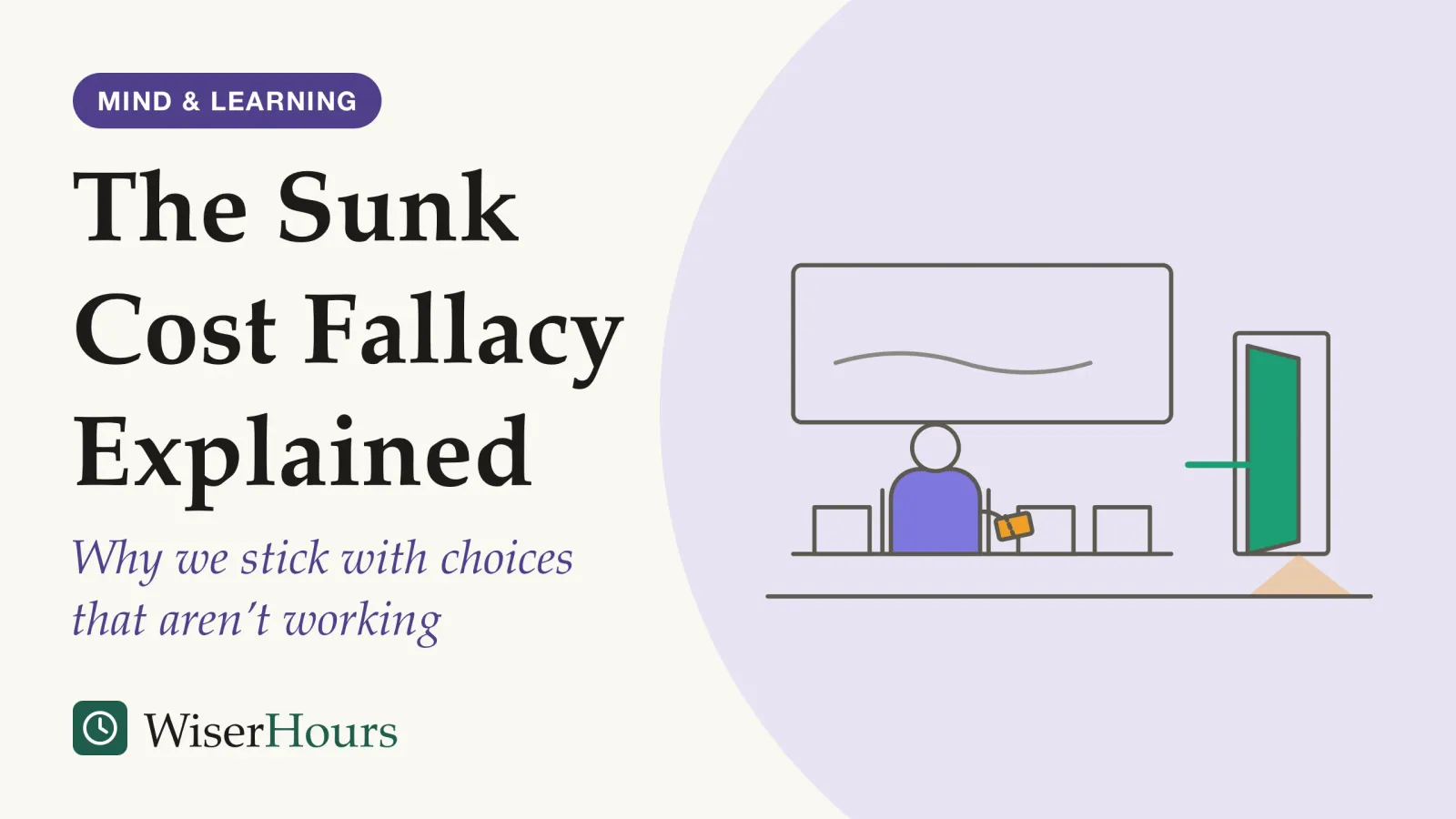
Forty minutes into a film, you know it is not going to get better. You stay anyway, because the ticket was paid for, and walk out an hour later having spent both the money and the evening.
The sunk cost fallacysunk-cost effect: The pull to keep putting time, money or effort into something because of what has already been spent on it, rather than because of what it will bring from now on.Full entry in the glossary is continuing something because of the money, time or effort already spent on it, rather than because of what continuing will bring.1 That spending is gone whichever way you choose, so only future costs and benefits should decide. A quick test is to ask whether you would start this today, knowing what you know now. The error is one of the better-studied cognitive biases that shortcut judgment in how people make everyday decisions, and its reputation runs ahead of the evidence. A 2012 meta-analysismeta-analysis: A study that combines the results of earlier studies on the same question into one overall estimate. Pooling makes the estimate more precise, but it cannot repair the studies it pools: a meta-analysis of surveys is still survey evidence.Full entry in the glossary of 166 samples from escalation research found that past spending was tangled up with being close to finishing: in studies that kept the two apart, its link to pressing on was small and uncertain.2
Prefer to watch? The video covers the same ground as this article.
What the sunk cost fallacy looks like in everyday choices
The sunk cost fallacy shows up whenever past spending, rather than future value, decides whether you carry on. Economists call the rule it breaks the bygones principle: in standard economic theory only costs you can still avoid belong in a rational choice, and costs already paid are, in Wikipedia’s phrase, water under the bridge.1
The everyday versions are familiar. A car that keeps breaking down gets one more repair because of all the repairs before it. A course or a degree you no longer want continues because a year of fees and evenings is already in it. A work project that stopped making sense keeps its budget because a team has spent months on it. And people stay in failing relationships because they feel they have already invested too much to leave.1
Governments make the same mistake on a larger scale. Britain and France kept funding Concorde, their supersonic airliner, after there was no longer an economic case for it; the British government privately regarded the project as a commercial disaster, but political and legal issues made it impossible for either government to pull out. That is why the error has a second name, the Concorde fallacy.1
In each case the past spending feels like a reason, but it is the same whichever way you go. Staying to the end of the film does not bring the ticket money back; it only adds an hour you would rather have spent elsewhere. The honest comparison is between the two roads ahead.
- Already spent: money, time or effort you cannot get back, whichever road you take
- Keep going: what continuing will still cost, and what it will bring
- Stop or switch: what changing course will cost, and what it will bring
- The real comparison: weigh the two roads ahead against each other; the stack behind you counts the same on both
To run that comparison, cover up the past. Picture someone handing you this exact situation today, with no history attached: the half-finished course, the car as it now runs, the project as it now stands. Would you choose to start it? If you would not, the only thing keeping you in is the receipt.
Arkes and Blumer’s theatre tickets: the study that made it famous
The best-known test came in 1985, when the psychologists Hal Arkes and Catherine Blumer defined the sunk cost effect as a greater tendency to continue an endeavor once money, effort or time has been invested, and then looked for it among real season-ticket buyers at a university theatre.3
The study
Limited evidence
Same seats, different prices: one season at a university theatre
People buying season tickets at the start of a season were sold them at full price or at an unannounced discount, given out at random. Over the first half of the season, full-price buyers attended more plays: about 4.1 of 5, against 3.3 for those who got a discount. In the second half, the two groups did not behave differently.4
Every ticket holder had the same right to walk in, so the price paid should not have changed who turned up. It did, but only for a while, in one season at one theatre, and that fading matters. Stefan Roth’s team in Germany reported in a 2015 meta-analysis that the effect on using what you paid for shrinks as time passes after the payment, a pattern known as payment depreciation.5
The core pattern has also survived a large retest. The Many Labs project of 2014, which reran 13 classic and newer effects across 36 samples, asked people whether they would brave a freezing day to watch a football game; those told they had paid for the ticket said they were likelier to go than those given it free, and the effect replicated, though it was small.6
The pull is strongest while a payment is fresh, just after the gym membership, the course fee or the expensive tool, so that is when a decision to keep using something deserves a second look. If you are dragging yourself to a class mainly because the fee left your account last week, ask whether you would book that class as a one-off tonight.
Why we keep going: waste, pride and escalation of commitment
People keep going for three reasons researchers have studied closely: a rule against waste stretched too far, the wish to prove the first choice was right, and the way losses feel. Money is only part of it.
The first is a habit that usually serves people well. Hal Arkes and Peter Ayton argued in 1999 that adults overgeneralize a rule of thumb, don’t waste, and they presented evidence that young children in a comparable situation behave more in line with cost-benefit rules than adults do.7 Not wasting food, money or effort is normally good sense, which is why walking out of a paid-for film feels like throwing the ticket away. The rule misfires once the waste has already happened: sitting through the film cannot un-spend the ticket, it only adds a lost evening to it.
Pride is the second force. Barry Staw’s 1976 study, the starting point for research on escalation of commitment, asked business students at the University of Illinois to play a finance executive deciding where to put research money. Students who had personally chosen a division that then declined put about $13 million of a fresh $20 million budget back into it, more than any other group; students told the earlier choice was someone else’s put in about $9 million on average.8 Staw’s explanation was self-justification: putting in more is a way to defend the first choice and show it was rational after all.
- 1Commityou choose a course and put resources in
- 2Bad newsresults come in below what you expected
- 3Need to justifystopping would admit the first call was wrong
- 4Invest morethe stake grows, and so does the next loss
Then repeat from “Commit”
The third force is how losses feel. In prospect theoryprospect theory: Kahneman and Tversky's account of how people choose under risk: outcomes are judged as gains or losses from a reference point, and losses weigh more than gains of the same size. Its main patterns have held up when the original questions were run again in many countries.Full entry in the glossary, one of the explanations the 2012 meta-analysis tested, a choice framed as a loss triggers loss aversion and a willingness to take risks, and in a failing project the risky option is spending more. Consistent with that, bad news framed positively went with less escalation than the same news framed negatively.2 Framing is partly in your hands: “we have lost six months” invites a push to win them back, while “six months have shown us this design does not work” points the conversation at what comes next.
Across its samples, the meta-analysis by Dustin Sleesman and colleagues found personal responsibility for the first decision to be the most studied driver and a consistent one, while the need to save face and time already invested were among the strongest. Stopping is hard not only because of the money but because it means saying “I chose this.” One fix follows: at work, let someone who did not make the original call decide whether it continues, a step scholars have long advised, Sleesman’s team notes.2
Real, but patchier than its reputation
The sunk cost effect is real, but it is less consistent than its reputation. A 2015 meta-analysis from Germany, pooling 98 effect sizes, found clear evidence that it exists, of moderate size overall, with results that differed a lot between studies, and no clear sign that a business or economics background protects people.5
The bigger surprise is the confound in the opening finding. In many classic studies, higher spending was presented together with being nearly finished, and nearness to the finish line pulls people on by itself. In studies that did not tie the money spent to progress toward completion, Sleesman’s team found its link to escalation small enough that they could not rule out zero, and concluded it may be less reliable than the literature suggests.2 “We’ve spent so much” and “we’re almost done” feel like one argument, but only the second is about the future. When you hear yourself say the first, test the second: how close are you, and what will the rest cost?
Outside questionnaires, the picture is mixed. In a 2022 lab experiment on investment decisions, economists Marcello Negrini, Arno Riedl and Matthias Wibral found no standard sunk cost bias; bigger first investments made people less likely to continue, although the same researchers reproduced the usual bias with hypothetical scenarios.9 In a 2010 field experiment in Zambia, the price households paid for a water-treatment solution showed no consistent effect on whether they used it.10 Against that, a 2018 study of drivers in Singapore linked the higher, government-driven cost of buying a car between 2009 and 2013 to about 6 percent more driving, a modest shift that the authors present as the first field evidence of the fallacy in using a major durable good.4
Even the classic questionnaires are shaky. A 2025 study from the University of Wroclaw in Poland, by Michał Białek and Emilia Biesiada, gave several well-known sunk cost scenarios to English-speaking online participants and found the answers hardly hung together as one measure, suggesting each scenario taps somewhat different motives.11
That mixed record is useful. The fallacy is not a fixed flaw that fires whenever you have paid for something, so the practical skill is spotting the situations where it shows up.
| What it is | What the best evidence found | Evidence |
|---|---|---|
| Past spending pushes people to continue | Clear overall effect across 98 effect sizes, varying widely; weaker as time passes after payment | Meta-analysis, moderate5 |
| Past spending apart from nearness to finishing | Small link to escalation, not clearly above zero | Meta-analysis, limited2 |
| Personal responsibility for the first choice | Consistent link to escalation across 54 samples | Meta-analysis, moderate2 |
| Lab investment task, 2022 | No standard bias; the reverse appeared | Lab experiment, limited (abstract only)9 |
| Price paid for water treatment, Zambia, 2010 | No consistent effect on use | Field experiment, limited (abstract only)10 |
| Cost of buying a car, Singapore, 2018 | Higher sunk cost linked to more driving | Observational, moderate4 |
So expect the pull to be strongest where money, pride and a near finish line come together, and weakest where the cost is small, old or someone else’s.
When carrying on is not a fallacy
Continuing after heavy spending is only a fallacy when the past spending is the reason. Wikipedia’s summary of the economics lists cases where persisting can be rational: a manager may persist to protect a personal reputation for perseverance, even if the company gains nothing, or may hold private information showing that abandoning a project would be worse than outsiders think.1
- Myth
- If you have already sunk a lot into something, quitting is the rational move.
- Fact
- Past spending should be ignored in both directions. It is no reason to continue and no reason to quit; only what each option will cost and bring from here decides.
Being nearly finished is the commonest good reason. If a renovation needs one more week and a modest sum to become a usable kitchen, finishing may beat abandoning it, because the remaining cost is small against what you get.
Write your reason for continuing in one sentence. If every word is about the future (what it will cost, what it will bring), you are deciding. If the sentence leans on “already”, you are paying for the past again.
The mirror-image error is not only theoretical: in the 2022 lab experiment described above, bigger first investments made people less likely to continue.9 Either way, the fix is the same one-sentence test.
Questions to ask before you put more in
The most useful questions move attention from what is gone to what lies ahead, and several safeguards tested in experiments are set up before bad news arrives. Itamar Simonson and Barry Staw compared de-escalation strategies in a 1992 study and found three most effective: making negative outcomes less threatening, setting minimum targets that trigger a change of course if they are missed, and judging decision makers on their process rather than the outcome.12
Keep going or stop? Five questions
Download PDF
The third question needs timing. Sleesman’s team found that making the opportunity cost visible usually curbed escalation, but that it could backfire when people felt highly responsible or were close to finishing, and they suggest it may matter most early on.2 Ask it before pride and progress have piled up, not only when things are going badly.
The fifth question works only if the limit exists, so set it on day one. Before a project, a course or a big repair, write down where you will stop or rethink: a budget, a date, a result you must see by then. Agreeing it in advance, while nothing is sunk and nobody’s pride is at stake, is an everyday version of Simonson and Staw’s minimum target.

The bottom line
Money, time and effort you have already spent cannot be recovered by spending more, so they should not decide what you do next. Ask whether you would start the thing today, give the continue-or-stop call to someone who did not make the first one when you can, and set your stopping rule before you begin.
Frequently asked questions
How does the sunk cost fallacy differ from escalation of commitment?
They overlap. The sunk cost fallacy is letting past spending decide whether to continue. Escalation of commitment, Barry Staw's term from 1976, is the wider pattern of putting more into a failing course of action, which a 2012 meta-analysis linked to several drivers besides money spent, including personal responsibility for the first decision and threats to self-image.
Is the sunk cost fallacy the same as the Concorde fallacy?
Mostly, yes. Concorde fallacy is a nickname taken from the British and French funding of the supersonic airliner. Hal Arkes and Peter Ayton noted in 1999 that the term had been applied only to animals, and argued there were no unambiguous animal examples, while young children in a similar situation acted more in line with cost-benefit rules than adults.
Does studying economics protect you from the sunk cost fallacy?
Not reliably. Stefan Roth and colleagues, in a 2015 meta-analysis, found no clear evidence that a business background or training in economic decisions reduced the effect in everyday usage decisions. The same analysis found older adults were less likely than younger adults to honor sunk costs in those decisions.
Does time count as a sunk cost, or only money?
Time counts. A 2012 meta-analysis by Dustin Sleesman and colleagues found time already invested was among the stronger drivers of escalation, though it rested on only seven samples. Arkes and Blumer's 1985 definition names money, effort and time. Hours put into a course, a manuscript or a relationship can pull on a decision too.
Sources
- Sunk cost. Wikipedia (accessed 2026-09-28)
- Cleaning Up the Big Muddy: A Meta-Analytic Review of the Determinants of Escalation of Commitment. Sleesman, D. J., Conlon, D. E., McNamara, G. & Miles, J. E. (2012). Academy of Management Journal, 55(3), 541-562
- The psychology of sunk cost. Arkes, H. R. & Blumer, C. (1985). Organizational Behavior and Human Decision Processes, 35(1), 124-140
- Sunk Cost Fallacy in Driving the World's Costliest Cars. Ho, T.-H., Png, I. P. L. & Reza, S. (2018). Management Science, 64(4), 1761-1778
- On the sunk-cost effect in economic decision-making: a meta-analytic review. Roth, S., Robbert, T. & Straus, L. (2015). Business Research, 8(1), 99-138
- Investigating variation in replicability: A “Many Labs” replication project. Klein, R. A., Ratliff, K. A., Vianello, M., et al. (2014). Social Psychology, 45(3), 142-152
- The sunk cost and Concorde effects: Are humans less rational than lower animals? Arkes, H. R. & Ayton, P. (1999). Psychological Bulletin, 125(5), 591-600
- Knee-deep in the big muddy: a study of escalating commitment to a chosen course of action. Staw, B. M. (1976). Organizational Behavior and Human Performance, 16(1), 27-44
- Sunk cost in investment decisions. Negrini, M., Riedl, A. & Wibral, M. (2022). Journal of Economic Behavior & Organization, 200, 1105-1135
- Can Higher Prices Stimulate Product Use? Evidence from a Field Experiment in Zambia. Ashraf, N., Berry, J. & Shapiro, J. M. (2010). American Economic Review, 100(5), 2383-2413
- On the Low Reliability of Sunk Cost Vignettes. Białek, M. & Biesiada, E. (2025). Brain Sciences, 15(8), 808
- Deescalation strategies: A comparison of techniques for reducing commitment to losing courses of action. Simonson, I. & Staw, B. M. (1992). Journal of Applied Psychology, 77(4), 419-426
How we researched this
Sources were found in September 2026 through OpenAlex, Crossref, PubMed Central and open web searching, starting from Arkes and Blumer's 1985 paper and Staw's 1976 study and moving forward to meta-analyses, multisite replications and lab and field experiments. Sources run from 1976 to 2025; Wikipedia was used only for definitions and examples. Full texts were read for most sources; for four, only the abstract or an opening page could be read, and nothing here goes beyond it. Main limitation: most studies use short imagined scenarios, and real-stakes evidence is scarce and mixed.
Keep reading
Hindsight Bias: Why Everything Seems Obvious After the Fact
Hindsight bias makes outcomes look predictable once you know them. Fischhoff's 1975 experiments, its three levels, and the one fix with evidence.
The Dunning–Kruger Effect: What It Really Says and What It Doesn't
The 1999 Dunning-Kruger paper never drew 'Mount Stupid'. Statistics explain part of its pattern, but two 2021 studies of about 4,000 people each found a gap.
Cognitive Biases Explained: Why Your Brain Takes Shortcuts
Cognitive biases are shortcuts that misfire. Anchoring and framing survived a retest in 36 samples; bias scores barely correlate.
The OODA Loop Explained: Observe, Orient, Decide, Act
The OODA loop's 4 steps in plain words: where John Boyd's model came from, why Orient matters most, and how to use it at work, plus its limits.