The Slippery Slope Argument: When It's a Fallacy and When It Isn't
The slippery slope fallacy explained: 3 kinds of slope argument, everyday and work examples, and 3 questions that separate a weak chain from a fair warning.

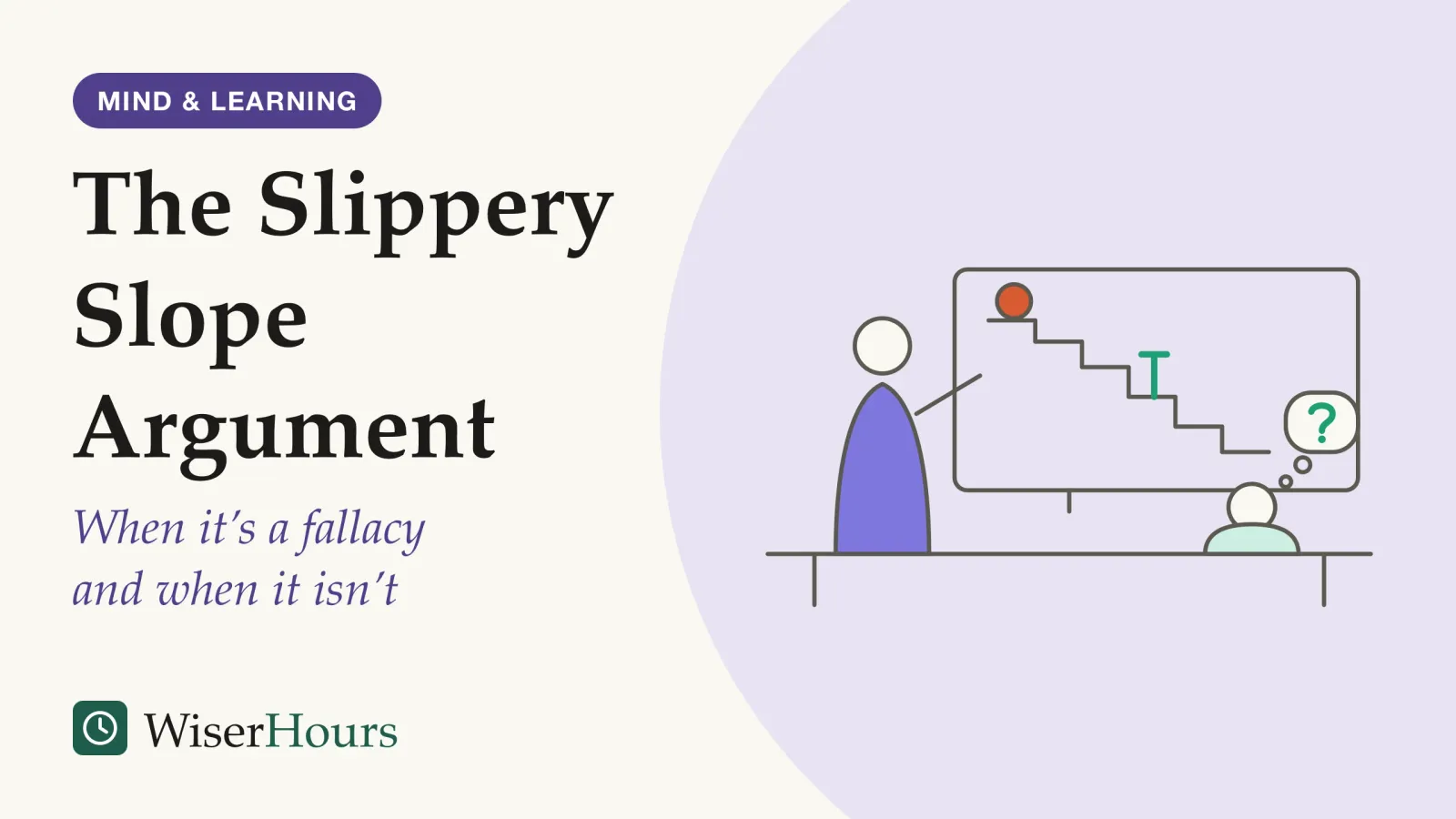
Let Sam leave at four on Fridays, the warning goes, and soon everyone will want to, the office will empty out and client work will slip. That is a slippery slope argument: it rejects a first step because of where a chain of later steps supposedly ends. It becomes a slippery slope fallacy when the chance of that chain has been exaggerated. The Internet Encyclopedia of Philosophy puts the test plainly: the same step-by-step form appears in good arguments and bad ones, and what separates them is how likely each step is.1
That makes the slope a question of arithmetic. Each link in a chain is a separate prediction, and the odds of the whole chain are the odds of every link holding at once. The encyclopedia’s own example shows how fast that shrinks: three links that are each 80 percent likely leave roughly even odds that the chain runs to the end.1 A slope argument earns your attention when someone can show the links, so the most useful reply is to ask for them.
What counts as a slippery slope fallacy?
A slippery slope fallacy claims that a modest first step will lead, through a series of smaller steps, to an outcome everyone wants to avoid, and then rejects the first step on that basis, without good reason to think the steps will follow. The fault lies in the overstated chain. Taking consequences seriously is fine.
In one sentence
A slippery slope fallacy rejects a first step by predicting a chain of further steps that ends badly, when the chain is far less likely than the argument claims.
The Internet Encyclopedia of Philosophy gives a domestic example. A student says he stayed up studying with coffee, and his mother warns that caffeine will soon stop being enough, then come diet pills, then something stronger, and finally a serious drug habit, so he should stop drinking coffee.1 Every link is possible in some life. None is likely enough, and the chain as a whole is very unlikely.
The Stanford Encyclopedia of Philosophy gives a version closer to everyday advice, running from skipping college to no degree, no good job and no enjoyment of life, and locates the weakness in its second and third causal links, the ones a listener waves through.2 The Friday warning in the opening has the same shape: the jump from one person leaving early to an empty office is the link nobody has argued for.
Douglas Walton, a philosopher who worked at the University of Windsor in Canada and wrote a 1992 book on these arguments, warns about the opposite habit too. Students who first learn the fallacy tend to label every warning about bad consequences a slippery slope, and the label alone puts the other person on the defensive.3 Calling “slippery slope” is itself a claim about the chain, and like any other tool for making better decisions, it needs support of its own.
Causal, precedent and conceptual slopes
Slippery slope arguments come in at least three kinds, depending on what is supposed to push you down. Walton’s taxonomy separates causal slopes, where one event brings about the next; precedent slopes, where one decision makes the next harder to refuse; and conceptual slopes, where a vague boundary lets each small step look like no change at all.3 He adds a fourth, a full slope that mixes the other three.
| Kind | What moves you along | The question to ask |
|---|---|---|
| Causal | Each event triggers the next, like the coffee example | How likely is each link, on what evidence?1 |
| Precedent | Treating like cases alike: once one is allowed, the next looks the same | Can the first case be told apart from the later ones?3 |
| Conceptual | A vague word with no sharp edge, such as “heap” or “late” | Where can a clear line be drawn, even an arbitrary one?2 |
The Stanford Encyclopedia of Philosophy illustrates the conceptual kind with a bearded man who loses one hair at a time: because “beard” is vague, no single plucked hair makes him beardless, yet in the end he has none.2 Wikipedia’s article notes that writers disagree on whether such puzzles and causal chains belong under one name at all.4
At work the conceptual kind appears wherever a standard is fuzzy. If arriving 5 minutes late is fine, 6 is hard to object to, then 7. A clear line fixes it, even one whose exact place is somewhat arbitrary, because it gives each next step something to cross.
Is a slippery slope argument always a fallacy?
A slippery slope argument is not always a fallacy. Walton treats it as a form of argument that can be reasonable, with a strength that depends on how well each step holds up.3 On the Internet Encyclopedia of Philosophy’s account, it turns into a fallacy when the chance of the chain is exaggerated.1
- Myth
- Any argument that one step will lead to another is a slippery slope fallacy.
- Fact
- It is a fallacy only when the chain is oversold. Some slopes have well-understood drivers behind each step.
Walton calls these arguments defeasible: they hold tentatively and can be defeated by asking the right questions.3 His example of a reasonable slope is a warning against trying a highly addictive drug: pleasure invites repetition, and once dependence sets in, the person has lost control of the next step. Each link has a known driver.
Eugene Volokh, a law professor at UCLA in the US, goes further in a 2003 Harvard Law Review article. He defines a slippery slope as any case where a decision you might like, call it A, materially raises the chance that others will bring about a decision you oppose, B, and he argues that such slopes are a real cause for concern that cannot simply be dismissed as paranoid.5 His examples come from US law and politics, but the definition fits any setting where one decision changes the conditions for the next.
The study
Limited evidence
How students read a slippery slope argument (UK lab study)
Asked to rate 24 written slope arguments, 45 psychology students at the University of Manchester judged the predicted bad outcome only somewhat more likely if the first step were taken: about 25 on a 0-100 probability scale, against about 18 on its own. Yet they rated the arguments as strongly implying that the first step should be rejected, and the worse the predicted outcome, the stronger that reading.6
A small rise in the odds of a frightening outcome came with a clear message that the first step should be refused. The sample was small and made up of students, so treat it as an early sketch of how these arguments land with listeners. Earlier experiments by the psychologists Adam Corner, Ulrike Hahn and Mike Oaksford found that slope arguments were judged stronger when the start and the end of the slope were more alike, so that both seemed to belong in the same category, according to the paper’s abstract.7 Vivid endings and familiar categories carry weight with listeners for the same reasons other mental shortcuts that misfire as cognitive biases do. When a slope argument feels decisive, separate how bad its ending is from how likely it is, and judge the argument on the second.
Slippery slope vs. causal argument: what’s the difference?
A plain causal argument says A will cause B and offers evidence for that one link. A slippery slope argument says A will lead to B, then C, then D, and asks you to accept the whole chain because the end is bad. Every link in it is its own causal claim, and each needs separate support.4
This is where the arithmetic bites. If each step in a four-step chain is 70 percent likely, the whole chain comes in at about one in four, because the chances multiply. A speaker who talks only about the frightening last step skips that multiplication, and listeners rarely do it in their heads.
A parent told that a first phone means social media, then late nights, then falling grades is hearing three predictions, and the last one depends on both before it. Each may be worth discussing on its own; the chain as a whole is less likely than any single step.
A weak link often rests on two things that tend to go together without one driving the other. The guide to telling correlation from causation covers those questions; for a slope, apply them to each link in turn.
- Is each link likely?: every step is its own claim, and the chances shrink as the steps add up
- Where could it stop?: look for a rule, a review date or a clear line inside the grey middle
- Who takes the next step?: if you or a group you trust decides each step, the slide is not automatic
When the slippery slope worry is justified
Some slopes are real, and the documented ones share a pattern: each step changes the conditions for the next, and nobody is checking the total. Volokh lists several ways this happens, including a first step that lowers the cost of the next, one that shifts what people see as normal, and a series of changes each too small to resist on its own.5
The space shuttle Challenger is a widely studied case. In a 2010 article on how unsafe practices become routine, John Banja of Emory University’s Center for Ethics in the US notes that NASA had known about the booster O-ring failures for at least five years before the 1986 disaster. He describes how deviations from the rules become, with enough repetitions, normal practice that nobody regards as unusual. Drawing on the work of Diane Vaughan, he calls this the normalization of deviance.8 No single decision looked like the step that ended in catastrophe.
Ordinary work has smaller versions. Project managers name one of them scope creep, the continuous or uncontrolled growth in a project’s scope after it starts, which is generally considered harmful, with cost and schedule overruns among the harms.9 A single extra feature is reasonable. The fifth, added without a review, is how a three-month project becomes a year.
Persuasion research gives a third mechanism. The foot-in-the-door technique gets people to agree to a large request by first asking a modest one.10 A 1999 review by the US psychologist Jerry Burger concluded that several processes can be at work after the first yes, from self-perception to a wish to stay consistent, and noted studies in which the technique failed or even lowered compliance.11 A small yes can raise the chance of a bigger one without making it automatic.
All three mechanisms are easier to manage once small changes have a running total: a list of the exceptions granted, features added or favors agreed, reviewed at a fixed date by someone who can say no.
How to test each link in the chain
Testing a slippery slope argument comes down to three questions, drawn from Walton’s critical questions and Volokh’s mechanisms: is each step likely, is there a place where the slide could stop, and who controls the next step? A chain that survives all three deserves a real answer; one that fails them can be set aside.3
1. Is each step likely, on what evidence?
Write the chain out, one step per line, and ask what makes each step follow from the one before. The Internet Encyclopedia of Philosophy says the proper analysis depends on being sensitive to these chances.1 Rough numbers are enough. If you would not bet on two of the links, the chain is weak, however bad its ending.
2. Where could it stop?
Walton calls the stretch where a line is hard to draw the grey zone, and he names one critical question as among the most important: whether a bright line can be placed inside it.3 Law does this all the time, with fixed ages, limits and definitions. At work, a written rule (“Friday early finishes for anyone whose deadlines are met”), a cap or a review date can play the same role.
3. Who takes the next step?
Walton’s scheme includes a loss of control: at some point the person can no longer stop.3 Volokh’s definition turns on what others will do once the first decision is made.5 If you, or people you trust, will decide each step on its merits, the slide is not automatic. If later steps fall to people who want the bad ending, or to habits that harden, take it more seriously.
Four checks for any slope argument
How do you respond to a slippery slope argument?
Respond to a slippery slope argument by asking for its mechanism: which step leads to which, and why. Volokh observes that anyone can shout “slippery slope”, and that listeners then ask why it would happen here when it has not happened elsewhere; an argument that names a concrete path persuades better and is easier for the other side to answer.5
In a meeting, that sounds like “Which step worries you most, and what would make it happen?” The question takes the worry seriously and moves it from the frightening ending to the link where the evidence is. Often it reveals one real concern that a trial period, a written limit or a review date can meet.
Avoid answering with the label alone. Walton’s point that mislabeling unfairly shifts the burden cuts both ways: if the other person has a real driver in mind, “that’s a fallacy” will not make it disappear.3 If you are the one worried about a slope, name the step you fear, the driver behind it, and what would reassure you.
A slope argument can sit beside other weak moves, such as attacking a distorted version of the proposal; if the person is arguing against something nobody suggested, deal with that first.
The bottom line
A slippery slope is an argument about how likely a chain of steps is, and it stands or falls on its weakest link. When someone warns that a first step leads to disaster, write the chain out, ask what drives each step, and look for the rule or review date that would stop the slide. If the links hold, add the safeguard and take the step with your eyes open.
Frequently asked questions
Where does the phrase slippery slope come from?
The metaphor is old. Wikipedia's article on the argument traces it at least to Cicero's essay on friendship, where affairs are said to glide down the path of ruin once they start. The logician Alfred Sidgwick described the same objection in 1910 as the thin end of the wedge, and logic textbooks now usually discuss it as a fallacy.
Is the slippery slope a formal or an informal fallacy?
It is an informal fallacy. The Internet Encyclopedia of Philosophy explains that the same step-by-step form appears in good and bad arguments alike, so the form alone proves nothing. What decides the matter is the content: how likely each step is. That is why you have to check the links rather than the shape.
What is the difference between a slippery slope and the domino effect?
They overlap. The Internet Encyclopedia of Philosophy calls a slope built purely from causes the domino fallacy, and the philosopher T. Edward Damer prefers that name. Douglas Walton draws a line between them: a domino chain runs from cause to cause, while a true slippery slope needs a loss of control, a point where the person can no longer stop.
Can a slippery slope argument be used in a positive way?
Yes. Wikipedia's article notes that the same structure can encourage a first step because it leads somewhere good: start a small savings habit, the argument goes, and larger habits follow. The same test applies. Ask how likely each step is, and what would keep the good chain going once the first step is taken.
Sources
- Fallacies. Dowden, B. Internet Encyclopedia of Philosophy (accessed 2026-10-24)
- Fallacies. Hansen, H. Stanford Encyclopedia of Philosophy (first published 2015, revised 2024)
- The Basic Slippery Slope Argument. Walton, D. (2015). Informal Logic, 35(3), 273-311
- Slippery slope. Wikipedia (accessed 2026-10-24)
- The Mechanisms of the Slippery Slope. Volokh, E. (2003). Harvard Law Review, 116(4), 1026-1137
- Slippery slope arguments imply opposition to change. Haigh, M., Wood, J. S. & Stewart, A. J. (2016). Memory & Cognition, 44(5), 819-836
- The psychological mechanism of the slippery slope argument. Corner, A., Hahn, U. & Oaksford, M. (2011). Journal of Memory and Language, 64(2), 133-152
- The normalization of deviance in healthcare delivery. Banja, J. (2010). Business Horizons, 53(2), 139-148
- Scope creep. Wikipedia (accessed 2026-10-24)
- Foot-in-the-door technique. Wikipedia (accessed 2026-10-24)
- The foot-in-the-door compliance procedure: a multiple-process analysis and review. Burger, J. M. (1999). Personality and Social Psychology Review, 3(4), 303-325
How we researched this
Sources were gathered in October 2026: the Internet Encyclopedia of Philosophy and Stanford Encyclopedia of Philosophy entries on fallacies, Douglas Walton's 2015 paper, Eugene Volokh's 2003 Harvard Law Review article and Wikipedia for the theory; two psychology papers found through Wikipedia and OpenAlex for how people judge these arguments. Main limitation: the psychology rests on a few small lab studies with students, and two sources were read in abstract only.
Keep reading

Loss Aversion: Do Losses Really Loom Larger Than Gains?
Loss aversion makes a loss sting more than an equal gain pleases. Evidence since 1979 says it is real on average, but weak or absent when stakes are small.
Overconfidence Bias: Why We Trust Our Own Judgment More Than We Should
Overconfidence bias has 3 forms. In studies reviewed in 2008, ranges people were 90% sure of held the answer under half the time. What helps.
Hindsight Bias: Why Everything Seems Obvious After the Fact
Hindsight bias makes outcomes look predictable once you know them. Fischhoff's 1975 experiments, its three levels, and the one fix with evidence.
The OODA Loop Explained: Observe, Orient, Decide, Act
The OODA loop's 4 steps in plain words: where John Boyd's model came from, why Orient matters most, and how to use it at work, plus its limits.