Focus Meditation: A 10-Minute Practice for Sharper Concentration
A 10-minute focus meditation, minute by minute, with desk variations and an honest look at what research says it does for concentration.

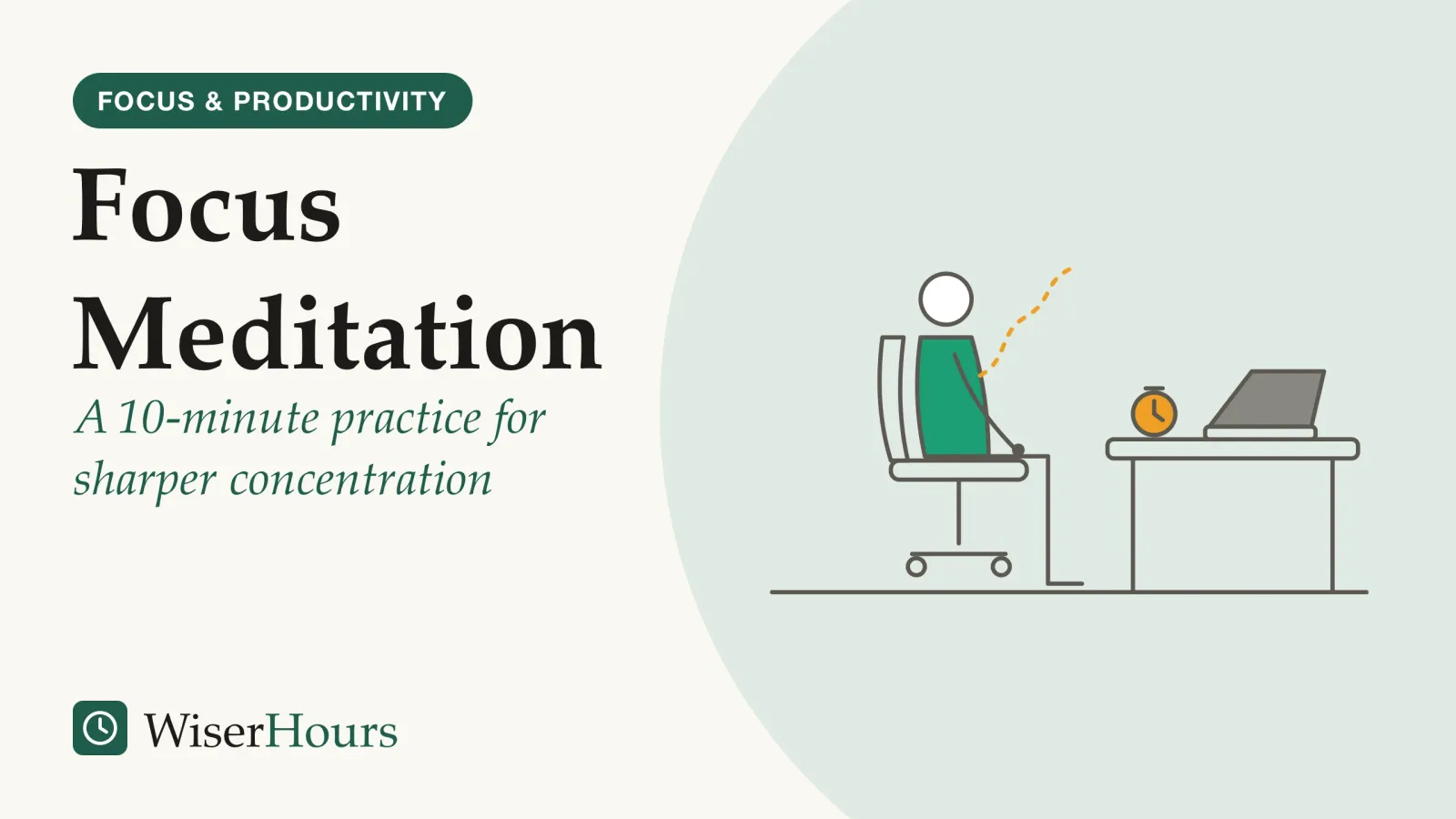
The most useful moment in focus meditation is the one where you realize you have stopped doing it. The practice means resting your attention on one thing, usually the breath, catching it when it slips away, and bringing it back; the catch and the return are the exercise. Antoine Lutz and colleagues, in an influential 2008 review, describe the method as training three skills: spotting a distraction, letting go of it, and steering back.1
What it does for concentration is a more modest story than wellness pages tell. A 2022 University College London meta-analysismeta-analysis: A study that combines the results of earlier studies on the same question into one overall estimate. Pooling makes the estimate more precise, but it cannot repair the studies it pools: a meta-analysis of surveys is still survey evidence.Full entry in the glossary from the UK, which pooled randomized studies, found that mindfulness programs gave thinking skills a small lift overall but no clear gain on attention tests, and no edge over other active activities.2 Brief sessions have helped on some lab tasks straight afterwards.3 That makes the practice a sensible warm-up and a skill worth rehearsing, not a sure upgrade.
The 10-minute practice has four parts:
- Minute 0 to 1: settle in your chair and choose one anchor
- Minutes 1 to 4: find the anchor and stay with one breath at a time
- Minutes 4 to 9: catch the drift, label it and return
- Minutes 9 to 10: close with a check-in and point attention at your next task
What is focus meditation?
Focus meditation, which researchers call focused-attention meditation, means holding attention on a single chosen object and returning to it each time it wanders. In the framework that Lutz and colleagues, led from the University of Wisconsin-Madison in the US, set out in 2008, every return exercises three skills: a background monitor that notices distraction, the ability to disengage from it, and the ability to redirect attention to the object.1
Those three moves are what concentration at work is made of. You are reading a contract when a colleague mentions your project two desks away. Realizing that your eyes are still moving while your mind has left, dropping the conversation and finding your place on the page are the same three moves, made with higher stakes.
The same review offers some comfort to beginners. A novice meets more distractions, so the three skills get used more often, and advanced practitioners become especially quick to spot a wandering mind.1 A session with forty drifts is a session with forty repetitions, so count a busy session as a full workout rather than a failed one.
Focused attention has a sibling, open monitoring, in which you watch thoughts, sounds and feelings come and go without settling on any one of them. The main types of meditation and what each trains compares both families side by side. If your instruction names one object and asks you to come back to it, you are doing focus meditation.
This page covers one technique in depth. The wider routine, from if-then plans to sleep and caffeine, lives in a practical plan for better focus.
A 10-minute focus meditation, minute by minute
The script below is adapted from a free guided breathing practice published by UCLA’s Mindful Awareness Research Center in the US, lengthened to ten minutes and given a working close.4 Its core instructions match those used in lab studies of brief breath focus: sit upright, attend to the breath without controlling it, and return when distracted.3 The timing and the closing check-in are our own suggestions, untested as separate steps.
- 0:00Settle and choose one anchor
- 1:00Find the anchor, one breath at a time
- 4:00Catch, label, return
- 9:00Check in, then name the next task
- 10:00Start work
1. Minute 0 to 1: settle in your chair and choose one anchor
Set a timer for ten minutes so you never need to check the clock. UCLA’s script suggests a back that is upright but not too tight, hands placed wherever feels comfortable, and either a chair or a cushion.4 At a desk the chair is the obvious choice, and resting both feet flat helps you stay still without effort. Then pick one anchor and keep it for the whole session. The breath is the usual choice because it is always with you, but the pressure of your soles against the floor works too.
2. Minutes 1 to 4: find the anchor and stay with one breath at a time
Notice where the breath is clearest: the belly, the chest or the nostrils. Leave it as it is rather than deepening or slowing it. UCLA’s instruction is to feel one breath at a time, and when one ends, the next begins.4 In a 2010 study, Fadel Zeidan and colleagues had beginners start with the sensation of breath at the tip of the nose and later widen to the full breath from nostrils to belly.5 If the anchor feels vague, that small spot at the nose is a good place to begin.
3. Minutes 4 to 9: catch the drift, label it and return
Expect to leave quickly: a few breaths in, you are planning lunch or replaying a meeting. When you notice, say “thinking” or “wandering” silently and return to the anchor, gently rather than with a jolt.4 Do not keep score of the drifts. Each catch is the repetition that matters, so treat it as a small win rather than a slip.
4. Minutes 9 to 10: close with a check-in and point attention at your next task
When the timer sounds, take one breath with your whole body in view, then ask two questions: how settled do I feel, from one to five, and which single task will I open first? Write the answer down. That turns a pleasant pause into the start of a focus block, much as a first deep work session starts with one defined task.
Your 10-minute focus meditation
Does meditation improve concentration?
Brief meditation has lifted scores on some lab attention tests in the short term.3 Across randomized trials, though, mindfulness programs showed no clear gain on attention tests and did not clearly beat other structured activities.2 The pooled evidence looks like this:
The study
Mixed evidence
A small lift for thinking, none clear for attention (UCL-led review, 2022)
Researchers led from University College London in the UK gathered randomized studies of mindfulness-based programs in adults that measured thinking with objective tests: 56 studies with 2,931 participants, the largest share run in North America and most of the rest in Europe and Asia. The programs beat comparison groups by a small margin overall, an effect sizeeffect size: A number saying how big a difference a study found, not just whether it found one. Standardized forms such as Cohen's d and Hedges' g scale it by how much the people studied varied, so results on different measures can be compared and the same value can mean different things in different groups.Full entry in the glossary of 0.15, with gains in executive function and working memory. They did not clearly beat comparison groups on attention tests, and they outperformed inactive comparison groups but not active ones. Most studies had an unclear risk of bias.2
A figure of 0.15 is small: visible on average across a group, hard for one person to notice in an ordinary working day. The programs in this review were also whole courses, not ten minutes of breath focus, so they gave meditation a generous chance to show its reach. The gap against active comparisons matters most for you, because it suggests part of the benefit might stem from doing any structured, attentive activity rather than from meditation in particular.
Other work points the same mixed way. Another meta-analysis, published in 2021 by David Sumantry and Kathleen Stewart, which this guide knows from its abstract, concluded that meditation may improve some, but not all, attention processes, with larger gains on accuracy than on speed.6 The lab gains showed up more as fewer mistakes than as quicker responses.
The brief-training studies are where the enthusiastic claims start. In a 2010 US study run at UNC Charlotte, Zeidan’s team found that students who did four short sessions of breath-focused training scored better on working memory and attention-related tests than students who listened to an audiobook. Groups were assigned by the week people signed up rather than one by one, the final sample was small, and everyone had volunteered because they wanted to learn meditation.5 In a 2012 experiment at UC Santa Barbara, also in the US, students randomly assigned to a few minutes of mindful breathing then showed fewer signs of mind wandering on a computer attention task than students who rested or read a newspaper.3 Both results were measured at the end of the practice, in students, on lab tasks, which puts them in the warm-up column rather than the lasting-change one.
- Myth
- A few days of meditation gives you the focus of a long-term meditator.
- Fact
- Small student studies found lab-test gains after brief practice, but reviews of many trials find small, inconsistent effects on attention.
What should you take from this? A short session before demanding work may help you settle in, and the noticing skill it rehearses is the one you use all day. But a higher score on a ten-minute computer task does not equal a sharper afternoon at your desk, and nobody has shown that a brief daily habit changes concentration at work.
| What it is | What the best evidence found | Evidence |
|---|---|---|
| Mindfulness courses lasting weeks | Small lift to thinking overall, mainly working memory; no clear gain on attention tests; no edge over active comparisons | Meta-analysis of randomized studies, mixed2 |
| Meditation studies scored on attention tasks | Gains in some attention processes but not all; larger on accuracy than on speed | Meta-analysis, abstract read, mixed6 |
| Four 20-minute sessions of breath focus | Better working-memory and attention-related scores than listening to an audiobook | Small student study, groups assigned by sign-up week, limited5 |
| 8 minutes of mindful breathing before a task | Fewer signs of mind wandering on the next computer task than rest or reading | Small randomized lab study, limited3 |
| 13 minutes a day of guided meditation | Better attention scores after 8 weeks, but not after 4, than podcast listening | Randomized trial, abstract read, limited7 |
| Mindfulness programs at work or university | Slightly better task performance than no-treatment groups; no clear difference against active comparisons | Meta-analysis, very low confidence8 |
How long and how often to practice for focus
Nobody has pinned down a dose for focus, but the best hint is that regular practice over weeks seems to matter more than long sessions. A 2019 trial from New York University (US) gave adults new to meditation 13 minutes of guided meditation a day; after 8 weeks, but not after 4, they scored better on attention than a podcast group. The authors suggest this marks a lower limit for how long the practice is needed; it comes from one trial, and this guide relies on its abstract alone.7
In practice, that points to ten minutes you can repeat on most working days rather than a heroic half hour you will drop by Thursday. One way to keep it going is to pair it with a fixed point already in your day, such as opening your laptop in the morning. For broader advice on session length and frequency, see how long a beginner’s meditation sessions should last.
Can you meditate at your desk?
Yes. UCLA’s guided breathing practice works seated in a chair.4 In the 2012 lab experiment, students sat upright for their breathing practice and then went straight on to a computer task.3 The variations below adapt the same loop to office life; they are practical suggestions built on the script above, not separately tested methods.
Fitting the loop into a workday
Before a focus block: do the full script, then open the task you named in the last minute. Between meetings: set the timer for three minutes and do only the noticing and returning. In an open-plan office: keep your eyes open with your gaze resting on the desk, and use your feet on the floor as the anchor if the breath feels conspicuous. Before a video call: sit with the camera off for two minutes, anchor on the breath, then switch the camera on.
If your employer offers a mindfulness program, keep expectations modest. A 2025 review that pooled randomized trials, mostly with employees or students and led from the University of Cambridge in the UK, found slightly better task performance after programs than with no treatment, with no clear difference against active alternatives, and rated its confidence in the results very low.8 Judge such a course by whether it helps you, not by a promise of higher output.
Meditation also does not suit everyone. The UK’s National Health Service says some people find mindfulness does not help them or makes them feel worse.9 A 2020 systematic review reported that adverse effects are not uncommon during or after meditation, and can appear in people with no history of mental health problems.10 If a session leaves you shaken, stop, and read what to do when meditation makes you feel worse before trying again; if the unease lingers for days, mention it to a doctor or therapist.
The bottom line
Every time you catch a drifting mind and bring it back, you rehearse a skill that work asks of you all day, and focus meditation gives you ten minutes of nothing else. Done in your own chair and finished with the name of your next task, it is a cheap warm-up for demanding work. Expect a small, uncertain benefit, and let a two-week trial of your own decide whether it stays.
Frequently asked questions
Is focus meditation the same as mindfulness?
Partly. Focused attention is one of the main styles of practice taught in mindfulness courses. Antoine Lutz and colleagues' 2008 review points out that both focused attention and open monitoring appear in secular programs, including Mindfulness-Based Stress Reduction. A mindfulness course usually contains focus meditation, while focus meditation on its own is one narrow part of what such a course teaches.
What if I cannot stop thinking during focus meditation?
You are not meant to stop thinking. The guided breathing script published by the Mindful Awareness Research Center at UCLA treats a wandering mind as natural rather than a problem: notice it, silently label it thinking or wandering, and go back to the breath. Lutz and colleagues observe that beginners meet more distractions, which simply gives them more practice at the noticing and returning the method trains.
Is it better to meditate just before a focus block or at another time of day?
Nobody has compared times of day for this. The nearest evidence is a 2012 experiment with students at UC Santa Barbara in the US: those who did a short breathing exercise just before a computer attention task showed fewer signs of mind wandering on it. Only the next few minutes were measured, so how long any benefit lasts is unknown.
Sources
- Attention regulation and monitoring in meditation. Lutz, A., Slagter, H. A., Dunne, J. D. & Davidson, R. J. (2008). Trends in Cognitive Sciences, 12(4)
- The Effect of Mindfulness-based Programs on Cognitive Function in Adults: A Systematic Review and Meta-analysis. Whitfield, T., Barnhofer, T., Acabchuk, R. et al. (2022). Neuropsychology Review, 32(3)
- Mindfulness and mind-wandering: Finding convergence through opposing constructs. Mrazek, M. D., Smallwood, J. & Schooler, J. W. (2012). Emotion, 12(3)
- Breathing Meditation (transcript). Winston, D. UCLA Mindful Awareness Research Center (MARC), UCLA Health
- Mindfulness meditation improves cognition: Evidence of brief mental training. Zeidan, F., Johnson, S. K., Diamond, B. J., David, Z. & Goolkasian, P. (2010). Consciousness and Cognition, 19(2)
- Meditation, Mindfulness, and Attention: a Meta-analysis. Sumantry, D. & Stewart, K. E. (2021). Mindfulness, 12(6)
- Brief, daily meditation enhances attention, memory, mood, and emotional regulation in non-experienced meditators. Basso, J. C., McHale, A., Ende, V., Oberlin, D. J. & Suzuki, W. A. (2019). Behavioural Brain Research, 356
- Mindfulness-Based Programmes for Work Performance: A Systematic Review and Meta-Analysis of Randomised Controlled Trials. Vainre, M., Dalgleish, T., Bendriss-Otiko, S. et al. (2025). Stress and Health, 41(6)
- Mindfulness. NHS (UK), page last reviewed 17 August 2026
- Adverse events in meditation practices and meditation-based therapies: a systematic review. Farias, M., Maraldi, E., Wallenkampf, K. C. & Lucchetti, G. (2020). Acta Psychiatrica Scandinavica, 142(5)
How we researched this
We started from the 2008 review that defines focused-attention meditation, then searched Europe PMC, Crossref and publishers' websites during October 2026 for brief-training experiments and meta-analyses on meditation and attention; most were read in full, three only as abstracts. Sources date from 2008 to 2026. The weak spot: most trials are small, rely on students and lab tests, and rarely compare meditation with another active habit.
Keep reading
Best Time of Day to Focus: Finding Your Peak Hours
The best time of day to focus depends on your body clock and your age. How to find your peak hours in 1 to 2 weeks, and why off-peak hours may suit insight.
Why Multitasking Doesn't Work: The Evidence in Plain English
Your brain takes turns on 2 thinking tasks, and each switch costs time. What the research shows, why hands-free doesn't help, and when multitasking is fine.
Deep Work for Beginners: How to Start With Just One Hour a Day
Deep work for beginners in 5 steps: one protected hour a day, a task chosen the night before, an if-then start, alerts off and a closing note on your next move.
Does Listening to Music Help You Focus? What Studies Show
Does music help you focus? On dull tasks it can, but lyrics disrupt reading about as much as speech, a 2018 review of 65 studies found.