How to Increase Your Attention Span: The Five-More Rule and Other Small Stretches
How to increase attention span in 6 small steps: time your baseline, do five more when you want to stop, hide the phone, move on breaks, protect sleep.

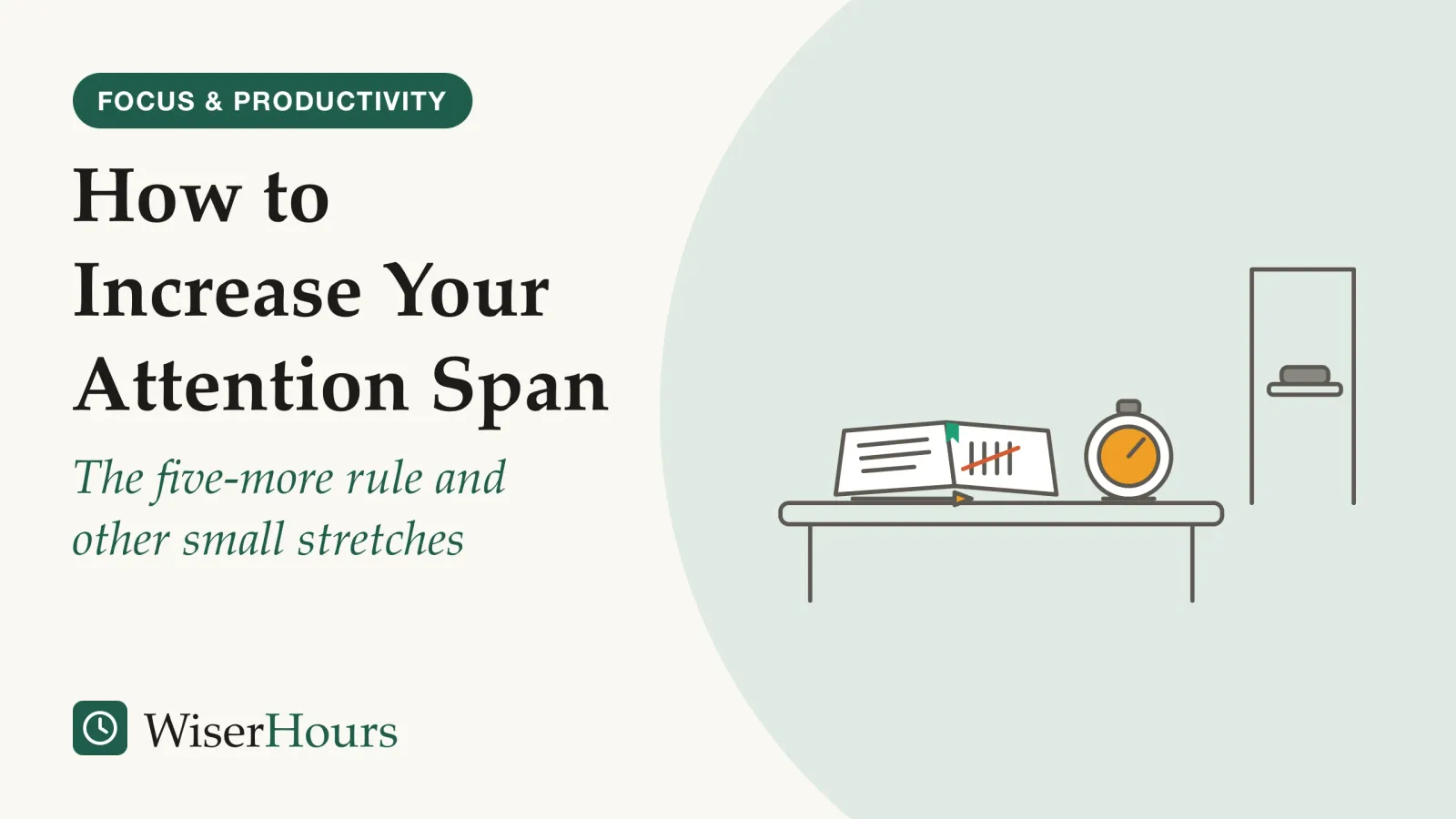
Twelve minutes into a dense contract, a paralegal feels the familiar pull to check the inbox, refill the coffee or open a new tab. Nothing is wrong with the contract. The urge turns up at about the same point every day, and most days she follows it.
How to increase attention span starts with that moment, because it is the part you can practice. There is little evidence that brain games improve everyday thinking, a 2016 review concluded after examining the research that brain-training companies point to.1 What you can change is how you respond to the urge to stop, and the conditions around the task. Six small steps, starting with a timer today:
- Time your current baseline
- Use the five-more rule when you want to stop
- Stretch your blocks a little at a time
- Move your phone out of sight and reach
- Take breaks that get you moving
- Protect sleep and regular exercise
Broader habits, from planning to caffeine, are in our main guide to how to focus.
Why your attention span feels so short
Attention span feels short mostly because of the task and the setting, not because of a fixed limit in you. Speaking to the BBC in 2017, the Open University (UK) psychologist Gemma Briggs called the idea of an “average attention span” close to meaningless, since attention varies with the task.2 Someone who loses the thread of a spreadsheet after ten minutes can follow a long match or a tense meeting without once checking the time.
Long, unchanging tasks are especially hard. A 2008 review of vigilance research by Joel Warm and colleagues concluded that staying alert to a monotonous task is hard mental work and stressful, and that people’s performance on such tasks declines over time.3 So the drift you feel at minute twelve is a normal response to effortful work, something to plan around.
- Myth
- Attention span is a fixed trait: some people have a long one and some a short one.
- Fact
- The same person can focus for minutes on one task and hours on another; the demands of the work, the setting and rest all shift it.
Surroundings add to it. A University of Rochester page with neuroscientist Ian Fiebelkorn explains that attention shifts in brief, regular windows several times a second, which helps people notice danger but also gives every alert and screen a chance to pull them away.4 Kaiser Permanente lists frequent phone notifications, poor sleep and chronic stress among the common reasons people struggle to focus.5
Claims that human attention has collapsed to a few seconds do not hold up, as our look at the claim that attention spans are shrinking shows. Before you decide your brain is the problem, note which task you were on and what was within reach when you drifted.
Can you train your attention span?
You can train the habits around attention, but the evidence that attention itself grows like a muscle is thin. Brain-training games, the best-known attempt to train it directly, fare poorly. A 2016 review led by psychologist Daniel Simons examined the peer-reviewed studies cited by leading brain-training companies and found extensive evidence that people improve on the trained tasks, less on closely related tasks, and little on distant tasks or everyday thinking. Many of the studies also had major weaknesses in design or analysis.1
Meditation fares little better: a 2022 meta-analysismeta-analysis: A study that combines the results of earlier studies on the same question into one overall estimate. Pooling makes the estimate more precise, but it cannot repair the studies it pools: a meta-analysis of surveys is still survey evidence.Full entry in the glossary covered in our 10-minute focus meditation guide found mindfulness programs did not reliably improve scores on attention tests.
That leaves a modest kind of training: practicing a response at the moment you want to stop, and making the setting easier. No trial has combined these six steps, and each borrows from research on a neighbouring question, graded in the table near the end. Treat them as experiments you run on yourself and judge each one by your own timer.
How to increase attention span in six steps
Measure first, stretch in small amounts, then protect the conditions that make stretching possible.
1. Time your current baseline
Pick one kind of task you want to stay with longer, such as reading reports, writing or studying. Start a timer when you begin and stop it the first time you switch away or catch yourself drifting. Do this on three or four ordinary days and note the times.
The number belongs to that task in that setting. A manager who stays 14 minutes on a quarterly sales review but 40 on a planning document has two baselines, and the first is the one worth stretching.
2. Use the five-more rule when you want to stop
The five-more rule is our name for a small stretch: when the urge to stop arrives, do five more minutes, lines or problems, then decide whether to stop. No study has tested this rule; it draws on research about urges and plans.
Urge surfing is a technique from addiction research in which you notice a craving and let it rise and fall without acting on it. In a 2009 University of Washington trial with 123 students who smoked, brief instructions in urge surfing did not reduce the urges themselves, but the students who received them smoked fewer cigarettes over the following week than a control group. (We read the study’s abstract only.)6 Smoking is a different urge from checking your phone, but the result suggests practicing your response, since the urge itself may not shrink. The technique is explained in riding out cravings with urge surfing.
Plans help too. Pooling 642 tests, a 2025 meta-analysis found that plans with an if-then structure (“if situation X comes up, I respond with Y”) help people regulate their thoughts and actions, and the effects grew when people rehearsed their plan.7 “If I want to stop, then I do five more” is a plan of that kind, so say it to yourself once before you start.
Pick the unit that fits the task: lines for writing, problems for maths or code, minutes for reading.
Using the five-more rule
When the pull comes, name it to yourself (“there’s the urge”). Do five more lines, problems or minutes, then carry on or stop on purpose. Mark a tally either way, to see how often the urge passes before the five are up.
3. Stretch your blocks a little at a time
Once the five-more rule feels routine, set a timed block a few minutes longer than your baseline and keep it for a week, then add a few minutes more. A block you can finish teaches you that the urge passes; a block twice your baseline mostly teaches you that you failed.
A student whose baseline on textbook chapters is 15 minutes might work in 20-minute blocks for a week, then 25. No interval has evidence behind it, so choose a step that feels slightly uncomfortable but finishable.
- 1Time your baselineone task, a few ordinary days
- 2Add five morewhen the urge to stop arrives
- 3Set a slightly longer blockkeep it for a week
- 4Review and step upadd a little only when it feels finishable
4. Move your phone out of sight and reach
Phone cues are the cheapest distraction to remove. Cindy Lustig, a cognitive neuroscientist at the University of Michigan, suggests turning off unnecessary notifications and, better still, putting the phone in a different room.8 The University of Rochester page gives similar advice: switch the phone off or move it out of the room, and disconnect from the internet when you work offline.4
Distance helps for a simple reason: if checking means walking to another room, the urge has time to pass first. A shelf in the hall at home, or a zipped bag at the office, adds that delay.
5. Take breaks that get you moving
Kaiser Permanente’s advice on attention span starts with mini breaks to walk around or stretch.5 Breaks that involve doing something, such as a short walk or moving to another room, are what experts quoted by the Associated Press recommend, and passive phone scrolling does not count.8
A 2011 University of Illinois lab experiment (abstract read) hints at why. On a long vigilance task, people who now and then briefly switched to recalling a set of digits avoided the usual decline in performance, which appeared when they recalled the digits only at the end.9
Walks in green places have the best-known evidence, though it is less solid than its reputation.
The study
Limited evidence
A walk in a park before a memory test (Berman, Jonides and Kaplan, 2008)
Students first did a tiring memory task, then took a walk of about 50 to 55 minutes either in a tree-lined park or along busy downtown streets in Ann Arbor, and swapped routes a week later. After the park walk they scored better on a backwards digit-span test, which asks you to repeat numbers in reverse order; after the city walk the change was not reliable.10
Later reviews are more cautious. A 2016 systematic review of 31 studies by a University of Exeter team (UK) found benefits of natural settings on only three of the attention measures it could pool, with no marked effect on the rest, and warned that the studies were few and small.11 A walk outside is a reasonable break with a modest chance of helping concentration.
Short pauses mainly help how you feel. A 2022 meta-analysis of micro-breaks of up to 10 minutes found they raised energy and eased fatigue, while the gain in overall performance was not significant; after very draining tasks, the authors suggest, a longer break may be needed.12 A five-minute walk between chapters is a sensible default.
6. Protect sleep and regular exercise
Pooling 70 articles, a 2010 meta-analysis found that less than 48 hours without sleep hit simple attention hardest, with lapses showing the largest effect of any measure tested; these were studies of short-term total sleep loss, not months of short nights.13 If short nights are the problem, start with practical ways to sleep better, and set a gentler target after a bad night.
A review carried out in part for the advisory committee behind the 2018 US Physical Activity Guidelines judged the evidence strong that one session of moderate or vigorous exercise brings short-lived benefits for thinking afterward.14 A brisk walk before a hard reading session is a sensible way to use that window.
Set up a five-more session
How long does it take to improve attention span?
No study gives a timeline for stretching attention, so expect weeks of practice and judge progress by your own timed baselines. In a UK study of habits published in 2010, 96 volunteers repeated a daily behavior for 12 weeks; individuals needed anywhere between 18 and 254 days before the behavior came close to its own peak level of automaticity, and missing one day did not materially set people back. (We read the abstract.)15
A slow first fortnight is no sign of failure. Re-time your baseline every week or two on the same kind of task; the research is unpacked in our guide to how long habits take to form.
Grading the research behind each step
Each step borrows from research of different strength, and none has been studied as a way to lengthen attention span.
| What it is | What the best evidence found | Evidence |
|---|---|---|
| Brain-training games | Players improve at the practiced games; little sign of everyday benefit | Review of company-cited studies, limited1 |
| Urge surfing (basis of five-more) | Did not reduce urges; fewer cigarettes over a week in students who smoked | One trial, limited (abstract read)6 |
| If-then plans | Helped people regulate thoughts and actions; larger when rehearsed | Meta-analysis, moderate7 |
| Brief task switches | Prevented the usual decline on a long vigilance task | One lab experiment, limited (abstract read)9 |
| Walks in nature | Better backwards digit span after a park walk; mixed in later reviews | Small trial and review, mixed1011 |
| Micro-breaks (10 minutes or under) | More energy and less fatigue; performance gain not significant | Meta-analysis, mixed12 |
| A single exercise session | Short-lived boost to thinking after the session | Umbrella review, strong14 |
Exercise has the strongest evidence but is the least specific to attention span, and the five-more rule has the thinnest. Start with the cheap steps (the timer, the phone, a moving break) and keep the rule if your tallies show the urge passing more often.
When poor focus is worth a doctor’s visit
Persistent trouble focusing can be linked to depression, anxiety or thyroid problems, and less often to ADHD, according to Kaiser Permanente (US).5 We have grouped advice from the NHS (UK), the US National Institute of Mental Health (NIMH) and Cleveland Clinic (US) by urgency (a GP, in NHS wording, is a family doctor).
- Now: sudden confusion in anyone is an emergency, according to the NHS; call your local emergency number (in the UK, 999, or go to A&E), and do not drive yourself.16 If poor focus comes with thoughts of suicide or self-harm, contact your local emergency number or a crisis service straight away; for the US, NIMH lists the 988 Suicide and Crisis Lifeline.17
- Soon: trouble concentrating is one of the depression signs NIMH describes, and it recommends talking with a health professional if such signs last.17 Cleveland Clinic advises telling a provider if fog and trouble paying attention disrupt your daily routine, and lists poor sleep, anxiety, depression and medication side effects among possible causes.18 A doctor or pharmacist can check whether a medicine you take might be playing a part; keep taking a prescribed medicine until you have asked them.
- At your next appointment: ADHD symptoms begin in childhood and usually continue into adulthood, NIMH says, and they often occur alongside sleep problems, anxiety or depression.19 If you have long been easily distracted or forgetful and it affects study, work or relationships, the NHS advises making a GP appointment, where other possible causes can also be considered.20
The bottom line
A longer attention span is more likely to come from practicing a different response at the moment you want to stop, in a setting that makes the urge easier to outlast, than from brain games. Time your current stretch on one task this week, use the five-more rule each time the pull arrives, and move the phone to another room before you begin. If poor focus persists and starts to affect work or study, book a doctor’s appointment.
This article is general information, not medical advice. If you're worried about your health, talk to a doctor or another qualified professional.
Frequently asked questions
What is a normal attention span for an adult?
There is no agreed normal figure. Psychologists measure attention on particular tasks, and the Open University psychologist Gemma Briggs told the BBC in 2017 that a single average figure is close to meaningless, since attention varies with the task. A more useful benchmark is your own: how long you stay with one kind of task today, timed, compared with the same task in a few weeks.
Is a short attention span a sign of ADHD?
Not on its own. Being easily distracted is one sign of ADHD, but the UK's NHS says symptoms usually start before age 12, and a psychiatrist at Kaiser Permanente (US) notes that new attention problems in an adult are unlikely to be ADHD. If distraction has been lifelong and affects work, study or relationships, the NHS suggests seeing a GP or family doctor.
Does meditation increase attention span?
The evidence is mixed. A 2022 meta-analysis of randomized trials of mindfulness programs in adults, covered in our guide to focus meditation, found a small lift in thinking skills overall but no reliable improvement on attention tests themselves. Treat it as an optional extra and judge it, like any step here, against your own timed baseline.
Sources
- Do “brain-training” programs work? Simons, D. J., Boot, W. R., Charness, N., et al. (2016). Psychological Science in the Public Interest, 17(3)
- Busting the attention span myth. Maybin, S. (10 March 2017). BBC News, for BBC World Service's More or Less
- Vigilance requires hard mental work and is stressful. Warm, J. S., Parasuraman, R. & Matthews, G. (2008). Human Factors, 50(3), 433-441
- How to Increase Attention Span. University of Rochester Medical Center (US), Health Matters, with neuroscientist Ian Fiebelkorn (updated March 2026)
- Trouble focusing? Learn how to increase your attention span. Kaiser Permanente (US), health article reviewed by psychiatrist Ashley Zucker, MD (last reviewed 23 July 2026)
- Surfing the urge: Brief mindfulness-based intervention for college student smokers. Bowen, S. & Marlatt, A. (2009). Psychology of Addictive Behaviors, 23(4), 666-671
- The when and how of planning: Meta-analysis of the scope and components of implementation intentions in 642 tests. Sheeran, P., Listrom, O. & Gollwitzer, P. M. (2025). European Review of Social Psychology, 36(1)
- Easily distracted? How to improve your attention span. Shastri, D. & Bargfeld, L. (2025). Associated Press, reposted by the University of Michigan Department of Psychology (2 June 2025)
- Brief and rare mental “breaks” keep you focused: Deactivation and reactivation of task goals preempt vigilance decrements. Ariga, A. & Lleras, A. (2011). Cognition, 118(3), 439-443
- The cognitive benefits of interacting with nature. Berman, M. G., Jonides, J. & Kaplan, S. (2008). Psychological Science, 19(12), 1207-1212
- Attention Restoration Theory: A systematic review of the attention restoration potential of exposure to natural environments. Ohly, H., White, M. P., Wheeler, B. W., et al. (2016). Journal of Toxicology and Environmental Health, Part B, 19(7), 305-343
- “Give me a break!” A systematic review and meta-analysis on the efficacy of micro-breaks for increasing well-being and performance. Albulescu, P., Macsinga, I., Rusu, A., et al. (2022). PLOS ONE, 17(8)
- A meta-analysis of the impact of short-term sleep deprivation on cognitive variables. Lim, J. & Dinges, D. F. (2010). Psychological Bulletin, 136(3)
- Physical activity, cognition, and brain outcomes: A review of the 2018 Physical Activity Guidelines. Erickson, K. I., Hillman, C., Stillman, C. M., et al. (2019). Medicine & Science in Sports & Exercise, 51(6)
- How are habits formed: Modelling habit formation in the real world. Lally, P., van Jaarsveld, C. H. M., Potts, H. W. W. & Wardle, J. (2010). European Journal of Social Psychology, 40(6), 998-1009
- Sudden confusion (delirium). NHS (UK), page last reviewed 28 May 2024
- Depression. National Institute of Mental Health, National Institutes of Health (US), revised 2024
- Brain fog. Cleveland Clinic (US), health library, medically reviewed (last updated 14 May 2024)
- Attention-Deficit/Hyperactivity Disorder (ADHD). National Institute of Mental Health, National Institutes of Health (US), last reviewed August 2026
- ADHD in adults. NHS (UK), page last reviewed 19 March 2025
How we researched this
We searched PubMed, Crossref, OpenAlex and the web in October 2026, read health-system pages from Kaiser Permanente, the University of Rochester and Cleveland Clinic, and NHS and NIMH pages, and preferred reviews and randomized experiments. Sources date from 2008 to 2026; nine were read as abstracts only. Main limitation: no trial has tested a rule like five-more, so the steps rest on related evidence.
Keep reading
Focus Meditation: A 10-Minute Practice for Sharper Concentration
A 10-minute focus meditation, minute by minute, with desk variations and an honest look at what research says it does for concentration.
Ultradian Rhythms: Working With Your Brain's Natural Cycles
Ultradian rhythms repeat many times a day. The 90-minute sleep cycle is well documented; a 90-minute focus cycle while awake is not. How to test your own.
Best Time of Day to Focus: Finding Your Peak Hours
The best time of day to focus depends on your body clock and your age. How to find your peak hours in 1 to 2 weeks, and why off-peak hours may suit insight.
Why Multitasking Doesn't Work: The Evidence in Plain English
Your brain takes turns on 2 thinking tasks, and each switch costs time. What the research shows, why hands-free doesn't help, and when multitasking is fine.