Best Time of Day to Focus: Finding Your Peak Hours
The best time of day to focus depends on your body clock and your age. How to find your peak hours in 1 to 2 weeks, and why off-peak hours may suit insight.

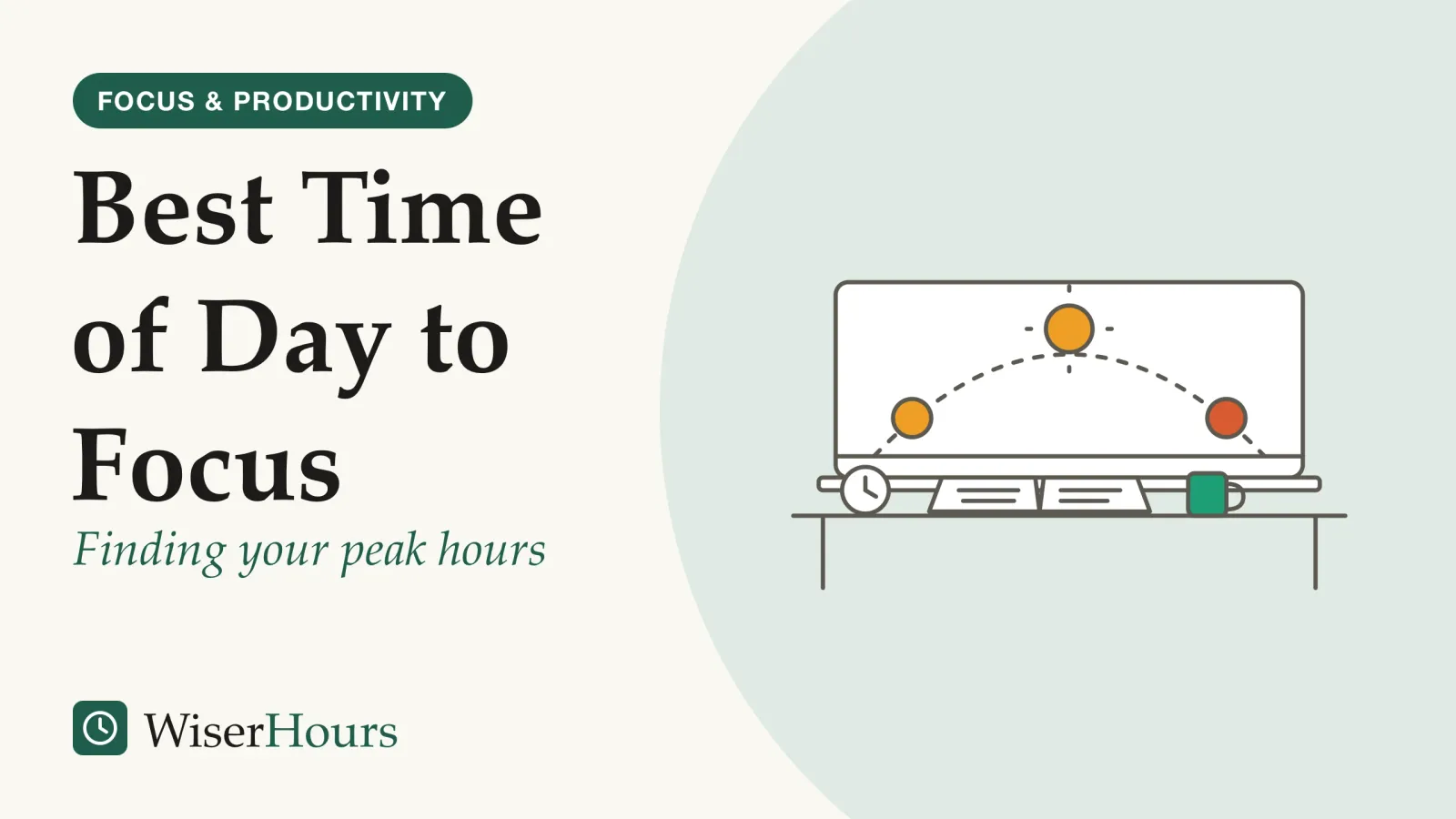
Two analysts open the same budget file first thing in the morning. One is at her sharpest and finds the broken formula in minutes. The other reads the same column again and again and misses it, though by late afternoon she would catch it easily. Neither is lazier; their body clocks keep different hours.
The best time of day to focus on demanding, analytical work is the window when your own alertness peaks: early in the day for morning types, late afternoon or evening for evening types, and somewhere in between for the many people who are neither. Routine, well-practiced tasks change little across the day. Performance on attention and memory tasks is best when the hour matches a person’s chronotype, a 2023 review by Cynthia May, Lynn Hasher and Karl Healey concludes, and the effect is clearest for strong morning or evening types doing effortful, analytical work.1
Finding your own window takes a week or two of noticing:
- Work out the middle of your sleep on days without an alarm.
- Rate your alertness three or four times a workday.
- Put your hardest analytical work into the hours where your ratings run high.
- Give the other hours to routine work and stuck problems.
This page is about timing only. The everyday habits that protect concentration at any hour are in how to focus on the work that matters, and the wider research on attention sits in the focus and concentration section.
Prefer to watch? The video covers the same ground as this article.
Why your attention has a daily rhythm
Attention rises and falls across the day because two forces pull against each other, a 2025 review in the Annual Review of Psychology by Christian Cajochen and Christina Schmidt explains: a pressure to sleep that builds the longer you are awake, and a signal from the body clock that promotes wakefulness and grows through the day to hold that pressure off.2
When the two are in step they roughly balance, which is why most people can get through a normal waking day at all. What is left over is uneven: in lab studies, sleepiness and sustained attention, the ability to keep watching for something that rarely happens, swing the most, while working memoryworking memory: The small mental workspace that holds and handles the information you are using right now, such as a phone number you are about to dial. Its capacity is limited, which is why juggling several things at once quickly overloads it.Full entry in the glossary and other executive tasks swing less.2 An earlier review by Schmidt and colleagues concluded that time of day affects attention, executive function and memory, and that the effect depends on a person’s chronotype.3
A 2019 review by Pablo Valdez of the Autonomous University of Nuevo León in Mexico sketches the shape of an ordinary day. For someone who sleeps from about 11 p.m. to 7 a.m. and is neither a strong morning nor evening type, attention is low for the first few hours after waking, improves towards noon, dips after lunch and is at its best from late afternoon into the evening before falling at night.4
- Low after waking: the body clock is near its low point, and grogginess from sleep adds to it
- Post-lunch dip: a drop in early afternoon that can appear even without lunch
- Best stretch: late afternoon into early evening, for this typical sleeper
The early-afternoon slump is not only about food. Timothy Monk of the University of Pittsburgh describes a post-lunch dip in some people and some tasks that is linked to a rise in sleepiness at that hour, and that can appear even when someone has skipped lunch and does not know the time. A high-carbohydrate lunch makes it worse.5 Beating the slump deserves its own page; for planning, keep your most exacting work out of it.
- Myth
- Everyone's mind is sharpest first thing in the morning.
- Fact
- For a typical sleeper, a 2019 review describes attention as low in the first hours after waking and best from late afternoon into the evening.
The hour on the clock is only half of it; how long you have been working counts too. In Denmark, where the timing of national computer-based tests in public schools depended on class schedules and computer-room availability, children’s scores slipped slightly for each hour later in the school day a test was taken, and a break of 20 to 30 minutes before the test more than made up for an hour’s decline. The authors attribute the decline to mental fatigue building over the school day.6
So plan with two clocks in mind: where you are in your body’s day, and how much effort is already behind you. A hard report late in the afternoon is a different task for someone who started mid-morning than for someone who has sat in meetings since early morning, and a short break before it costs little.
Your chronotype sets your peak: the synchrony effect
The hour that suits careful work depends on whether you are a morning type, an evening type or neither. The 2023 review by May, Hasher and Healey, a narrative reviewnarrative review: A review in which an expert summarizes a body of research in prose, choosing which studies to discuss. It can be a good map of a field, but without a stated search and pooling method it is easier for selection and opinion to shape the conclusions than in a systematic review.Full entry in the glossary by researchers who ran much of this work, names the pattern the synchrony effect: people do best when the task falls at their peak, and worse at their off-peak time.1
The reason, in the authors’ account, is control over distraction. At off-peak hours the mind is less good at suppressing thoughts and cues that are not relevant, so irrelevant information leaks in. People tested off-peak were more easily misled by distracting hints on word puzzles, more swayed by glossy but weak arguments, and more likely to fall back on quick, automatic answers to problems that needed reflection.1
Synchrony matters most when a task is effortful, analytical or full of distraction, and hardly at all for automatic, well-practiced work such as naming familiar colors or finishing a highly predictable sentence. It also matters little for young adults without a strong morning or evening leaning, and the authors estimate that up to half of young adults and a quarter of older adults are such neutral types.1 A 2025 systematic review by independent researchers in the UK and Germany, read in abstract only, found the effect in fewer than half of studies of adults aged 18 to 45 but in most studies of older adults.7
A 2018 study in the UK checked chronotype with biological markers as well as a questionnaire. Researchers at the University of Birmingham compared early and late chronotypes at three times of day, and late chronotypes felt sleepier during the day and did worse in the morning than early chronotypes on every measure, including reaction time and a thinking test.8
Think of a night owl booked into an early-morning contract review. On the synchrony account, the clause she would normally question slides past, and a confident but thin argument sounds better than it is. Moved to late afternoon, the review gets a sharper reader.
Some thinking goes better at your off-peak hour
Puzzles that need a sudden new angle, known as insight problems, may be solved more often when you feel less sharp. A 2011 experiment by Mareike Wieth of Albion College and Rose Zacks of Michigan State University found that students solved more insight puzzles at their non-optimal time of day, while step-by-step problems showed no clear difference.9
The study
Limited evidence
Wieth and Zacks (2011): insight came easier off-peak
Each student was randomly given a session between 8:30 and 9:30 a.m. or between 4 and 5:30 p.m., with four minutes per problem. Those working at their non-optimal time solved about 42 percent of the insight problems, against 33 percent at their optimal time. On the analytic problems there was no clear difference. Most of the sample were evening types.9
The authors’ explanation runs through the same mechanism as the synchrony effect. Insight problems need you to drop your first reading of the problem and try another, and a mind that filters distraction less tightly lets more remote ideas in. With only six puzzles, which the authors concede differed in difficulty, the result is a lead rather than a rule.9 A 2017 study of 72 students in Hungary, who picked their own session times, found a similar edge on word-association puzzles only for evening types, and none for open-ended idea generation.10
In practice that suggests a split. Someone stuck on how to fit three projects into one budget might return to it in a slow afternoon, then check the answer the next morning at their peak, when distractions and weak arguments get filtered out. An off-peak mind is a poor editor but not always a poor source of ideas.
How to find your best time of day to focus
No study has checked whether the steps below improve work output; each borrows the way researchers measure chronotype and alertness, and together they take a week or two.
1. Work out the middle of your sleep on free days
Take a few days without an alarm, note when you fall asleep and when you wake naturally, and find the midpoint. That is the measure behind the Munich ChronoType Questionnaire run by Till Roenneberg’s group. On free days, the researchers explain, sleep timing reflects the body clock more closely than on alarm-driven workdays, and they correct the figure for people who sleep in to repay sleep lost during the week. The earlier the midpoint, the earlier your chronotype.11
For example, asleep at 1 a.m. and awake without an alarm at 9 a.m. puts your midpoint at 5 a.m. A colleague asleep at 11 p.m. and awake at 7 a.m. has a midpoint of 3 a.m., two hours earlier, so her best window will tend to arrive earlier in the day as well.
2. Rate your alertness a few times a day
Three or four times a workday, rate how alert you feel on a simple scale and jot down the hour. In the lab studies Cajochen and Schmidt review, ratings of sleepiness showed some of the largest daily swings of anything measured, alongside sustained attention, so a quick rating is a fair guide to where your curve sits.2 After a week or two, look for the stretch where your ratings are reliably high. If they barely move, you may be a neutral type for whom the hour matters little; then breaks and time on task deserve more of your attention.

3. Put your hardest analytical work into that window
Use the window for work that needs judgment, checking or resistance to distraction, the kinds of task where the synchrony effect is strongest.1 Protect it on the calendar the way you would a meeting; time blocking your workday explains how.
4. Give the rest of the day to routine work and stuck problems
Well-practiced, routine work such as email triage or filing leans on the kind of automatic processing the May review found changes little across the day, so it can take the slower hours.1 A problem that needs a fresh angle may even suit them, going by the insight experiment.9 If every hour feels like an off-peak hour, sleep is worth looking at first, and the sleep and rest section is the place to start.
Plan a week around your peak
Download PDF
Your peak drifts later in your teens and earlier after 20
Chronotype is not fixed for life: it grows later through adolescence and earlier again through adulthood. Till Roenneberg and colleagues, reviewing in 2019 the nearly 300,000 entries their online questionnaire collected worldwide, report that chronotype gets later from about age ten to the end of adolescence, around 20, and then gets earlier until the end of life.11
The same curve shows up in a nationally representative US sample. Using American Time Use Survey diaries from more than 50,000 Americans, Dorothee Fischer and colleagues found chronotype shifted later through the teens, was latest at about age 19 and shifted earlier after that. Men were typically later than women before 40.12 The May review adds that most people over 60 lean toward mornings, while many college students lean toward evenings.1
On a mixed-age team, the early meeting that suits a manager in her fifties may land at the low point of the day for an analyst in his early twenties. If you plan a team’s week, keep the earliest and latest slots for routine items where you can, and rerun your own alertness check every few years.
Which timing findings are solid, and which rest on one study
The daily rhythm in attention is well established in the lab; how much it changes real work output is much less measured.
| What it is | What the best evidence found | Evidence |
|---|---|---|
| Daily rhythm in attention | Sustained attention and sleepiness swing most across the day; working memory and executive tasks swing less | Review of lab studies, moderate2 |
| Synchrony effect | Best performance at hours matching your chronotype, mainly for effortful or distracting tasks | Narrative review by the researchers involved, moderate; a 2025 systematic review is mixed for adults aged 18 to 451 7 |
| Neutral types | Time of day matters little for young adults without a strong morning or evening leaning | Narrative review, limited1 |
| Chronotype and age | Later through the teens, latest around 20, earlier afterwards | Large questionnaire and diary surveys, observational, moderate11 12 |
| Post-lunch dip | A mid-afternoon drop in some people and tasks, even without lunch | Review, read as abstract only, limited5 |
| Insight problems off-peak | More insight puzzles solved at the non-optimal time; no clear difference on analytic problems | One randomized experiment and a small follow-up, limited9 10 |
| Later tests in Danish schools | Slightly lower scores later in the day; a break before the test more than made up for it | Natural experiment, national data, moderate6 |
Off-peak problem solving rests on one experiment and a small follow-up, so test it on yourself before relying on it.
The bottom line
Match the hour to the task. Your best window for analytical work is the one that fits your body clock, and it moves with age. Find it from your free-day sleep and a week or two of alertness ratings, guard it for work that needs judgment, and give routine tasks, and perhaps a problem you are stuck on, to the hours when you feel less sharp.
Frequently asked questions
Can you change your chronotype?
Partly. Till Roenneberg and colleagues, reviewing data from their Munich ChronoType Questionnaire in 2019, name three likely sources of the wide spread in chronotype: genetics, light exposure and age. Light is the part you influence: a 2025 review by Christian Cajochen and Christina Schmidt notes that evening light tends to shift the body clock later and morning light earlier. Age shifts it too, whatever you do.
Why do teenagers find early mornings so hard?
Their body clocks run late. A 2023 review by Cynthia May, Lynn Hasher and Karl Healey reports a shift toward eveningness at the onset of puberty, found in countries from Japan and Taiwan to Germany, Spain and the United States. Evening-type teenagers tend to get lower grades, and school experiments in Argentina and elsewhere found that their disadvantage shrank or reversed when lessons or tests came later in the day.
Do physical tasks have the same peak hours as mental ones?
In one small UK study, they followed a similar pattern. In 2018 Elise Facer-Childs and her University of Birmingham team tested 56 healthy adults at three times of day. Late chronotypes were worse than early chronotypes in the morning on every measure, including sleepiness, reaction time, a thinking test and grip strength. With so few people and one site, read it as a lead worth testing, not a rule.
Sources
- For Whom (and When) the Time Bell Tolls: Chronotypes and the Synchrony Effect. May, C. P., Hasher, L. & Healey, K. (2023). Perspectives on Psychological Science, 18(6), 1520-1536
- The Circadian Brain and Cognition. Cajochen, C. & Schmidt, C. (2025). Annual Review of Psychology, 76, 115-141
- A time to think: Circadian rhythms in human cognition. Schmidt, C., Collette, F., Cajochen, C. & Peigneux, P. (2007). Cognitive Neuropsychology, 24(7), 755-789
- Circadian Rhythms in Attention. Valdez, P. (2019). Yale Journal of Biology and Medicine, 92(1), 81-92
- The Post-Lunch Dip in Performance. Monk, T. H. (2005). Clinics in Sports Medicine, 24(2), e15-e23
- Cognitive fatigue influences students' performance on standardized tests. Sievertsen, H. H., Gino, F. & Piovesan, M. (2016). Proceedings of the National Academy of Sciences, 113(10), 2621-2624
- Chronotype and synchrony effects in human cognitive performance: A systematic review. Chauhan, S., Vanova, M., Tailor, U., Asad, M., Faßbender, K., Norbury, R., Ettinger, U. & Kumari, V. (2025). Chronobiology International, 42(4), 463-499
- The effects of time of day and chronotype on cognitive and physical performance in healthy volunteers. Facer-Childs, E. R., Boiling, S. & Balanos, G. M. (2018). Sports Medicine - Open, 4, 47
- Time of day effects on problem solving: When the non-optimal is optimal. Wieth, M. B. & Zacks, R. T. (2011). Thinking & Reasoning, 17(4), 387-401
- Differential influence of asynchrony in early and late chronotypes on convergent thinking. Simor, P. & Polner, B. (2017). Chronobiology International, 34(1), 118-128
- Chronotype and Social Jetlag: A (Self-) Critical Review. Roenneberg, T., Pilz, L. K., Zerbini, G. & Winnebeck, E. C. (2019). Biology, 8(3), 54
- Chronotypes in the US: Influence of age and sex. Fischer, D., Lombardi, D. A., Marucci-Wellman, H. & Roenneberg, T. (2017). PLOS ONE, 12(6), e0178782
How we researched this
We searched OpenAlex, Crossref, Europe PMC and PubMed in September 2026 for reviews and experiments on time-of-day effects on attention, chronotype and the post-lunch dip, preferring recent reviews and studies with random assignment to testing times. Sources date from 2005 to 2025. Three were read as abstracts only, and nothing beyond their abstracts is used. Main limitation: most studies test students in labs for an hour or two, so effects on a full working week are largely unmeasured.
Keep reading
Ultradian Rhythms: Working With Your Brain's Natural Cycles
Ultradian rhythms repeat many times a day. The 90-minute sleep cycle is well documented; a 90-minute focus cycle while awake is not. How to test your own.
Monk Mode: What It Is and Whether It Helps You Focus
Monk mode has no research of its own. Nearby studies back its focus parts and warn against cutting out people. Includes a 2-week plan that keeps friends.
How to Increase Your Attention Span: The Five-More Rule and Other Small Stretches
How to increase attention span in 6 small steps: time your baseline, do five more when you want to stop, hide the phone, move on breaks, protect sleep.
Focus Meditation: A 10-Minute Practice for Sharper Concentration
A 10-minute focus meditation, minute by minute, with desk variations and an honest look at what research says it does for concentration.