The Feynman Technique: Learn a Topic by Explaining It in Plain Words
The Feynman technique in 4 steps: explain a topic aloud in plain words, find where you stall, then fix it. What research on learning by explaining supports.

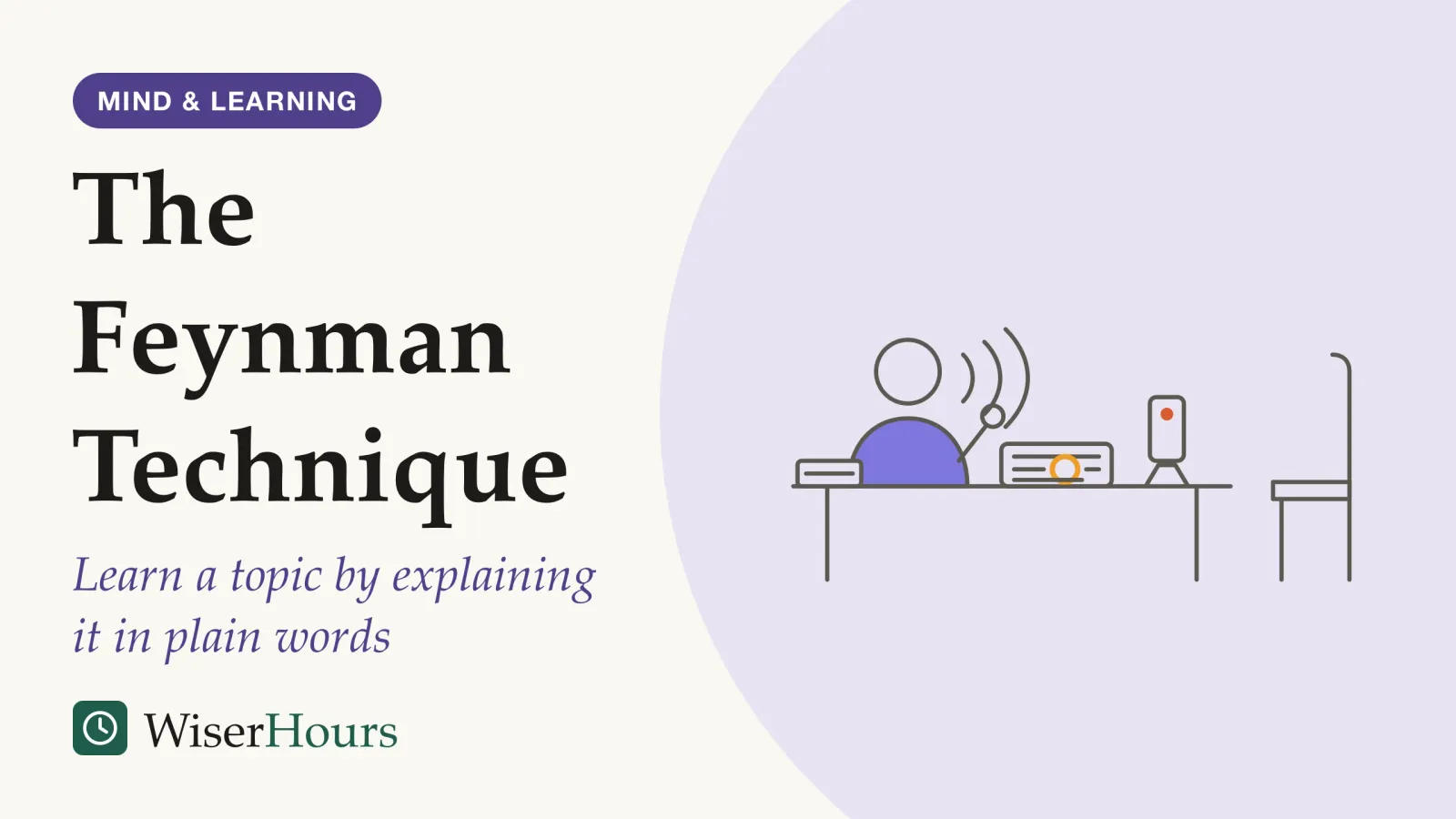
Richard Feynman, the Caltech physicist, once promised his colleague David Goodstein a lecture for first-year students on a subtle point of quantum physics: why particles of a certain spin obey Fermi-Dirac statistics. A few days later he came back and admitted he could not do it. For Feynman, Goodstein wrote in 1989, failing to bring an idea down to that level meant nobody really understood it yet.1
The Feynman technique turns that standard into a study method: you learn a topic by explaining it aloud in plain words, as if to someone who knows nothing about it, and treat every place where your explanation stalls as the next thing to study. A 2022 review by Andreas Lachner and colleagues suggested, from limited evidence, that explaining to an imagined learner works best when you explain aloud and from memory, after studying with teaching in mind, and then return to the material.2 That gives four steps:
- Study the topic as if you will teach it
- Explain it aloud, from memory, to an imagined beginner
- Mark where you stalled and go back to the source
- Explain it again, more simply, with your own example
What the Feynman technique is, and what Feynman actually said
The Feynman technique is a four-step study method named after Richard Feynman, the Nobel laureate known for explaining physics plainly, but it is a later recipe rather than something he wrote down. We found no text by Feynman that sets out the steps. What the record shows is the standard behind them, in Goodstein’s account of the lecture Feynman could not write.1
I couldn’t reduce it to the freshman level. That means we really don’t understand it.
The recipe circulates in slightly different versions. In the one described by Englevert Reyes and colleagues in a 2021 paper, you write down what you know about a topic, explain it simply as if teaching a child, look for gaps in your understanding or your explanation, and then simplify further or reach for an analogy, repeating the last three steps as often as you need.3
The idea overlaps with two lines of research. Self-explanation means explaining material to yourself while you study; it gets a short treatment, and a moderate rating, among the six habits in learning how to learn. Learning by teaching means explaining material to someone else, and it is the closer match, because the Feynman technique always imagines a listener. That research is where most of the evidence in this article comes from.
- 1Studyas if you will have to teach it
- 2Explain aloudfrom memory, in plain words, to a beginner
- 3Find the gapsgo back to the source for those parts
- 4Explain againsimpler, with an example of your own
Then repeat from “Study”
What Feynman’s standard asks for is an explanation that says what causes what. “The cache speeds the app up” names a part; “the app keeps a copy of recent results close by, so it does not have to fetch them again” explains it. So don’t follow any version of the recipe to the letter: judge each attempt by whether every step says why the next one follows. The evidence behind the steps below is decent for the parts and thin for the package.
Why explaining shows you what you don’t know
Explaining exposes gaps because people routinely overestimate how well they understand how things work, and the overestimate shows only when they have to produce the explanation step by step. Leonid Rozenblit and Frank Keil of Yale University named this the illusion of explanatory depth in a 2002 series of experiments.4
In their first studies, graduate and undergraduate students rated how well they understood everyday devices such as a zipper, a flush toilet and a cylinder lock, then wrote a detailed, step-by-step explanation of how each one works. Their ratings of their own understanding fell once they had tried, and many were surprised at how little they could explain. The illusion was far stronger for how things work than for facts such as capital cities, for procedures or for the plots of films, and it was strongest for things with visible mechanisms. The authors’ explanation: seeing the working parts of something gives a false sense of knowing how they interact.4
Only when you have to say what causes what, in order, do the missing links surface. The same thing happens at work. Picture a new team lead who has sat through the company’s budget approval twice and feels sure they understand it. Asked to walk a new hire through it, they can name every stage but cannot say why a request sits for weeks between finance and the department head. Rereading the slides from the last round would never have shown them that gap. Explaining did.
The practical lesson is where to aim the technique. It earns its keep on how and why questions, such as how a process works or why a result holds, because that is where the gap between feeling and knowing is widest. For facts and routines, a quick self-test is a cheaper check.
Does explaining a topic help you learn it?
Explaining a topic often helps you learn it, but not reliably. A 2022 review by Andreas Lachner and three colleagues of experiments on explaining to an absent or imagined learner found that the benefit depends on how and when you explain, and some studies found none at all.2
The study
Mixed evidence
Lachner, Hoogerheide, van Gog and Renkl (2022), Educational Psychology Review
In the studies reviewed, students studied a text or lesson and then explained it, usually aloud and recorded, to a fictitious fellow student who knew little about the topic. Several studies found better learning than restudying the material, but others found no benefit, and a few found worse results on some measures. The reviewers’ practical advice, based on what they call limited evidence: explain aloud rather than in writing, from memory rather than with the material in view, after studying with the expectation of teaching, and then study the material again.2
So the Feynman technique’s instinct holds up, but the details decide whether it pays off. Keep the setting in mind too: these were brief sessions, mostly with science and technology material, and the reviewers say it is unclear whether the findings carry over to other subjects or to real teaching.2
Two further studies point the same way, and the second suggests why. A 2019 meta-analysismeta-analysis: A study that combines the results of earlier studies on the same question into one overall estimate. Pooling makes the estimate more precise, but it cannot repair the studies it pools: a meta-analysis of surveys is still survey evidence.Full entry in the glossary by Keiichi Kobayashi, pooling 28 studies, found that preparing to teach and then teaching improved learning, even after a delay, and more so when the teaching was interactive.5 In a 2018 experiment at the National University of Singapore, learners who taught the material without notes did better on a comprehension test a week later than learners who taught it with notes, and the researchers suggested that retrieval, pulling the material out of memory, may explain teaching’s benefit.6
Recalling has repeatedly been shown to beat restudying as a way to learn, as Kobayashi’s 2022 review of the teaching studies notes, though it calls the evidence that retrieval explains teaching’s benefit inadequate so far.7 Either way, that is the case for explaining with the book closed.
Picture two colleagues preparing to present a new travel policy. One rereads it twice and feels ready. The other explains it aloud to an empty meeting room, stalls on what happens when a trip is cancelled, and rereads that clause. Same time spent; only the second found the gap.
The named technique itself has had only a few small direct tests that we could find, mostly in schools. In one, a 2021 study by Reyes and colleagues set in English lessons at two schools in the Philippines, pupils randomly assigned to use it scored higher afterwards than classmates taught the usual way. But the classes were small, the researchers ran the sessions themselves, and it is one study.3
What this means for you: close the book before you explain, say it out loud, and plan to reread afterwards. An explanation read off your notes is closer to rereading than to learning.
Further reading
The Knowledge Illusion: Why We Never Think Alone
Two cognitive scientists build on the illusion of explanatory depth: why we feel we understand things far better than we can explain them.
As an Amazon Associate WiserHours earns from qualifying purchases.
How to use the Feynman technique, step by step
Run the four steps on one narrow idea at a time, the kind you could explain in a few minutes: how a process works or why a result holds.
1. Study the topic as if you will teach it
Read or watch the material knowing you will have to explain it afterwards. In Kobayashi’s meta-analysis, simply expecting to teach helped learning, before any teaching happened.5 Lachner’s review lists studying with that expectation among its four recommendations.2
Pick a small target. “How our invoice approval works” is a topic; “finance” is not. Mechanisms and causes make the best targets, because that is where Rozenblit and Keil found people most overrate what they know.4
2. Explain it aloud, from memory, to an imagined beginner
Close the material and explain the idea out loud, as if to a bright newcomer with no background: a new hire, a friend from another field, a teenager. Recording a voice memo keeps you honest. In Lachner’s review, spoken explanations tended to help more than written ones, and in one study writing an explanation did no better than restudying.2
Keep the notes shut for the whole explanation: reading from them skips the recall that may do part of the work.
Plain words are the point of the exercise, not decoration. A technical term can stand in for an idea you have not actually understood, and everyday language forces you to spell out the link the term hides. That is our reading of why the recipe insists on simple language; no study we found tested plain wording on its own.
3. Mark where you stalled and go back to the source
Listen back, or think back, and note every point where you hesitated, reached for a term you could not unpack, or jumped from one step to the next without saying why. Those are the gaps. Then reopen the material for those parts only.
Going back matters because an imagined listener, unlike a real one, cannot point out inconsistencies or ask a question. Restudying after explaining is one of the four recommendations in Lachner’s review for exactly this kind of solo explaining.2
- Explain from memory: aloud, in plain words, each step of how or why it works
- Find the break: where you stall or reach for jargon is what you do not yet understand
- Back to the source: reread only the part that broke, then close the book again
- Explain it again: simpler, with an example of your own attached
4. Explain it again, more simply, with your own example
Explain the idea again from memory, filling the gaps, and attach an example or analogy of your own. Students whose explanations contained more elaborations, meaning examples, analogies and inferences that go beyond the material, tended to learn more, Kobayashi’s 2022 review notes.7 That is a correlationcorrelation: A measure of how closely two things move together, running from minus one, where one rises as the other falls, through zero, meaning no link, to plus one. It says how strong the relationship is, not what causes it, and it is not a percentage.Full entry in the glossary: it shows what good explanations look like rather than proving that adding examples causes learning.
Here is the loop in practice. A developer explains how the team’s code reaches production: “you push it, the pipeline runs, and it deploys.” The stall is the pipeline. After rereading the documentation, the second attempt reads: “every change runs automatic tests, a bit like a spell-checker for code, and if one fails, nothing ships until someone fixes it.” The example is what makes the step stick.
One round of explaining, start to finish
When the Feynman technique is the wrong tool
The Feynman technique suits complex concepts and mechanisms you have already studied. It is a weaker fit for basic concepts, routine procedures and topics you are meeting for the first time: Lachner’s 2022 review judged it less useful for basic knowledge and procedures, where it did not hurt but the lack of clear gains has to be weighed against the extra effort.2
It also needs something to work with. In studies with learners who knew too little, explaining did no better, or worse, than restudying or simple recall, which the reviewers put down to having too little to build an explanation from.2 For a new subject, study first and bring in explaining once the basic ideas are in place. For facts you simply need to remember, testing yourself and spacing your reviews over days, the two habits the learning-how-to-learn guide ranks first, are the better-tested tools.
Take a new analyst in their first week. Memorizing product codes and the steps of the expense system are jobs for self-testing, not for explaining. A month later, why one region’s orders take longer to ship is a how-and-why question worth talking through out loud, because by then there is something to build the explanation from.
If the honest answer is “only the parts,” the technique is worth the effort. Here is how each part of the recipe stands on the evidence:
| Part of the recipe | What the best evidence found | Evidence |
|---|---|---|
| Explaining to find gaps | Trying to explain how devices work lowered people’s ratings of their own understanding, much less so for facts, procedures and stories | Lab experiments with students, moderate4 |
| Explaining to an imagined beginner | Sometimes better than restudying; other studies found no benefit or worse results | Review of lab experiments, mixed2 |
| Preparing to teach, then teaching | Helped learning even before any teaching took place, and more when the teaching was interactive | Meta-analysis, moderate; abstract only5 |
| Explaining from memory | Teaching without notes beat teaching with notes a week later | One lab experiment, limited; abstract only6 |
| Aloud rather than in writing | Spoken explanations tended to help more than written ones | A few experiments, limited2 |
| The four-step technique as named | In one small trial, pupils using it scored higher than a comparison group; other direct tests are few | School studies, limited3 |
The bottom line
Explaining a topic in plain words is a good test of whether you understand it, and, done from memory and followed by a return to the source, a reasonable way to learn it better. Save it for how and why questions you have already studied, say your explanation out loud, and treat the stalls as your reading list. The name is Feynman’s, but the evidence comes from studies of explaining and teaching, mostly with students, far more than from tests of the recipe itself.
Frequently asked questions
Do you need a real person to explain to?
No, but a real listener may help more. In a 2019 meta-analysis, Keiichi Kobayashi found that preparing to teach and then teaching improved learning, and that the benefit was larger when students expected and took part in interactive teaching, with someone who could respond, than when they taught without interaction. An imagined beginner often helps; a colleague who asks questions may help more.
How long should a Feynman-style explanation take?
A few minutes per idea is enough to start. In the experiments reviewed by Andreas Lachner and colleagues in 2022, students usually gave a short recorded explanation; in one example instruction, from a 2014 study, it was a lecture of up to 5 minutes, as if teaching someone with no prior knowledge. No study we found compared different lengths, so stop when you reach the end of the idea or hit a gap.
Does the Feynman technique work for children?
There are only a few small tests. In one, a 2021 study of English lessons at two public schools in the Philippines, pupils in grades 4, 7 and 11 who were randomly assigned to use the technique improved more than classmates taught as usual. The classes were small and the researchers ran the sessions, so treat it as a promising start, not proof. Most research on learning by explaining involves university students.
Is there evidence for using it at work or outside science subjects?
Very little. The 2022 review by Andreas Lachner and colleagues notes that most studies of explaining to an imagined learner were short laboratory sessions using science and technology texts, and that it is unclear whether the findings hold in other subjects or in real teaching. The ideas behind it, recalling and finding gaps, are general, but direct evidence for working adults is missing.
Sources
- Richard P. Feynman, Teacher (excerpt reprinted in Feynman at 100, Caltech Magazine, Summer 2018). Goodstein, D. L. (1989). Physics Today, 42(2), 70-75, doi:10.1063/1.881195; excerpt in Caltech Magazine (2018)
- Learning-by-Teaching Without Audience Presence or Interaction: When and Why Does it Work? Lachner, A., Hoogerheide, V., van Gog, T. & Renkl, A. (2022). Educational Psychology Review, 34(2), 575-607
- Feynman Technique as a Heutagogical Learning Strategy for Independent and Remote Learning. Reyes, E. P., Blanco, R. M. F. L., Doroon, D. R. L., Limana, J. L. B. & Torcende, A. M. A. (2021). Recoletos Multidisciplinary Research Journal, 9(2), 1-13
- The misunderstood limits of folk science: an illusion of explanatory depth. Rozenblit, L. & Keil, F. (2002). Cognitive Science, 26(5), 521-562
- Learning by Preparing-to-Teach and Teaching: A Meta-Analysis. Kobayashi, K. (2019). Japanese Psychological Research, 61(3), 192-203
- The learning benefits of teaching: A retrieval practice hypothesis. Koh, A. W. L., Lee, S. C. & Lim, S. W. H. (2018). Applied Cognitive Psychology, 32(3), 401-410
- The Retrieval Practice Hypothesis in Research on Learning by Teaching: Current Status and Challenges. Kobayashi, K. (2022). Frontiers in Psychology, 13, 842668
How we researched this
We searched Google Scholar, PubMed, Crossref and publishers' sites in September 2026 for studies of the Feynman technique and for experiments and reviews on learning by explaining or teaching, preferred the most recent review, and read the full text wherever it was open. Sources date from 1989 to 2022. Main limitations: the named technique has had only a few small direct tests, mostly in schools, and two studies were read in abstract only.
Keep reading
The 10,000-Hour Rule: What the Original Research Really Found
The 10,000-hour rule began as an average from one 1993 violin study. Later research finds practice matters but explains far less than the rule implies.
Test Anxiety: Why Your Mind Goes Blank and What Helps
On average across OECD countries, 55% of 15-year-olds in PISA 2015 felt very anxious before tests even when prepared. Why minds go blank, and what helps.
How to Learn a Language as an Adult: What the Research Supports
Adults can learn a language well, but slowly: US government trainees study 24 to 88 weeks full-time. Five research-backed steps, and what apps can do.
Learning Styles Are a Myth: What the Research Actually Shows
Nearly 9 in 10 educators surveyed believe matching teaching to a learning style helps. The few experiments designed to test that claim found no benefit.