The 10,000-Hour Rule: What the Original Research Really Found
The 10,000-hour rule began as an average from one 1993 violin study. Later research finds practice matters but explains far less than the rule implies.

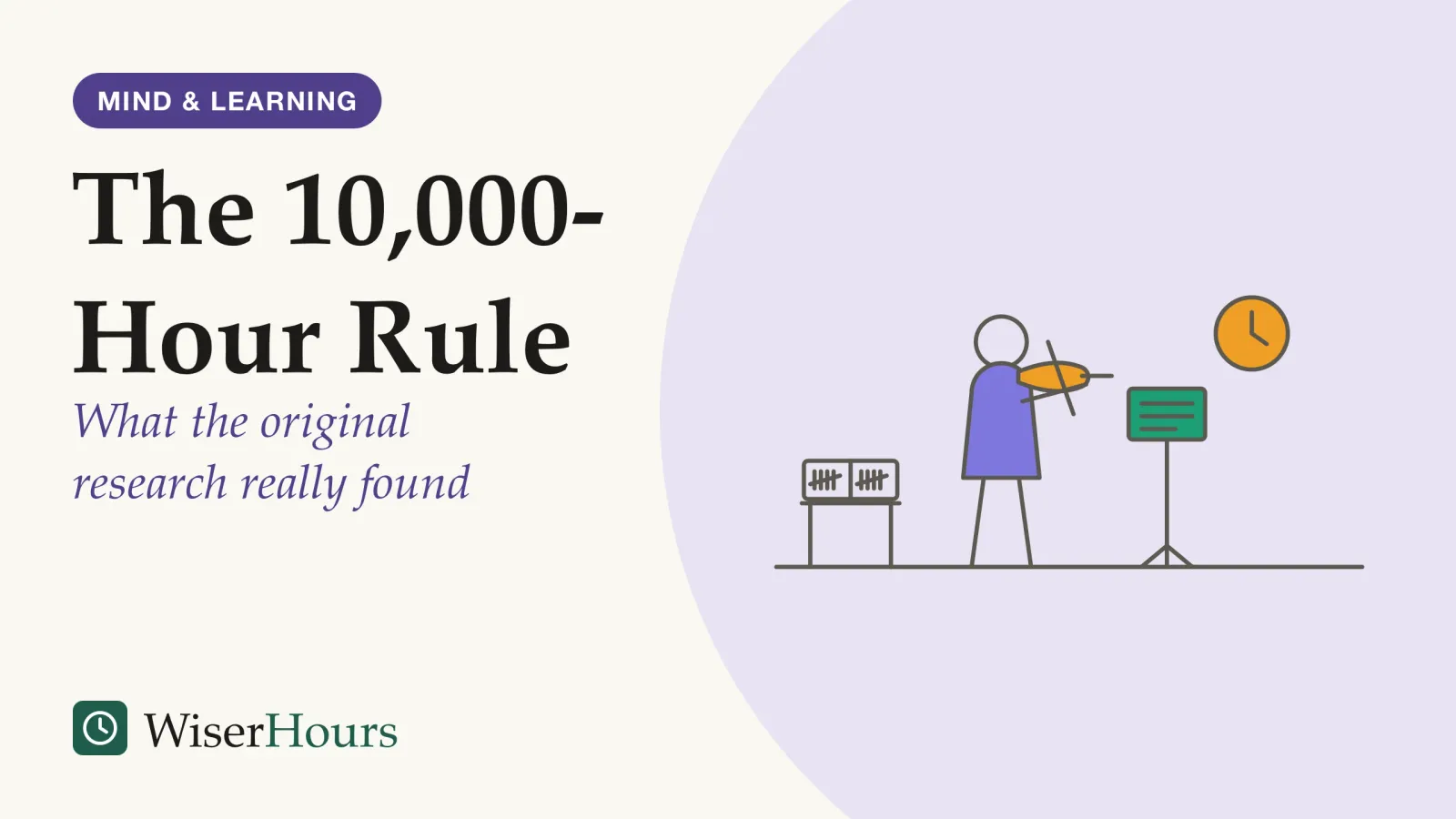
Ten thousand hours was never a finish line. The number started as a group average: in a 1993 study at a Berlin music academy, the violin students their professors had picked out as the best had, on average, practiced alone for longer than the others.1
That group’s average later became the 10,000-hour rule, the idea that it takes about 10,000 hours of practice to become an expert. Research since then agrees that practice goes with skill and argues about how much. A 2014 analysis pooling 88 studies found that accumulated deliberate practice accounted for about a seventh of the differences in performance between people, leaving most of those differences unexplained.2 That figure comes from the authors’ 2018 correction, which changed the numbers slightly but not the conclusions.3
For your own practice, the research points away from counting hours and toward what each session contains: a task designed to improve on your current level, feedback right after each attempt, and another try at the same or a similar task.1 The last section turns that into a routine for one skill this week. If you are studying for a course or an exam, the habits with the best record in learning research, such as quizzing yourself and spacing out study sessions, are set out in the site’s beginner’s guide.
Where the 10,000-hour rule came from: a Berlin violin study
The 10,000-hour rule traces back to a 1993 paper in Psychological Review by K. Anders Ericsson, Ralf Krampe and Clemens Tesch-Römer. They asked violin students at a Berlin music academy to estimate how many hours a week they had practiced alone in every year since they started, then added the years up. The paper’s central idea was deliberate practice: activities specially designed to improve a person’s current level of performance, usually set by a teacher, and effortful rather than enjoyable. The authors measured it through practice alone, which almost all the violinists rated the most relevant thing they did to get better.1
The study
Limited evidence
Thirty violin students, three groups, hours recalled from memory
By age 18, the students their professors saw as potential international soloists had practiced alone for an average of about 7,400 hours, against about 5,300 for the good violinists and about 3,400 for students training to become music teachers. Each step up in skill came with more accumulated practice on average.1 The famous number is the same group two years later: by age 20, its average had passed 10,000 hours.2
Read closely, that is a narrow result. It compares the averages of three small groups who had all already been admitted to an elite academy, and it relies on young adults remembering how much they practiced as children.1
- Myth
- Ten thousand hours of practice will make almost anyone an expert.
- Fact
- The figure was an average for a handful of elite students, and the study behind it never tested whether hours alone create expertise.
Ericsson himself later stressed that the study showed only that the best students had practiced more on average, not that anyone who puts in the hours becomes an expert.4 It describes a pattern across groups, not a promise to any one person.
Try the study’s method on a skill of your own. Asked how much time you spent on spreadsheets in a typical week five years ago, you would give a round, confident number that could easily be off. The 2014 meta-analysis found a pattern that fits this worry: practice was most strongly linked to skill in studies that relied on interviews about the past, and least in studies that logged practice as it happened.2 So when you meet a practice statistic, ask how the hours were counted.
How an average became a rule
The number became a rule in 2008, when Malcolm Gladwell’s book Outliers gave a chapter to what he called the 10,000-hour rule and cited the Berlin study as its main evidence. Ericsson later wrote that his research had shown a long period of training was needed for international-level performance, but no magic number.5
The round figure was not only Gladwell’s, though. A 2007 Harvard Business Review article co-written by Ericsson said even the most gifted performers need at least ten years, or 10,000 hours, of intense training before they win international competitions, as his critics Hambrick, Macnamara and Oswald later pointed out.6
In a 2016 excerpt from their book Peak, Ericsson and the writer Robert Pool set out what the rule got wrong. Ten thousand hours was the best group’s average at 20, a round number, when the figure at 18 was lower. Half of the ten violinists in that group had not reached it. The students were promising, not masters. And some of Gladwell’s examples, such as the Beatles’ long nights playing clubs in Hamburg, were performance rather than practice designed to fix specific weaknesses.4
First, there is nothing special or magical about ten thousand hours.
Gladwell’s own account is narrower than the popular one. In a 2013 New Yorker essay he agreed with the writer David Epstein that the rule should be understood as an average, repeated that achievement is talent plus preparation, and that his point applied to cognitively demanding fields rather than to sprinting or high jumping.7 Ericsson and Pool agree that Gladwell never claimed anyone could become an expert this way, though many readers heard the rule as that promise. Like the belief that teaching to your learning style helps you learn, the rule is easy to remember and offers a simple cause and effect, which they see as much of its appeal.4
The test that punctures the rule works on any number that sounds like a threshold. If a sales team’s average time to close a deal is three months, some reps close in weeks and some never do, and nobody would call three months a rule. Ask whose average it is, how many people it describes and how far apart they were.
Further reading
Peak: Secrets from the New Science of Expertise
Ericsson's own account of deliberate practice, including what he says the 10,000-hour rule got wrong.
The Sports Gene: Inside the Science of Extraordinary Athletic Performance
The critic Gladwell answered in 2013 sets out why athletes with the same hours of practice still end up far apart.

As an Amazon Associate WiserHours earns from qualifying purchases.
Practice matters, but it explains less than the rule implies
More practice goes with better performance across the research that followed the violin study, but less strongly than the rule suggests. In the 2014 meta-analysismeta-analysis: A study that combines the results of earlier studies on the same question into one overall estimate. Pooling makes the estimate more precise, but it cannot repair the studies it pools: a meta-analysis of surveys is still survey evidence.Full entry in the glossary, Brooke Macnamara and her colleagues combined the studies they found that measured both practice and performance, and the link varied widely by field.2
Their headline measure, the share of the differences in performance that lines up with practice, is easy to misread. Picture a hundred chess players ranked by rating. If practice explained all of the variation, knowing each player’s hours would let you predict the ranking exactly. If it explains a small share, your guess improves but most of the order depends on things the studies did not measure.
| Field | Share of performance differences linked to practice | Evidence |
|---|---|---|
| Games such as chess (24%), music (23%) and sports (20%) | About a fifth to a quarter | Meta-analysis of correlational studies, moderate3 |
| Education (5%) and professions (about 1%, not statistically significant) | A twentieth or less | Meta-analysis, limited: few studies of professions3 |
The pattern is not random. Practice predicted the most in activities the authors classed as highly predictable, such as running, and the least in unpredictable ones, such as handling an aviation emergency. For courses and jobs, they suggest it is less clear what deliberate practice would even look like, and that people start them knowing different amounts.2
Think of a typist and a new project manager. The typist can repeat the same drill and see every error at once. The manager’s hardest problems rarely repeat, and the feedback on a decision may arrive months later. If your work looks more like the second job, hours at the desk are a weak guide to how much skill you are building, so build the repetition and the feedback in on purpose.
A stricter rerun of the violin study
In 2019, Brooke Macnamara and Megha Maitra repeated the Berlin study with violin students in Cleveland, Ohio, adding what the original lacked: interviewers who did not know each student’s group, students who were not told the study’s purpose, and an analysis plan registered before anyone saw the datapreregistration: Filing a study's hypotheses and analysis plan publicly before the data are collected or examined. It stops a planned test from being rewritten once the results are in, so a reader can tell a real confirmation from a hunt through the data.Full entry in the glossary. In their replicationreplication: Running a study again with fresh data and the same method, to see whether the original result comes back. A finding that fails to replicate is not automatically wrong, but it stops being something you can lean on.Full entry in the glossary, practice still went with skill: the least accomplished group had practiced least. But the best and the good violinists did not differ significantly, even counting only practice a teacher had designed, and most of the best students had practiced less than the good group’s average. Practice accounted for 26 percent of the differences in skill, against 48 percent in the original analysis, which the authors say is not a trivial share but not enough to support the claim that practice largely accounts for performance.8
The authors offer three possible reasons for the gap: their students may have been more accomplished overall, the original interviews may have nudged the answers, or the first result may have been partly chance. They add that Ericsson had reported in 2014 a margin of error around the original best group’s average wide enough to take in the good group’s average. What survives is a gradient, not a threshold: in both studies the least accomplished group had practiced least, but in the replication, hours were a poor guide to who was best among students who had all practiced a great deal.8
- The rule as people hear it: one finish line of hours that every learner crosses on the way to expertise
- An average, not a line: in the 1993 study the best group averaged more than ten thousand hours by age 20, but half of its ten students had not reached that figure (Ericsson and Pool, 2016)
- The groups overlap: in the 2019 replication, most of the best students had practiced less than the good group's average (Macnamara and Maitra, 2019)
Picture two colleagues who have each spent about eight years in the same role. Their years tell you both are far past beginner level, and very little about which of them is better. When you compare yourself with people who have put in about as much time as you, stop comparing hours and look at what each of you practices and how you get feedback.
Ericsson’s reply: count only the right kind of practice
K. Anders Ericsson answered his critics by arguing that they had measured the wrong thing. In a 2019 paper with Kyle Harwell, he said the 2014 meta-analysis used a definition of deliberate practice that differed significantly from his original one, so it counted activities he would not have counted. Reanalyzing only the effects that met their criteria, they estimated that practice explained 29 percent of the differences in performance, and 61 percent after correcting for measurement error. They also reported that genetic effects had so far explained remarkably little, apart from height and body size.5
- 1993Berlin violin study introduces deliberate practice
- 2008Outliers names the 10,000-hour rule
- 2014Meta-analysis finds practice explains a minority of skill differences
- 2016Ericsson and Pool list what the rule got wrong
- 2019Double-blind replication; Ericsson and Harwell reanalysis
- 2020Critics question the definition; Ericsson replies
In a 2020 reply to Macnamara and Hambrick, he restated the 1993 paper’s five criteria, the last being individual guidance from a qualified teacher. He also described some young piano students who did not improve during solo practice even with a teacher’s supervision; videotapes showed them hitting the same sequence of keys over and over without full concentration.9 Hours without attention added little.
Reviewing more than 25 years of his writing, also in 2020, Hambrick, Macnamara and Oswald argued that the definition had shifted, in places requiring a teacher and in places not, which they say makes the theory hard to test at all. They also set out what both sides accept: expertise is acquired gradually, and training can bring very large improvements.6
The argument runs through sport too. A 2016 meta-analysis by Macnamara, David Moreau and Hambrick reported that practice accounted for only about 1 percent of the differences in performance among elite athletes.10 Ericsson and Harwell replied that among people who are all elite, the range of skill is so restricted that a weak link is to be expected.5 The two colleagues with eight years each show the same logic: experience separates both from a new hire, yet says little about which of them is stronger.
The evidence is thinner than either side’s confidence suggests. Every study here is correlational: nobody has randomly assigned people to thousands of hours of practice, which Ericsson and Pool note is what it would take to show that the hours alone produce expertise.4 What you can take from both camps is a working habit: decide what counts as practice before you count it. An hour on a drill aimed at one weakness, with feedback, and an hour playing through pieces you already know are different hours.
What the research means for how you practice
The research gives no number of hours to aim for, but it does describe what makes an hour count. The 1993 paper drew four conditions from earlier learning research: the motivation to attend and try to improve, a task pitched at what you already know, immediate, informative feedback, and repetition of the same or similar tasks.1
Take someone learning to write clearer reports at work. Writing twenty reports a year is time on the task. Rewriting one paragraph three ways, asking a sharp colleague which works and why, and then trying again on the next report is much closer to what the research describes.
Expect hours to pay off most where the rules stay put and results show quickly, and plan extra feedback where they do not. When progress stalls, change what you practice before you add more time: the piano students who kept repeating the same keys are the warning.
The bottom line
The 10,000-hour rule turned an average from a small study of elite violin students into a promise the study never made. Practice has gone with skill in the research since, but it accounts for a minority of the differences between people, and for less in unpredictable work than in games, music or sport. Spend less effort counting hours and more on what each hour contains: a narrow goal, fast feedback and a chance to try again.
Frequently asked questions
Is the 10,000-hour rule the same as the 10-year rule?
They come from the same research tradition. In a 2013 New Yorker essay, Malcolm Gladwell traced his rule to Herbert Simon and William Chase, who estimated that reaching grandmaster level in chess took about a decade of intense preoccupation with the game. Ericsson's 1993 paper also spoke of intense practice lasting at least 10 years. Neither figure was tested as a fixed threshold.
Can someone become world-class with far fewer than 10,000 hours?
In some fields, yes. K. Anders Ericsson and Robert Pool wrote in 2016 that the number varies from field to field: a volunteer in an early memory experiment became better at memorizing strings of digits than anyone before him after about 200 hours of practice. At the other end, they estimated that winners of international piano competitions have put in 20,000 to 25,000 hours by around age 30.
Did Gladwell say anyone can become an expert with 10,000 hours?
No, by both his account and Ericsson's. In his 2013 New Yorker essay, Gladwell repeated that achievement is talent plus preparation and agreed that the figure should be read as an average. Ericsson and Pool wrote in 2016 that Gladwell did not make that promise, but that many readers took the rule as one, and that nothing in the violin study showed it.
Does practice matter as much for office and professional skills?
The evidence is thinnest there. In the 2014 meta-analysis by Brooke Macnamara and colleagues, the professions category covered 321 people in jobs such as programming, aircraft piloting and insurance selling, across only 7 effect sizes, and practice showed no statistically significant link to performance. That is a gap in the research, not proof that practice does not help at work.
Sources
- The role of deliberate practice in the acquisition of expert performance. Ericsson, K. A., Krampe, R. T. & Tesch-Römer, C. (1993). Psychological Review, 100(3), 363-406
- Deliberate Practice and Performance in Music, Games, Sports, Education, and Professions: A Meta-Analysis. Macnamara, B. N., Hambrick, D. Z. & Oswald, F. L. (2014). Psychological Science, 25(8), 1608-1618
- Corrigendum: Deliberate Practice and Performance in Music, Games, Sports, Education, and Professions: A Meta-Analysis. Macnamara, B. N., Hambrick, D. Z. & Oswald, F. L. (2018). Psychological Science, 29(7), 1202-1204
- Malcolm Gladwell got us wrong: Our research was key to the 10,000-hour rule, but here's what got oversimplified. Ericsson, K. A. & Pool, R. (2016). Salon, 10 April 2016; adapted from their book Peak: Secrets from the New Science of Expertise
- Deliberate Practice and Proposed Limits on the Effects of Practice on the Acquisition of Expert Performance: Why the Original Definition Matters and Recommendations for Future Research. Ericsson, K. A. & Harwell, K. W. (2019). Frontiers in Psychology, 10, 2396
- Is the Deliberate Practice View Defensible? A Review of Evidence and Discussion of Issues. Hambrick, D. Z., Macnamara, B. N. & Oswald, F. L. (2020). Frontiers in Psychology, 11, 1134
- Complexity and the Ten-Thousand-Hour Rule. Gladwell, M. (2013). The New Yorker, 21 August 2013
- The role of deliberate practice in expert performance: revisiting Ericsson, Krampe & Tesch-Römer (1993). Macnamara, B. N. & Maitra, M. (2019). Royal Society Open Science, 6(8), 190327
- Given that the detailed original criteria for deliberate practice have not changed, could the understanding of this complex concept have improved over time? A response to Macnamara and Hambrick (2020). Ericsson, K. A. (2021). Psychological Research, 85(3), 1114-1120; published online 2020
- The Relationship Between Deliberate Practice and Performance in Sports: A Meta-Analysis. Macnamara, B. N., Moreau, D. & Hambrick, D. Z. (2016). Perspectives on Psychological Science, 11(3), 333-350
How we researched this
We read the 1993 study by Ericsson, Krampe and Tesch-Römer in full, then the main tests of it and the replies: the 2014 meta-analysis, the 2019 replication, Ericsson's 2019 and 2020 responses and a 2020 review by his critics, all in full text except a 2016 sports meta-analysis (abstract only). No newer meta-analysis on the general question appeared in Crossref or Europe PMC searches run in September 2026. Main limitation: every study cited here is correlational.
Keep reading
Learning Styles Are a Myth: What the Research Actually Shows
Nearly 9 in 10 educators surveyed believe matching teaching to a learning style helps. The few experiments designed to test that claim found no benefit.

Test Anxiety: Why Your Mind Goes Blank and What Helps
On average across OECD countries, 55% of 15-year-olds in PISA 2015 felt very anxious before tests even when prepared. Why minds go blank, and what helps.

How to Learn a Language as an Adult: What the Research Supports
Adults can learn a language well, but slowly: US government trainees study 24 to 88 weeks full-time. Five research-backed steps, and what apps can do.
The Feynman Technique: Learn a Topic by Explaining It in Plain Words
The Feynman technique in 4 steps: explain a topic aloud in plain words, find where you stall, then fix it. What research on learning by explaining supports.