Test Anxiety: Why Your Mind Goes Blank and What Helps
On average across OECD countries, 55% of 15-year-olds in PISA 2015 felt very anxious before tests even when prepared. Why minds go blank, and what helps.

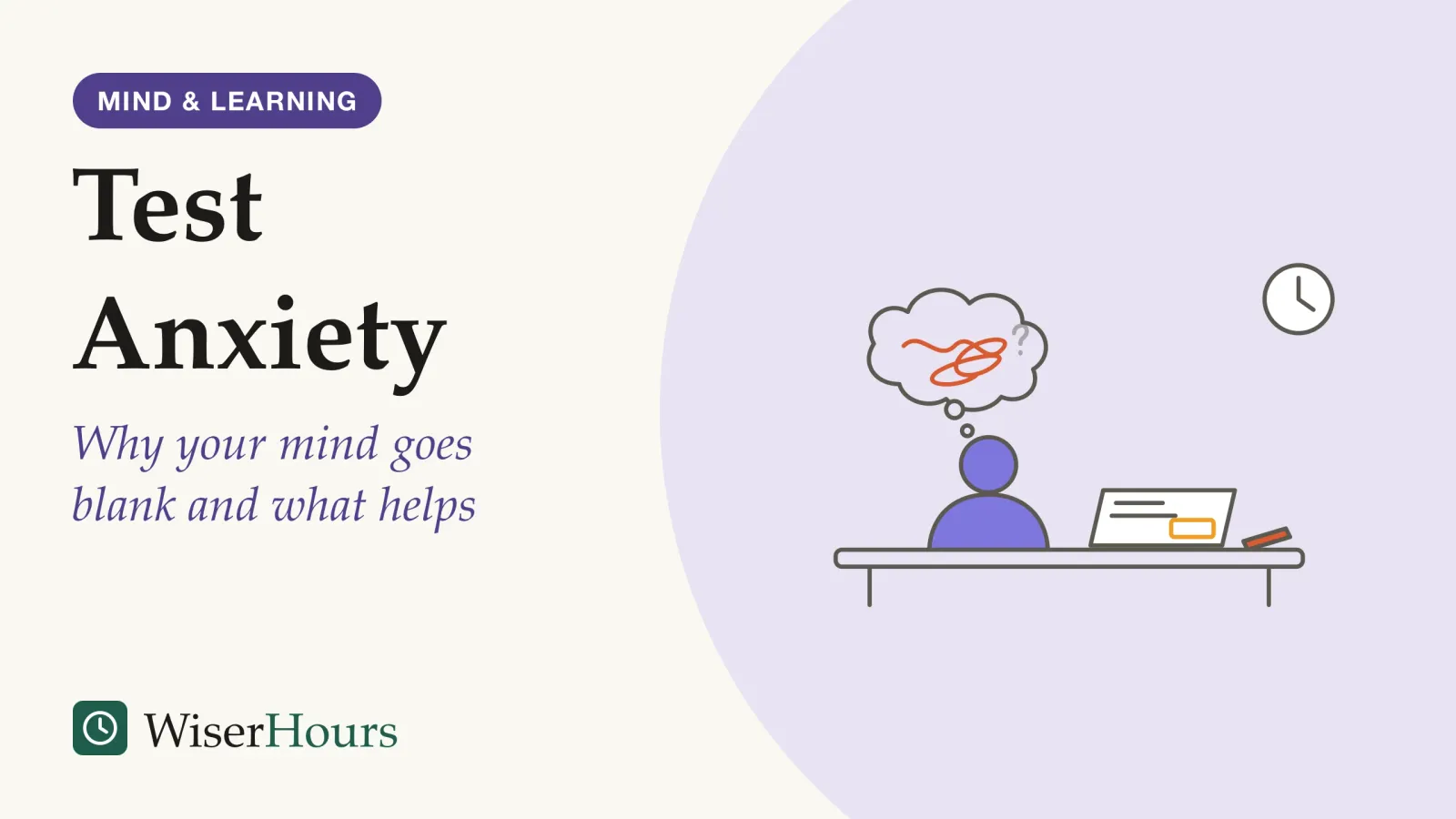
You turn over the paper, read the third question and know you revised it twice. Then a thought lands: if this goes badly, the university place is gone. The page stays empty, and the answer turns up an hour later, on the walk home.
Test anxiety can empty your mind like this, and the best-supported explanation is that worry takes up working memoryworking memory: The small mental workspace that holds and handles the information you are using right now, such as a phone number you are about to dial. Its capacity is limited, which is why juggling several things at once quickly overloads it.Full entry in the glossary, the small mental workspace you reason with. Two self-help moves have tested support: quiz yourself from memory in low-stakes practice before the day, and when your heart races, remind yourself that the arousal could be helping.
In the OECD’s 2015 PISA survey, an average of 55 percent of 15-year-olds across OECD countries said they feel very anxious before a test even when they are well prepared. That is a self-report from a very large international sample, not a count of diagnoses: feeling this way is ordinary.1
Self-testing and spacing, the habits that make knowledge last, are covered in learning how to learn: the study methods the evidence backs; this piece stays with the anxiety.
Why does your mind go blank in an exam?
Your mind most likely goes blank because anxiety competes with the exam for attention. Attentional control theory, set out in 2007 by Michael Eysenck of Royal Holloway, University of London, and colleagues, says anxiety weakens the goal-directed attention that keeps you on a task and hands more control to whatever grabs attention, especially anything that feels threatening.2
Working memory is where that attention does its job: it holds the numbers of a problem while you solve it, or keeps the question in mind while you search for the answer. A 2016 meta-analysismeta-analysis: A study that combines the results of earlier studies on the same question into one overall estimate. Pooling makes the estimate more precise, but it cannot repair the studies it pools: a meta-analysis of surveys is still survey evidence.Full entry in the glossary by Tim Moran of the Georgia Institute of Technology, pooling 177 samples, found that people who report more anxiety score lower on working-memory tasks with a small-to-moderate gap, one that shows up across a group and says little about any single person.3
You can feel the squeeze away from any exam: try multiplying two numbers in your head while someone reads you a shopping list, and steps start to slip. In the exam hall, the worried thought plays the part of the shopping list. The fact you need is still in long-term memory; there is just less room to pull it in and use it.
The workspace view also fits a surprise from a 2005 US lab study of math problem solving: Sian Beilock and Thomas Carr found that pressure harmed only the people with the most working memory, and only on the problems that demanded the most of it.4 Strong students who lean on that capacity have more to lose when worry takes a share.
- Working memory: a small workspace for what you are reasoning about right now
- Worry takes room: anxious thoughts compete with the task for the same space
- Hard steps fall out first: problems that need the most workspace suffer most under pressure
- Several routes in: practicing recall may leave more ways to reach an answer; such memories held up under stress in one lab study
The practical lesson is to read a blank as a crowded workspace, not proof that you never learned the material. That changes what helps: strategies that calm the worry or make answers easier to reach, rather than another late night of rereading.
Does test anxiety lower exam scores?
Test anxiety goes with lower exam results, but the link is modest. A 2018 meta-analysis by Nathaniel von der Embse and colleagues in the US, synthesizing 238 studies published since 1988, found test anxiety related to lower results on standardized tests, university entrance exams and grade point averages; across the variables it examined, the relationships were small to moderate. Anxiety ran higher when a test was seen as difficult or high-stakes.5
Those are correlations, not proof that anxiety alone lowers the score: weaker preparation, for example, could raise both the worry and the chance of a poor mark.
Across OECD countries in PISA, how often schools set tests seemed unrelated to how anxious students felt; the OECD’s reading is that what matters is whether students see the assessment as threatening.1 Picture the same paper sat as a practice mock that counts for nothing, then again with a university place riding on it: identical questions, a different threat. You rarely control how many exams you sit, but you have some say in how threatening each one feels.
For teachers and exam setters
In the PISA data, after accounting for performance and socio-economic status, students were less likely to report test anxiety when their science teachers adapted lessons to the class and gave individual help to those who struggled.1
So exam anxiety is linked to the classroom, not only the exam itself.
Writing out your worries: a famous fix that did not hold up
Expressive writing, spending about ten minutes before an exam writing openly about your fears, became one of the best-known test anxiety fixes after a 2011 study in Science, but later and larger studies have not found a reliable benefit. The reasoning sounds sensible: if worries are using up working memory, putting them on paper might free some of that space.
The study
Mixed evidence
Ten minutes of writing before a ninth-grade biology final
Gerardo Ramirez and Sian Beilock of the University of Chicago randomly assigned ninth-grade biology students, in two yearly groups of 51 and 55, either to write about their thoughts on the coming final exam or to think about a topic that would not be on it. A subgroup analysis found that among the most test-anxious students, the writers beat the control group on the final by 6 percent, roughly a B+ against a B-, while less anxious students saw no difference.6
The result did not survive later testing. A 2018 project led by Colin Camerer of Caltech in the US repeated 21 social-science experiments from Nature and Science with samples about five times larger on average, including the Ramirez and Beilock lab study; the original authors argue the repeat did not create enough pressure.7 As a 2021 paper by Sarah Myers and colleagues summarizes, both well-powered attempts at that study found no benefit from expressive writing. Myers’s own team then tested it before four real exams in an Iowa State University course, where 173 students alternated writing with a control task; writing neither reduced anxiety nor raised scores.8
A 2025 meta-analysis by Patti O’Meara and Benjamin Lovett of Teachers College, Columbia University, in the US pooled 21 studies and found a negligible effect on anxiety and no clear effect on scores once one extreme result was set aside; it concluded that single writing sessions are not supported as a treatment.9
If scribbling your fears in the corridor settles you, nothing here says stop; it is just not a fix to count on for the score. The wider lesson is that a few small studies, however striking, are a weak basis for advice until they are repeated, which is why replicationreplication: Running a study again with fresh data and the same method, to see whether the original result comes back. A finding that fails to replicate is not automatically wrong, but it stops being something you can lean on.Full entry in the glossary matters.
Reading a racing heart as a sign of readiness
Reappraising arousal means treating a pounding heart and sweaty hands as your body getting ready rather than as a warning of failure. A 2024 Swiss meta-analysis that pooled only randomized studies found that it helps performance by a small amount.
In the best-known early test (2010), Jeremy Jamieson, then at Harvard University in the US, and colleagues gave students preparing for the GRE graduate admissions test a practice test. One group first read a short message explaining that arousal does not hurt performance on such tests and can help. That group scored higher on the math section, and one to three months later, their official GRE math scores were higher too; verbal scores did not differ.10 Only 28 students finished both sessions, so the study is small.
The message participants read ended with a line you can borrow:
if you find yourself feeling anxious, simply remind yourself that your arousal could be helping you do well.
The 2024 review, by Michel Bosshard of the University of Bern and Patrick Gomez of the University of Lausanne, pooled 44 results from 35 randomized studies of tasks such as exams and public performances. Reappraisal and related stress-mindset messages improved performance by a small amount, and the estimate shrank after a correction for missing small studies, a sign of publication biaspublication bias: The tendency for studies with striking or statistically significant results to be published, while quieter ones stay in the drawer. Since the missing studies are mostly the unimpressive ones, a pooled result tends to overstate the effect until it is corrected.Full entry in the glossary. The authors call these interventions a promising, low-cost approach, not a silver bullet.11
In practice, when your heart is thumping in the corridor before the start, tell yourself the arousal could be helping you do well, then walk in.
Studying by recall may protect answers from stress
Recalling material from memory while you study, rather than rereading it, may make that material harder for stress to knock out, going by a single 2016 lab study at Tufts University in the US.
Amy Smith, Victoria Floerke and Ayanna Thomas had 120 participants learn lists of words and pictures, either by restudying them or by trying to recall themretrieval practice: Learning by recalling material from memory, for example by quizzing yourself, instead of rereading it. Pulling information out makes it easier to recall later, a result also known as the testing effect.Full entry in the glossary. A day later, half gave a speech and solved math problems in front of judges, a common lab method for inducing stress. About 25 minutes after the stress began, the restudy group recalled less than unstressed restudiers, while the recall-practice group held up about as well as its unstressed counterpart.12
The authors suggest that practicing recall creates several routes to the same memory, so stress can block one and leave others open.12 Think of knowing three ways to walk to the station: if one street is closed, you still arrive. A commentary by Oliver Wolf and Annette Kluge of Ruhr University Bochum in Germany points out that the recall group also simply learned more, so it is unclear whether stronger memories of any kind would resist stress equally well.13 Either way, the list learning in this study is far simpler than an exam.
- Myth
- If your mind goes blank in an exam, you did not really learn the material.
- Fact
- Pressure can crowd the working memory you need to use what you know; memories built by practicing recall held up better under stress in a lab study.
One catch: in two experiments published in 2014, Scott Hinze and David Rapp in the US found that practice quizzes framed as high-stakes lost the benefit that low-stakes quizzes gave on a later test.14 So test yourself often, and keep it low-pressure: close the notes, write out what you remember about a topic, then check it against the book, with nobody grading the result.
Which test anxiety fixes have the best evidence?
Of the fixes in this article, structured programs have the broadest support and single sessions of expressive writing the weakest; reappraisal and recall practice sit between, each with a caveat.
| What it is | What the best evidence found | Evidence |
|---|---|---|
| Behavior therapy and other structured programs | Less test anxiety and somewhat better academic performance than control groups in 44 trials with university students; publication bias and poor reporting | Meta-analysis, moderate15 |
| Practicing recall while you study | Recall of material learned this way held up under lab stress in 120 participants; untested on real exams | Single lab study, limited12 |
| Reading arousal as readiness | Small improvement in performance across 35 randomized studies, smaller after bias correction | Meta-analysis, moderate11 |
| Writing out worries just before a test | Negligible effect on anxiety and no clear effect on scores across 21 studies | Meta-analysis, no clear benefit9 |
In practice, try the two cheap changes now, and look to a structured program if the anxiety keeps coming back.
In the weeks and minutes before an exam
When test anxiety needs a counselor or doctor
Occasional exam nerves are normal, but anxiety that lasts, spreads beyond exams or disrupts daily life deserves professional help. A 2019 meta-analysis by Christopher Huntley of the University of Liverpool in the UK and colleagues, pooling 44 randomized trials with test-anxious university students, found that interventions reduced test anxiety and raised academic performance compared with control groups, with most support for behavior therapy. It found signs of publication bias and poor reporting, so how big the benefit really is remains unclear.15
For anxiety that goes beyond exams, the World Health Organization’s 2026 fact sheet says psychological therapies based on cognitive behavioral therapycognitive behavioral therapy: A structured talking therapy that works on the links between thoughts, feelings and behavior, usually over a set number of sessions with practice between them. It is given by a trained therapist or through guided programs, and versions exist for specific problems.Full entry in the glossary have the most evidence across anxiety disordersanxiety disorder: A mental health condition in which worry or fear is persistent, out of proportion to the situation and hard to control, and gets in the way of daily life. It differs from ordinary anxiety, which passes, and it is diagnosed by a clinician.Full entry in the glossary.16 A student counseling service, where your school or university has one, is a sensible first stop.
The three levels below combine advice, checked in September 2026, from the WHO, the UK’s NHS and NIMH, the US federal mental health research agency; elsewhere, check what your own health system offers.
- Now. Where a life may be in danger, including when someone is having suicidal thoughts or thoughts of harming themselves, call your local emergency number first. In the UK, for example, NHS guidance is to dial 999 or attend A&E when life is threatened or when a person feels they cannot keep themselves or others safe; Samaritans answer on 116 123.17 For US readers, NIMH lists the Suicide & Crisis Lifeline (988), open to calls and texts, and 911 whenever a life is under threat.18 If panic arrives alongside chest pain or difficulty breathing, the site’s guide to telling a panic attack from an anxiety attack explains why that calls for emergency help.
- Soon. The NHS advises seeing a GP (family doctor) if you think you may have generalized anxiety disorder, which is more likely when you feel anxious most of the time and it gets in the way of everyday life; in England, adults may refer themselves for NHS talking therapies.19 The WHO notes that symptoms of an anxiety disorder typically last at least several months and that people usually avoid what makes them anxious, so skipping exams or classes to escape the fear is worth mentioning.16
- Routine. Anxiety that flares only around exams but keeps costing you marks is worth raising with a counselor, tutor or doctor at your next chance, especially if self-help has not worked.
The bottom line
A blank mind in an exam most likely means worry has crowded your working memory, not that the knowledge is gone. On your own, practice recall in low-stakes quizzes before the day, which kept memories reachable under stress in one lab study, and remind yourself that a racing heart could be helping; structured programs such as behavior therapy have the broadest support. Writing out worries just before the test has not held up, and anxiety that lasts or spills into daily life calls for a counselor or doctor rather than more effort alone.
This article is general information, not medical advice. If you're worried about your health, talk to a doctor or another qualified professional.
Frequently asked questions
Is test anxiety a mental health condition?
Not necessarily. The World Health Organization's 2026 fact sheet says everyone can feel anxious sometimes, and that anxiety disorders involve fear and worry that are intense, excessive, hard to control and disruptive to daily life. The UK's NHS says generalized anxiety disorder is more likely if you feel anxious most of the time and it affects everyday life, and a clinician makes that diagnosis.
Is test anxiety more common in girls?
In the OECD's 2015 PISA survey of 15-year-olds, girls reported more schoolwork-related anxiety than boys in every participating country and economy. Across OECD countries, about 64 percent of girls and 47 percent of boys said they felt very anxious before a test even when well prepared. These are self-reports, not diagnoses.
Does test anxiety affect adults taking work or certification exams?
Probably, but the evidence is thin, because nearly all of the research uses school pupils and university students. The best-known adult example is a 2010 US study of 28 people preparing for the GRE graduate admissions test, in which a short reappraisal message was followed by higher math scores. None of the cited studies followed working adults taking professional certification exams.
Do breathing or relaxation exercises help with exam nerves?
They may ease symptoms. The World Health Organization's 2026 fact sheet lists relaxation techniques such as slow breathing and progressive muscle relaxation among self-care steps for anxiety. A 2019 meta-analysis of 44 trials with test-anxious university students found most support for behavior therapy. None of the sources here tested a single breathing exercise before a real exam.
Sources
- PISA 2015 Results (Volume III): Students' Well-Being. OECD (2017). PISA, OECD Publishing, Paris
- Anxiety and cognitive performance: Attentional control theory. Eysenck, M. W., Derakshan, N., Santos, R. & Calvo, M. G. (2007). Emotion, 7(2)
- Anxiety and working memory capacity: A meta-analysis and narrative review. Moran, T. P. (2016). Psychological Bulletin, 142(8)
- When High-Powered People Fail: Working Memory and "Choking Under Pressure" in Math. Beilock, S. L. & Carr, T. H. (2005). Psychological Science, 16(2)
- Test anxiety effects, predictors, and correlates: A 30-year meta-analytic review. von der Embse, N., Jester, D., Roy, D. & Post, J. (2018). Journal of Affective Disorders, 227
- Writing About Testing Worries Boosts Exam Performance in the Classroom. Ramirez, G. & Beilock, S. L. (2011). Science, 331(6014)
- Evaluating the replicability of social science experiments in Nature and Science between 2010 and 2015. Camerer, C. F., Dreber, A., Holzmeister, F. et al. (2018). Nature Human Behaviour, 2
- Does expressive writing or an instructional intervention reduce the impacts of test anxiety in a college classroom? Myers, S. J., Davis, S. D. & Chan, J. C. K. (2021). Cognitive Research: Principles and Implications, 6
- Single-session expressive writing interventions for test anxiety: a meta-analysis. O'Meara, P. & Lovett, B. J. (2025). Anxiety, Stress, & Coping, 39(1)
- Turning the knots in your stomach into bows: Reappraising arousal improves performance on the GRE. Jamieson, J. P., Mendes, W. B., Blackstock, E. & Schmader, T. (2010). Journal of Experimental Social Psychology, 46(1)
- Effectiveness of stress arousal reappraisal and stress-is-enhancing mindset interventions on task performance outcomes: a meta-analysis of randomized controlled trials. Bosshard, M. & Gomez, P. (2024). Scientific Reports, 14, 7923
- Retrieval practice protects memory against acute stress. Smith, A. M., Floerke, V. A. & Thomas, A. K. (2016). Science, 354(6315)
- Commentary: Retrieval practice protects memory against acute stress. Wolf, O. T. & Kluge, A. (2017). Frontiers in Behavioral Neuroscience, 11
- Retrieval (Sometimes) Enhances Learning: Performance Pressure Reduces the Benefits of Retrieval Practice. Hinze, S. R. & Rapp, D. N. (2014). Applied Cognitive Psychology, 28(4)
- The efficacy of interventions for test-anxious university students: A meta-analysis of randomized controlled trials. Huntley, C. D., Young, B., Temple, J. et al. (2019). Journal of Anxiety Disorders, 63
- Anxiety disorders (fact sheet). World Health Organization (2026)
- Where to get urgent help for mental health. NHS (UK), reviewed 2023
- Anxiety Disorders. National Institute of Mental Health (US)
- Generalised anxiety disorder (GAD). NHS (UK)
How we researched this
The search (September 2026) took in PubMed, Europe PMC, OpenAlex, Crossref and the OECD, WHO, NHS and NIMH websites, favoring meta-analyses, randomized experiments and official statistics published between 2005 and 2025. The OECD report and seven papers were read in full; seven other papers, four of them meta-analyses, were read only as abstracts. The biggest limit: nearly all participants were school or university students in a few countries, many samples are small, and few studies measured real exam scores.
Keep reading
The 10,000-Hour Rule: What the Original Research Really Found
The 10,000-hour rule began as an average from one 1993 violin study. Later research finds practice matters but explains far less than the rule implies.
How to Learn a Language as an Adult: What the Research Supports
Adults can learn a language well, but slowly: US government trainees study 24 to 88 weeks full-time. Five research-backed steps, and what apps can do.
The Feynman Technique: Learn a Topic by Explaining It in Plain Words
The Feynman technique in 4 steps: explain a topic aloud in plain words, find where you stall, then fix it. What research on learning by explaining supports.
Learning Styles Are a Myth: What the Research Actually Shows
Nearly 9 in 10 educators surveyed believe matching teaching to a learning style helps. The few experiments designed to test that claim found no benefit.