Context-Dependent Memory: Does Where You Study Affect What You Recall?
Context dependent memory is real but small: a 2001 meta-analysis of 93 results found a modest recall edge where you learned, and ways to work around it.

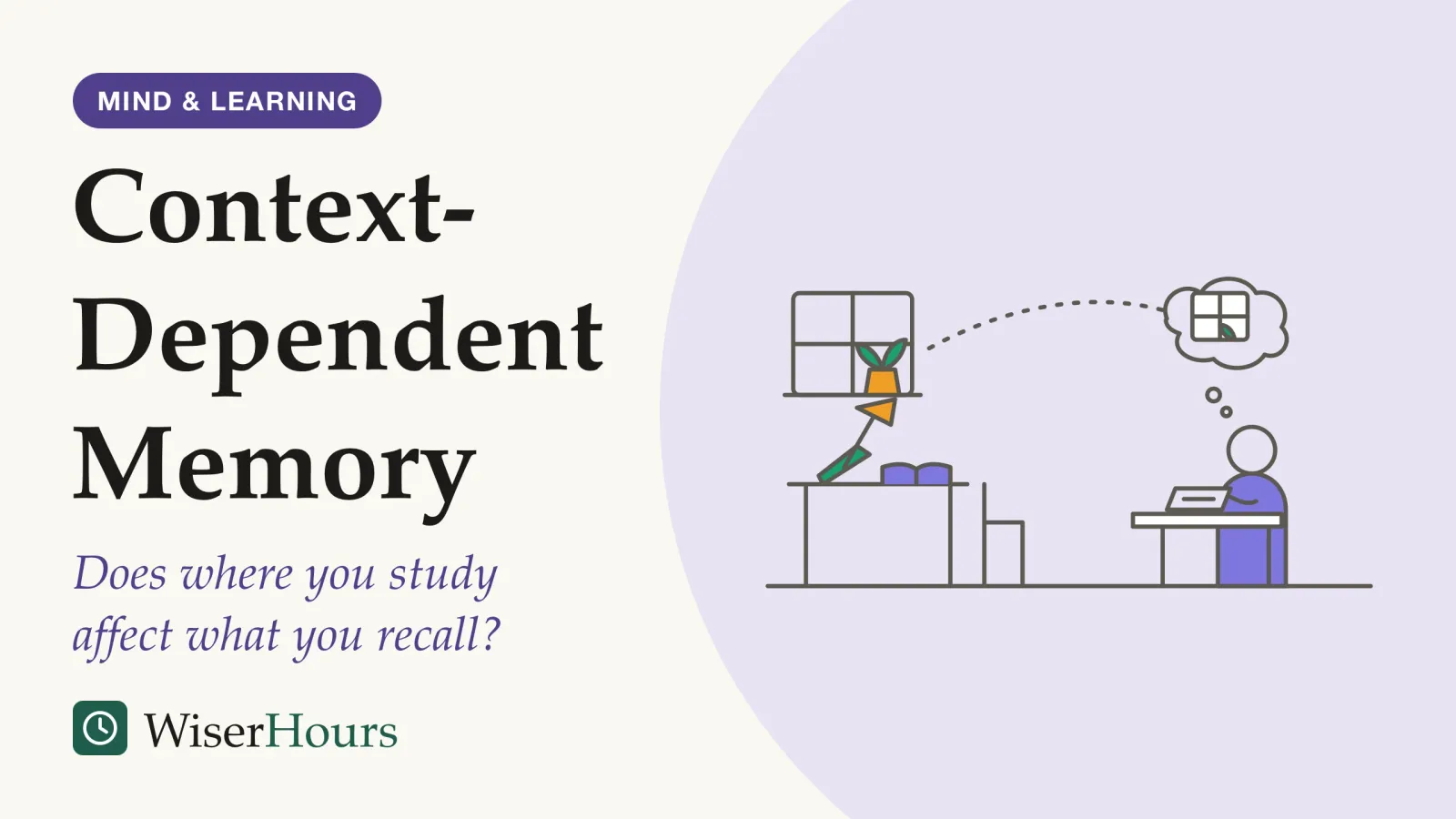
Where you study does affect what you recall, but by less than the classic stories suggest. Context dependent memory, the finding that people remember more when the setting at test matches the setting where they learned, is one of the older results in memory research. A 2001 meta-analysismeta-analysis: A study that combines the results of earlier studies on the same question into one overall estimate. Pooling makes the estimate more precise, but it cannot repair the studies it pools: a meta-analysis of surveys is still survey evidence.Full entry in the glossary by Steven Smith and Edward Vela, pooling 93 results from 75 studies, found a small but reliable advantage for being tested where you learned.1
The same review showed the advantage shrinking when people learn for meaning or picture the original room when they are tested.1 You rarely get to revise in the exam hall, and you mostly don’t need to. Three habits cover most of what the room would have given you:
- In the first minute of the exam, picture the place where you studied: the desk, the view, the sounds.
- Practice answering from memory under exam-like conditions, timed, without notes and in quiet if the exam will be quiet.
- Spread revision over two or three places, and study for meaning so the material carries its own cues.
Prefer to watch? The video covers the same ground as this article.
Context-dependent memory: the room as a cue
Context-dependent memory is better recall of information when the context present at learning is present again at retrieval. Wikipedia’s entry puts it in one idea: details of the surroundings are stored along with what you learn, so those surroundings can later cue the memory.2
Definition
Context-dependent memory is the improvement in recall when the setting at retrieval (a room, a sound, a mood or a physical state) matches the setting at learning.
The reason lies in how retrieval works, and Wikipedia’s entry ties the effect to the encoding specificity principle.2 A memory is easier to reach when the cue in front of you fits the way it was first laid down, and the room is one of those cues. You didn’t try to memorize the window or the hum of the radiator, but they were there, and they got stored with the material.
A familiar example is retracing your steps to find lost keys. Another is getting up from your desk to fetch something, arriving in the kitchen with no idea why, and remembering the moment you sit back down.2
When a fact will not come, change the cue instead of straining at it. Go back to where you had the idea, or think about where you were and what was around you when you learned it.
How state-dependent and mood-dependent memory differ
Context-dependent memory usually refers to the outside world, while state-dependent memory refers to your inner physical state, such as being sober or under the influence of a drug, and mood-dependent memory to your emotional state. Wikipedia’s entry groups them as members of one family: in each, recall is better when the state at test matches the state at learning.2
| Effect | What has to match | What the research found |
|---|---|---|
| Context-dependent | The outside setting, such as the room | A small but reliable recall edge across 93 results from lab studies1 |
| State-dependent | Your body’s state, such as a drug | In a 1969 US alcohol study, people drunk at both sessions recalled more than people drunk only while learning; recognition did not change clearly3 |
| Mood-dependent | Your mood at learning and at test | Recall is better when the moods at learning and at test match2 |
The best-known state-dependent experiment comes from a 1969 study in Science by Donald Goodwin and colleagues at Washington University in St. Louis, in the US. Male volunteers did memory tasks either sober or after drinking alcohol and were tested a day later. Those who had been drinking at both sessions did better on recall than those who had been drinking only at the first, while a recognition task was not clearly affected.3 Nobody should read that as a study aid: the finding concerns the match between states, and it says nothing in favor of studying while drunk.
Mood comes in two forms that are easy to mix up. Mood-dependent memory is the matching effect above. Mood-congruent memory works differently: a sad mood makes sad memories easier to bring up, and a happy mood happy ones, because the content of the memory fits your current mood.2 Smith and Vela discuss a mood explanation for room effects, in which a change of room works partly by changing how people feel. They note that the studies they pooled did not report mood, and they concluded that mood alone could not explain the rest of their findings.1
A calm, focused state while studying and a similar state in the exam may be part of the same matching, and you have more control over your state than over which room you sit in. Revising when you are as rested and alert as you hope to be on exam morning is an easy match to make.
How strong is context dependent memory?
The effect of place on memory is real but modest on average, according to the largest review. Smith and Vela’s 2001 meta-analysis covered studies conducted between 1935 and 1997 and found a reliable effect of matching or changing the surroundings, with wide variation from study to study.1
The study
Moderate evidence
Smith and Vela (2001), Psychonomic Bulletin & Review
Across 93 results, changing the room or other surroundings reliably affected memory, and the average effect sizeeffect size: A number saying how big a difference a study found, not just whether it found one. Standardized forms such as Cohen's d and Hedges' g scale it by how much the people studied varied, so results on different measures can be compared and the same value can mean different things in different groups.Full entry in the glossary came to about 0.28 (a small effect by the usual benchmark). Nearly 1 in 5 results showed a large effect, and effects were much smaller when people had linked the items to each other by meaning.1
A small average effect means most people would notice little difference on a typical test, though a few conditions produce a large one. In a classroom, that could mean a noticeable difference for some students and none for others. Smith and Vela also found larger effects when the test came a day to a week after learning, but only a handful of results fell in that group, so the authors treated it as suggestive.1
The diver study most textbooks cite, Godden and Baddeley’s 1975 experiment on land and underwater, failed to reappear in a 2021 replicationreplication: Running a study again with fresh data and the same method, to see whether the original result comes back. A finding that fails to replicate is not automatically wrong, but it stops being something you can lean on.Full entry in the glossary by Jaap Murre at the University of Amsterdam, run in an indoor pool.4 The full story of the diver study and its repeat sits in the how memory works guide.
If your exam is in a hall you have never seen, expect the room itself to cost you little on average. The moves below shrink even that.
When does the setting matter less?
The setting matters less when you can bring the context back in your head, when you learn for meaning, and, in many word-list experiments, when the test asks you to recognize answers instead of producing them. Smith and Vela’s review found all three patterns, though the last one is less consistent than often claimed.1
Mental reinstatement is the clearest. In a 1979 experiment, Steven Smith had 50 US students learn a word list in one room and tested them the next day. Students moved to a new room recalled about a third fewer words than students tested in the room where they had learned. Students moved to a new room but first asked to spend a few minutes remembering the original room, and to use that memory, recalled about as much as the same-room group.5
- 1Learn in room Athe room is stored with the list
- 2Tested in room Bthe room cues are missing
- 3Picture room Aa few minutes of remembering it
- 4Recall recoversclose to same-room levels
Smith’s volunteers were asked to list what they remembered seeing in the old room, think about how it looked and sounded, and then use that memory to help bring back the words.5 A student in an unfamiliar exam hall can run the same routine in a minute: the desk, the lamp, the noise from the street, then the first question.
Meaning matters too. In the meta-analysis, experiments in which people linked the items to each other in meaningful ways rarely showed any effect of changing rooms. Smith and Vela’s explanation is that a well-connected memory brings its own cues, so the surroundings have less to add.1 Coursework that you understand, as opposed to isolated facts, should depend on the room less for the same reason, although that link is an inference from lab studies.
Recognition versus recall is the mixed one. Several direct comparisons, including Smith’s own 1978 experiments, found that changing rooms hurt free recall but not recognition of a word list. Across the whole meta-analysis, though, recognition results showed nearly the same average effect as recall results, and the authors traced the difference to the kind of material used.1 A small 1998 US study with meaningful text found a matching effect on both short-answer and multiple-choice questions.6 Plan for the room to matter on both kinds of paper, and lean hardest on the picture-the-room step for essays and short answers, where you have to produce the answer yourself.
Is it worth revising in the exam hall?
Studying in the exam room is likely to help a little at most, and the best-known classroom field experiments did not find an advantage. Smith and Vela cite classroom field experimentsfield experiment: An experiment run in a real setting, such as a workplace, shop or website, with people going about their ordinary lives, usually with random assignment. It shows how an effect plays out in practice, though often for one setting and one group at a time.Full entry in the glossary by Saufley, Otaka and Bavaresco, published in 1985, that failed to support a room effect on exam scores.1
The review also explains why classroom studies are hard to read. Students study in many other places besides the lecture room, at home, in libraries and on buses, so the “learning context” of an exam is never one room, and Smith and Vela left classroom studies out of the meta-analysis for that reason.1
- Myth
- You will do much worse if your exam is not in the room where you studied.
- Fact
- Lab studies find a small average effect of changing rooms, and a 1985 set of classroom field experiments found no clear effect.
For most students, booking the exam hall for revision is not worth the trouble. Matching the conditions you control is more promising. In the 1998 study by Harry Grant’s team at Iowa State University, published in Applied Cognitive Psychology, 40 people read an article in quiet or with background noise, and both kinds of test went better when the test conditions matched the reading conditions.6 The authors suggested that students may do better on exams by studying in silence, so if your exam will be silent, do at least some of your revision without music or chatter.
Should you study in different places?
Studying in more than one place can help you remember in a new room, though the evidence is older and later studies disagree about when it works. The best-known result is a 1978 experiment by Smith, Arthur Glenberg and Robert Bjork, with 16 students at the University of Michigan.7
Students studied a list of 40 words twice, three hours apart, either in the same room both times or in two very different rooms, one a cluttered room in an old building off the main campus and the other a tiny windowed room in a modern laboratory building. Three hours later they were tested in a third room, and the two-room group recalled about half as many words again as the one-room group.7
One explanation the authors offered is that each room adds its own set of cues, so a strange test room has less power to take them all away.7
Later work complicates the picture. In 2014, Smith and Justin Handy found that varying the background helped final recall of face-name pairs when learners used retrieval practiceretrieval practice: Learning by recalling material from memory, for example by quizzing yourself, instead of rereading it. Pulling information out makes it easier to recall later, a result also known as the testing effect.Full entry in the glossary on the names, but made no difference when they simply restudied.8 A 2021 study led by Megan Imundo at the University of California, Los Angeles, found the opposite pattern for word lists: restudying in a new place did not hurt and in one experiment helped, while being tested in a new place lowered recall.9 The two studies used different materials and procedures, so the evidence here is mixed.
Spreading your study across two or three places is cheap and unlikely to hurt, and it may make your memory less tied to one desk. A student who revises at home, in the library and in a café is doing this already. Pair it with the habits that have stronger support, such as active recall and spaced sessions, and don’t expect the change of scenery to do the work on its own.
Study moves that make the room matter less
The research points to a few moves that protect recall wherever the exam takes place. None of them needs access to the exam room, and picturing the study room has the most direct evidence behind it.5
Picturing your study room is the one to rehearse. Before you start writing, spend a minute recalling where you studied: the desk, the view, what you could hear. It is the move Smith’s 1979 volunteers were asked to make in the new room.5
Test-like practice covers the conditions you can control. Answer questions from memory, at a desk, timed, without notes, and in quiet if the exam will be quiet.6 That puts some of the exam’s conditions into your study sessions instead of the reverse. Our guide on how to study for an exam sets out how to schedule that practice in the weeks before.
Studying for meaning is the last move. Explaining how ideas connect, in your own words, builds the kind of linked memory that depended least on the room in Smith and Vela’s review.1 After each topic, close the book and explain to an empty chair how its parts fit together.
The bottom line
Matching the room gives a small edge on recall, and the habits that stand in for it are within your control. Before your next exam, practice answering from memory under test-like conditions, study in more than one place, and spend the first minute of the test picturing where you learned.
Frequently asked questions
Is the famous diver study on context-dependent memory still trusted?
Less than it used to be. In Godden and Baddeley's 1975 study, divers remembered word lists best in the place they had learned them, underwater or on dry land. Jaap Murre at the University of Amsterdam repeated it in 2021 with 16 divers in an indoor pool and found no such advantage. In Smith and Vela's 2001 meta-analysis, the broader effect of surroundings on recall held across many studies, but on average it was small.
Why do I forget why I walked into a room?
One common explanation is context: the intention was formed at your desk, and the new room lacks the cues that went with it. Wikipedia's entry on context-dependent memory describes this kind of momentary forgetting and notes that going back to where the thought began often brings it back. That is an everyday account rather than a tested rule, and it is free to test on yourself.
Should I study in silence if my exam is silent?
It may help a little. In a small 1998 US study by Harry Grant and colleagues, 40 people read an article in quiet or with background noise and were tested in quiet or noise; scores on both short-answer and multiple-choice questions were higher when the conditions matched. The authors suggested that students may do better on exams by studying in silence.
Sources
- Environmental context-dependent memory: A review and meta-analysis. Smith, S. M. & Vela, E. (2001). Psychonomic Bulletin & Review, 8(2), 203-220
- Context-dependent memory. Wikipedia, accessed 17 October 2026
- Alcohol and Recall: State-Dependent Effects in Man. Goodwin, D. W., Powell, B., Bremer, D., Hoine, H. & Stern, J. (1969). Science, 163(3873), 1358-1360
- The Godden and Baddeley (1975) experiment on context-dependent memory on land and underwater: a replication. Murre, J. M. J. (2021). Royal Society Open Science, 8(11), 200724
- Remembering in and out of context. Smith, S. M. (1979). Journal of Experimental Psychology: Human Learning and Memory, 5(5), 460-471
- Context-dependent memory for meaningful material: information for students. Grant, H. M., Bredahl, L. C., Clay, J., Ferrie, J., Groves, J. E., McDorman, T. A. & Dark, V. J. (1998). Applied Cognitive Psychology, 12(6), 617-623
- Environmental context and human memory. Smith, S. M., Glenberg, A. & Bjork, R. A. (1978). Memory & Cognition, 6(4), 342-353
- Effects of varied and constant environmental contexts on acquisition and retention. Smith, S. M. & Handy, J. D. (2014). Journal of Experimental Psychology: Learning, Memory, and Cognition, 40(6), 1582-1593
- Where and how to learn: The interactive benefits of contextual variation, restudying, and retrieval practice for learning. Imundo, M. N., Pan, S. C., Bjork, E. L. & Bjork, R. A. (2021). Quarterly Journal of Experimental Psychology, 74(3), 413-424
How we researched this
Our starting point was the sources named in the brief. We read Smith and Vela's 2001 meta-analysis and Smith's 1978 and 1979 experiments in full from the author's own copies, then looked for replications and newer studies through Crossref, OpenAlex and general web searches in October 2026. The sources span 1969 to 2021. Most of the evidence comes from laboratory memory experiments and very few studies test real exams, which is the main limitation.
Keep reading
Tip-of-the-Tongue Moments: Why Words Go Missing and How to Find Them
Most adults get a word stuck on the tip of the tongue about once a week, more often with age. Why words hide, 4 ways to find them, when to get it checked.
How to Memorize a Speech Without Sounding Rehearsed
How to memorize a speech: learn the opening and close word for word, the middle as 3 to 5 points, and recite from memory on separate days instead of rereading.
Is Photographic Memory Real? What Science Says
Is photographic memory real? No adult has passed repeated tests. Eidetic images appear in an estimated 2 to 10% of children; trained and rare memories are real.
Prospective Memory: How to Remember to Do Things Later
Prospective memory is remembering to act later. Why calls and errands slip, and 5 fixes, led by if-then plans and reminders placed where you will act.