Working Memory and ADHD: What's Different and What Helps
Working memory and ADHD: reviews find lower scores on average with wide overlap, and training seldom eases symptoms. 6 daily habits can ease the load.

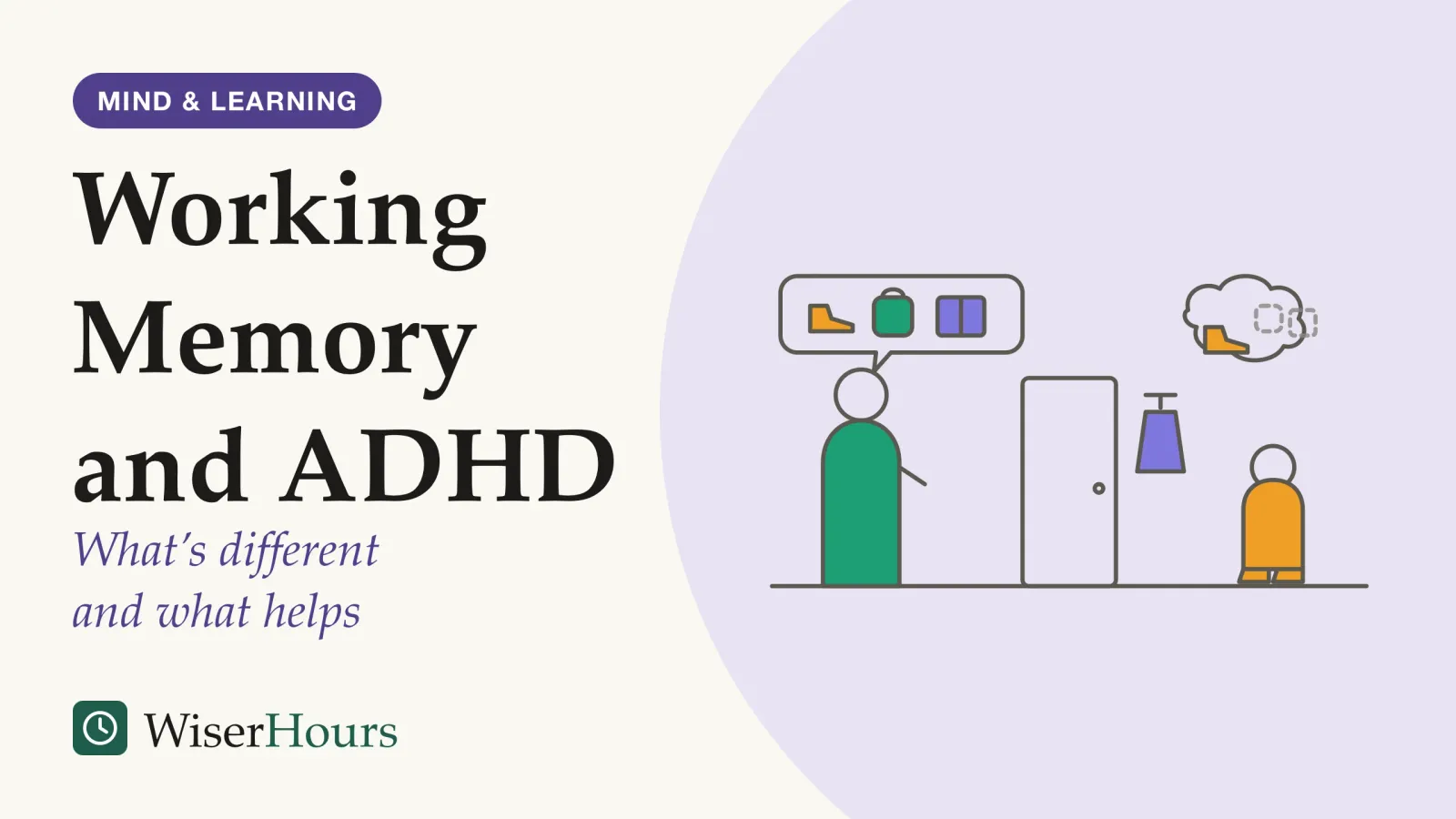
A parent calls down the hall: shoes on, bag by the door, reading book in the bag. The child comes back in shoes, with no bag and no book, and both of them start the school day annoyed. The child heard all three requests. Keeping the second and third waiting while doing the first is the part that slipped, and that is where working memory and ADHD meet.
working memoryworking memory: The small mental workspace that holds and handles the information you are using right now, such as a phone number you are about to dial. Its capacity is limited, which is why juggling several things at once quickly overloads it.Full entry in the glossary keeps a few items ready for the next few seconds while you use them; working memory as your mental scratchpad explains it in full. In ADHDADHD: Attention deficit hyperactivity disorder: a condition, usually present from childhood, marked by persistent inattention, hyperactivity or impulsiveness that affects daily life. In adults it can show up as disorganization or trouble finishing tasks, and a specialist makes the diagnosis.Full entry in the glossary, it tends to be weaker. Reviews find lower working memory scores in ADHD, in children and adults, with the gap clearest on visual-spatial tasks in children.12 The average hides wide differences between people, and training games raise test scores far more than they change daily life. The help that health and workplace guidance recommends is practical: give the mind less to hold, with written capture, visible timers, one-step instructions, checklists where the task happens, fewer interruptions and adjustments at work or school.
Working memory is one of several memory systems, and the others are mapped in our guide to how memory works.
Working memory and ADHD in children and adults
Children with ADHD scored lower than other children on working memory tasks in a 2005 meta-analysismeta-analysis: A study that combines the results of earlier studies on the same question into one overall estimate. Pooling makes the estimate more precise, but it cannot repair the studies it pools: a meta-analysis of surveys is still survey evidence.Full entry in the glossary of 26 studies by Rhonda Martinussen and colleagues in Canada. The gap showed up on tasks that only asked children to hold information and on tasks that asked them to hold it and work on it at once. It was larger for locations and patterns than for words and numbers, and language learning disorders or lower general ability did not explain it.1 A 2012 US update by Lisa Kasper, Matt Alderson and Kristen Hudec, pooling newer studies, again found large gaps in both verbal and visual-spatial working memory, and how big the gap looked depended partly on the test used.3 In adults, a 2013 review by the same group found moderate-sized gaps and concluded that the deficits persist into adulthood.2
Working memory carries whatever a task needs that is out of sight: the rest of the instruction, the number you are carrying in a sum, the reason you walked into the room. When it holds less, a person can still do each step and yet lose the plan between steps.
The strain shows up wherever something has to be kept in mind while something else happens: a spoken instruction with several parts, mental arithmetic while someone talks, where the keys went while hunting for the wallet. If you live or work with someone who has ADHD, notice which tasks ask them to hold several things at once. A written note or a shorter instruction will do the most good there.
Many people with ADHD have typical working memory
Working memory weakness is common in ADHD but not universal. A 2005 meta-analysis by Erik Willcutt and colleagues in the US, pooling 83 studies, found medium-sized average gaps in executive functions, the thinking skills that keep behavior aimed at a goal, with working memory among the most consistent. The weaknesses did not appear in everyone with ADHD, though, and the authors concluded they are neither necessary nor sufficient to cause all cases.4
A medium-sized gap between two group averages still leaves the groups overlapping heavily, so many people with ADHD score within the range of people without it. A 2005 paper by Joel Nigg and colleagues in the US and UK described this overlap in thinking-skill scores and argued that only a subgroup of people with ADHD may have executive deficits.5 A group average is a weak guide to any one person.
Two classmates with the same diagnosis can look quite different. One loses a spoken instruction halfway through. The other can repeat it word for word and still struggles to start, or to stop checking the window. Both may need help, but only one of them mainly needs help with holding information.
- Myth
- Everyone with ADHD has a poor working memory.
- Fact
- Working memory is weaker on average, but large reviews find it is not weak in everyone with ADHD, and many score in the usual range.
A diagnosis tells you what to watch for. It does not tell you which supports a particular person needs, so ask them, or try one small change and see whether it helps.
A full workspace can look like not paying attention
In a small 2010 US lab study, children with ADHD drifted off task more when a memory task overloaded what they could hold, and they reached that point at lower loads than other children. Michael Kofler and colleagues had independent observers watch 15 children with ADHD and 14 without while they did memory tasks that varied how much the children had to hold and how much they had to juggle.6
Two conditions accounted for the whole gap in attention between the groups. One was any demand on the attention-control part of working memory, which mattered even when there was little to hold. The other was going past a child’s holding capacity, which had a similar effect on both groups but happened at lower loads for the children with ADHD.6 It was one small study of children, so it suggests a mechanism without settling it.
For parents, teachers and managers, this changes how a lapse looks. A child who wanders off after a four-part request, or an adult who drifts during a long spoken briefing, may have run out of room to hold it. Before repeating an instruction more firmly, try making it shorter.
How can I improve my working memory with ADHD?
No everyday habit has been shown to enlarge working memory in ADHD, but you can ask much less of it. Psychologists call this cognitive offloadingcognitive offloading: Using something outside your head, such as a note, a calendar alert, a search engine or a chatbot, to cut the mental work a task needs. It usually helps you do the task, though you may remember less of what you handed over.Full entry in the glossary: using a physical action, such as setting a phone reminder, to cut how much a task asks of the mind.7 England’s NICE guideline (2018, updated 2019), the UK’s NHS and the US Job Accommodation Network describe supports of exactly this kind. No trial has tested each one alone in people with ADHD, so treat them as experiments and keep the ones that help.
- Everything held at once: a long spoken request asks working memory to hold every step; in a small lab study, children with ADHD drifted off task once the load went past what they could hold
- One step held, the rest written down: instructions given one at a time, a written backup, a checklist where the job happens and a visible timer leave less to hold
Fixed places for things and one shared calendar are covered in how to get organized with ADHD. The steps here deal with the load from one moment to the next.
1. Capture it the moment it arrives
Write a task down before doing anything else, in one place you always carry: a notebook, or a single notes app. A colleague mentions a Thursday deadline in the corridor; it goes into the phone before the next step. The NHS lists a to-do list kept somewhere easy to see among the supports for children with ADHD.8
2. Make time visible
A timer that shows the time remaining holds the “how long have I got” question for you. The US Job Accommodation Network suggests a timer or programmable watch to pace yourself, and lists timers and calendars among workplace accommodation ideas for ADHD.9
3. Give, and ask for, one step at a time
For children, the NHS suggests clear and simple instructions given one at a time.8 NICE’s guideline lists backing up spoken requests with written instructions among the changes that can reduce the impact of ADHD.10 At home that might mean asking a partner to pick up bread, then texting the other two items rather than adding them to the same sentence.
4. Put the checklist where the job happens
A list helps most where the task takes place: the leaving-the-house list on the inside of the front door, the end-of-day list taped beside the screen. The Job Accommodation Network suggests creating checklists and placing sticky notes where you will see them.9
5. Guard the hardest stretches from interruptions
Plan the most demanding work for a quiet block. NICE’s examples include reducing distractions, for instance with headphones, and working in shorter periods of focus with movement breaks.10
6. Ask for adjustments at work or school
NHS guidance for the UK (reviewed 2025) says people with ADHD may ask their workplace or place of study for changes called reasonable adjustmentsreasonable adjustments: Changes an employer makes so that a disabled job applicant or worker is not put at a disadvantage, such as extra time in a test or changed hours. Great Britain calls them reasonable adjustments and the US reasonable accommodations; what the law requires depends on the country.Full entry in the glossary, such as a quiet place to work, written instructions alongside spoken ones, and help from another person to plan and structure tasks.11 The Job Accommodation Network, a US service, lists accommodation ideas for ADHD and notes that the Americans with Disabilities Act, a US law, has no fixed list of conditions that count as disabilities.9 Whether an employer or school must agree to a change depends on local law, so outside the UK and US check what your own employment and education rules allow.
These supports come from health guidance and workplace advice. They carry little risk and can be used alongside any treatment a doctor suggests.
Less to hold this week
Does working memory training help ADHD?
Working memory training raises scores on working memory tests, but reviews of randomized trials find little change in everyday ADHD symptoms when the people rating them do not know who was trained. Monica Melby-Lervåg and Charles Hulme’s 2013 meta-analysis pooled 23 studies of clinical groups and of typically developing children and adults. It found reliable short-term gains on memory tasks and no convincing evidence that they spread to other skills such as attention, word reading or arithmetic.12
A memory game and a memory test ask for much the same thing, so practice on one shows up on the other. Symptoms are a different measure: they are rated by parents, teachers or trained observers watching ordinary days, and who does the rating turns out to matter.
The study
Moderate evidence
Symptom gains from training shrank when raters were blinded
Samuele Cortese and colleagues of the European ADHD Guidelines Group pooled randomized trials of computer-based cognitive training in children and teenagers with ADHD, published in 2015. Training improved scores on lab tests of working memory. Parents and others close to the training, who usually knew who had been trained, reported fewer symptoms; with raters who probably did not know, the effect shrank sharply. Programs that trained working memory alone had no clear effect on ADHD symptoms.13
The raters who knew had reasons to hope, which is why blindingblinding: Keeping participants, and sometimes researchers, from knowing who received which treatment in a trial, so that expectations cannot sway the results. Double-blind means neither side knows; some treatments, such as exercise, cannot be blinded at all.Full entry in the glossary matters here. A larger 2023 review of 36 trials by Samuel Westwood and colleagues in the UK found the same pattern: better working memory scores, no effect on overall symptoms on probably blinded ratings, and a small gain in inattention that was largest when rated in the setting where the training took place.14 The same narrow gain turns up in studies of brain-training games in healthy adults.
- 1Practice a memory gamerepeated, adaptive practice
- 2Memory test scores riseon tasks like the ones practiced
- 3Blinded symptom ratingslittle or no change in the reviews
If a school, clinic or app offers working memory training for ADHD, ask what its evidence shows on blinded ratings of everyday behavior. On that measure, these reviews found little change.
Does ADHD medication improve working memory?
The ADHD medicine methylphenidate raised memory test scores in placebo-controlled trials, in children and in adults, though most of the gains were small. A 2014 meta-analysis by David Coghill and colleagues in the UK, pooling placebo-controlled trials in children and teenagers aged 5 to 18, found it better than placebo on every memory measure, with a small effect on what the authors call executive memory and a medium one on non-executive memory.15
In adults, a 2018 US meta-analysis of 21 double-blind trials lasting about two and a half weeks on average found a very small benefit on working memory, and the authors found signs of publication bias, which can make effects look larger than they are.16 Medication’s clearer benefit is on symptoms: an umbrella review published in the BMJ in 2025 rated the evidence for methylphenidate reducing ADHD symptoms in children and teenagers as moderate to high certainty, with medium to large effects in the short term.17
A working memory gain as small as the one in adults would be hard to notice in a single person’s day, even when symptoms improve. NHS guidance in the UK (reviewed 2025) says an ADHD specialist must start and monitor ADHD medicines, and that not everyone needs or wants to take medicine.11 Whether to take one, and which, is a decision to make with a doctor; prescribing rules differ by country, and the everyday supports above can be used alongside any choice.
Getting help from a doctor or specialist
Working memory struggles on their own are not an emergency, but ADHD can come with other difficulties that are. The levels below draw on UK and US sources; outside these countries, a GP means your family doctor, and your own health service may work differently.
- Now: if you have thoughts of suicide or are in danger, call your local emergency number or a crisis line where you live, and tell someone you trust. In the US, you can also call or text 988, the Suicide & Crisis Lifeline.18 The NHS notes that people with ADHD are at higher risk of suicide and says it is important to tell someone.11
- Soon: when forgetfulness or disorganization gets in the way of relationships, study or work, the NHS suggests booking a GP appointment. The GP will ask how the symptoms affect your life and consider other conditions, such as anxiety or autism, before any referral for an ADHD assessment.11
- At your next review: people already diagnosed and taking medication can mention changes in concentration or memory to the specialist who monitors it.11
The bottom line
On average, people with ADHD score lower on working memory tests, and the everyday response that health and workplace guidance recommends is to hold less in your head. This week, pick one moment when things usually get dropped, such as leaving the house or the close of a meeting, and give it a written list, a visible timer or a single-step instruction.
This article is general information, not medical advice. If you're worried about your health, talk to a doctor or another qualified professional.
This article is general information, not legal advice. Rules differ by country and change over time; for your own situation, speak to a qualified lawyer or an official advice service where you live.
Frequently asked questions
Can a working memory test diagnose ADHD?
No. A 2005 meta-analysis of 83 studies by Erik Willcutt and colleagues found that weaknesses in thinking skills such as working memory were not found in everyone with ADHD, so a normal score does not rule it out. In the UK, the NHS describes diagnosis as an assessment by an ADHD specialist who asks about the history of your symptoms and how they have affected you.
Do adults with ADHD still have working memory problems?
On average, yes. A 2013 meta-analysis of 38 studies of adults by Matt Alderson and colleagues in the US found moderate gaps between adults with ADHD and adults without it on both verbal and visual-spatial tasks, and concluded that the deficits persist into adulthood. How large the gap looked depended partly on how each study tested it.
Is weak working memory the cause of ADHD?
Probably not on its own. Willcutt and colleagues concluded in 2005 that weaknesses in executive functions, which include working memory, are neither necessary nor sufficient to cause all cases of ADHD, and called them one important component of a more complex picture. Researchers still debate how working memory and the other parts fit together.
Sources
- A meta-analysis of working memory impairments in children with attention-deficit/hyperactivity disorder. Martinussen, R., Hayden, J., Hogg-Johnson, S. & Tannock, R. (2005). Journal of the American Academy of Child and Adolescent Psychiatry, 44(4)
- Attention-deficit/hyperactivity disorder (ADHD) and working memory in adults: a meta-analytic review. Alderson, R. M., Kasper, L. J., Hudec, K. L. & Patros, C. H. G. (2013). Neuropsychology, 27(3)
- Moderators of working memory deficits in children with attention-deficit/hyperactivity disorder (ADHD): a meta-analytic review. Kasper, L. J., Alderson, R. M. & Hudec, K. L. (2012). Clinical Psychology Review, 32(7)
- Validity of the executive function theory of attention-deficit/hyperactivity disorder: a meta-analytic review. Willcutt, E. G., Doyle, A. E., Nigg, J. T., Faraone, S. V. & Pennington, B. F. (2005). Biological Psychiatry, 57(11)
- Causal heterogeneity in attention-deficit/hyperactivity disorder: do we need neuropsychologically impaired subtypes? Nigg, J. T., Willcutt, E. G., Doyle, A. E. & Sonuga-Barke, E. J. S. (2005). Biological Psychiatry, 57(11)
- ADHD and working memory: the impact of central executive deficits and exceeding storage/rehearsal capacity on observed inattentive behavior. Kofler, M. J., Rapport, M. D., Bolden, J., Sarver, D. E. & Raiker, J. S. (2010). Journal of Abnormal Child Psychology, 38(2)
- Cognitive Offloading. Risko, E. F. & Gilbert, S. J. (2016). Trends in Cognitive Sciences, 20(9)
- ADHD in children and young people. NHS (UK), page last reviewed 19 March 2025; checked 2026-11-07
- Attention Deficit/Hyperactivity Disorder (ADHD): accommodation ideas. Job Accommodation Network (US), checked 2026-11-07
- Attention deficit hyperactivity disorder: diagnosis and management (NG87). National Institute for Health and Care Excellence (England), 2018, last updated 13 September 2019, last reviewed 23 July 2026; checked current 2026-11-07
- ADHD in adults. NHS (UK), page last reviewed 19 March 2025; checked 2026-11-07
- Is working memory training effective? A meta-analytic review. Melby-Lervåg, M. & Hulme, C. (2013). Developmental Psychology, 49(2)
- Cognitive training for attention-deficit/hyperactivity disorder: meta-analysis of clinical and neuropsychological outcomes from randomized controlled trials. Cortese, S., Ferrin, M., Brandeis, D., et al., for the European ADHD Guidelines Group (2015). Journal of the American Academy of Child and Adolescent Psychiatry, 54(3)
- Computerized cognitive training in attention-deficit/hyperactivity disorder (ADHD): a meta-analysis of randomized controlled trials with blinded and objective outcomes. Westwood, S. J., Parlatini, V., Rubia, K., et al. (2023). Molecular Psychiatry, 28(4)
- Effects of methylphenidate on cognitive functions in children and adolescents with attention-deficit/hyperactivity disorder: evidence from a systematic review and a meta-analysis. Coghill, D. R., Seth, S., Pedroso, S., Usala, T., Currie, J. & Gagliano, A. (2014). Biological Psychiatry, 76(8)
- Neurocognitive effects of methylphenidate in adults with attention-deficit/hyperactivity disorder: A meta-analysis. Pievsky, M. A. & McGrath, R. E. (2018). Neuroscience & Biobehavioral Reviews, 90
- Benefits and harms of ADHD interventions: umbrella review and platform for shared decision making. Gosling, C. J., et al. (2025). BMJ, 391, e085875
- Suicide Prevention. National Institute of Mental Health (US), last reviewed August 2026; checked 2026-11-07
How we researched this
We searched Europe PMC, PubMed and OpenAlex in November 2026 for meta-analyses on working memory in children and adults with ADHD, on cognitive training and on stimulant medication, then checked NICE, NHS and US Job Accommodation Network pages for everyday supports and help routes. Sources date from 2005 to 2025. Main limitation: several meta-analyses were read as abstracts only, and no trial has tested single habits such as timers or checklists in ADHD.
Keep reading
Working Memory Explained: Your Brain's Mental Scratchpad
Working memory is the mind's small scratchpad. A 2017 review counted 9 definitions; here are the main models, how it is tested and what lowers it.
Tip-of-the-Tongue Moments: Why Words Go Missing and How to Find Them
Most adults get a word stuck on the tip of the tongue about once a week, more often with age. Why words hide, 4 ways to find them, when to get it checked.
How to Memorize a Speech Without Sounding Rehearsed
How to memorize a speech: learn the opening and close word for word, the middle as 3 to 5 points, and recite from memory on separate days instead of rereading.

Is Photographic Memory Real? What Science Says
Is photographic memory real? No adult has passed repeated tests. Eidetic images appear in an estimated 2 to 10% of children; trained and rare memories are real.