How to Get Organized With ADHD
How to get organized with ADHD in 5 steps that put reminders in the room, not your head, and what 2010 trials of skills therapy for adults found.

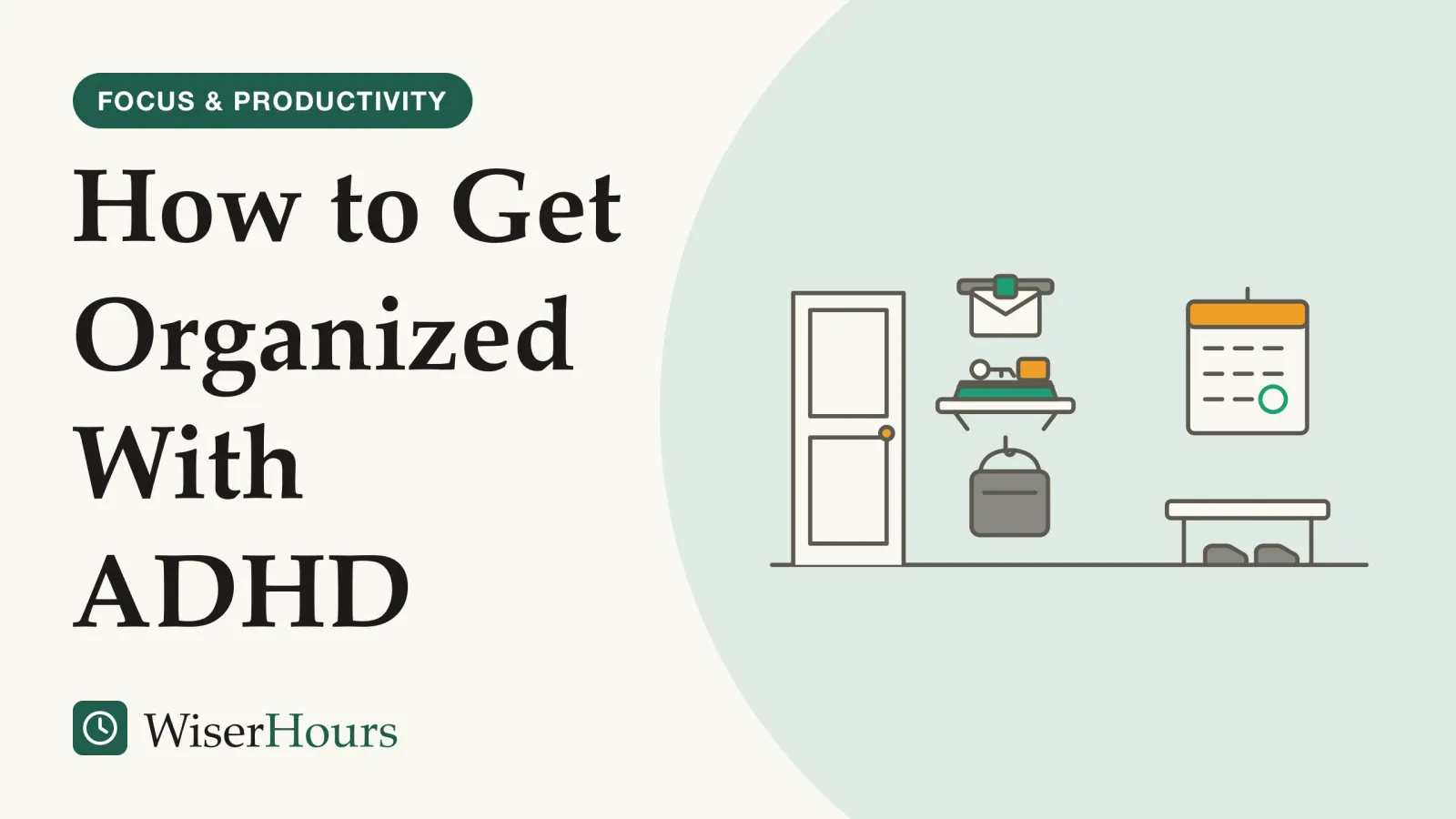
Keys, a wallet, a letter that needs an answer by Friday: for adults with ADHDADHD: Attention deficit hyperactivity disorder: a condition, usually present from childhood, marked by persistent inattention, hyperactivity or impulsiveness that affects daily life. In adults it can show up as disorganization or trouble finishing tasks, and a specialist makes the diagnosis.Full entry in the glossary, losing things and forgetting tasks are among the recognized signs of the condition, not proof of carelessness.1 The best-tested non-drug help for adults does not ask you to remember harder. It moves the remembering into your surroundings and teaches planning skills step by step.
Learning how to get organized with ADHD mostly means making things visible, giving them fixed homes, and letting written systems do the reminding. A 2025 umbrella review in the BMJ, which re-analyzed earlier meta-analyses of randomized trials, found moderate-certainty evidence that cognitive behavioral therapycognitive behavioral therapy: A structured talking therapy that works on the links between thoughts, feelings and behavior, usually over a set number of sessions with practice between them. It is given by a trained therapist or through guided programs, and versions exist for specific problems.Full entry in the glossary eases adult ADHD symptoms in the short term, with a medium-sized benefit on clinician ratings.2 The five steps below borrow from the skills programs tested in trials and from national guidance:
- Give everyday things a home you can see
- Keep the things you leave with in one spot by the door
- Put every date and task in one calendar and one list
- Make the first step small and visible
- Ask for instructions in writing and a planning partner
For decluttering and a weekly reset, see how to get organized; this page covers what changes with ADHD.
With ADHD, forgetting is a symptom, not a character flaw
Forgetting and losing things are part of how ADHD shows up in adults, which is why organizing is harder with it. The UK’s NHS counts being easily distracted or forgetful, struggling to organize time, trouble finishing tasks and often losing things such as a wallet, phone or keys among the inattentive signs, which usually begin before age 12.1 A 2021 global review of population studies in 30 countries estimated that in 2020 about 1 adult in 40 worldwide had ADHD that began in childhood: a common condition, not a rare one.3
The team behind the New York meta-cognitive therapy program, described later, argues that medication alone may not build time-management and organizing skills that likely developed less in childhood, so the program teaches them directly. It also gives participants the phrase “out of sight, out of mind” as a cue to clear distractions from the space where they organize and work.4
Picture, as an illustration, a parking-permit renewal letter put in a drawer “to deal with later”. It stays there until the permit runs out. The task was easy; the letter simply stopped being seen. Clipped by the door with the deadline written on it, the same letter asks for attention every time you leave.
- Myth
- Adults with ADHD could stay organized if they just tried harder.
- Fact
- Disorganization and losing things are listed signs of the condition. Skills programs teach planning skills and change the setup around a person rather than asking for more effort.
So judge any system by whether it still works on a distracted day, not by how much willpower it asks of you.
Setting up your space: how to get organized with ADHD
Each step borrows a support that the skills programs or national guidance describe, and each is a habit, not a treatment. No trial has tested any of them on its own, so keep what helps and drop what does not. The UK’s 2018 NICE guideline calls such changes environmental modifications and says they should be fitted to each person’s needs.5 The common idea: every reminder you can see is one less thing to hold in your head.
1. Give everyday things a home you can see
Choose one home for each thing you use daily and make the home visible: open shelves, clear boxes, hooks, labels written on the front. A charger on a labelled hook takes seconds to find; one in a drawer of cables does not. For whatever pulls you off task, flip the rule to “out of sight, out of mind”: what you need stays in view, and what distracts you goes behind a door.
2. Keep the things you leave with in one spot by the door
Put a tray, a hook and a small shelf where you walk out: keys, wallet, phone charger, bag, and anything that has to leave the house tomorrow. Some people call this a launch pad. It turns several things to remember into one place to look. The night before, rest anything that must go out, such as a library book or a signed form, on top of your bag.
3. Put every date and task in one calendar and one list
Keep a single calendar and a single task list, and check both at the same time each day, say with your first coffee. Training in a calendar and task-list system was the first module of the CBT program in a 2010 Boston trial, and a planner was the first skill taught in the New York one.46 Paper or phone both work, as long as there is only one of each, so there is one place to look. Set alerts for anything timed, and write the next action (“email the draft to Sam”), not just the topic.
- Held in memory: keys, letters and dates kept in your head are easy to lose track of; losing things and forgetting are listed signs of ADHD in adults
- Placed in the room: each item gets a visible home; dates and tasks go into one calendar and one list, like the planner and task-list systems taught in skills programs tested in 2010
4. Make the first step small and visible
Break a job into steps small enough to start without thinking, and leave the first one where you will see it. The New York program taught a self-cue for stuck moments: if getting started is hard, the first step is too big.4 For the permit letter, “sort out parking” becomes “fill in page one”, with the form left open and a pen on top. The same idea turns up in why we procrastinate.
5. Ask for instructions in writing and a planning partner
Writing gives a spoken request somewhere to live. In the UK, NHS advice reviewed in 2025 includes written as well as spoken instructions, and help from another person to plan and structure tasks, among the changes a worker or student with ADHD can ask for as reasonable adjustmentsreasonable adjustments: Changes an employer makes so that a disabled job applicant or worker is not put at a disadvantage, such as extra time in a test or changed hours. Great Britain calls them reasonable adjustments and the US reasonable accommodations; what the law requires depends on the country.Full entry in the glossary.1 Outside work, a partner or friend can join you for a short weekly plan. Rules on workplace adjustments differ by country, so check what applies where you live.
Reminders that live outside your head
Two 2010 trials put planning skills to the test
Two 2010 trials, one in New York and one in Boston, were among the first to test skills training for adults with ADHD against a control treatment of the same length. In both, a program that taught time management, organizing and planning did better than the same number of hours spent on support or relaxation.46
The study
Moderate evidence
Skills group or support group? New York's meta-cognitive therapy trial, 2010
Adults diagnosed with ADHD were randomly assigned to 12 weeks of group skills training in time management, organization and planning (using a planner, breaking tasks into parts and rewarding yourself for finishing them, organizational systems, then planning larger goals), or to a support group of the same length. An evaluator who did not know who was in which group rated 42% of the skills group as meaningfully improved in inattention symptoms (a drop of at least 30%), against 12% of the support group. Among those in skills training, completing more of the home exercises went with larger improvement.4
The support group also improved a little, which the authors think may reflect the value of support in itself. The caveats are real: one clinic, participants with above-average IQ scores, a program tested by the team that built it, and no follow-up after treatment ended.4
The Boston trial, at Massachusetts General Hospital, enrolled 86 adults who were already taking ADHD medication but still had symptoms. Twelve individual CBT sessions, covering a calendar and task-list system, breaking down big tasks, writing distractions down instead of acting on them and reworking unhelpful thoughts, produced roughly twice as many responders as relaxation training with education about ADHD. Gains held at 12 months for those who responded. Three of the authors disclosed royalties from the publisher of the treatment manual.6
In a normal week, that is a planner left open on the kitchen table and read every morning, even on quiet days. Practice matters more than purchases: a planner you open daily does work that new storage boxes cannot.
Where guidelines place therapy and medication
National guidelines treat organizing supports as part of care, not a substitute for it, but order the options differently. The treatments below are described, not recommended for anyone, and readers outside the UK and Australia should look up their own national guidance.
In the UK, NICE’s 2018 ADHD guideline, last updated in 2019 and still current when we checked, says medication should be offered to adults whose symptoms still cause significant problems in at least one area of life after changes to their surroundings have been made and reviewed. For adults who choose not to take medication, find it hard to keep taking it, or find it ineffective or cannot tolerate it, the guideline says to consider non-drug treatment: at a minimum, a structured supportive psychological intervention focused on ADHD, with regular follow-up, which may include CBT. Its committee judged the benefit of non-drug treatment to be real but smaller than that of medication.5
Worth bringing to an appointment
Because the UK’s 2018 NICE guideline expects changes to a person’s surroundings to be tried and reviewed before medication is offered, a short note of what you have set up, and what still goes wrong, gives a clinician something concrete to work with.
In Australia, the 2022 ADHD guideline, approved by the country’s National Health and Medical Research Council, says cognitive-behavioral interventions should be offered to adults with ADHD, and that clinicians should explain that medication is the most effective treatment for core symptoms while non-drug treatments add support.7 The panel made the therapy recommendation strong on low-certainty evidence, judging that the benefits outweigh the harms while accepting that the true effect may prove quite different from current estimates.8
Reviews agree on the direction of the effect more than on its size or how long it lasts. The BMJ umbrella reviewumbrella review: A review that gathers and compares existing systematic reviews and meta-analyses on a broad question, rather than individual studies. It gives a wide view quickly, but it inherits the limits of the reviews it collects.Full entry in the glossary found no high- or moderate-certainty evidence for any ADHD treatment beyond the short term.2 A 2025 network meta-analysis of trials in adults, led by Edoardo Ostinelli at Oxford, found CBT better than placebo when clinicians rated symptoms but not when patients rated their own; we saw only its abstract.9 A 2026 meta-analysis of 70 studies of mixed designs, also read as an abstract only, linked CBT with moderate gains in everyday functioning, strongest at work; its authors warn of bias, self-reports, mostly Western samples and short follow-ups.10
If you try therapy, keep your own simple record, such as missed deadlines or lost items each month, so you and your clinician can judge change in daily life, not only on a symptom scale.
Which supports have the strongest evidence?
Of the non-drug supports, skills-based CBT has the strongest evidence, for the first few months of treatment; none of the everyday supports has had a trial of its own.
| What it is | What the best evidence found | Evidence |
|---|---|---|
| CBT for adults with ADHD | Medium-sized short-term benefit on clinician-rated symptoms; no moderate- or high-certainty evidence beyond the short term | Umbrella review, moderate2 |
| Group meta-cognitive therapy | More people meaningfully improved than in a support group | Trial, moderate: 88 adults, one clinic4 |
| Individual CBT alongside medication | About twice as many responders as relaxation training; gains held at 12 months in responders | Trial, moderate: 86 adults, one hospital6 |
| Changes to surroundings | Recommended in the UK before medication; examples include fewer distractions and written instructions | Guideline (UK, 2018)5 |
| Visible homes, a spot by the door | No trial of single supports found | Gap: drawn from program content |
Read from the bottom up, the table makes a practical point: the supports you can set up tonight are the least tested, but also low-risk and easy to drop. Therapy is better tested, and a clinician can say whether it fits.
Getting an assessment, and when help is urgent
Lifelong disorganization that disrupts work, study or relationships deserves a doctor’s view, and mood problems need prompt help. According to the NHS, people with ADHD may be more likely to have anxiety and depression, and they face a higher risk of suicide.1 We have ordered the official advice below by urgency.
- Now: if you are having thoughts of suicide or self-harm, or someone’s life is in danger, call your local emergency number without waiting. In the US, the National Institute of Mental Health lists the 988 Suicide & Crisis Lifeline (call or text 988) and, for life-threatening situations, 911.11 In the UK, the NHS advises 999 or A&E when a life is at risk; in England, it points to 111 and its mental health option when help is urgent.12
- Soon: if possible ADHD symptoms are affecting your studies, work or relationships, the NHS advice is to make a GP appointment (a family doctor outside the UK); the GP may look at other possible causes, such as anxiety, and may refer you for a specialist assessment.1
- Routine: if you already have a diagnosis and organizing still causes significant problems, bring it up at a routine appointment; skills-based therapy such as CBT and adjustments at work or college are both worth asking about. The UK’s 2018 NICE guideline describes considering non-drug treatment alongside medication for adults who have benefited from medication but whose symptoms still cause significant problems.5
The bottom line
A system that depends on remembering will let you down on exactly the days ADHD makes remembering hardest, so build one that does the reminding for you. Give things visible homes, keep what you leave with in one spot by the door, and run your days from one calendar and one list. If disorganization has been with you since childhood and is costing you at work or at home, skills-based therapy is the best-tested non-drug help, and a doctor can tell you whether an assessment makes sense.
This article is general information, not medical advice. If you're worried about your health, talk to a doctor or another qualified professional.
This article is general information, not legal advice. Rules differ by country and change over time; for your own situation, speak to a qualified lawyer or an official advice service where you live.
Frequently asked questions
Do I need an ADHD diagnosis to use these organizing supports?
No. Open storage, a spot by the door and one calendar are low-risk habits anyone can try. A diagnosis matters for other reasons: the UK's NHS, in advice reviewed in 2025, says an ADHD specialist discusses support after diagnosis, and that people at work or in education can request changes called reasonable adjustments. Elsewhere, check which workplace or study adjustments your own country's rules allow.
Is ADHD coaching the same as CBT?
Not quite. Australia's 2022 ADHD guideline says coaching shares elements with cognitive-behavioral approaches, including changes to surroundings and to behavior, and that it could be part of a treatment plan. It notes that coaching approaches vary and that the recommendation rests on a narrative review, not a graded evidence review, so ask a coach how they work.
Can ADHD medication fix disorganization on its own?
Not always. The 2010 Boston trial enrolled adults who were already taking ADHD medication but still had symptoms, and the UK's 2018 NICE guideline suggests considering a non-drug treatment alongside medication when medication has helped but symptoms still cause significant problems. Decisions about medication belong with the specialist who prescribes it.
Is there an app that helps adults with ADHD get organized?
No trial we found tested a particular app. The two 2010 trials trained people to use a planner or a calendar and task list, which can be paper or digital. Choose the tool you will open every day, keep only one of each, and set its alerts so they reach you where you are.
Sources
- ADHD in adults. NHS (UK), page last reviewed 19 March 2025
- Benefits and harms of ADHD interventions: umbrella review and platform for shared decision making. Gosling, C. J., et al. (2025). BMJ, 391, e085875
- The prevalence of adult attention-deficit hyperactivity disorder: A global systematic review and meta-analysis. Song, P., et al. (2021). Journal of Global Health, 11, 04009
- Efficacy of Meta-Cognitive Therapy for Adult ADHD. Solanto, M. V., et al. (2010). American Journal of Psychiatry, 167(8), 958-968
- Attention deficit hyperactivity disorder: diagnosis and management (NG87). National Institute for Health and Care Excellence (UK), 2018, last updated 2019; checked current 2026-09-26
- Cognitive Behavioral Therapy vs Relaxation With Educational Support for Medication-Treated Adults With ADHD and Persistent Symptoms: A Randomized Controlled Trial. Safren, S. A., et al. (2010). JAMA, 304(8), 875-880
- The Australian evidence-based clinical practice guideline for attention deficit hyperactivity disorder. May, T., et al. (2023). Australian and New Zealand Journal of Psychiatry, 57(8), 1101-1116
- Summary of recommendations: Australian ADHD Clinical Practice Guideline. Australasian ADHD Professionals Association, guideline released October 2022; checked 2026-09-26
- Comparative efficacy and acceptability of pharmacological, psychological, and neurostimulatory interventions for ADHD in adults: a systematic review and component network meta-analysis. Ostinelli, E. G., et al. (2025). Lancet Psychiatry, 12(1), 32-43
- Cognitive behavioral therapy effects on global functioning, domain-specific functioning, and quality of life in adult ADHD: A comprehensive meta-analysis. López-Pinar, C., et al. (2026). Behaviour Research and Therapy, 201, 105026
- Suicide Prevention. National Institute of Mental Health (US), last reviewed August 2026
- Where to get urgent help for mental health. NHS (UK), page last reviewed 26 April 2023; content checked 2026-09-26
How we researched this
We searched PubMed, publisher sites and national guideline bodies in September 2026 for randomized trials, meta-analyses and clinical guidelines on psychological and organizational treatments for adults with ADHD, and checked NHS and NIMH pages for symptoms and help routes. Sources date from 2010 to 2026. Main limitation: no trial has tested single supports such as a spot by the door, the key trials were small and run by the teams that built the programs, and two reviews were read as abstracts only.
Keep reading
How to Get Organized When You Don't Know Where to Start
How to get organized in 4 steps: list what's in your head, plan the tasks that nag, clear one small area, then hold a weekly reset. Why that order works.
Ergonomic Desk Setup: The Basics
An ergonomic desk setup in 6 steps from US and UK safety guidance, and what trials show: the setup has not been proven to prevent pain.
How to Organize Computer Files: A Folder Structure That Lasts
How to organize computer files in 6 steps, based on studies of how people really find their files: shallow folders, one per project, and an archive.
How to Let Go of Sentimental Items
How to let go of sentimental items in 4 steps: photograph the memory, box the hard cases, choose who gets each, keep a few in view.