How to Meditate: A Beginner's Guide to Your First Ten Minutes
How to meditate for your first 10 minutes: 5 steps from sitting down to finishing, what to do when your mind wanders, and fixes for first-week snags.

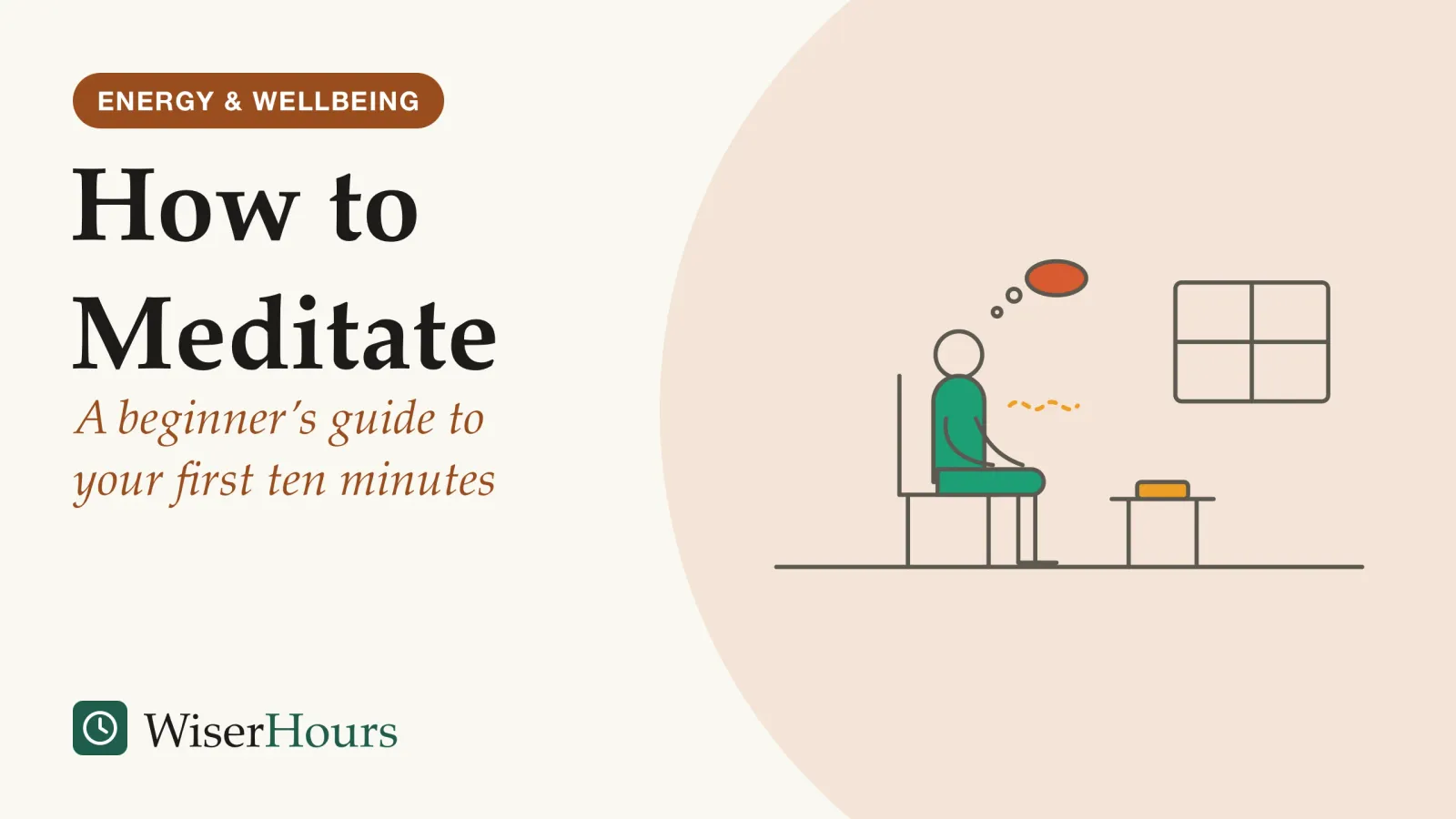
Most of a first meditation is practice at one small move: noticing that your attention has slipped off the breath, and bringing it back. It may slip many times in ten minutes. The free breathing meditation from UCLA’s Mindful Awareness Research Center calls a wandering mind “very natural” and not a problem, so the return is the exercise.1
Five steps show how to meditate for the first time, drawn from that UCLA script and from the beginner instructions published by Mindful magazine:2
- Sit so you can stay still and alert
- Set a timer for about ten minutes
- Find the breath in your body and stay with it
- When your mind wanders, notice and come back
- Widen your attention before you stand up
This page sticks to the practice itself. The definition, the trial evidence and the known side effects are set out in what mindfulness is and how the trials judge it.
Prefer to watch? The video covers the same ground as this article.
How to meditate for ten minutes, in five steps
The beginner instructions from UCLA, Mindful and UC Berkeley follow the same arc: settle the body, give attention one place to rest, return it when it drifts, and close on purpose. The steps below follow UCLA’s script, which UCLA offers free in English and in more than a dozen other languages, from Arabic to Vietnamese.3 They are teachers’ instructions: trials test whole programs or recordings, and we found none that tests the steps one at a time.
1. Sit so you can stay still and alert
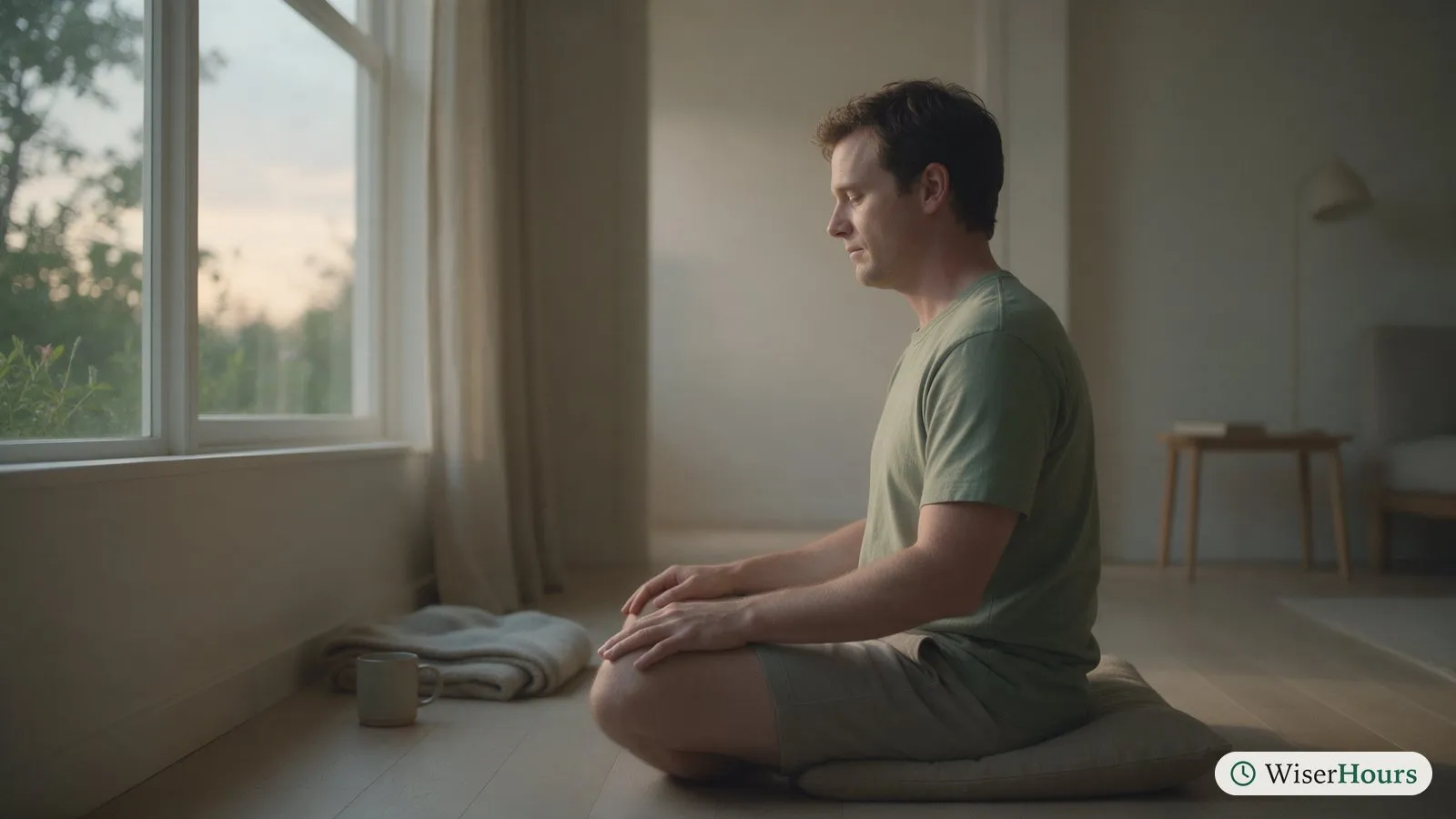
Sit on a chair or on a cushion on the floor, with your back upright but not tight and your hands resting wherever they are comfortable, as UCLA’s script puts it.1
The aim is a seat that is, as Tara Healey puts it in Mindful, relaxed and at ease yet alert.4 A kitchen chair beats a sofa you sink into, and your eyes can be open or closed. Finer points of posture can wait; for now, pick the position you could hold for ten minutes without shifting every few breaths.
2. Set a timer for about ten minutes
Set a timer before you begin, and keep the session short: Mindful’s guide suggests five or ten minutes for a beginner.2 The timer takes over the job of watching the clock, so you are not glancing at your phone to see how long is left. Lay the phone face down, with notifications silenced, where you cannot see the screen.
Ten minutes is a workable length, and the research on how long to meditate as a beginner found no clear advantage for longer sittings. If ten minutes feels long on day one, five is a reasonable start.
3. Find the breath in your body and stay with it
Let the breath be natural, at its usual length, and notice where you feel it most: the belly, the chest, the throat or the nostrils. Then follow the sensation one breath at a time.1 You are feeling the breath without steering it, which sets this apart from paced techniques such as box breathing, where you breathe to a count.
Why the breath? Greater Good in Action, from UC Berkeley, explains that it gives you an anchor, something to come back to when a stressful thought carries you off.5 Breath focus is the classic case of the focused-attention family among the main types of meditation.
In practice, choose one spot, say the air cooling the rims of your nostrils, and keep coming back to that same spot rather than hunting for a better one.
4. When your mind wanders, notice and come back
Within a breath or two, you will be thinking about something else: an email, lunch, whether you are doing this right. UCLA’s instruction is to notice that the mind has wandered, say “thinking” or “wandering” softly in your head, and gently bring attention back to the breath.1 It happens even to well-known teachers. Sharon Salzberg recalls her first try:
And to my absolute amazement, it was one breath, and I’d be gone
Researchers describe this as a cycle with four phases: mind wandering, becoming aware of it, shifting attention back, and staying with the breath. In a 2012 brain-imaging study at Emory University in the US, 14 meditation practitioners pressed a button each time they realized their mind had wandered from the breath. Brain activity differed by phase, with regions linked to mind wandering active while attention drifted and attention-related networks active as people noticed and came back.6 This guide relies on the paper’s abstract alone, and the study maps the cycle rather than showing that repeating it builds a skill.
The cycle is useful because it tells you where the exercise is. Noticing is a success, not the end of a failure. The UK’s National Health Service (NHS) makes the same point: mindfulness is not about making thoughts go away but about seeing them as mental events that come and go.7 Think of each return as one repetition at the gym. A session with forty wanderings holds forty repetitions.
5. Widen your attention before you stand up
When the timer sounds, do not jump straight up. Mindful’s guide suggests lifting your gaze or opening your eyes, then noticing the sounds around you, how your body feels, and your thoughts and emotions.2
These last seconds turn the session into a check-in: you learn something about your state today without grading it. Then stand up slowly and get on with your day.
Your first ten minutes
Download PDF
What a first session changes, and what it does not
A first session trains a skill, and on its own it is likely to change how you feel only a little. A 2018 meta-analysismeta-analysis: A study that combines the results of earlier studies on the same question into one overall estimate. Pooling makes the estimate more precise, but it cannot repair the studies it pools: a meta-analysis of surveys is still survey evidence.Full entry in the glossary from Carnegie Mellon University, pooling randomized trials of brief mindfulness training that lasted from a single session to two weeks, found only a small drop in negative feelings such as worry and low mood, and almost none once likely unpublished null results were allowed for.8
The study
Limited evidence
Does a short dose of mindfulness lift your mood? Schumer, Lindsay and Creswell's 2018 answer
The authors pooled 65 randomized trials with 5,489 participants, most without meditation experience, that measured outcomes such as anxiety, depressed mood, stress and rumination. Brief training reduced these slightly compared with control activities, a small effect. The pattern of results suggested that studies finding nothing had gone unpublished, a form of publication biaspublication bias: The tendency for studies with striking or statistically significant results to be published, while quieter ones stay in the drawer. Since the missing studies are mostly the unimpressive ones, a pooled result tends to overstate the effect until it is corrected.Full entry in the glossary, and adjusting for them shrank the effect to about zero.8
Why so modest? These trials measured mood after a short dose, and a first session is closer to a first music lesson than to a performance: you learn where to put your hands, and nobody expects a concert. So a flat mood after your first few sittings says little about where the practice will take you.
Attention may shift a little sooner. In two small 2018 lab experiments at Swarthmore College in the US, students who listened to a ten-minute guided breath recording, modeled on a first class of Mindfulness-Based Stress Reduction, did better on a computer attention test than students who heard a magazine article about sequoia trees. The gain showed mainly in students who scored lower on neuroticism, a trait linked to worry, and a better lab score does not prove better focus at your desk.9
Most of the advice above rests on teachers’ experience, with a thin layer of research on brief practice:
| Question | What the best evidence found | Evidence |
|---|---|---|
| Does breath focus beat other brief exercises? | In a comparison across studies, breath-only training showed smaller effects than training with several exercises | Secondary analysis within a meta-analysis, limited8 |
| Does ten minutes do anything measurable? | Better attention test scores than after a control recording, mainly in students lower in neuroticism | Two small lab trials, limited9 |
| Posture, timer, eyes and ending | Consistent across teachers; not tested one by one | Expert opinion2 |
Sleepiness, doubt and other first-week snags
The snags most beginners meet, sleepiness, doubt and a breath that feels wrong, each have a simple adjustment in the advice Mindful magazine gives beginners. A few reactions are different, and the next section covers when to stop.
Sleepiness is most likely when you meditate lying down, late at night or when you are exhausted. Mindful suggests sitting upright on a chair or cushion, practicing earlier in the day, or opening your eyes partway. If sitting upright is hard, for example with chronic pain, fatigue or back problems, Mindful says lying down may be the most sustainable posture for you.10 If you nod off after a long workday, try the same ten minutes before breakfast or after lunch instead.
Doubt is the other common snag: many beginners assume a busy mind means they are failing. Healey’s answer is that getting lost in thought, noticing and returning to your anchor is how it is done, and she adds that if you keep falling asleep in sessions, you may simply need more sleep.4 If you came back even once, the session worked as intended.
If attention on the breath leaves you tense or uneasy, change what you rest on. The anchor does not have to be the breath: Healey lists sound and body sensation as alternatives, so the feel of your feet on the floor or the sounds in the room will do.4 Mindful’s advice is that you can always open your eyes, stand up, move or stop, because you do not have to push through.10
When meditation needs a clinician’s view, and when to stop
Unpleasant experiences during or after meditation are not rare. A 2020 systematic review of 83 studies, led by Miguel Farias at Coventry University in the UK, found adverse events in about 8 percent of people who meditated, most often anxiety and depression, and said they may appear even in people who have never had mental health problems.11 That rate swung widely with the kind of study, so read it as a ballpark rather than your personal risk. The UK’s NHS says the same in plainer words: mindfulness is not right for everyone, and some people find it makes them feel worse.7
Some of these effects outlast the practice. Willoughby Britton’s team at Brown University in the US tracked adults with symptoms of depression during eight-week programs of mindfulness-based cognitive therapy, in a study published in 2021. The unpleasant effects that lasted were linked to signs of hyperarousal, such as anxiety and insomnia, and of dissociation, such as emotional numbness or a feeling that things are unreal. In line with the programs’ guidelines, the study had screened out people with a lifetime history of bipolar disorder or psychosis, current post-traumatic stress disorder, extremely severe depression or active suicidal thoughts.12
Because people with those histories were screened out, the study says little about how meditation affects them, which is one reason to ask a clinician before you start.
Talk it through with a clinician beforehand if you have
A history of trauma, psychosis or bipolar disorder, severe depression, or any current mental health condition. The US National Center for Complementary and Integrative Health (NCCIH), in safety guidance last updated in 2022, warns against letting meditation stand in for conventional care or delaying a medical appointment because of it. Its other tips: ask how a teacher was trained, and let your health care providers know that you meditate.13
Where to turn, sorted by urgency (our own grouping):
- Right away: phone your local emergency number if suicidal thoughts or urges to hurt yourself come up, or you feel unable to stay safe. Across the EU that number is 112, and the European Commission says it also works in some countries outside the EU and on GSM mobile networks worldwide.14 US readers can reach 911 in a life-threatening emergency, or text or call the 988 Suicide & Crisis Lifeline; both are listed by the National Institute of Mental Health.15 UK readers can phone 999 or head to A&E, as the NHS advises when a life is at risk, or ring Samaritans on 116 123.16 Elsewhere, look up the crisis line for your country.
- Within days: if panic, flashbacks, low mood, poor sleep or a sense of unreality persist after you stop practicing, see a doctor rather than pushing on, in line with NCCIH’s advice not to put off seeing a health care provider.13
- Before your first session: with any history in the box above, talk it over with a clinician and describe the kind of practice you have in mind.
The bottom line
A first session needs a stable seat, a timer set for about ten minutes, the breath as an anchor, and a gentle return each time attention drifts. A restless session still counts, since each return is the practice. Try it for ten minutes today, and if it leaves you shaken, stop and get a doctor’s view.
This article is general information, not medical advice. If you're worried about your health, talk to a doctor or another qualified professional.
Frequently asked questions
Is there a special way to breathe when meditating?
No. The breathing meditation from UCLA's Mindful Awareness Research Center asks you to let the breath be natural, neither long nor short, and simply feel it. That differs from paced techniques such as box breathing, which set a count. Greater Good in Action, from UC Berkeley, suggests one exaggerated breath can help you settle when you feel stressed, before you let the breath return to its own rhythm.
Can I scratch an itch or shift position mid-session?
Yes. Tara Healey, writing for Mindful magazine, says you can scratch an itch, but suggests first simply paying attention to it for a moment. Mindful's beginner steps ask only that your position be stable enough to stay in for a while, so if you do shift, move slowly and then return to the breath. If pain keeps building, change position or stop.
Should my eyes be open or closed?
Either works. Greater Good in Action, the practice site of UC Berkeley's Greater Good Science Center, says your eyes may be open or closed, or rest in a soft gaze that is partly closed and not focused on anything in particular. Mindful magazine suggests opening your eyes partway if you keep getting sleepy, and opening them fully if something that comes up feels overwhelming.
Are there free guided meditations in languages other than English?
Yes. UCLA's Mindful Awareness Research Center offers its short guided meditations, including a breathing meditation of about five minutes, free to stream or download in English and in translations such as Arabic, Mandarin, Hindi, Spanish, French, Russian and Vietnamese, plus American Sign Language. The recordings and transcripts are shared under a Creative Commons licence for non-commercial use.
Sources
- Breathing Meditation (transcript). Winston, D. UCLA Mindful Awareness Research Center (MARC), UCLA Health
- How to Meditate. Mindful (Mindful Communications), accessed 28 September 2026
- UCLA Mindful: Free Guided Meditations. UCLA Mindful Awareness Research Center, UCLA Health, accessed 28 September 2026
- Am I Doing This Right? Healey, T. (2016). Mindful
- Mindful Breathing. Greater Good in Action, Greater Good Science Center, University of California, Berkeley
- Mind wandering and attention during focused meditation: A fine-grained temporal analysis of fluctuating cognitive states. Hasenkamp, W., Wilson-Mendenhall, C. D., Duncan, E. & Barsalou, L. W. (2012). NeuroImage, 59(1)
- Mindfulness. NHS (UK), page last reviewed 17 August 2026
- Brief mindfulness training for negative affectivity: A systematic review and meta-analysis. Schumer, M. C., Lindsay, E. K. & Creswell, J. D. (2018). Journal of Consulting and Clinical Psychology, 86(7)
- Brief Mindfulness Meditation Improves Attention in Novices: Evidence From ERPs and Moderation by Neuroticism. Norris, C. J., Creem, D., Hendler, R. & Kober, H. (2018). Frontiers in Human Neuroscience, 12
- Meditation and Mindfulness FAQ. Mindful (Mindful Communications), accessed 28 September 2026
- Adverse events in meditation practices and meditation-based therapies: a systematic review. Farias, M., Maraldi, E., Wallenkampf, K. C. & Lucchetti, G. (2020). Acta Psychiatrica Scandinavica, 142(5)
- Defining and measuring meditation-related adverse effects in mindfulness-based programs. Britton, W. B., Lindahl, J. R., Cooper, D. J., Canby, N. K. & Palitsky, R. (2021). Clinical Psychological Science, 9(6)
- Meditation and Mindfulness: Effectiveness and Safety. National Center for Complementary and Integrative Health, US National Institutes of Health (last updated June 2022)
- 112 - the EU's emergency phone number. European Commission, Shaping Europe's digital future, accessed 28 September 2026
- Help for Mental Illnesses. National Institute of Mental Health, US National Institutes of Health (last reviewed April 2026)
- Where to get urgent help for mental health. NHS (UK), page last reviewed 26 April 2023
How we researched this
We read beginner instructions from university mindfulness centres (UCLA, UC Berkeley's Greater Good Science Center) and established teachers, then searched PubMed and Europe PMC in September 2026 for randomized trials and reviews of brief meditation and for research on adverse effects, reading most in full. Sources date from 2012 to 2026. Main limitation: the steps are teachers' advice, not tested one by one.
Keep reading
What Is Mindfulness? A Plain-English Definition Without the Mysticism
What is mindfulness? A plain definition, what 47 randomized trials found it does and doesn't do, the side effects, and who should check with a clinician first.
The Physiological Sigh: What the Research Found
The physiological sigh is two breaths in and one long breath out. Done 5 minutes a day it lifted mood in one trial; the one-sigh quick fix is untested.
Unsent Letters: Writing to Process Conflict and Loss
Unsent letters give what you never said a place to go. How to write one, what to do with it afterwards, and what a review of 146 trials found.
Silent Retreats: Benefits, Risks, and Who Should Think Twice
A silent retreat can ease stress, but it carries real risks. What happens, what 21 studies found, and who should see a clinician before booking.