How to Build Self-Confidence: What Actually Works
Albert Bandura named 4 sources of confidence in 1977. The evidence favors small wins, peer models and task feedback over power poses and affirmations.

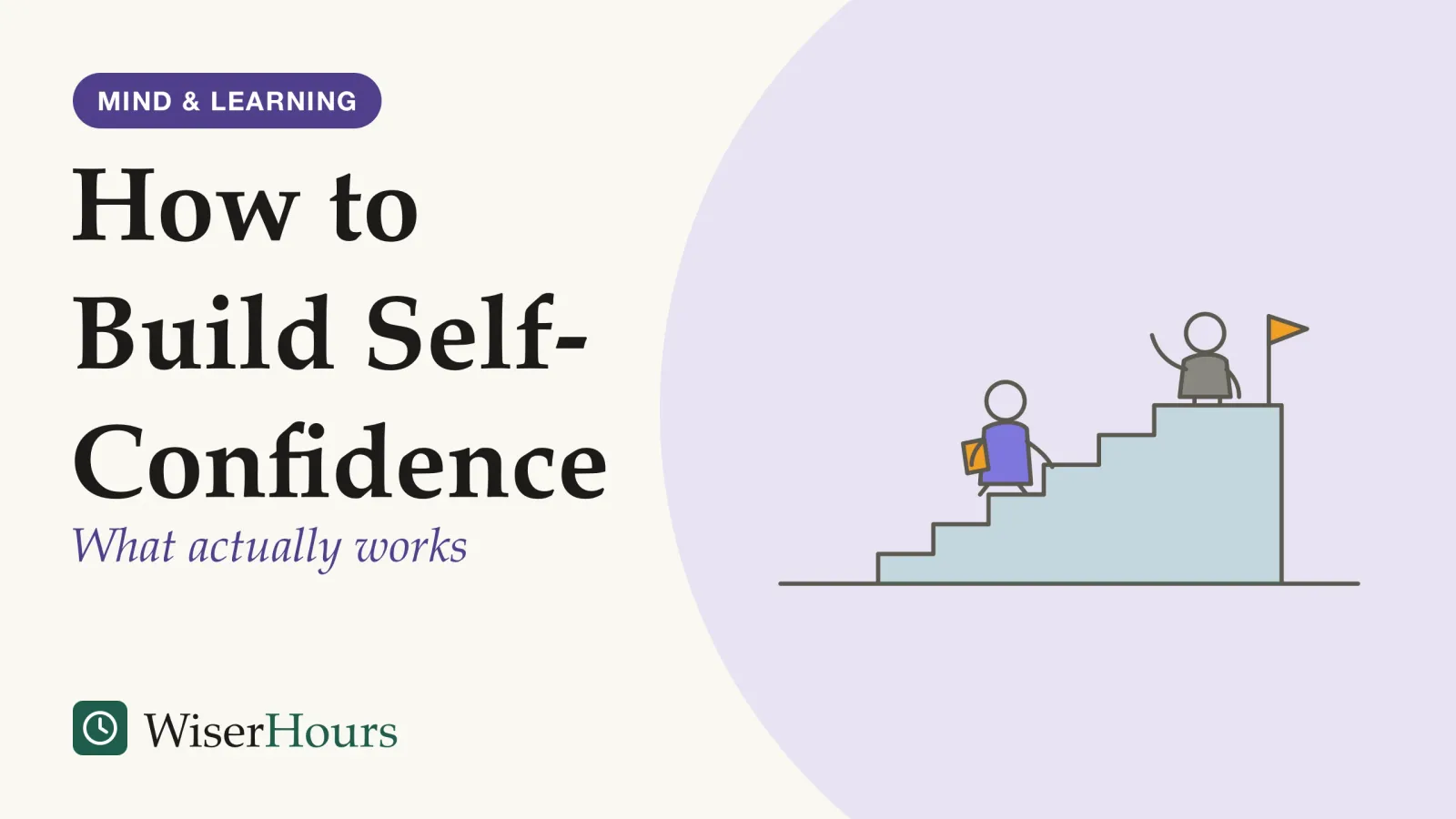
Confidence is mostly earned from what you have already done, not summoned before you start. Psychologist Albert Bandura of Stanford University set out the idea in 1977: belief in your ability to handle a specific task, which he called self-efficacyself-efficacy: A person's belief in their ability to carry out a particular task or reach a particular goal. It is specific to the task, so someone can feel capable at work and unsure with money, and it goes with how readily people start and keep going.Full entry in the glossary, grows from four kinds of experience, starting with doing the task yourself.1 In a 2013 meta-analysis of studies that followed the same people over time, Traci Sitzmann and Gillian Yeo found that confidence tracked past performance far more than it drove the next result.2
That makes how to build self confidence a practical question: which of those experiences can you set up this week? Five steps, starting with the source Bandura ranked most effective:
- Stack small wins in graded steps
- Rehearse until the task feels familiar
- Watch someone like you succeed
- Ask for feedback on the work
- Read your nerves as energy
Power poses and repeated affirmations, the popular shortcuts, have the weakest support.
Prefer to watch? The video covers the same ground as this article.
Where confidence comes from: Bandura’s four sources
Bandura’s 1977 theory in Psychological Review names four sources of self-efficacy: performance accomplishments, vicarious experience, verbal persuasion and physiological states.1 The four are what you have done, what you have seen people like you do, what credible people tell you, and how you read your body and mood as a task approaches.
The four are not equal. In a 1994 overview, Bandura called mastery experiences the most effective way to build a strong sense of efficacy: successes build the belief, and failures undermine it, especially early on. He added a twist: a run of easy successes teaches you to expect quick results and leaves you easily discouraged, so a sturdy belief comes from getting past obstacles through sustained effort.3
- Mastery experiences: succeeding at the task yourself, including getting past setbacks
- Vicarious experience: seeing people similar to you succeed through effort
- Social persuasion: being told, credibly, that you can do it
- Physical and emotional states: how you read your nerves, tiredness and mood
Later research agrees on what sits at the top. Angela Byars-Winston of the University of Wisconsin-Madison and colleagues pooled 61 studies of academic self-efficacy in a 2017 meta-analysismeta-analysis: A study that combines the results of earlier studies on the same question into one overall estimate. Pooling makes the estimate more precise, but it cannot repair the studies it pools: a meta-analysis of surveys is still survey evidence.Full entry in the glossary, and performance accomplishments had by far the strongest link with it once the other three sources were taken into account.4 These are correlations from studies of students, so they show which source travels with confidence rather than proving that it causes it.
For an illustrative case, picture a new team lead who dreads chairing the weekly meeting. A colleague’s “you’ll be great” lifts her for an evening; what changes her view is chairing a few meetings that go acceptably, then steadying one that drifts.
Treat confidence as specific: the aim is to collect proof that you can do this particular thing, at this level. That is a narrower idea than a mindset about whether ability can grow, and easier to act on.
Confidence follows performance more than it leads
Waiting to feel confident before you act gets the order mostly backward, according to Sitzmann and Yeo’s 2013 meta-analysis in Personnel Psychology, which pooled studies that measured confidence and performance in the same people again and again.
The study
Moderate evidence
Belief trails the result when people are followed task after task
Within the same person, past performance and later confidence were correlated at about .40, and still at about .30 after allowing for people’s general improvement over time. Confidence and the next performance looked linked at first (.23), but the link fell to a weak, non-significant .06 once that trend was removed. The authors concluded that self-efficacy is mainly a product of past performance rather than the force behind future performance.2
This does not make confidence useless. A 1998 meta-analysis of 114 studies by Alexander Stajkovic and Fred Luthans found a clear positive correlation between self-efficacy and work performance.5 The two travel together, but much of the traffic runs from doing to believing.
If you want to feel sure of yourself when presenting, the better-supported route is to present, in low-stakes settings first, and let the feeling catch up with the record.
How to build self confidence in five steps
These five steps turn Bandura’s sources into habits, starting with the one he ranked most effective. They are for ordinary nerves and self-doubt, not a treatment for anxiety or depression.
1. Stack small wins in graded steps
Break a daunting task into steps small enough that you will probably succeed at the first, and raise the difficulty after each success. Bandura wrote that good confidence builders set up situations that bring success, avoid pushing people too early into likely failure, and measure success by self-improvement rather than by beating others.3
- 1Speak onceone comment in a small meeting
- 2Present one slideto your own team
- 3Run one agenda itemincluding the questions
- 4Chair the meetingafter a few smooth runs
The evidence on how to package this is mixed, though. UK researchers led by Stefanie Ashford of Coventry University pooled 27 exercise-promotion studies in 2010 and found that programs using a technique labelled graded mastery were linked to lower exercise self-efficacy, not higher.6 That is one field and a comparison across programs, but it is a warning that a step plan on paper is not a success. Each rung only counts if you clear it, so make the first ones almost too easy.
Setbacks will come, and getting past them is what makes the belief durable; how to meet a flop without harsh self-judgment is the subject of Kristin Neff’s research on self-compassion.
2. Rehearse until the task feels familiar
Rehearsal is mastery experience you can collect in private. Bandura’s 1977 paper proposed that persisting at activities that feel threatening but are in fact fairly safe builds self-efficacy through experiences of mastery.1 Rehearsing a talk aloud or doing a mock interview gives you small, real successes before the one that counts.
Make it close to the real thing: stand up, rehearse the opening until you can say it without notes, use the room or video tool you will use on the day, and invite one friendly listener.
3. Watch someone like you succeed
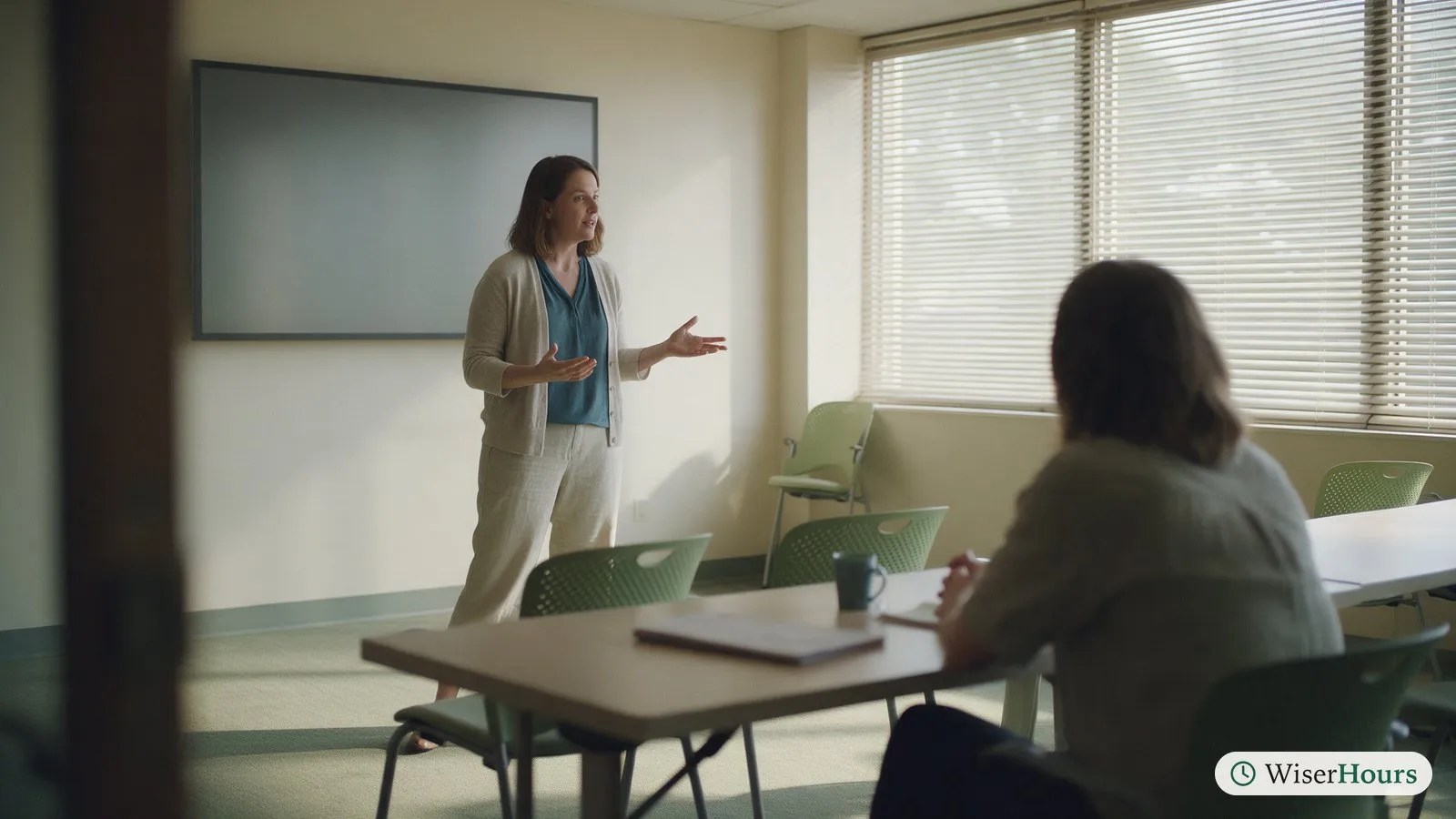
Seeing a peer succeed through effort raises your belief that you can too, Bandura wrote in 1994, and he stressed that the effect depends on similarity: the more a model seems like you, the more their success or failure counts. Good models also pass on skills and strategies as well as proof that it can be done.3 In the 2010 exercise meta-analysis, programs that used vicarious experience were linked to higher self-efficacy.6
That is why a colleague a year ahead of you is often a better model than a celebrated expert: a star shows what excellent looks like, while a peer who was nervous last year shows the route. Ask about their first attempts, and watch them handle a real task.
4. Ask for feedback on the work
Feedback that shows your progress has some of the better support among confidence builders. In the 2010 meta-analysis, interventions that gave feedback on people’s past performance or on other people’s performance were linked to the highest self-efficacy of any technique in the review.6
Feedback can also backfire. When Avraham Kluger and Angelo DeNisi pooled feedback studies in a 1996 meta-analysis, feedback improved performance on average, yet over a third of the interventions made it worse, and the more a message pulled attention off the task and onto the person, the less it helped.7
Ask about the work instead: “Which part of the proposal was hardest to follow?” rather than “Was I any good?” After each attempt, jot down one thing that went better than last time, so progress stays visible. If every good review still feels like luck, the pattern is described in why so many capable people feel like frauds.
5. Read your nerves as energy
Bandura argued that what matters is how you interpret a pounding heart: people with high self-efficacy tend to read arousal as energizing, while people beset by self-doubt read it as a sign they will do badly.3 Harvard Business School researcher Alison Wood Brooks described a series of experiments in 2014: people who reappraised pre-performance anxiety as excitement, such as by saying “I am excited” aloud, reported more excitement and did better than people who tried to calm down, on tasks that included public speaking.8 When US researchers repeated the speech experiment in 2025 with 74 university students, saying “I am excited” again raised excitement, but judges rated the speeches no better, and the students felt no more capable of public speaking.9
Keep expectations modest. Swiss researchers Michel Bosshard and Patrick Gomez, of the Universities of Bern and Lausanne, combined 35 randomized studies of reappraisal-type messages in a 2024 meta-analysis. Performance improved slightly on average, and less once they adjusted for likely missing small studies; they saw a promising, low-cost tool rather than a silver bullet.10
When your pulse jumps before a talk or a difficult call, name it as your body getting ready, and begin.
A week of confidence practice
Download PDF
Why the popular shortcuts rank lowest
Quick confidence tricks rest on thin evidence, and psychology’s record on replication is a reason for caution. In 2015 the Open Science Collaboration, a large group of researchers, repeated 100 published psychology studies and got statistically significant results in about a third of them, with effects on average half the size of the originals.11
Power poses are the best-known example. A team led by economists Eva Ranehill and Anna Dreber ran a 2015 replicationreplication: Running a study again with fresh data and the same method, to see whether the original result comes back. A finding that fails to replicate is not automatically wrong, but it stops being something you can lean on.Full entry in the glossary with 200 people: an expansive stance raised how powerful people said they felt, but hormone levels and risk-taking did not budge.12 A 2022 pooled analysis led by Robert Körner, covering 88 studies, found posture effects on self-rated feelings and some behavior, none on physiological measures, and cautioned that publication biaspublication bias: The tendency for studies with striking or statistically significant results to be published, while quieter ones stay in the drawer. Since the missing studies are mostly the unimpressive ones, a pooled result tends to overstate the effect until it is corrected.Full entry in the glossary or outliers may have inflated the behavioral results.13
- Myth
- A power pose before a big moment shifts your hormones and makes you bolder.
- Fact
- When 200 people were tested in a 2015 replication, poses left hormones and risk-taking unchanged; only self-reported feelings of power rose.
Repeated affirmations may backfire for the people who want them most. In two experiments, Joanne Wood and colleagues at Canada’s University of Waterloo found that people with low self-esteem who repeated “I’m a lovable person” felt worse than those who did not, while people with high self-esteem felt better only to a limited degree.14 It is one paper, so hold it as an early warning, not a settled finding.
A stance struck in a restroom before an interview may lift how powerful you feel, but it adds nothing to what you know you can do. Spend your practice time on the first four steps, which give you real evidence of competence, and treat poses and slogans as optional extras.
Evidence at a glance
| What it is | What the best evidence found | Evidence |
|---|---|---|
| Small wins, step by step | Performance accomplishments had the strongest link with academic self-efficacy | Meta-analysis of correlational studies of students; moderate for the link, not for cause4 |
| Confidence before action | Confidence followed past performance more than it predicted the next result | Meta-analysis of within-person studies; moderate2 |
| Seeing peers succeed and progress feedback | Both went with higher exercise self-efficacy; persuasion and graded mastery went with lower | Meta-analysis of 27 program studies; limited, one field6 |
| Feedback in general | Improved performance on average; over a third of interventions made it worse | Meta-analysis, 1996; moderate7 |
| Reading nerves as excitement | Slight performance gain, shrinking after adjustment for likely missing studies | Meta-analysis of randomized studies; moderate, small effect10 |
| Power poses | Hormones and risk-taking unchanged; self-reported power rose | Replication trial of 200 people; moderate12 |
| Repeated positive affirmations | People with low self-esteem felt worse after repeating one | Two experiments in one paper; limited14 |
Where self-doubt ends and a health problem begins
Everyday self-doubt usually eases with practice, but social fear that disrupts daily life, or low self-worth with lasting low mood, can be a health condition. The World Health Organization describes social anxiety disorder as intense fear and worry about social situations in which a person might feel humiliated, embarrassed or rejected, and says effective treatments exist, with therapies grounded in cognitive behavioral therapycognitive behavioral therapy: A structured talking therapy that works on the links between thoughts, feelings and behavior, usually over a set number of sessions with practice between them. It is given by a trained therapist or through guided programs, and versions exist for specific problems.Full entry in the glossary having the strongest evidence; these include exposure therapy, in which people learn to face their fears, a treatment rather than the everyday step ladder above.15 Match the step to the urgency:
- Now, in a crisis: if you are thinking about harming yourself or feel unable to stay safe, call your local emergency number or a crisis line; WHO’s own guidance is to reach any emergency service or crisis line you can.16 As national examples, the US National Institute of Mental Health names 911 for life-threatening situations, plus the 988 Suicide & Crisis Lifeline by phone or text.17 The UK’s NHS says to ring 999 or go to A&E straight away if someone’s life is at risk.18
- Soon, within days or weeks: see a doctor or another health professional if low mood or a loss of interest has lasted most of the day, nearly every day, for two weeks or more, particularly alongside low self-worth or hopelessness. WHO describes that pattern as a possible depressive episode.16
- Routinely, at your next appointment or earlier if it is getting worse: raise a fear of being judged that makes you avoid meetings, phone calls or meals with others. England’s NHS describes social anxiety as more than shyness and lets people there self-refer to an NHS talking therapies service without going through a GP first.19 Elsewhere, a family doctor or your national health service is a sensible first stop.
The bottom line
Confidence is built mostly the way Bandura described nearly fifty years ago: by doing the thing in steps you can manage, watching people like you do it, and getting honest feedback on the work. Start this week with one specific task and the smallest version of it you can finish. If fear of judgment or low self-worth is shrinking your life, see a professional.
This article is general information, not medical advice. If you're worried about your health, talk to a doctor or another qualified professional.
Frequently asked questions
How quickly can self-confidence grow?
There is no set timeline, because confidence grows task by task rather than all at once. Albert Bandura wrote in 1994 that easy, quick successes leave people easily discouraged by failure, and that a durable sense of efficacy comes from getting past obstacles through sustained effort. Expect it to build over repeated attempts at the same kind of task, including a few that go badly.
Can you be too confident?
Yes, if the confidence runs well ahead of the evidence. Bandura argued in 1994 that people who misjudge themselves usually overestimate, and he saw a modest overestimate as useful because it pushes people to aim a little higher. He also warned that unrealistic boosts are quickly disproved by disappointing results, so confidence that is not backed by practice tends not to last.
Does encouragement from other people build confidence?
A little, and less than doing the task yourself. Bandura wrote in 1994 that it is harder to build belief in your ability through persuasion alone than to undermine it, and that the best encouragers also set up situations where people can succeed. In a 2010 meta-analysis of exercise programs, persuasion was linked to lower self-efficacy, not higher.
Sources
- Self-efficacy: Toward a unifying theory of behavioral change. Bandura, A. (1977). Psychological Review, 84(2), 191-215
- A Meta-Analytic Investigation of the Within-Person Self-Efficacy Domain: Is Self-Efficacy a Product of Past Performance or a Driver of Future Performance? Sitzmann, T. & Yeo, G. (2013). Personnel Psychology, 66(3), 531-568
- Self-efficacy. Bandura, A. (1994). In V. S. Ramachaudran (Ed.), Encyclopedia of Human Behavior, Vol. 4, 71-81. Academic Press. Read via an archived copy of the author's text
- Unique effects and moderators of effects of sources on self-efficacy: A model-based meta-analysis. Byars-Winston, A., Diestelmann, J., Savoy, J. N. & Hoyt, W. T. (2017). Journal of Counseling Psychology, 64(6), 645-658
- Self-efficacy and work-related performance: A meta-analysis. Stajkovic, A. D. & Luthans, F. (1998). Psychological Bulletin, 124(2), 240-261
- What is the best way to change self-efficacy to promote lifestyle and recreational physical activity? A systematic review with meta-analysis. Ashford, S., Edmunds, J. & French, D. P. (2010). British Journal of Health Psychology, 15(2), 265-288
- The effects of feedback interventions on performance: A historical review, a meta-analysis, and a preliminary feedback intervention theory. Kluger, A. N. & DeNisi, A. (1996). Psychological Bulletin, 119(2), 254-284
- Get excited: Reappraising pre-performance anxiety as excitement. Brooks, A. W. (2014). Journal of Experimental Psychology: General, 143(3), 1144-1158
- Getting Excited About Public Speaking: A Replication. Poynter, M. & Smith Pasqualini, M. (2025). Psychology of Language and Communication, 29(1), 254-265
- Effectiveness of stress arousal reappraisal and stress-is-enhancing mindset interventions on task performance outcomes: a meta-analysis of randomized controlled trials. Bosshard, M. & Gomez, P. (2024). Scientific Reports, 14, 7923
- Estimating the reproducibility of psychological science. Open Science Collaboration (2015). Science, 349(6251)
- Assessing the Robustness of Power Posing: No Effect on Hormones and Risk Tolerance in a Large Sample of Men and Women. Ranehill, E., Dreber, A., Johannesson, M., Leiberg, S., Sul, S. & Weber, R. A. (2015). Psychological Science, 26(5), 653-656
- Dominance and prestige: Meta-analytic review of experimentally induced body position effects on behavioral, self-report, and physiological dependent variables. Körner, R., Röseler, L., Schütz, A. & Bushman, B. J. (2022). Psychological Bulletin, 148(1-2), 67-85
- Positive self-statements: Power for some, peril for others. Wood, J. V., Perunovic, W. Q. E. & Lee, J. W. (2009). Psychological Science, 20(7), 860-866
- Anxiety disorders. World Health Organization, fact sheet, 15 September 2026
- Depressive disorder (depression). World Health Organization, fact sheet, 11 September 2026
- Help for Mental Illnesses. National Institute of Mental Health, US National Institutes of Health (page last reviewed April 2026)
- Where to get urgent help for mental health. NHS (UK), page last reviewed 26 April 2023
- Social anxiety (social phobia). NHS (UK), page last reviewed 17 May 2023
How we researched this
We searched PubMed, Crossref, OpenAlex and APA PsycNet in September 2026 for Bandura's theory, meta-analyses of self-efficacy and its sources, feedback and anxiety reappraisal, and replications of popular confidence tricks, and read WHO, NIMH and NHS pages for help routes. Sources date from 1977 to 2026. Main limitation: several meta-analyses were read at abstract level only, and much of the evidence is correlational or comes from students.
Keep reading
"Fake It Till You Make It": Does Acting Confident Work?
Does fake it till you make it work? A 17-lab test of the famous smile study found no effect. Acting confident helps most by getting you to practice.
Rejection Sensitivity: Why Some People Feel It More Deeply
Rejection sensitivity, as defined by psychologists in 1996, is anxiously expecting, readily seeing and strongly reacting to rejection. Its causes are unsettled.
Toxic Positivity: When Looking on the Bright Side Does Harm
Toxic positivity meets pain with forced cheer. A 40-country study links pressure to feel happy with worse well-being. Examples, and what to say instead.
Delayed Gratification: How to Get Better at Waiting for What You Want
Delayed gratification is easier to set up than to force. 4 evidence-based ways to wait for money, food, screens or goals, and when waiting is not worth it.