Toxic Positivity: When Looking on the Bright Side Does Harm
Toxic positivity meets pain with forced cheer. A 40-country study links pressure to feel happy with worse well-being. Examples, and what to say instead.

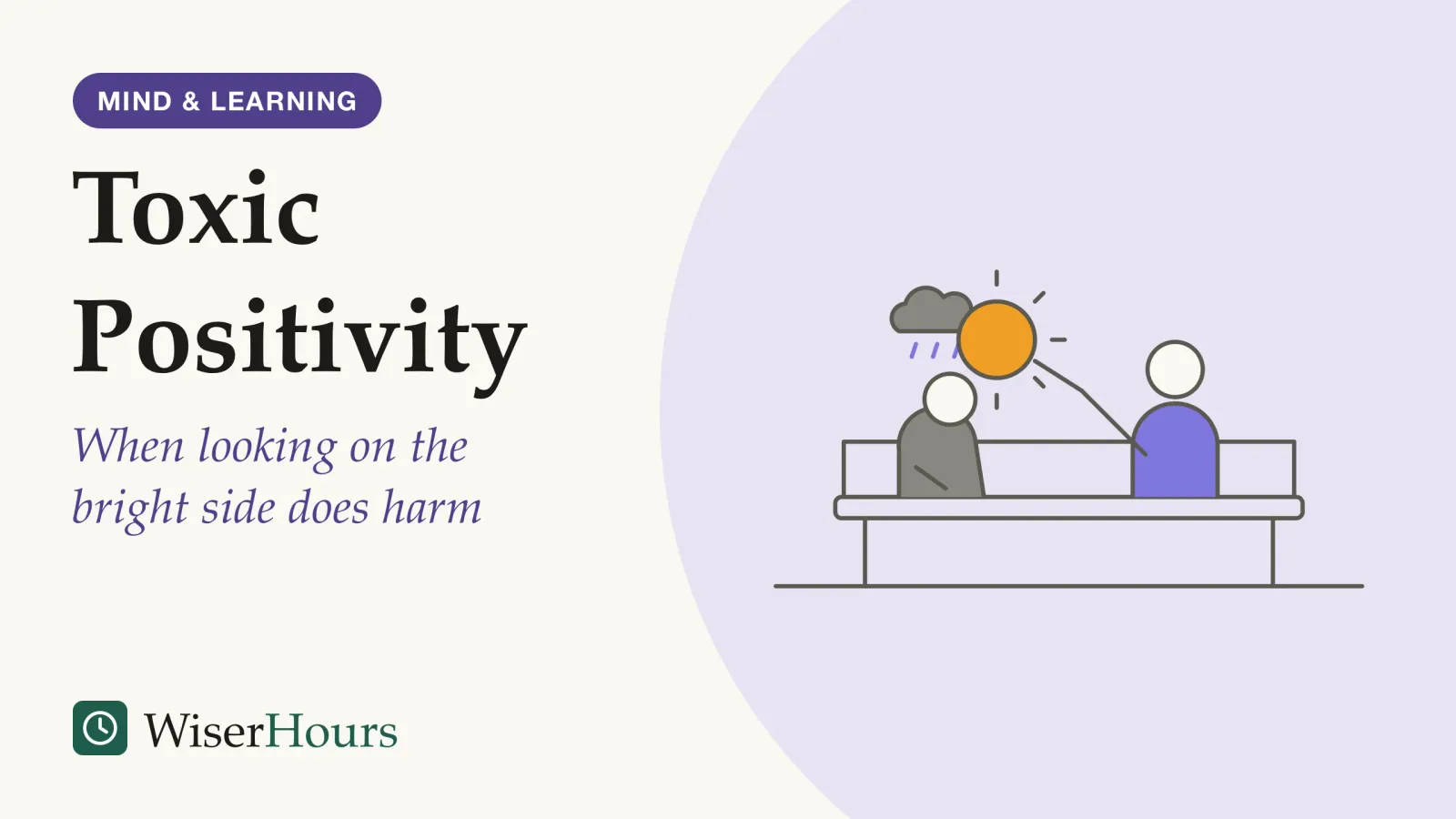
Telling a friend who has just lost a job to look on the bright side is meant kindly, yet it can tell them their worry is not welcome. Toxic positivity is the name for that pressure to stay upbeat however bad things get, and for the reflex of answering sadness, anger or fear with a cheerful line instead of listening. Wikipedia describes it as handling emotions without fully admitting the negative ones and, between people, as dismissing someone’s negative emotion by suggesting a positive one instead.1 It is an everyday label rather than a diagnosis, and the research behind it is mostly about hiding, judging and accepting feelings.
In a 2022 survey of 7,443 people, most of them university students, in 40 countries, those who felt more societal pressure to be happy and not sad reported lower well-being, and the link was strongest in the happiest nations, according to Egon Dejonckheere and an international team.2 Everyone answered once, so the result shows that pressure and lower well-being travel together, not which comes first. Beliefs about which feelings are allowed are part of how the beliefs you hold shape what you do.
When someone is struggling, name what they feel, listen, and ask what would help before you reach for a silver lining. Phrases that work better are in the table below the examples.
What is toxic positivity? A name for an everyday habit
Toxic positivity is cheerfulness used against a feeling that fits the moment. Wikipedia separates it from positivity in general, which it calls a usually helpful attitude: positivity turns toxic when it rejects negative feelings that fit the situation, such as grief after a loss.1
Definition
Toxic positivity is the belief or pressure that you should stay positive whatever happens, shown by dismissing sad, angry or anxious feelings, your own or someone else’s, instead of acknowledging them.
The term is young: Wikipedia reports that it first appeared in the scholar Jack Halberstam’s 2011 book The Queer Art of Failure, and that searches for it began to climb around 2019.1 A 2026 scoping review by two researchers at Christ University in Bangalore, India, which charted 59 academic and other sources, found that toxic positivity still has limited research of its own, no standard definition and no validated way to measure it.3 Most of the evidence for its harms therefore comes from older research on hiding, judging and accepting emotions.
The test is whether a sentence leaves room for the feeling that is there. “At least you learned a lot” may be true, but said first to a colleague whose project was just cancelled, it tells them the disappointment is unwelcome.
Examples of toxic positivity, from grief to the group chat
Toxic positivity shows up wherever a hard feeling meets an unwritten rule against it. The health site Medical News Today lists typical examples: telling a bereaved person to focus on the good things in their life, saying “everything happens for a reason” after a catastrophe, brushing off a worry with “it could be worse”, and treating people who always look cheerful as stronger or more likable.4
Everyday versions, as illustrations:
- To a friend after a breakup: “Plenty more fish in the sea.”
- To a colleague after a layoff: “Everything happens for a reason.”
- In a team chat after a bad quarter: “No negativity here, let’s keep the energy up.”
- To yourself, late at night: “Other people have it worse, so I have no right to feel this.”
Toxic positivity often turns inward, and researchers who study acceptance measure its opposite with statements such as telling yourself you shouldn’t be feeling the way you’re feeling.5 People usually mean well; the trouble is that the listener learns the feeling is a problem to fix fast.
- Myth
- Staying positive no matter what is the healthy way to cope.
- Fact
- Positivity helps when it sits beside a hard feeling. Insisting on it in place of that feeling is what research links to more distress.
Listen for sentences that start with “at least” or “just”; they often do the dismissing.
What to say instead of toxic positivity
What to say instead of toxic positivity is usually less: name the feeling, show you heard it, and ask what would help before offering any bright side. The reason is that a cheerful reply, however kind, tells the other person which feelings are allowed, and the international survey above linked a wider form of that pressure, felt from society as a whole, with lower well-being.2
| Instead of | Why it can sting | Try |
|---|---|---|
| “Everything happens for a reason.” | Asks for meaning before the loss has sunk in | “I’m so sorry. This is really hard.”4 |
| “It could be worse.” | Ranks the pain and finds it too small | “That sounds tough. Do you want to talk about it?”4 |
| “Just stay positive.” | Turns the feeling into a failure | “It makes sense that you feel this way.”5 |
| “Focus on the good things.” | Skips the part that hurts | “What’s been the hardest part?”4 |
| “Good vibes only.” | Tells people to keep problems to themselves | “What’s worrying you about this?”2 |
Each line in the right column shows the feeling is welcome; the exact words matter less. A silver lining can come later, ideally one the other person finds. If a friend’s parent gets a serious diagnosis, “Stay strong, they’ll beat it” leaves no room for fear, while “That’s frightening. How are you doing?” lets them say what they feel. On yourself, “I’m worried, and that makes sense” is acceptance, not giving up.
Why toxic positivity is harmful: hidden feelings do not leave
Toxic positivity can do harm by asking people to hide feelings, and hiding them is linked to real costs. In five studies reported in 2003, James Gross of Stanford University and his colleague Oliver John linked habitually suppressing emotions to more negative emotion, worse relationships and lower well-being.6
In their summary, people who habitually suppressed expressed and felt less positive emotion, yet still experienced more negative emotion.6 Hiding a feeling changes the face more than the feeling. People who habitually reappraised, rethinking what a situation meant, showed the opposite pattern.
The cost may depend on culture. In a 2007 Stanford study led by Emily Butler, Americans holding Western-European values who hid their feelings in a face-to-face conversation came across as less responsive, and their partners saw them more negatively; those effects were smaller when people with more Asian cultural values did the hiding.7
Picture the colleague who says “I’m fine, honestly” through a tight smile. Telling someone to cheer up usually asks them to hide a feeling they still have.
Pressure to feel happy can make sadness heavier
Believing that other people expect you not to be sad can make sadness worse. Across four studies reported in 2012, Brock Bastian and colleagues found that when people thought others expected them not to feel negative emotions, they felt sad more often and more intensely, partly because they judged themselves for it; two of the studies were experiments.8
The effects showed up in Australia and, less strongly, in Japan.8 A later online diary studydiary study: A study in which people record what they do or feel repeatedly, often daily or when prompted at random moments, close to when it happens; the prompted form is called experience sampling. It relies less on memory, but it is still self-report.Full entry in the glossary, published in 2017 by researchers at KU Leuven in Belgium, followed just over 100 people with raised depression scores for a month: feeling social pressure not to be sad or anxious tended to come before a rise in symptoms, but rising symptoms did not predict more felt pressure.9
Even valuing happiness too much can backfire. In a small 2011 US experiment, Iris Mauss and colleagues had women read a mock newspaper article praising the benefits of happiness. When they then watched a happy film clip, they reported feeling less happy than women who had read the same article praising accurate judgments instead, and their disappointment with their own feelings explained the gap.10 In a companion survey of women in the Denver area, valuing happiness more went with lower well-being, but only among women with little recent stress.10
The authors suggest that people who make happiness a target feel let down when it does not arrive, most of all when life is going well.10 Both samples were US women, so the result needs wider testing. Treat happiness as something that turns up, rather than a score you are failing to hit.
- Judge the feeling telling yourself you should not feel this way can add a second layer: feeling bad about feeling bad
- Accept the feeling letting the feeling be there without judging it went with less negative emotion when stress hit
Accepting a bad feeling is linked to less distress
Accepting a negative feeling without judging it is linked to better mental health, and to smaller emotional reactions when stress hits. The clearest evidence comes from three 2018 studies by Brett Ford of the University of Toronto and colleagues at Berkeley.5
The study
Limited evidence
Ford and colleagues (2018): accepting feelings, studied three ways
In about 1,000 undergraduates, people who habitually accepted their emotions and thoughts reported better psychological health, including lower depression and anxiety symptoms. In a lab stress test with 156 women, acceptance went with less negative emotion while giving a speech. In 222 adults from the Denver area, acceptance went with less negative emotion during daily stressors, which in turn accounted for better psychological health six months later.5
Acceptance was not linked to more positive emotion; it seemed to stop people adding a layer of distress on top. The benefit was specific to accepting thoughts and feelings: accepting a bad situation itself showed no such link. The authors say experiments that change acceptance directly are still needed before calling it a cause.5
In practice that can mean naming the feeling (“I’m disappointed”), letting it be there without arguing with it, then deciding what, if anything, to do. Acceptance sits close to self-compassion, offering yourself the kindness you would give a friend.
Optimism and toxic positivity: where the line falls
The difference between optimism and toxic positivity is whether the hard part is allowed in. Optimism expects things to work out while still seeing the problem; toxic positivity refuses to look at the problem or the feeling. Wikipedia describes healthy positivity as acknowledging sadness, anger and jealousy while pushing for growth through setbacks.1
Optimism has real support. A 2009 meta-analysismeta-analysis: A study that combines the results of earlier studies on the same question into one overall estimate. Pooling makes the estimate more precise, but it cannot repair the studies it pools: a meta-analysis of surveys is still survey evidence.Full entry in the glossary of 83 studies by Heather Rasmussen and colleagues found that more optimistic people tended to have better physical health outcomes, a modest association that was larger when health was self-reported.11 Rethinking what a situation means works too: a 2012 meta-analysis of 306 experimental comparisons by Thomas Webb and colleagues found that changing how you think about a situation shifted emotions by a small-to-medium amount, while trying to suppress the feeling itself did not work.12
So the line is about timing and permission. A reframe you reach yourself, after the feeling has had its say, is a coping skill; the same words pressed on someone in place of what they feel are the toxic kind. Recovering from a setback, the subject of research on resilience, does not require pretending it did not hurt.
Good vibes only: forced cheer at work
At work, toxic positivity usually arrives as a rule, spoken or not, that people should look upbeat whatever happens. Showing feelings you do not have is part of emotional labor, managing feelings as part of a job, and the faking has a cost: a 2011 meta-analysis of 95 studies, led by Ute Hülsheger, linked surface acting, showing emotions you do not feel, with signs of poorer well-being.13
Because the review pools correlations, it cannot say which way the arrow points.13 Familiar versions include a cheerful all-hands meeting during layoffs, or a manager who meets every concern with “let’s focus on solutions”. Where worry counts as negativity, people have a reason to sit on bad news. Managers can make room for the hard part on purpose: ask “what’s worrying you?” as a regular question, treat raising a problem as useful rather than negative, and say plainly when news is bad.
If sadness lingers: where to turn
A low mood that will not lift calls for care rather than more effort at cheer. The World Health Organization describes a depressive episode as a low, irritable or empty mood, or a loss of interest, that lasts most of the day, almost every day, for two weeks or more. It notes that effective care exists, with psychological treatments offered first, and encourages anyone with symptoms to seek it.14
- Now: thoughts of suicide or self-harm, or feeling unable to stay safe, mean contacting your local emergency number or a crisis line straight away.14 US readers, for example, can call or text 988, and dial 911 if someone’s life is at stake.15 UK readers can call 999 or go to the nearest A&E department.16
- Soon: when a low, hopeless or flat mood has lasted at least two weeks, book an appointment with a doctor or nurse. People in England can reach mental health help through NHS 111, and in the UK Samaritans offers a free listening line on 116 123.16 Elsewhere, ask a family doctor or your national health service what support is available locally.
- Next check-up: mention it if you find you always shove hard feelings aside, or have nobody you can tell when things are bad.
The bottom line
Accepting a hard feeling, your own or someone else’s, is linked to less distress, and hiding or judging it to more. When someone is struggling, name what they feel and listen first, then let any bright side come later. If low mood lasts, get help.
This article is general information, not medical advice. If you're worried about your health, talk to a doctor or another qualified professional.
Frequently asked questions
Can you be toxically positive toward yourself?
Yes. The same pattern can run inward, as in telling yourself you should not feel the way you feel, or that others have it worse so you have no right to be upset. Brett Ford and colleagues measured this kind of self-judgment in their 2018 studies and found that people who did less of it, and accepted their feelings instead, reported better psychological health.
Is gratitude a form of toxic positivity?
Not in itself. Gratitude becomes part of toxic positivity when it is used to shut a feeling down, as in telling a grieving person to focus on the good things in their life, which Medical News Today lists as a typical example. Noticing what is still good, once the loss has been acknowledged, is a different thing.
Does toxic positivity look the same in every culture?
Probably not. In a 2007 study, Emily Butler and colleagues found that hiding emotions had smaller social costs for people holding more Asian cultural values than for Americans with Western-European values. A 2022 international survey found that pressure to be happy went with worse well-being most strongly in the happiest nations. Norms about feelings differ, and so does their weight.
Sources
- Toxic positivity. Wikipedia, accessed 11 October 2026
- Perceiving societal pressure to be happy is linked to poor well-being, especially in happy nations. Dejonckheere, E., Rhee, J. J., Baguma, P. K., et al. (2022). Scientific Reports, 12, 1514
- Conceptualising toxic positivity: definition, dimensions, antecedents and consequences: a scoping review of the literature. Premlal, D. & K., A. J. (2026). Cognition and Emotion, advance online publication, 1-20
- What to know about toxic positivity. Villines, Z. (31 March 2021). Medical News Today, medically reviewed by Jacquelyn Johnson, PsyD
- The psychological health benefits of accepting negative emotions and thoughts: Laboratory, diary, and longitudinal evidence. Ford, B. Q., Lam, P., John, O. P. & Mauss, I. B. (2018). Journal of Personality and Social Psychology, 115(6), 1075-1092
- Individual differences in two emotion regulation processes: Implications for affect, relationships, and well-being. Gross, J. J. & John, O. P. (2003). Journal of Personality and Social Psychology, 85(2), 348-362
- Emotion regulation and culture: Are the social consequences of emotion suppression culture-specific? Butler, E. A., Lee, T. L. & Gross, J. J. (2007). Emotion, 7(1), 30-48
- Feeling bad about being sad: The role of social expectancies in amplifying negative mood. Bastian, B., Kuppens, P., Hornsey, M. J., Park, J., Koval, P. & Uchida, Y. (2012). Emotion, 12(1), 69-80
- Perceiving social pressure not to feel negative predicts depressive symptoms in daily life. Dejonckheere, E., Bastian, B., Fried, E. I., Murphy, S. C. & Kuppens, P. (2017). Depression and Anxiety, 34(9), 836-844
- Can seeking happiness make people unhappy? Paradoxical effects of valuing happiness. Mauss, I. B., Tamir, M., Anderson, C. L. & Savino, N. S. (2011). Emotion, 11(4), 807-815
- Optimism and physical health: A meta-analytic review. Rasmussen, H. N., Scheier, M. F. & Greenhouse, J. B. (2009). Annals of Behavioral Medicine, 37(3), 239-256
- Dealing with feeling: A meta-analysis of the effectiveness of strategies derived from the process model of emotion regulation. Webb, T. L., Miles, E. & Sheeran, P. (2012). Psychological Bulletin, 138(4), 775-808
- On the costs and benefits of emotional labor: A meta-analysis of three decades of research. Hülsheger, U. R. & Schewe, A. F. (2011). Journal of Occupational Health Psychology, 16(3), 361-389
- Depressive disorder (depression). World Health Organization, fact sheet dated 11 September 2026 (checked current 2026-10-11)
- Suicide Prevention. National Institute of Mental Health, US National Institutes of Health (page last reviewed August 2026)
- Where to get urgent help for mental health. NHS (UK), page last reviewed 26 April 2023 (checked 2026-10-11)
How we researched this
We searched Europe PMC, PubMed, OpenAlex and the web in October 2026 for research on emotional suppression, acceptance of negative emotions, valuing happiness and perceived social pressure to be happy, plus definitions of the term. Sources date from 2003 to 2026. We read the Mauss, Ford and Dejonckheere (2022) papers in full and eight others as abstracts only; the term itself has little direct research.
Keep reading
"Fake It Till You Make It": Does Acting Confident Work?
Does fake it till you make it work? A 17-lab test of the famous smile study found no effect. Acting confident helps most by getting you to practice.
Rejection Sensitivity: Why Some People Feel It More Deeply
Rejection sensitivity, as defined by psychologists in 1996, is anxiously expecting, readily seeing and strongly reacting to rejection. Its causes are unsettled.
Delayed Gratification: How to Get Better at Waiting for What You Want
Delayed gratification is easier to set up than to force. 4 evidence-based ways to wait for money, food, screens or goals, and when waiting is not worth it.
How to Build Self-Confidence: What Actually Works
Albert Bandura named 4 sources of confidence in 1977. The evidence favors small wins, peer models and task feedback over power poses and affirmations.