Perfectionism Explained: Healthy Striving vs. the Kind That Hurts
Perfectionism has 2 sides: very high standards, and fear of mistakes with harsh self-judgment. Research ties the second far more closely to distress.

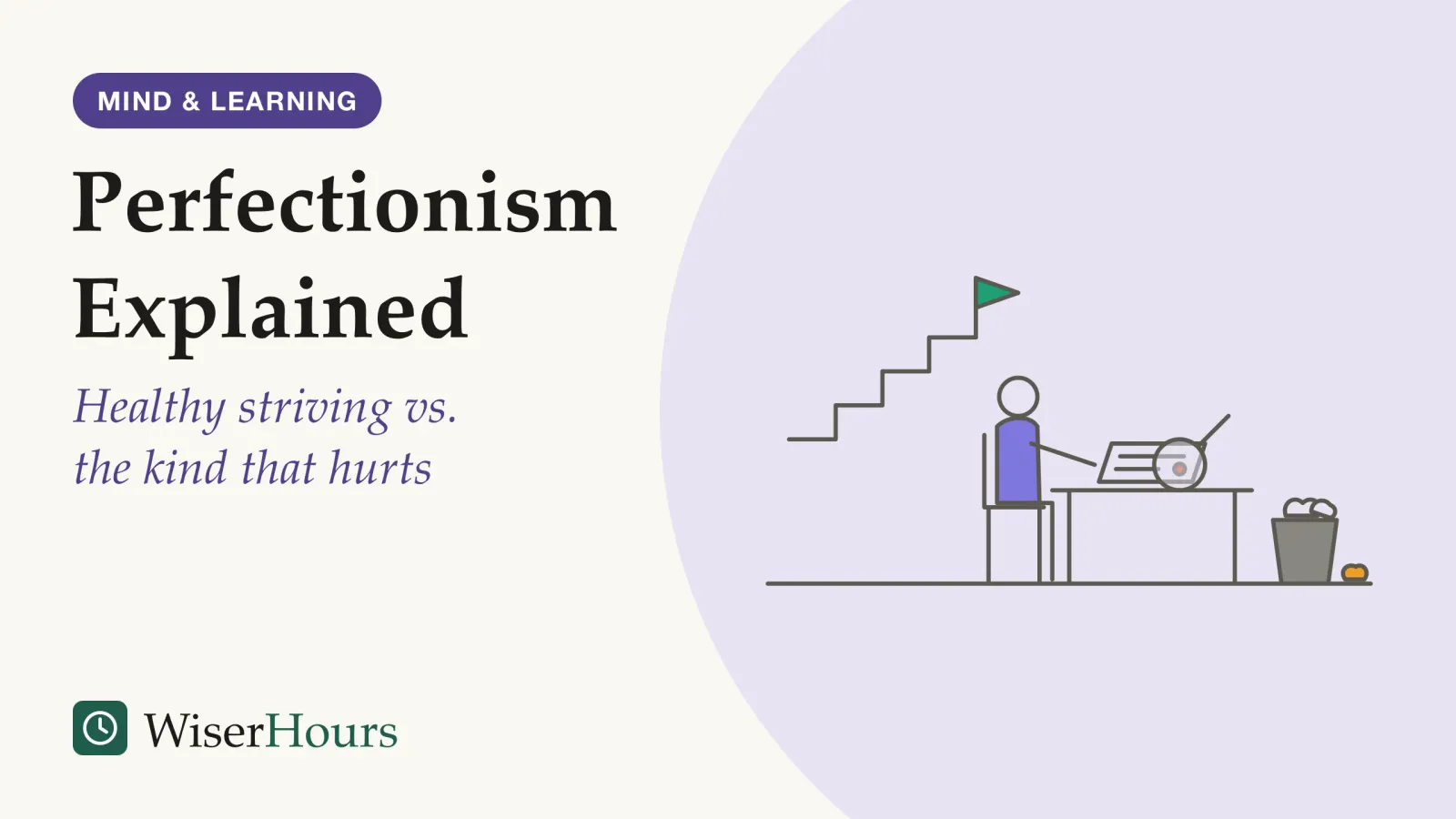
Two colleagues are polishing the same client presentation, and both have rewritten the opening slide four times. One is enjoying the polish and will send the deck at five. The other is replaying a typo from last month and bracing for the client to spot every small flaw. From the outside they look identical, yet research on perfectionism would put them in very different places.
Perfectionism is best understood as two related tendencies: reaching for very high standards, and fearing mistakes, judging yourself harshly and worrying about what others will think. The second is where most of the trouble shows up. A 2017 meta-analysis of studies on perfectionism and mental health found that both tendencies were linked to symptoms of depression, anxiety and eating disorders, but the fear-and-self-criticism side far more strongly for depression and anxiety, in research that was mostly one-off surveys.1
That split matters to anyone who suspects they are a perfectionist, or manages one. You do not have to stop caring about quality; what counts is how you react when the work falls short.
What perfectionism is: high standards plus a fear of falling short
Psychologists define perfectionism as a combination of exceedingly high standards and a preoccupation with harsh self-evaluation, a definition from Randy Frost and colleagues in 1990 that Andrew Hill and Thomas Curran use in their 2016 review. They describe it as a trait with two higher-order dimensions: perfectionistic strivings and perfectionistic concerns.2
Definition
Perfectionism is holding yourself to exceedingly high standards while judging yourself harshly for falling short. Researchers split it into perfectionistic strivings (the high standards) and perfectionistic concerns (the fear of mistakes and of others’ judgment).
Strivings are the self-set push for perfection and very high personal standards. Concerns cover worry about making mistakes, fear of being judged by others, a sense of a gap between what you expected and what you did, and a harsh reaction to anything imperfect. The two tend to rise together, but they are separate enough to measure apart.2
The split is older than the terms. A 1978 proposal already separated “normal” from “neurotic” perfectionism, and a 2006 review by Joachim Stoeber and Kathleen Otto offered a common framework for the later research, including these two dimensions. Their reading of the evidence was that striving is positive as long as a person is not overly worried about mistakes and about others’ negative judgments.3
A second model, from Paul Hewitt and Gordon Flett in 1991, sorts perfectionism by direction instead. As Curran and Hill describe it, self-oriented perfectionism is demanding perfection of yourself; socially prescribed perfectionism is believing that others demand it of you and judge you harshly; and other-oriented perfectionism is demanding it of other people. Curran and Hill call perfectionism a personality trait, which sets it apart from a mindset, a belief about whether abilities can grow.4 In the two-dimension scheme, self-oriented perfectionism usually counts toward strivings, and socially prescribed toward concerns.1
All three directions are easy to picture in an office. The manager who reworks her own report late into the night shows the self-oriented kind; the new hire convinced the team tolerates zero errors shows the socially prescribed kind; the colleague who returns every draft covered in red ink shows the other-oriented kind. In a 2019 meta-analysis of more than 40,000 college students in the US, Canada and the UK, Curran and Hill found that all three rose between 1989 and 2016, the socially prescribed kind most.4 The lesson for now: when you ask whether you are a perfectionist, look past how hard you work to how you treat yourself when you slip, and to whether the pressure comes from you or from what you believe others expect.
Is it striving or self-criticism? A quick way to tell
The research offers no home test, and nothing here is a screening tool, but the definitions point to what to notice. High standards on their own show up as a demanding goal you set for yourself. Perfectionistic concerns show up as fear: of mistakes, of others’ judgment, of the gap between what you planned and what you did.2
The difference is easiest to see after something goes slightly wrong. Say you send a report and spot a small error an hour later. Correcting it in the next version and moving on fits striving. Rereading the report all evening, drafting apologies and dreading what your manager now thinks fits concerns. Both people care about the report; only one of them is treating the error as a judgment on themselves.
If the second answer sounds familiar, that is a pattern worth noticing, not a character flaw. Ways to ease it without dropping your standards are a subject of their own, and where the fear starts to shape your mood, sleep or eating, talking to a professional is a sensible step.
High standards and harsh self-judgment lead to different places
Perfectionistic concerns and perfectionistic strivings point in opposite directions on burnout. In Hill and Curran’s 2016 meta-analysis of 43 studies in workplaces, schools and sport, concerns were clearly linked to more burnout, while strivings had small negative or no links with it.2
The authors explain the gap through self-evaluation. Concerns come with all-or-nothing readings of results, generalizing from one bad event, rumination about past failures and a strong need for validation, so self-worth feels constantly under threat. People then lean on avoidant coping, which keeps the bad feelings going and lets stress pile up. Strivings were not linked to exhaustion, one of burnout’s core symptoms, and once their overlap with concerns was removed, “pure” strivings went with less burnout. In some analyses, work looked like the harshest setting: there, strivings looked less protective and concerns more harmful than in school or sport, perhaps, the authors suggest, partly because a job is harder to walk away from.2 Whether either side makes people put work off is a different question, taken up in the research on why people procrastinate.
Aim your effort at the concerns, not at your standards. The signs to watch for are rereading an email many times for fear of one error, avoiding a task because it might not go well, and treating one piece of criticism as a verdict on you.
Further reading
The Perfection Trap: Embracing the Power of Good Enough
Thomas Curran, whose meta-analyses this article draws on, explains the rise in perfectionism and the pressure behind it.

As an Amazon Associate WiserHours earns from qualifying purchases.
Which side of perfectionism tracks mental health symptoms
Perfectionism is linked to symptoms of several mental health conditions, and mostly through its concerns side. That conclusion comes from a 2017 meta-analysis by Karina Limburg, Hunna Watson, Martin Hagger and Sarah Egan at Curtin University in Australia, which its authors describe as the first to pool this research across many conditions at once.1
The study
Moderate evidence
Limburg and colleagues pool 284 studies to see where the distress sits (2017)
Both dimensions were linked to symptoms of depression, anxiety, obsessive-compulsive disorder (OCD) and eating disorders, and to suicidal thoughts. For depressive symptoms, the average correlation was about .39 for concerns, a moderate link, and about .11 for strivings, a small one. When the two were analyzed together, concerns had the larger unique link for almost every outcome. Some eating disorder symptoms, such as dietary restraint and drive for thinness, were the exception: there, both sides mattered about equally.1
In plain terms, how self-critical and mistake-focused someone is goes with low mood and anxiety much more closely than how high their standards are. Two people with equally demanding goals can differ sharply here: one reads a missed target as a bad week, the other as proof of being inadequate, and in these studies it is the self-critical side, not the height of the goal, that tracks distress. The main caveat is design. Nearly all the pooled research came from surveys taken at one timecross-sectional: Describes a study that measures everyone in its sample at a single point in time. Because the possible cause and the outcome are recorded together, it can show that two things occur together but not which of them came first.Full entry in the glossary, so, as the authors themselves say, it cannot show whether perfectionism comes before the problems or after them; the link could also run the other way, with low mood making people judge their own work more harshly. In the eating disorders research, though, the drive for very high standards itself, not only the fear of failing, was part of the pattern.1
The practical reading follows from that pattern. If low mood or anxiety is what worries you, the self-critical side is the part to watch. If eating is affected, the standards themselves belong in the picture too, and an early word with a doctor makes sense.
Is striving for excellence ever risk-free?
Very high standards are not always harmless, and the debate is live. Martin Smith and colleagues’ 2016 meta-analysis of 10 longitudinal studieslongitudinal study: A study that measures the same people more than once over a period of time, so it can see how they change and which thing came first. Following people over time still does not show that the earlier thing caused the later one.Full entry in the glossary found that every perfectionism dimension they examined, including personal standards and self-oriented perfectionism, predicted a small rise in depressive symptoms later, even after accounting for people’s starting mood and general tendency to negative emotion.5
Why would one-time surveys miss this? On the authors’ reading, high standards may do harm mainly when something goes wrong, such as a failed exam, which a snapshot taken on an ordinary day misses. Picture a consultant with exacting standards who feels fine for months, then takes one rejected proposal as a verdict on her worth. Yet when the authors also accounted for perfectionistic concerns, the link from high standards to later low mood disappeared, a result they caution against over-reading but which fits the view that high standards carry risk partly through their overlap with self-criticism.5
So “healthy perfectionism” is a fair label only with a condition attached. Striving hard seems to be safest when a miss is treated as information rather than proof that you are not good enough. If your standards are high, the useful test is your reaction on a bad day, not a good one.
What perfectionism looks like at work
Perfectionism has an unclear payoff at work. A 2018 meta-analysis of workplace research by Dana Harari and colleagues found that perfectionism had sizable, consistent links with several work-related factors, but an equivocal overall relationship with job performance.6 Put simply, the evidence does not show that perfectionists, taken as a group, do better work.
An illustrative case: an analyst spends two extra days checking a report no one will read line by line, misses a deadline, then lies awake over a formatting slip a manager never noticed. The standards produced little extra value; the concerns produced the cost. For a manager, the practical move is to make “good enough for this purpose” explicit: say which work needs polishing and which needs speed, and treat mistakes as problems to fix rather than verdicts.
The table sorts this article’s main findings by dimension.
| Dimension | What the best evidence links it to | Evidence |
|---|---|---|
| Perfectionistic concerns | Depression, anxiety, OCD and eating disorder symptoms; suicidal thoughts | Meta-analysis, mostly one-off surveys, moderate1 |
| Perfectionistic concerns | More burnout at work, school and sport, in some analyses more so at work | Meta-analysis, 43 studies, moderate2 |
| Perfectionistic strivings | Weaker links to most symptoms; about as strong as concerns for some eating disorder symptoms | Meta-analysis, mostly one-off surveys, moderate1 |
| Perfectionistic strivings | Small negative or no links with burnout | Meta-analysis, 43 studies, moderate2 |
| Perfectionistic strivings | Small rise in depressive symptoms over time, gone once concerns are accounted for | Meta-analysis of 10 long-term studies, limited5 |
| Perfectionism overall | No clear relationship with job performance | Meta-analysis, abstract read only, limited6 |
Read the last column before quoting any single row: only one row rests mainly on long-term data, and none shows that perfectionism causes the outcome beside it.
Where to turn if perfectionism starts to hurt
Perfectionism is not a diagnosis, but its links to depression, anxiety and eating disorders make it worth knowing the routes to help before you need them. They are listed by urgency and come from US and UK health bodies; outside those countries, read GP as the family doctor you usually see.
- Now: anyone in the US who is struggling, thinking about suicide or worried about someone else can call or text 988 to reach the Suicide & Crisis Lifeline, and should call 911 when there is a threat to life, according to the US National Institute of Mental Health (NIMH).7 If a person’s life is in danger, or you feel unable to keep yourself or anyone else safe, NHS guidance in the UK is to dial 999 or go straight to A&E.8 Anywhere else, dial your local emergency number.
- Soon: the NHS in England suggests phoning 111 and choosing its mental health option, or asking your GP practice for an urgent appointment, for urgent mental health help, and names Samaritans (116 123) among free listening services.8 It also advises people who think they might be depressed to seek help from a GP without putting it off, and people who think they might have an eating disorder to see one as soon as they can.910
- At your next check-up: if perfectionism keeps crowding out rest, relationships or finishing work, mention it to a GP or therapist, sooner if mood or eating changes. A 2022 review of 15 randomized trialsrandomized controlled trial: A study that assigns participants to the treatment or the comparison group at random, so the groups start out alike and a difference in what happens next can be put down to the treatment. Random assignment makes the two groups comparable; it does not make the people in the trial representative of anyone else.Full entry in the glossary, mostly of online and book-based self-help, found that cognitive behavioral therapycognitive behavioral therapy: A structured talking therapy that works on the links between thoughts, feelings and behavior, usually over a set number of sessions with practice between them. It is given by a trained therapist or through guided programs, and versions exist for specific problems.Full entry in the glossary aimed at perfectionism reduced perfectionism and symptoms of depression, anxiety and eating disorders compared with waiting-list or control groups. The trials were few and did not compare it with other therapies, and the review’s authors include a co-developer of the treatment model and researchers who ran many of the trials.11
The bottom line
The part of perfectionism worth changing is usually the fear, not the bar. Research ties self-criticism and dread of mistakes far more closely to burnout, anxiety and low mood than it ties high standards, although the evidence is mostly one-off surveys. Keep the standards if they serve you, and judge them by how you treat yourself on a bad day. If that reaction starts to shape your mood, eating or sleep, talk to a professional.
This article is general information, not medical advice. If you're worried about your health, talk to a doctor or another qualified professional.
Frequently asked questions
Is perfectionism a mental health condition?
No. Researchers such as Thomas Curran and Andrew Hill describe perfectionism as a personality trait, not a diagnosis. A 2017 meta-analysis by Karina Limburg and colleagues calls it a transdiagnostic factor: a trait linked to several conditions, including depression, anxiety disorders and eating disorders, rather than a condition of its own. A link seen across many people does not mean that any one perfectionist has, or will develop, any of these.
How do psychologists measure perfectionism?
Mostly with questionnaires. In the studies pooled by Limburg and colleagues in 2017, the most used were Randy Frost's Multidimensional Perfectionism Scale and Paul Hewitt and Gordon Flett's scale of the same name, each built from several subscales. When researchers analyze answers to such scales together, they usually find two broad factors: perfectionistic strivings and perfectionistic concerns.
What is other-oriented perfectionism?
It is demanding perfection from other people rather than from yourself. In Hewitt and Flett's model, as Curran and Hill describe it, other-oriented perfectionists impose unrealistic standards on those around them and judge them critically. In Limburg and colleagues' 2017 meta-analysis it was not clearly linked to most of the mental health outcomes studied, and the authors call for more research on it.
Sources
- The relationship between perfectionism and psychopathology: A meta-analysis. Limburg, K., Watson, H. J., Hagger, M. S. & Egan, S. J. (2017). Journal of Clinical Psychology, 73(10), 1301-1326
- Multidimensional perfectionism and burnout: A meta-analysis. Hill, A. P. & Curran, T. (2016). Personality and Social Psychology Review, 20(3), 269-288
- Positive conceptions of perfectionism: Approaches, evidence, challenges. Stoeber, J. & Otto, K. (2006). Personality and Social Psychology Review, 10(4), 295-319
- Perfectionism is increasing over time: A meta-analysis of birth cohort differences from 1989 to 2016. Curran, T. & Hill, A. P. (2019). Psychological Bulletin, 145(4), 410-429
- Are perfectionism dimensions vulnerability factors for depressive symptoms after controlling for neuroticism? A meta-analysis of 10 longitudinal studies. Smith, M. M., Sherry, S. B., Rnic, K., Saklofske, D. H., Enns, M. & Gralnick, T. (2016). European Journal of Personality, 30(2), 201-212
- Is perfect good? A meta-analysis of perfectionism in the workplace. Harari, D., Swider, B. W., Steed, L. B. & Breidenthal, A. P. (2018). Journal of Applied Psychology, 103(10), 1121-1144
- Suicide Prevention. National Institute of Mental Health, US National Institutes of Health (page last reviewed August 2026)
- Where to get urgent help for mental health. NHS (UK), page last reviewed 26 April 2023
- Overview: Depression in adults. NHS (UK), page last reviewed 5 July 2023
- Overview: Eating disorders. NHS (UK), page last reviewed 23 January 2024
- The efficacy of randomised controlled trials of cognitive behaviour therapy for perfectionism: A systematic review and meta-analysis. Galloway, R., Watson, H., Greene, D., Shafran, R. & Egan, S. J. (2022). Cognitive Behaviour Therapy, 51(2), 170-184
How we researched this
We searched PubMed, Europe PMC, Crossref and open repositories in September 2026 for meta-analyses on the dimensions of perfectionism and mental health, burnout, work and treatment, and read five of them in full as accepted manuscripts, plus NHS and NIMH help pages. Sources date from 2006 to 2026. Main limitation: the Stoeber and Otto review and the Harari workplace meta-analysis were read as abstracts only, and most studies are one-off self-report surveys.
Keep reading
Impostor Syndrome Explained: Why So Many Capable People Feel Like Frauds
Impostor syndrome was named in 1978 and is not a diagnosis. What the research shows about who feels like a fraud, why success fails to help, and what does.
Self-Compassion Explained: What Kristin Neff's Research Shows
Kristin Neff defines self-compassion in 3 parts. What research shows on distress, motivation and training, and the open dispute over how it is measured.

What Is Resilience? What Decades of Research Reveal
What is resilience? The psychology definition, why long-term studies find it the most common response to hardship, and what 6 decades of research leave open.

What Is a Mindset? How Your Beliefs Shape What You Do
The psychology definition of a mindset, where fixed and growth mindsets came from, and what a 12,490-student trial and 2 meta-analyses found.