Why Do We Procrastinate? The Psychology Explained
Why do we procrastinate? A 2007 meta-analysis of 691 correlations points to unpleasant tasks, distant rewards, self-doubt and impulsiveness.

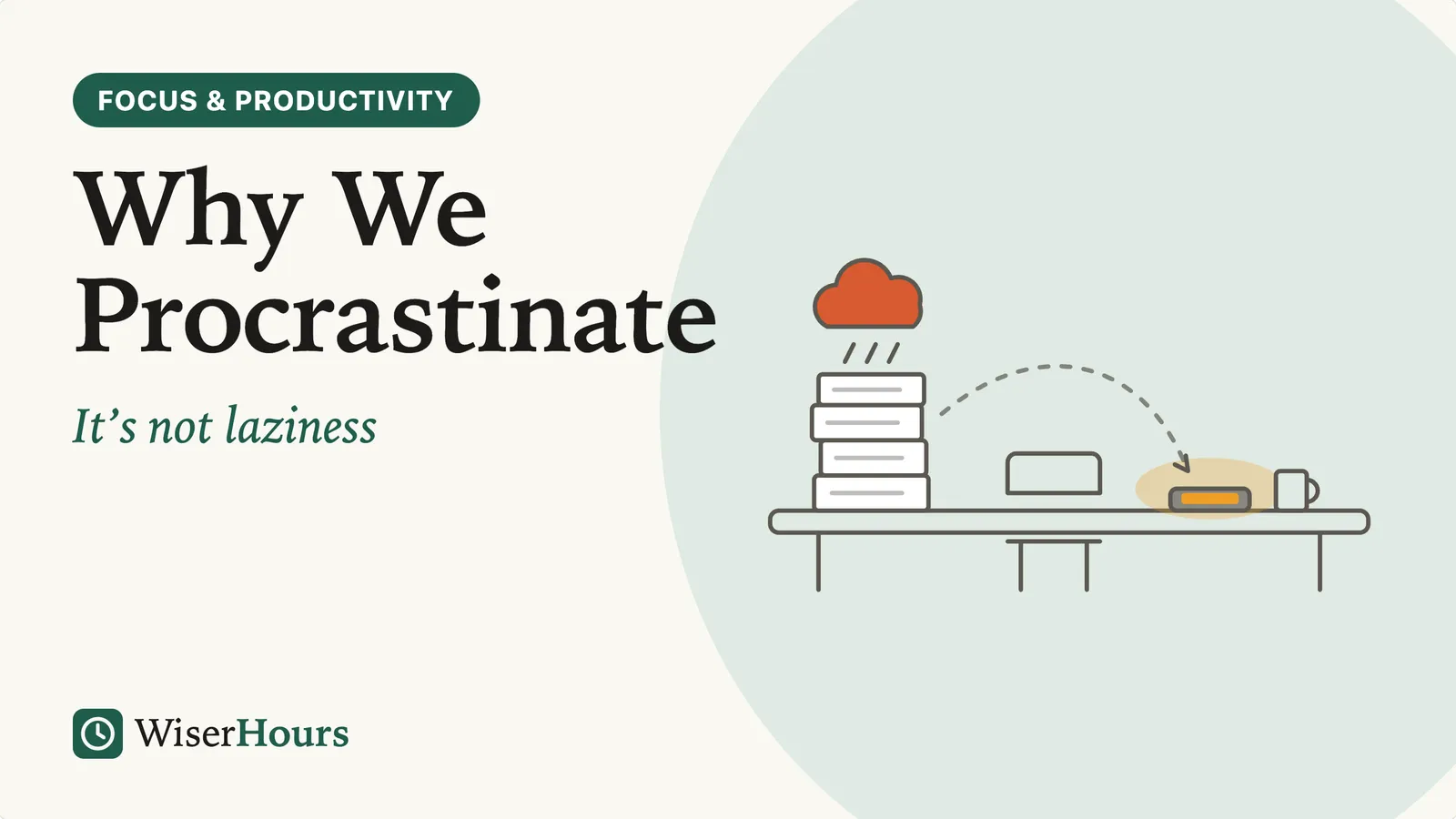
Procrastination is not the same as ordinary delay. Psychologists define procrastination as voluntarily delaying something you intend to do while expecting to be worse off for the delay, the definition set out in a 2007 review by Piers Steel of the University of Calgary.1 You know the report matters, you plan to write it, and you open something else anyway.
Why do we procrastinate? Piers Steel’s 2007 review points to four things: people put off tasks that feel unpleasant, whose rewards are far away or that they doubt they can do well, and impulsive people put things off more. Stepping away from a dreaded task also brings quick relief, other psychologists argue, while the work and the stress wait for later.
Why do we procrastinate? Four things predict delay
Pooling 691 correlations from 216 works, Piers Steel’s 2007 meta-analysis in Psychological Bulletin found that the strongest, most consistent predictors of procrastination were how unpleasant a task feels, how far off its rewards are, low confidence in one’s ability, and impulsiveness.1 Low conscientiousness, with its facets of poor self-control, distractibility and disorganization, went with them.
The study
Moderate evidence
What goes with procrastination: a 2007 meta-analysis of 216 works
Steel sorted every measure that had been studied alongside procrastination into traits and task features, then averaged the correlations. Disliking a task, rewards that come later, doubting one’s ability and impulsiveness stood out. Neuroticism, rebelliousness and sensation seeking showed only weak links.1
The main caveat is design. Most of the studies were correlational, used self-reports and drew on young university students, so they show which people and tasks go with delay rather than proving what causes it. Steel found that the age of participants did not change the results, which eases but does not remove the student problem.1
Here are three of those links as Steel’s average correlations, which run from -1 to 1; the further a figure sits from 0, the tighter the link.1
A correlation of 0.4 means two things go together clearly but loosely: it leaves most of the differences between people unexplained. The minus sign on self-efficacy means that the more confident people were, the less they put things off.
Delay can work as short-term mood repair
Procrastination has much to do with short-term mood repair, argue psychologists Fuschia Sirois and Timothy Pychyl in a 2013 review. A boring, frustrating or unstructured task triggers unpleasant feelings; avoiding it makes those feelings fade for now, and the future self inherits both the task and the stress.2
- 1A task feels badboring, frustrating or unclear
- 2You step awaythe feeling eases
- 3Relief nowmood repaired for the moment
- 4The task is still therewith less time and more stress
Then repeat from “A task feels bad”
Experiments back part of this account. In the third of three experiments published in 2001, Dianne Tice and colleagues at Case Western Reserve University found that people in a bad mood no longer turned to frivolous procrastination once they believed the mood could not be changed. The authors read this as people giving short-term mood repair priority over their other goals.3 The evidence is limited: one experiment, which we could read only in abstract.
The relief does not last. In two longitudinal studies of students published in 1997, Tice and Roy Baumeister found that procrastinators reported less stress and illness than other students early in the semester but more late in the term, and were sicker overall.4
Steel’s meta-analysis adds a complication. He found only a weak link with neuroticism, a trait close to worry and general anxiety, and concluded that procrastination does not appear to be anxiety related.1 A 2025 meta-analysis of 88 studies with about 63,000 people, mostly students, points the other way: it found moderate correlations, about 0.34, between procrastination and self-reported symptoms of depression, anxiety and stress.5 The views may fit together. In Steel’s own model, anxiety matters only if it makes some tasks feel worse than others, so the bad feeling a particular task produces counts for more than how anxious a person is in general.1
The mood account also points to a fix. In a 2016 paper, Marcus Eckert and colleagues reported a randomized trial in which training people to tolerate and modify unpleasant emotions reduced procrastination.6 The abstract, all we could read, gives neither the sample nor the effect size, so treat it as promising rather than settled.
Distant rewards lose to present comfort
Rewards that arrive later weigh less in the moment, and Steel’s review builds its explanation of procrastination around that fact. His 2007 review sets out Temporal Motivation Theory: a task pulls harder the more you expect to succeed and the more you value the result, and weaker the longer you must wait and the more impulsive you are.1
- Socializing: its reward is always now
- Writing the essay: its reward is months away
- September 15: essay set
- December 3: the essay finally pulls harder than socializing
- December 15: essay due, 12 days after the switch
Steel illustrates it with a hypothetical student, Thomas Delay, given an essay on September 15 that is due December 15. Socializing pays off now, so its appeal stays high all term. The essay’s payoff is distant, so its appeal climbs only as the deadline approaches, overtaking socializing on December 3 and leaving 12 days of concentrated work.1 The example is Steel’s illustration, not data.
The review also found that the gap between intending and acting widens the further apart the two are in time.1 A separate bias, underestimating how long our own tasks will take, sits alongside procrastination; our time management guide for beginners covers it and how to plan around it.
Laziness, perfectionism and genes: what holds up
Procrastinators are not simply lazy: by Steel’s definition they intend to act, and the gap between intention and action is the problem.1 Perfectionism explains less than self-help books suggest, Steel found, and a later meta-analysis shows its link to delay runs in two directions.17 Genes account for a measurable share of the differences between people, according to a 2014 twin study.8
- Myth
- Procrastinators are usually perfectionists.
- Fact
- A 2007 meta-analysis found perfectionism was not positively linked to procrastination overall; a 2017 update tied self-critical perfectionism to more delay and high personal standards to less.
The 2017 meta-analysis by Fuschia Sirois, Danielle Molnar and Jameson Hirsch split perfectionism in two. Perfectionistic concerns, meaning harsh self-criticism and preoccupation with others’ judgment, went with more procrastination (r = 0.23 across 43 studies with about 10,000 people). Perfectionistic strivings, meaning very high personal standards, went with less (r = -0.22 across 38 studies).7 Both links are small to medium and correlational.
In the 2014 study of 347 same-sex twin pairs in the Colorado Longitudinal Twin Study, with an average age of about 23, Daniel Gustavson and colleagues at the University of Colorado Boulder found procrastination moderately heritable, at 46 percent, and impulsivity at 49 percent. The genetic influences on the two traits overlapped completely, and differences in goal management, the ability to let important goals steer what you do, accounted for much of that overlap.8
Heritability describes differences between people in one sample; it does not mean 46 percent of any one person’s delay is fixed. The authors call theirs the first twin study to report the heritability of procrastination, so the figure awaits replication.8
Further reading
Steel's book-length account of the model behind this article's main study, his 2007 review of procrastination research.
As an Amazon Associate WiserHours earns from qualifying purchases.
How common is procrastination, and what it costs
The most quoted figures on how common procrastination is rest on thin evidence. Steel’s 2007 review cites estimates that 80 to 95 percent of college students procrastinate and that it chronically affects 15 to 20 percent of adults, but the adult figure draws on a 1996 study and a 2003 newspaper report, not on a representative survey.1 Treat both as rough estimates.
The costs are better measured. In a 2023 cohort study in JAMA Network Open of 3,525 university students in Stockholm and Örebro, Sweden, those who procrastinated more had slightly worse symptoms of depression, anxiety and stress nine months later. Poor sleep, physical inactivity, loneliness and money problems were also slightly more common, by amounts the paper gives only in relative terms. The authors call the links weak, and a cohort study cannot prove that delay caused them.9 Our explainer on how the stress response works covers what happens when stress stays switched on.
Working with the causes: five things to try
The five habits below each target one of the causes above: an unpleasant task, the bad feeling it brings, a distant payoff, easy temptation and the guilt that follows a delay. Most rest on correlational studies, small trials or expert reviews, so treat them as experiments to run on yourself.
1. Make the first step one you are sure you can finish
Low confidence predicts delay, and Steel’s review notes that confidence grows mainly from seeing others succeed and from succeeding yourself.1 Shrink the start until you are sure of it: open the file and write the heading, or find the one receipt you need.
2. Name the feeling, then start anyway
If delay is mood repair, the aim is to stay with the unpleasant feeling for a few minutes rather than escape it. Tolerating and changing unpleasant emotions is the skill Eckert’s 2016 trial trained, with less procrastination as a result.6 Say what the task makes you feel, such as bored, confused or afraid of judgment, and begin while the feeling is still there. The trial tested structured training, not this quick version; a feeling that is overwhelming or never lifts is a reason to see a doctor instead.
3. Bring the payoff closer with small, near goals
The further off a payoff is, the weaker its pull, so shorten the distance. Steel’s review points to older studies in which daily goals, periodic quizzes and contracts for regular progress reduced procrastination, and to a 2002 study in which deadlines helped, especially ones set by other people.1 But a 2026 replication of that study’s second experiment, with US university students, found that changing deadlines made little difference.10 A small goal for this week costs little to try, but treat it as an experiment.
4. Decide when you will start, and move temptations out of reach
Impulsive delay is easier when the tempting option is one click away. Steel recommends making tempting cues less visible and turning the task into a routine, which cuts the number of moments where you choose.1 Pair that with a specific plan for when and where you will start, the kind of if-then plan that helps you focus.
5. Forgive yourself for the last delay
Guilt about past procrastination can feed the next round. In a 2010 study of 119 first-year students in an introductory psychology course at Carleton University in Canada, those who forgave themselves for procrastinating before a first midterm exam procrastinated less before the second, a link that ran through less negative feeling. The study was observational, so it shows a link, not proof.11
For the task you are avoiding
When self-help is not enough, structured programs exist. A 2018 meta-analysis of 24 intervention studies with 1,173 participants, by Wendelien van Eerde and Katrin Klingsieck, reported a large reduction in procrastination after interventions that held at follow-up, with cognitive behavioral therapy (CBT) reducing it most so far; the abstract does not say how much of that was measured against control groups.12 In a 2015 randomized trial with 150 participants, internet-based CBT, with or without a therapist’s guidance, reduced self-reported procrastination by a moderate amount compared with a wait list.13 Its published protocol says participants lived in Sweden and the program came from a self-help book by the lead author.14 A 2018 systematic review of 12 randomized trials against inactive controls was more cautious: small benefits overall, and a moderate benefit for CBT that rested on only three studies.15 Such programs are run by psychologists or offered as structured self-help courses, and a doctor can say what is available where you live. We read these four papers at abstract level only.
Solid, suggestive or thin: the evidence behind each explanation
The explanations with the most consistent support are the task and trait correlates in Steel’s 2007 meta-analysis; the mood-repair account rests on fewer, smaller experiments, and the fixes mostly on small trials or observational studies.1
| What it is | What the best evidence found | Evidence |
|---|---|---|
| Unpleasant tasks, distant rewards, low confidence, impulsiveness | The most consistent correlates of procrastination | Meta-analysis of correlational studies, moderate1 |
| Mood repair | Believing a bad mood could not change removed the pull to procrastinate | Experiment, limited (one experiment, abstract only)3 |
| Perfectionism | Self-critical perfectionism linked to more delay, high personal standards to less | Meta-analysis of correlational studies, moderate7 |
| Genes | About 46% heritable, genetically inseparable from impulsivity | Twin study, limited (one sample)8 |
| Emotion-regulation training | Reduced procrastination | Trial, limited (abstract only)6 |
| Self-forgiveness | Linked to less delay before the next exam | Observational, limited (119 students)11 |
| Cognitive behavioral therapy | Against inactive controls, a moderate benefit in three trials; internet CBT beat a wait list | Meta-analysis of trials and trial, moderate (few trials)1513 |
When to talk to a doctor about procrastination
Some signs of depression and ADHD listed by the US National Institute of Mental Health (NIMH) and the UK’s NHS can look like procrastination: low energy, trouble making decisions, and difficulty organizing time or finishing tasks. Neither lists procrastination itself as a sign, and only a health professional can say what lies behind these signs. The grouping by urgency below is ours; the advice in each line is theirs.
- Immediately: if you are struggling or have thoughts of suicide, call or text the 988 Suicide & Crisis Lifeline in the US, and call 911 in a life-threatening situation, as NIMH advises.16 In the UK, the NHS says to call 999 or go to A&E if a life is at risk or you cannot keep yourself safe; for urgent help in England, its website says to call NHS 111 and choose the mental health option, and lists Samaritans on 116 123.17 Elsewhere, call your local emergency number.
- See a doctor soon: NIMH lists a persistent sad or empty mood, loss of interest, fatigue and difficulty concentrating or making decisions among common signs of depression, and advises talking to a health care provider if signs persist. A diagnosis requires symptoms most of the day, nearly every day, for at least 2 weeks, but that is not a waiting period: NIMH says to talk to a provider if you think you may have depression.16 Steel’s review suggests that depression’s link with procrastination runs mainly through low energy, which makes many tasks more unpleasant.1
- Book a routine appointment: the NHS lists finding it hard to organize your time or finish tasks among signs of ADHD, whose symptoms usually start before age 12. It suggests making a GP appointment if they affect your studies, work or relationships, and says the GP may consider other conditions that could be causing them.18 In a preregistered 2026 online survey of 640 adults, more self-reported ADHD inattention symptoms went with more procrastination.19
The bottom line
The research points to two pulls behind procrastination: avoiding an unpleasant task feels better now, and rewards that arrive later carry little weight in the moment. Self-doubt and impulsiveness go with more delay. Work on the cause rather than the calendar: a first step you know you can finish, a few minutes with the bad feeling, a nearer goal and less guilt about the last delay. If the pattern comes with persistent low mood or has followed you since childhood, raise it with a doctor.
This article is general information, not medical advice. If you're worried about your health, talk to a doctor or another qualified professional.
Frequently asked questions
Do some people really work better at the last minute?
Rarely, at least in studies of students. Piers Steel's 2007 meta-analysis found a weak but consistent link between procrastination and lower academic performance across 41 correlations, and concluded that for grades it is usually harmful, sometimes harmless and never helpful. In 1997 research with students by Dianne Tice and Roy Baumeister, procrastinators received lower grades on all their assignments, even though they felt less stressed early in the term.
Do people procrastinate less as they get older?
Probably, although the evidence compares people of different ages rather than following anyone over time. In Piers Steel's 2007 meta-analysis, procrastination fell with age across 16 correlations, and more steeply once he corrected for the narrow age range of the mostly student samples. At the level of whole samples the age effect was not statistically clear. Men procrastinated only slightly more than women across 44 correlations.
Is procrastination a modern problem caused by technology?
Not in origin. Piers Steel's 2007 review describes complaints about delay stretching back thousands of years and calls procrastination an almost archetypal human failing. Whether it is growing is unclear: average scores rose in samples published up to 2003, the overall trend was no longer statistically clear with data to 2005, and scores outside the US were still rising. None of this tested technology as a cause.
Sources
- The nature of procrastination: A meta-analytic and theoretical review of quintessential self-regulatory failure. Steel, P. (2007). Psychological Bulletin, 133(1), 65-94
- Procrastination and the priority of short-term mood regulation: Consequences for future self. Sirois, F. M. & Pychyl, T. A. (2013). Social and Personality Psychology Compass, 7(2), 115-127
- Emotional distress regulation takes precedence over impulse control: If you feel bad, do it! Tice, D. M., Bratslavsky, E. & Baumeister, R. F. (2001). Journal of Personality and Social Psychology, 80(1), 53-67
- Longitudinal study of procrastination, performance, stress, and health: The costs and benefits of dawdling. Tice, D. M. & Baumeister, R. F. (1997). Psychological Science, 8(6), 454-458
- The association between procrastination and negative emotions in healthy individuals: a systematic review and meta-analysis. Nie, Y., Wang, W., Zhou, F., et al. (2025). Frontiers in Psychiatry, 16, 1624094
- Overcome procrastination: Enhancing emotion regulation skills reduce procrastination. Eckert, M., Ebert, D. D., Lehr, D., Sieland, B. & Berking, M. (2016). Learning and Individual Differences, 52, 10-18
- A meta-analytic and conceptual update on the associations between procrastination and multidimensional perfectionism. Sirois, F. M., Molnar, D. S. & Hirsch, J. K. (2017). European Journal of Personality, 31(2), 137-159
- Genetic relations among procrastination, impulsivity, and goal-management ability: Implications for the evolutionary origin of procrastination. Gustavson, D. E., Miyake, A., Hewitt, J. K. & Friedman, N. P. (2014). Psychological Science, 25(6), 1178-1188
- Associations between procrastination and subsequent health outcomes among university students in Sweden. Johansson, F., Rozental, A., Edlund, K., et al. (2023). JAMA Network Open, 6(1), e2249346
- Replication of "Procrastination, deadlines, and performance: Self-control by precommitment". Hyndman, K. & Bisin, A. (2026). Psychological Science, 37(8), 557-571
- I forgive myself, now I can study: How self-forgiveness for procrastinating can reduce future procrastination. Wohl, M. J. A., Pychyl, T. A. & Bennett, S. H. (2010). Personality and Individual Differences, 48(7), 803-808
- Overcoming procrastination? A meta-analysis of intervention studies. van Eerde, W. & Klingsieck, K. B. (2018). Educational Research Review, 25, 73-85
- Internet-based cognitive-behavior therapy for procrastination: A randomized controlled trial. Rozental, A., Forsell, E., Svensson, A., Andersson, G. & Carlbring, P. (2015). Journal of Consulting and Clinical Psychology, 83(4), 808-824
- Internet-based cognitive behavior therapy for procrastination: Study protocol for a randomized controlled trial. Rozental, A. & Carlbring, P. (2013). JMIR Research Protocols, 2(2), e46
- Targeting procrastination using psychological treatments: A systematic review and meta-analysis. Rozental, A., Bennett, S., Forsström, D., et al. (2018). Frontiers in Psychology, 9, 1588
- Depression. National Institute of Mental Health, National Institutes of Health (NIH Publication No. 24-MH-8079, revised 2024)
- Where to get urgent help for mental health. NHS (UK), page last reviewed 26 April 2023, checked current 22 September 2026
- ADHD in adults. NHS (UK), page last reviewed 19 March 2025
- What are you waiting for?! Roles of motivation, goal orientation, and emotion regulation in explaining the link between ADHD and procrastination. Netzer Turgeman, R. & Pollak, Y. (2026). Journal of Attention Disorders, 30(5), 694-704
How we researched this
We searched PubMed, Europe PMC, Crossref and the web in September 2026 for meta-analyses, trials and cohort studies on the causes and correlates of procrastination, preferring meta-analyses and randomized trials, and read NIMH and NHS pages for the health section. Sources date from 1997 to 2026; we read eight studies in full, eight at abstract level only, and three NIMH and NHS pages. Main limitation: most procrastination research is correlational, self-reported and done with university students.
Keep reading
Revenge Bedtime Procrastination: Why You Stay Up Late and How to Stop
Revenge bedtime procrastination trades sleep for time of your own. The 3 reasons people give for staying up, and 6 low-risk habits to reclaim the night.
How to Stop Procrastinating on Studying
How to stop procrastinating on studying: 5 steps that add the structure a course leaves out, and why one round of advice failed in a 2024 trial.
Intrinsic vs. Extrinsic Motivation: Which Lasts Longer?
Rewards get people moving; interest and personal value keep them going. What 4 decades of research on intrinsic vs extrinsic motivation found.
How to Stop Procrastinating: 15 Strategies Backed by Research
15 ways to stop procrastinating, each matched to the cause of delay it targets and graded by its evidence, from if-then plans to self-set deadlines.